Canada’s Real-Time Rail Is Live: What the 24/7 Instant Payment System Changes, Who Is on It and When Your Bank Joins
Updated November 10, 2026. A news analysis built from Payments Canada’s announcement of November 9, 2026, its “Testing and launch” page, our own screenshots of both, and the Hacker News front page. This is general information, not financial advice.
The short version
On November 9, 2026 Payments Canada announced the launch of Canada’s Real-Time Rail (RTR), a national payment system that lets participating banks, credit unions and payment companies clear and settle payments instantly, 24 hours a day, every day of the year. The announcement drew more than 500 points on Hacker News. But a launch is not a switch that changes everything at once. At the start only eight named participants are live, and the plan for moving existing services such as Interac e-Transfer runs through 2027.
- What launched: a system for real-time clearing and settlement with data-rich ISO 20022 messaging, owned and operated by Payments Canada and overseen by the Bank of Canada.
- Who is on it today: Wealthsimple, Questbank, Peoples Trust Company, Paramount Commerce, KOHO, DoBusiness.com, Digital Commerce Bank and Bank of America.
- When more join: “all major Canadian financial institutions” are to onboard in the coming months, with availability to more than nine in 10 Canadians within a year of launch.
- Fraud design: mandatory centralized fraud services from day one, including confirmation of payee for consumer accounts.
What Payments Canada announced
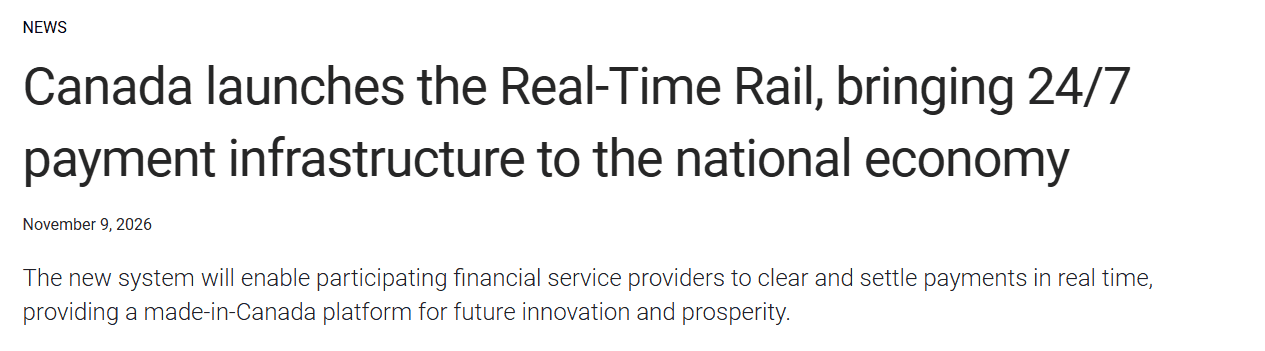
According to the release, the RTR will “enable participating members, including financial institutions, credit unions and payment service providers, to exchange, clear and settle payments securely in real time.” It promises instant speed and settlement, real-time cash-flow visibility and data-rich messaging through existing banking and payment channels. Finance Minister François-Philippe Champagne called it a foundation for “a more dynamic and competitive digital economy,” and Bank of Canada Governor Tiff Macklem said the Bank will oversee the system so that it operates safely and reliably.
The system was built by Payments Canada with delivery partners CGI, Deloitte Canada, IBM Canada and Interac Corp. Interac serves as the RTR’s technical operator and its first fraud services provider. It uses the ISO 20022 standard, a shared format that lets a payment carry far more structured information than older systems can, such as invoice references.
The money numbers, and what they mean
Payments Canada cites research from the C.D. Howe Institute. With the functions available at launch, the RTR is projected to generate up to $14.5 billion in cost savings over the next decade, from lower processing costs, less use of cash and cheques and reduced float, the period during which funds are unavailable to the recipient. The Institute also projects $16 billion in economic gains, growing to $27 billion as new functions are added.
Our arithmetic, from the figures in the release:
- $14.5 billion over ten years is about $1.45 billion a year. Against the $103 trillion Payments Canada says its systems cleared in 2025, that is roughly 0.0014%. The savings are meaningful in dollars but small next to the flows, which is normal for infrastructure: the gain comes from cheaper, faster handling of each payment, not from changing how much money moves.
- $27 billion versus $16 billion is a 69% increase in projected economic gains once new functions arrive. That growth depends on products that do not exist yet, so it is the least certain number in the announcement.
- $103 trillion a year at “more than $411 billion every business day” implies about 250 business days, so the two figures are consistent with each other.
These are projections from a think tank cited in the system operator’s own announcement. They are useful context, not measured results, and the release does not say how they were calculated.
Who is on the rail, and who is not yet
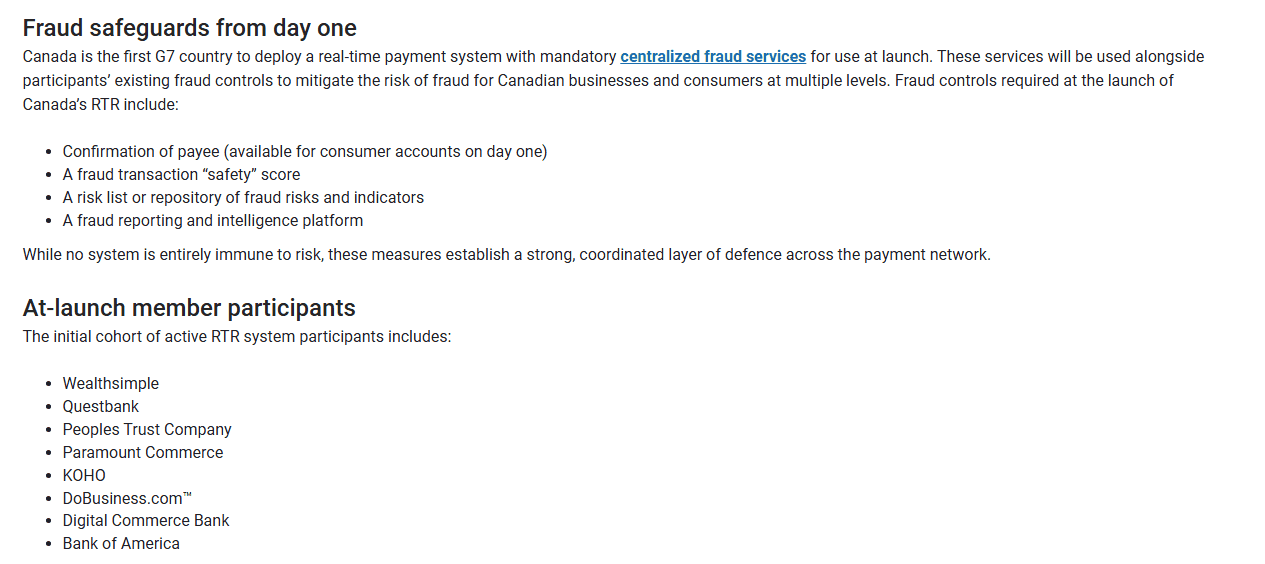
The initial cohort is eight names: Wealthsimple, Questbank, Peoples Trust Company, Paramount Commerce, KOHO, DoBusiness.com, Digital Commerce Bank and Bank of America. The release says additional participants will onboard “in the coming months,” including all major Canadian financial institutions and other members applying for access. In our reading, that means most people will not yet find the RTR inside their everyday bank app. The release also quotes executives from several large institutions as supporters, which is not the same as being live on the rail.
The quoted comments are, as in any launch release, supportive by design. They come from partners, participants and industry associations that have a stake in the system’s success. The one consumer-facing sentence worth noting is from Paramount Commerce, a payment service provider, which says first-to-market status gives its merchants “24/7 settlement, higher transaction limits and proactive fraud defence.” The release does not publish a limits table or a fee schedule.
The timeline: what changes when

- Q4 2026: launch of the RTR with initial direct participants.
- Q1 2027: initial Interac e-Transfer clearing and settlement migration participants.
- Q2 2027: additional e-Transfer clearing and settlement migration participants.
- Q3 2027: all participants in the initial launch phases at full transaction volumes.
Payments Canada calls this a “deliberately sequenced” and “risk-based” approach and says volumes and participation will increase over time so that participants and users have “full confidence.” Our reading: the headline “24/7 payments” arrives for most people when their own institution, or Interac e-Transfer behind it, moves onto the rail, which on this schedule is mainly a 2027 story. The page says “target” timeline, not a guarantee.
Fraud: what is built in, and what is not promised
Real-time payments are harder to reverse, which is why fraud design matters. Payments Canada says Canada is the first G7 country to deploy a real-time payment system with mandatory centralized fraud services at launch. Required controls include:
- Confirmation of payee, available for consumer accounts on day one: a check that the name you enter matches the account holder before money moves;
- a fraud transaction “safety” score;
- a risk list or repository of fraud risks and indicators;
- a fraud reporting and intelligence platform.
The release adds a candid line: “While no system is entirely immune to risk.” The text we read does not say what happens when a victim pays a scammer through the RTR, who bears the loss or how disputes will work. Those are the questions consumers will ask first, and we could not find answers in the announcement or on the launch page.
What people can do now (not advice)
- Ask your institution when it joins. Ask your bank, credit union or fintech whether and when it will use the RTR, and what it will change for you.
- Treat instant as final. Check the payee name, account details and amount before sending. Instant payments are difficult to reverse.
- Expect new name checks. Confirmation of payee may show a mismatch warning. Stop and verify through a channel you already trust.
- Watch for scams. Fraudsters use new systems as a pretext: unsolicited calls or messages about an “RTR upgrade,” “account migration” or “security transfer” should be ignored. Your institution will not ask for passwords or codes.
- Small businesses: plan your cash flow. Instant settlement can help receivables, but also shortens the window to fund payroll and suppliers. Check with your payment provider about limits, fees and reconciliation data.
- Keep your current methods until your institution confirms the new service.
If you send money across borders or run an online business, our reviews of Wise and MerchantService.com cover payment services on separate rails. They are not part of this announcement, and we make no claim about their use of the RTR.
What we do not know yet
- Fees for consumers and small businesses, and any transaction limits at launch.
- Exactly when each major bank and credit union will go live.
- How Interac e-Transfer will look to users after its Q1 2027 migration begins.
- Liability and dispute rules when a payment is fraudulent.
- Whether the projected savings reach consumers or stay with institutions.
What to watch next
- Announcements from the largest banks and credit unions on their onboarding dates.
- The first public volume and incident figures from Payments Canada and the Bank of Canada.
- Details of the planned link between the RTR and Europe’s instant payment systems, which Payments Canada welcomed in a November 2 news item.
- Fraud statistics once real-time payments are used at scale, especially confirmation-of-payee mismatch rates.
Frequently asked questions
Is the Real-Time Rail live now?
Yes, according to Payments Canada’s announcement of November 9, 2026, with eight named initial participants. Wider availability follows over the coming months and into 2027.
Can I send instant payments from my bank today?
Only if your institution is already on the rail. The release says major institutions will onboard in the coming months, so check with your own provider.
Will Interac e-Transfer change?
Payments Canada’s timeline lists Interac e-Transfer clearing and settlement migration beginning in Q1 2027, with additional participants in Q2 2027. How users will notice the change is not described.
Is it safe from fraud?
The system includes mandatory centralized fraud services and confirmation of payee, but Payments Canada states that no system is entirely immune. Careful checks by senders still matter.
How much will it save?
The C.D. Howe Institute projects up to $14.5 billion in cost savings over a decade. That is a projection, not a measured result.
Sources and method
- Payments Canada, “Canada launches the Real-Time Rail,” November 9, 2026 (our screenshots)
- Payments Canada, Real-Time Rail “Testing and launch” (our screenshot)
- C.D. Howe Institute, update on cost savings from the RTR (linked from the release; we did not read the full report)
- Hacker News front page, November 10, 2026
Method: we read the full Payments Canada release and its launch page, captured three sections ourselves on November 10, 2026 and did the arithmetic labelled “ours” from the published figures. We did not read the C.D. Howe reports, the system rules or participant terms, and did not test any payment. The release is the operator’s own announcement; quotes in it are from partners and participants. This article is general information, not financial advice. ToolReviewHub earns nothing from this article and has no commercial relationship with Payments Canada or any institution named. See our review method.