NAION and GLP-1 Drugs: What the FDA’s New Eye Warning for Ozempic, Wegovy and Zepbound Says (and Does Not)
Updated November 10, 2026. A health-news explainer built from the FDA Drug Safety Communication of November 9, 2026, our own screenshots of the FDA page and Google Trends, and news coverage. ToolReviewHub is not a medical site: this is general information, not medical advice. Talk to your own doctor about your medicines.
The short version
On November 9, 2026 the U.S. Food and Drug Administration told patients and health professionals that GLP-1 receptor agonist medicines, the class that includes Ozempic, Wegovy, Mounjaro and Zepbound, carry a potential increased risk of NAION, short for non-arteritic anterior ischemic optic neuropathy. It is a rare condition that can cause sudden, painless vision loss in one eye, and the loss can be permanent. The FDA is requiring every maker of these drugs to add the risk to the Warnings and Precautions section of the label. Searches for the term “naion” jumped within hours. This article explains what the FDA said, what its data shows, what it does not show and what a sensible reader can do.
- What changed: a class-wide labeling requirement for all GLP-1 receptor agonists, not a withdrawal or a ban.
- What the condition is: NAION is caused by reduced blood flow to the front of the optic nerve. The FDA says the underlying cause is not completely understood.
- What the numbers say: in the FDA’s trial analysis, 6.4 NAION cases per 100,000 person-years on GLP-1 drugs versus 3.8 in comparison groups.
- What the FDA did not say: it did not tell patients to stop taking these medicines. It said to contact a health care professional right away if symptoms appear.
What the FDA actually announced
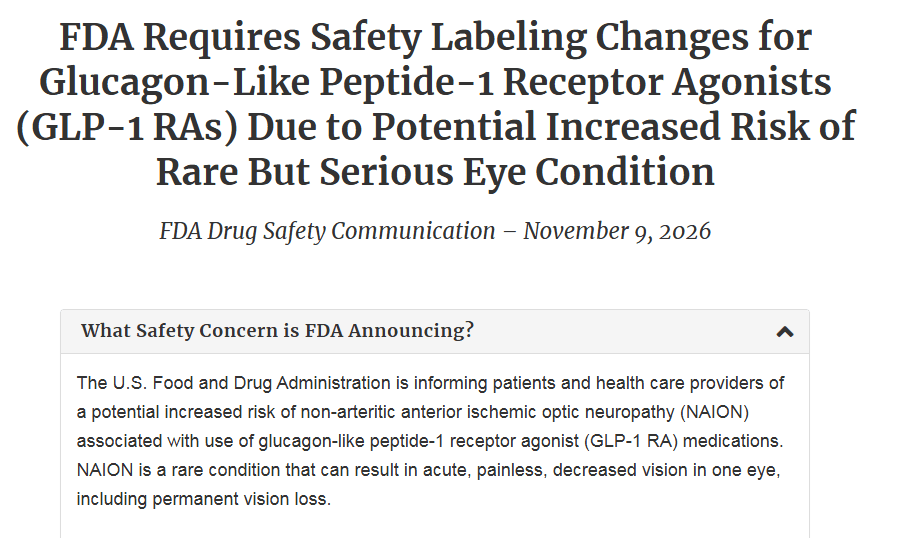
The notice is titled “FDA Requires Safety Labeling Changes for Glucagon-Like Peptide-1 Receptor Agonists (GLP-1 RAs) Due to Potential Increased Risk of Rare But Serious Eye Condition.” In plain terms, the agency is informing patients and providers of a potential increased risk of NAION with GLP-1 medicines and is requiring all application holders to add information to the Warnings and Precautions section of labeling. NAION is described as a rare condition that can result in acute, painless, decreased vision in one eye, including permanent vision loss.
The FDA’s list of approved GLP-1 receptor agonists is longer than many people expect. It includes older and newer products:
- Victoza (liraglutide, 2010), Trulicity (dulaglutide, 2014), Saxenda (liraglutide, 2014);
- Xultophy (liraglutide with insulin degludec, 2016) and Soliqua (lixisenatide with insulin glargine, 2016);
- Ozempic (semaglutide, 2017), Rybelsus (semaglutide, 2019), Wegovy (semaglutide, 2021);
- Mounjaro (tirzepatide, 2022) and Zepbound (tirzepatide, 2023). The FDA notes that tirzepatide also acts on the GIP receptor;
- Foundayo (orforglipron, 2026).
Byetta (exenatide) also appears in the table, but the FDA notes that its application was voluntarily withdrawn for reasons unrelated to safety or effectiveness and only generic exenatide is marketed. The FDA also says NAION cases have been reported for all currently marketed GLP-1 products, which is why the labeling change covers the whole class rather than one brand.
What the data shows
The agency’s reasoning started with a July 2024 study by Hathaway and colleagues in JAMA Ophthalmology that linked semaglutide to NAION. The FDA identified several limitations in that study but decided the question deserved a full review. It then looked at four kinds of evidence:
- Adverse-event reports. These were hard to interpret because NAION risk factors overlap with conditions common in people who take GLP-1 drugs.
- Animal data. The FDA says its review did not identify a mechanism by which GLP-1 drugs could raise NAION risk.
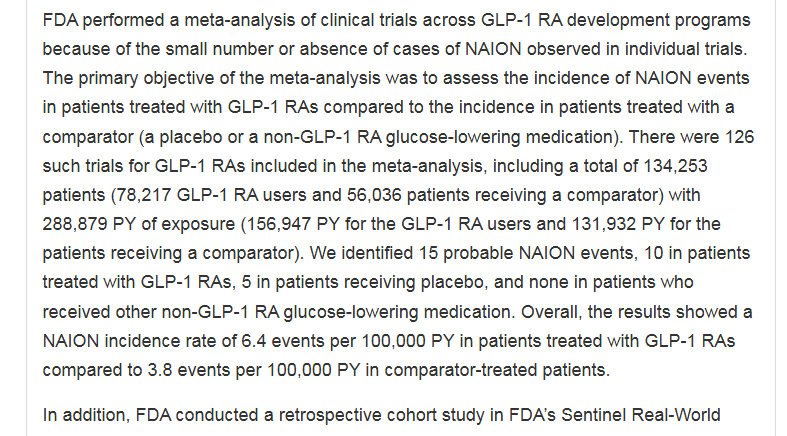
- A meta-analysis of clinical trials. 126 trials, 134,253 patients (78,217 on GLP-1 drugs and 56,036 on comparators) and 288,879 person-years of exposure. There were 15 probable NAION events: 10 in GLP-1 patients, 5 in placebo patients and none in people on other glucose-lowering drugs. The resulting rates were 6.4 events per 100,000 person-years on GLP-1 drugs versus 3.8 in comparators.
- A retrospective cohort study in the FDA’s Sentinel system. It followed adults with type 2 diabetes who started a GLP-1 drug or another diabetes medicine between 2019 and 2024. Rates ranged from 26 to 32 per 100,000 person-years (GLP-1 drugs 30 to 32, SGLT-2 inhibitors 31, DPP-4 inhibitors 26). Versus SGLT-2 inhibitors the hazard ratio was 1.19 (95% confidence interval 0.91 to 1.54), which was not statistically significant. Versus DPP-4 inhibitors it was 1.43 (1.02 to 2.01), which was.
The FDA also reviewed published observational studies. It says methodologically rigorous ones consistently reported an increased NAION risk in people with type 2 diabetes who started GLP-1 drugs compared with DPP-4 or SGLT-2 inhibitors, results it calls generally consistent with its own. Its conclusion is cautious: a “potential increased risk of rare NAION events.”
Our arithmetic: how big is the risk in plain numbers?
These calculations are ours, from the figures the FDA published. They are an illustration, not a prediction for any person.
- Rates check out. 10 events over 156,947 person-years is about 6.4 per 100,000. 5 events over 131,932 person-years is about 3.8 per 100,000.
- Absolute difference. 6.4 minus 3.8 is about 2.6 extra cases per 100,000 person-years. Put differently, that is roughly one additional case for every 38,000 patient-years of treatment.
- Relative difference. 6.4 divided by 3.8 is about 1.7. Relative numbers sound large; the absolute number is small because the condition is rare.
- Counts are tiny. The meta-analysis rests on 10 events versus 5. With so few events the estimate is imprecise, which is why the FDA calls the risk “potential” and why the Sentinel result against SGLT-2 inhibitors was not significant.
- Context. The FDA says NAION incidence in the general population is 2.3 to 10.2 cases per 100,000 persons per year in adults older than 50. Both the GLP-1 rate (6.4) and the comparator rate (3.8) sit inside that range. This is our observation, and different populations and methods are not strictly comparable.
Read together, the evidence suggests a small possible increase in a very rare event. It does not show that these drugs commonly cause blindness. At the same time, “rare” does not mean “trivial” for the person it happens to, because the vision loss can be permanent. Both statements are true at once.
Why searches for “naion” exploded
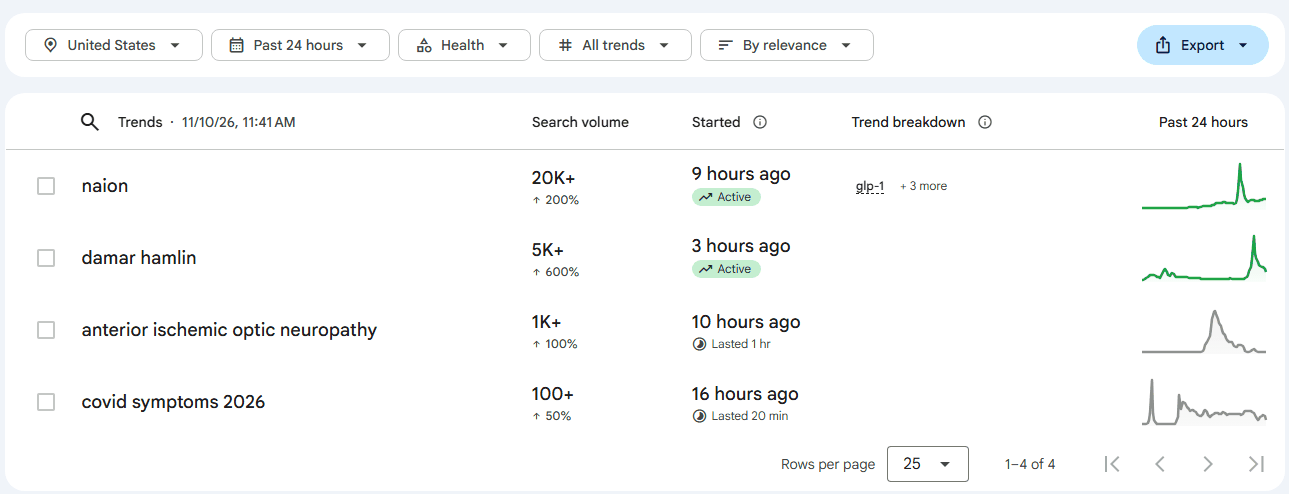
An unfamiliar medical acronym becomes a search term when a trusted institution links it to products millions of people use. News outlets including CNN and NBC News reported on the FDA notice, and Google Trends shows the term spiking within hours. The same pattern appears every time a safety label changes: the headline reaches people who take the drug, and they turn to search for answers before they reach their doctor. That is the reason accurate explanation matters more than speed in this kind of story.
What the symptoms look like
According to the FDA, NAION symptoms include:
- sudden, painless vision loss in one eye, which people may notice on waking;
- blurred or missing portions of vision, such as blind spots or tunnel vision;
- distortion of colors;
- reduced central sharpness, such as blurry or hazy spots.
The FDA tells patients to contact their health care professional right away if they have any of these symptoms. For health professionals, the notice says to refer a patient with suspected NAION to an ophthalmologist promptly and to consider discontinuing the GLP-1 drug in patients who develop NAION unless the benefits clearly outweigh the risk. That decision belongs to the patient and clinician, not to a website.
Who may be more exposed
The FDA lists possible risk factors for NAION: smoking, diabetes, high blood pressure, sleep apnea, anemia and kidney disease. If NAION has occurred in one eye, the risk that it will occur in the other eye is increased, and people with a history of NAION are at increased risk of recurrence. Many of these conditions are common in the people prescribed GLP-1 drugs, which is exactly why the FDA found adverse-event reports hard to interpret. Someone can have several of these factors and never develop NAION; the list describes association, not destiny.
What this means for people taking GLP-1 medicines (not advice)
- Do not stop a prescribed medicine on your own because of a headline. Stopping a diabetes or weight-related medicine can carry its own risks. Ask the clinician who prescribed it.
- Know the symptoms above and act on them quickly. Sudden loss of vision in one eye is a reason to seek urgent medical care, not to wait for an appointment.
- Tell your clinician about relevant history such as previous NAION, other eye problems, high blood pressure, sleep apnea, anemia, kidney disease, diabetes or smoking.
- Ask about your own balance of benefit and risk. The FDA notes that these drugs have approved uses beyond diabetes and weight, including reducing heart and kidney risks and treating sleep apnea and a type of liver disease in adults. Benefits differ widely from person to person.
- Keep regular eye checks if you already have diabetes or high blood pressure, as your care team advises.
- Report side effects. The FDA page explains how to report adverse events from GLP-1 drugs, which helps regulators learn more.
- Be careful with unregulated sellers. Compounded or online products of unknown origin are not covered by the label information discussed here. We do not review or recommend any medicine.
This list is general information. It is not medical advice, and we do not know your health history.
What this does not mean
- It does not mean the drugs are being pulled. The action is a labeling requirement.
- It does not prove cause and effect. The FDA says “potential” and describes the underlying cause of NAION as not completely understood. Its animal data did not identify a mechanism.
- It is not the same as other warnings. This is about one rare eye condition. Other side effects are described in each product’s label.
- It does not change for every drug in the same way. Each brand’s label update will be written by its own manufacturer, so the exact wording will differ.
What to watch next
- The updated prescribing information for each brand, which should show the new Warnings and Precautions text.
- Whether professional bodies such as ophthalmology and diabetes societies publish practice guidance.
- New studies that add NAION cases and narrow the uncertainty, especially for tirzepatide and for newer oral products.
- Any further FDA communication on this drug class.
Frequently asked questions
What does NAION stand for?
Non-arteritic anterior ischemic optic neuropathy. It is damage to the front part of the optic nerve from reduced blood flow.
Which drugs are affected?
All GLP-1 receptor agonists. The FDA’s table includes Ozempic, Wegovy, Rybelsus, Mounjaro, Zepbound, Victoza, Saxenda, Trulicity, Xultophy, Soliqua and Foundayo, and lists Byetta as withdrawn.
How common is NAION?
Rare. The FDA cites 2.3 to 10.2 cases per 100,000 persons per year in adults over 50, and 6.4 versus 3.8 per 100,000 person-years in its trial analysis.
Should I stop my GLP-1 medicine?
Not on the strength of this notice alone. The FDA tells patients to contact a health care professional right away if symptoms appear, and tells anyone who has had NAION to discuss with their clinician whether to continue.
Is this an FDA recall?
No. It is a Drug Safety Communication that requires a labeling update.
Sources and method
- U.S. Food and Drug Administration, Drug Safety Communication, November 9, 2026 (our screenshots)
- Google Trends, Trending now, United States, Health (our screenshot, November 10, 2026)
- CNN, November 9, 2026
- NBC News
- Hathaway JT et al., “Risk of Nonarteritic Anterior Ischemic Optic Neuropathy in Patients Prescribed Semaglutide,” JAMA Ophthalmology, 2024 (cited by the FDA)
Method: we read the FDA notice in full, including its collapsible sections, captured the FDA page and Google Trends ourselves on November 10, 2026, and did the arithmetic labelled “ours” from the FDA’s figures. We did not read the studies the FDA cites, only the FDA’s description of them, and we did not read the individual product labels. This article is general information, not medical advice. ToolReviewHub has no commercial relationship with any medicine mentioned and earns nothing from this article. See our review method.