Gemini API Prices Double on December 1: What Changes, What It Costs and How to Cut the Bill
Updated November 3, 2026. Prices below are read from Google's official Gemini API pricing page on the date shown, with our own screenshots and arithmetic. Prices can change, so check the live page before budgeting.
The short version
If you run an app, an automation or a side project on Google's newest model, your bill is about to double. Google's pricing page now lists Gemini 4 Argon at $2.00 per million input tokens and $10.00 per million output tokens through November 30, 2026, and $4.00 and $20.00 starting December 1, 2026. A second change follows soon after: Gemini 3.8 Flash, the cheaper workhorse, goes from $0.75 and $3.75 to $1.50 and $7.50 on January 1, 2027.
- Deadline 1: December 1, 2026 — Gemini 4 Argon input and output prices double.
- Deadline 2: January 1, 2027 — Gemini 3.8 Flash input and output prices double.
- Context caching also doubles on both models.
- Free tier: Argon has none; Flash shows a free tier with usage that may be used to improve Google's products.
What the official page shows
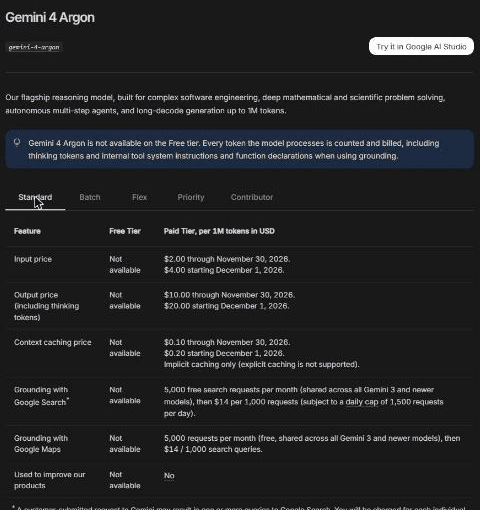
On the Standard tab, Argon is not available on the free tier, and Google notes that every token is counted and billed, including thinking tokens and the tokens used for tool instructions and function declarations when grounding is on. That last point matters: reasoning-heavy requests can cost far more than the visible answer suggests.
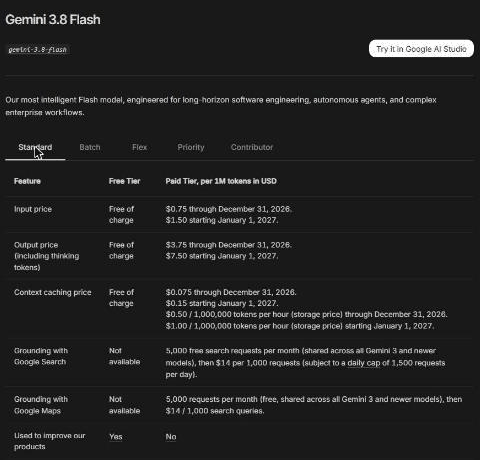
| Price per 1M tokens (Standard, paid) | Until the change | After the change |
|---|---|---|
| Gemini 4 Argon input | $2.00 (through Nov 30, 2026) | $4.00 (from Dec 1, 2026) |
| Gemini 4 Argon output, including thinking | $10.00 | $20.00 |
| Gemini 4 Argon context caching | $0.10 | $0.20 |
| Gemini 3.8 Flash input | $0.75 (through Dec 31, 2026) | $1.50 (from Jan 1, 2027) |
| Gemini 3.8 Flash output, including thinking | $3.75 | $7.50 |
| Gemini 3.8 Flash context caching | $0.075 | $0.15 |
Google's page lists these as scheduled prices and does not describe a promotion. Some third-party blogs describe the current Argon price as a promotional discount delivered as credits; we could not find that on the official page, so we treat the lower price as the current list price and the higher one as the scheduled change.
What it will cost you: three simple scenarios
These examples use our own arithmetic on the official prices and a simplified split of input and output tokens. Your real bill also depends on caching, thinking tokens and search grounding.
| Monthly usage | Argon today | Argon from Dec 1 | Flash today | Flash from Jan 1 |
|---|---|---|---|---|
| Hobby: 5M input, 1M output | $20 | $40 | $7.50 | $15 |
| Startup: 100M input, 20M output | $400 | $800 | $150 | $300 |
| Scale-up: 1B input, 200M output | $4,000 | $8,000 | $1,500 | $3,000 |
Notice that Flash costs well under half of Argon in every row, before and after the changes. That gap is the main lever available to most teams.
Why this matters beyond developers
Most people will never see an API bill, but the products they use are built on these models. Writing assistants, video tools, research tools and customer-support bots often pay a model provider per token and pass the cost on through plans, credits or usage limits. When the underlying price doubles, vendors have three options: absorb it, raise prices, or tighten limits. We cannot say which tools use Gemini or how they will respond, so treat this as something to watch in the plans you rely on rather than a prediction about any one product.
It also fits a wider pattern. According to SaaSRise and CIO Dive, software vendors are moving from per-seat licences toward usage-based or outcome-based AI pricing, and customers say they want usage pricing but worry about unpredictable bills. We read those as industry reporting, not as a verified list of price changes.
How to cut your Gemini bill before the deadline
- Measure first. Log input, output and thinking tokens per feature for a week. Most teams find a few expensive prompts cause most of the spend.
- Match the model to the task. Use Flash for classification, extraction, summaries and chat, and reserve Argon for hard reasoning. At the new prices the gap is about $4 against $1.50 per million input tokens.
- Use context caching for long, repeated prompts such as policy documents or codebases. The cached rate is a fraction of the normal input price, even after it doubles.
- Trim prompts and outputs. Shorter system prompts, capped output length and structured outputs reduce billed tokens directly.
- Watch thinking tokens. Google bills them like output, so lower the reasoning effort where it does not help quality.
- Check grounding costs. Google Search grounding includes 5,000 free requests per month, then $14 per 1,000 queries on the pages we saw, and each customer request can trigger more than one search.
- Set budget alerts and a hard cap in your cloud billing console so a loop or a traffic spike cannot surprise you.
- Re-test alternatives. Run your own prompts on competing models at current prices and compare quality per dollar, not list price alone.
A simple checklist for the next four weeks
- By mid-November: finish token logging and decide which workloads can move to Flash.
- By November 25: ship caching and prompt trimming, and re-forecast the bill at the December 1 prices.
- By December 1: confirm alerts and caps are in place.
- By mid-December: plan the January 1 Flash change, since Flash is the model most people will move to.
What we do not know
- Whether Google will extend, change or add discounts before the dates.
- How much the Batch, Flex and Priority tabs, which we did not capture, will change.
- Which third-party tools will pass the increase on.
FAQ
When do Gemini API prices change?
Gemini 4 Argon prices double on December 1, 2026, and Gemini 3.8 Flash prices double on January 1, 2027, according to Google's pricing page on November 3, 2026.
How much will Argon cost after December 1?
$4.00 per million input tokens and $20.00 per million output tokens, including thinking tokens, on the Standard paid tier.
Is there a free tier?
Argon is not available on the free tier. Flash shows a free tier, with the note that free-tier content may be used to improve Google's products.
Is the current Argon price a promotion?
Google's page presents it as a scheduled price change. Some blogs call it a promotional credit; we could not confirm that on the official page.
What should I do first?
Measure your token usage per feature, then move simple tasks to Flash and add caching.
Related on ToolReviewHub
Planning an AI budget? Browse our reviews of AI and SaaS tools, which list current prices and plan limits, and our latest news.
Sources and method
- Google Gemini Developer API pricing page (our screenshots, November 3, 2026)
- SaaSRise on seat-to-usage pricing
- CIO Dive on AI-driven SaaS pricing changes
Method: we opened Google's pricing page, read the Standard tab for each model, captured the screenshots, and calculated the scenarios ourselves. This is not financial or engineering advice.