Val Town Is Shutting Down on January 10, 2027: Dates, Refunds and a Migration Checklist for Developers
Updated November 11, 2026. A news analysis built from Val Town’s announcement of November 10, 2026, its homepage and pricing page, our own screenshots, and the Hacker News front page. This is general information, not technical, legal or financial advice.
The short version
Val Town, a developer platform where people deploy small TypeScript programs, websites, scheduled jobs and email handlers to live URLs, announced on November 10, 2026 that it is shutting down. Founder Steve Krouse wrote that the company “couldn’t compete in the cloud computing space.” New signups and plan upgrades ended the same day, billing is paused, the platform goes read-only on December 10, 2026, other services end on January 10, 2027 and the company plans to open-source Val Town on February 1, 2027. The announcement drew more than 330 points on Hacker News.
- Billing: paused on November 10. Existing subscriptions keep being served for free until the shutdown. Customers who prepaid for an annual plan will get a partial refund.
- Key dates: December 10, 2026 (read-only mode), January 10, 2027 (all other services end), February 1, 2027 (open-sourcing).
- Migration help: the company says it has guides for moving to Cloudflare, Vercel, Netlify and Render, and offers help by email and Discord.
- Unclear: exactly what “read-only” means for running endpoints and scheduled jobs, how refunds are calculated and what the open-source release will include.
What Val Town announced
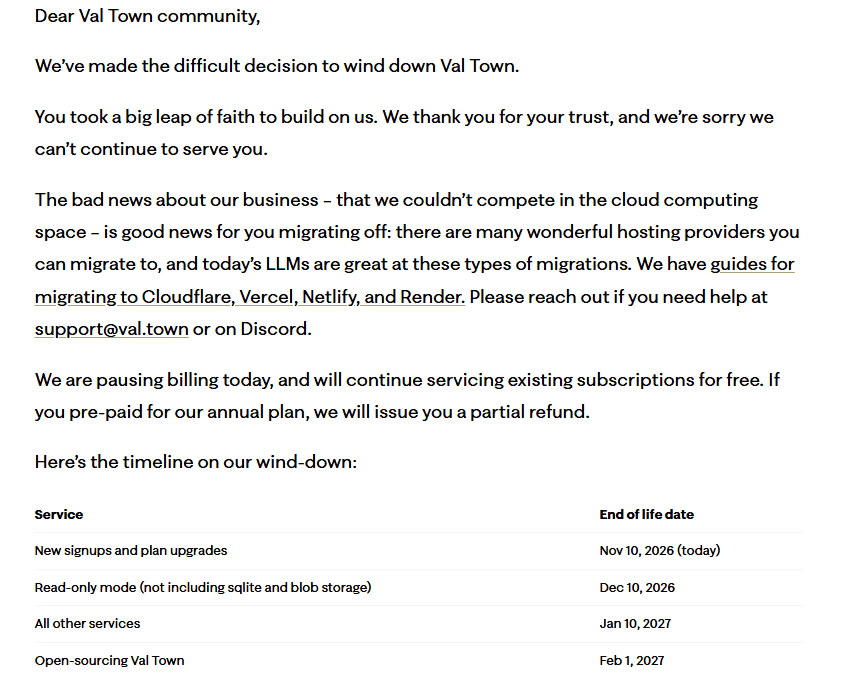
The letter is short and direct. It thanks users for taking “a big leap of faith to build on us,” apologizes for not being able to continue and says the “bad news about our business” is “good news for you migrating off”: there are many hosting providers to move to, and “today’s LLMs are great at these types of migrations.” It then lists the wind-down table above. Read-only mode excludes SQLite and blob storage, which in our reading means those two data services keep working normally until January 10, while the code side becomes read-only on December 10. The post does not spell this out, so treat it as an interpretation.
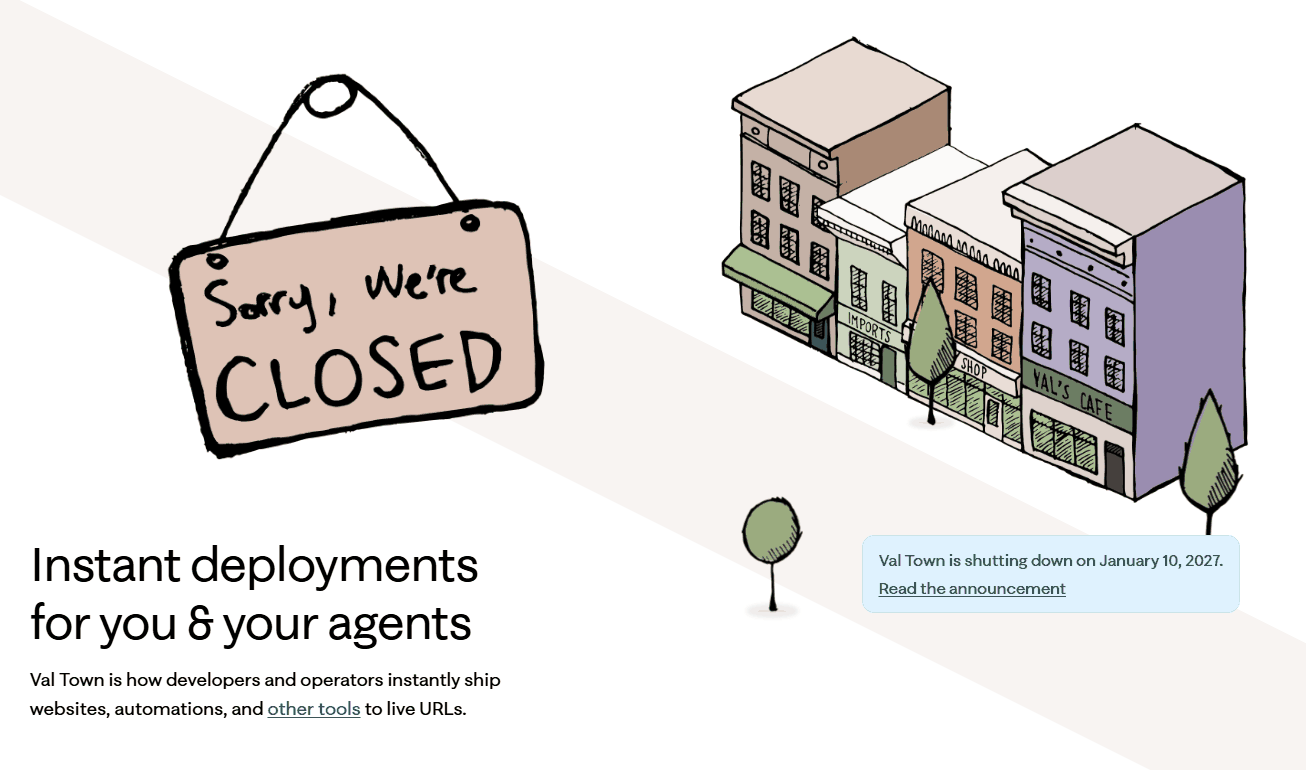
What Val Town did, and what depends on it
Val Town describes itself as the place where “developers and operators instantly ship websites, automations, and other tools to live URLs.” Its homepage lists code that runs in about 100 ms, scheduled cron jobs, emails received by code, a SQLite database, S3-style blob storage, a TypeScript editor, version control, a command-line tool and an MCP server for AI agents. Its homepage still carries quotes from engineers at companies such as Anthropic, OpenAI and Google praising how fast it is to publish a small API or webhook.
That list shows why a shutdown matters. A small program on a platform like this is rarely alone. It may be a webhook that a payment provider or form tool calls, an API that a mobile app uses, a cron job that sends a daily report, an email address that triggers code or a database that holds real data. The code can be copied in an afternoon. The URLs, schedules, credentials and stored data are harder.
What the plans cost, and our arithmetic
The pricing page, which still shows the shutdown notice at the top, lists a Free plan at $0, Pro at $21 a month (with “Save $50 (2 months free)” on yearly billing) and Business “starting from” $167 a month (with “Save $400”). Enterprise is custom. Pro includes ten custom domains, one-minute cron intervals and 1,000,000 runs a day, while Business adds team accounts, unlimited custom domains and 5 million runs a day.
- Pro, yearly: 12 x $21 = $252 per year at monthly rates, so a $50 saving implies about $202 a year. Business: 12 x $167 = $2,004, minus $400 is about $1,604 a year. These are our calculations from the page, and the page does not state the annual totals.
- Time left: from November 10 to December 10 is 30 days, to January 10 is 61 days and to February 1 is 83 days.
- What a partial refund might look like: if refunds are proportional to unused time, a $202 Pro annual plan bought on, say, July 10 would have about 6 of 12 months remaining, or about $100. That is only an illustration. The announcement does not say how refunds are calculated.
What we know versus what we do not
- Stated by Val Town: the reason (could not compete in cloud computing), the dates, the billing pause, free service for existing subscriptions, partial refunds for prepaid annual plans, migration guides for four providers and support contacts.
- Not stated in the post we read: how many customers it has, whether an acquirer was sought, whether running endpoints and cron jobs continue during read-only mode, how data export works for SQLite and blob storage, what license the open-source release will use and whether it will be usable to self-host.
- Our caution: we did not read the migration guides themselves, test any migration or contact the company. We rely on the post, the homepage and the pricing page.
A migration checklist for developers (not advice)
- Take inventory now. List every program, endpoint, cron job, email handler, SQLite database, blob and secret you have on the platform, and who calls each one.
- Back up data before December 10. The company says data services last until January 10, but do not wait for the last day. Export your SQLite databases and files and check that you can open them elsewhere.
- Find every inbound URL. Search third-party dashboards for webhooks and callback addresses that point to your Val Town URLs, such as payment tools, form tools, chat apps and mobile apps. Plan to update each one.
- Plan your domains. If you use a custom domain, lower the DNS time-to-live ahead of the change so the switch takes effect quickly, and decide where it will point.
- Rotate secrets. Move environment variables to the new host and replace API keys you stored on the old platform once you have cut over.
- Pick a target with open eyes. Val Town names Cloudflare, Vercel, Netlify and Render. Compare limits, cron support, storage and pricing for your workload. For general-purpose servers and app platforms, our reviews of Railway, DigitalOcean, Linode and Cloudways cover pricing and trade-offs, but we have not checked how well any of them fits a Val Town migration.
- Test, then cut over. Run the new version in parallel, compare outputs and logs and only then redirect traffic. Note that Val Town’s log retention is short (three days on Free, ten on Pro per its pricing page), so save logs you need.
- Ask for your refund. If you prepaid an annual plan, keep your receipt and email the support address in the announcement.
- Watch for scams. Shutdowns attract fake “migration assistance” or “claim your refund” emails. Use only the official site and addresses you already know.
The broader lesson about platform risk
Small developer platforms are attractive because they remove work: no servers, no deployment pipeline, a live URL in seconds. The trade is concentration risk. When a tool is both the host and the place your logic lives, its failure becomes yours. The practical protection is cheap: keep source code in your own repository, write down where your data lives, avoid platform-specific features for anything critical, and set a calendar reminder to check the health of vendors you depend on. The same logic applies to any SaaS tool we review, including the ones in our reviews, which is why we note pricing dates and policies.
It is also worth noting the humane tone of this shutdown. A pause on billing, free service through the notice period, refunds and open-sourcing are the right steps, and they give customers more control than a sudden outage would. Customers still carry the work of moving, and the notice period is about two months for the main services.
What to watch next
- Val Town’s migration guides and any export tools or documentation.
- Clarification on what read-only mode means for running endpoints and cron jobs from December 10.
- The open-source release on February 1, 2027: license, scope and whether it can be self-hosted.
- Whether any other company takes over customers or code before the shutdown.
- Reports from developers who have already migrated, which will show the real effort involved.
Frequently asked questions
When does Val Town shut down?
January 10, 2027, according to its announcement and homepage. The platform goes read-only on December 10, 2026, and new signups and plan upgrades ended on November 10, 2026.
Will I be charged?
No. The company paused billing on November 10 and says it will keep servicing existing subscriptions for free.
Do I get a refund?
Customers who prepaid for an annual plan will get a partial refund, according to the post. The calculation is not described.
Where should I move?
Val Town says it has guides for Cloudflare, Vercel, Netlify and Render. The right choice depends on your limits, data and budget, so compare options for your workload.
Will Val Town be open source?
The company plans to open-source it on February 1, 2027. Details were not given in the post.
Sources and method
- Val Town blog, “Val Town is winding down,” November 10, 2026 (our screenshot)
- Val Town homepage (our screenshot) and pricing page
- Hacker News front page, November 11, 2026
Method: we read the announcement, homepage and pricing page in full, captured the timeline and homepage ourselves on November 11, 2026, and did the arithmetic labelled “ours.” We did not read the migration guides, test any export or contact the company. The refund illustration is hypothetical. This article is general information, not technical or financial advice. ToolReviewHub earns nothing from this article and has no commercial relationship with Val Town or any provider named. See our review method.