Verisign Backs Down on Deleting 22,000 .name Domains: What Changed, What Is Still Not Guaranteed and What Owners Should Do
Updated November 11, 2026. A news analysis built from Verisign’s letter to ICANN of November 5, 2026, ICANN’s own (now voided) approval letter, trade coverage by Domain Name Wire, the account of an affected registrant and our own screenshots. This is general information, not legal or technical advice.
The short version
For two months, about 22,000 people who own third-level .name domains such as firstname.lastname.name were told those domains, and the email addresses attached to them, would be deleted in early 2027. On November 5, 2026 Verisign, the registry that runs .name, wrote to ICANN that it will now keep supporting existing third-level registrations and email forwarding. On November 10 news of the reversal spread, and ICANN’s page for its July 28 approval letter now shows the letter stamped “VOIDED 9 NOVEMBER 2026.” It is a win for owners, but the letter attaches a condition that is easy to miss.
- What Verisign now says: it will support existing third-level registrations and email forwarding “for as long as at least one ICANN-accredited registrar also continues to offer these services at the retail level.”
- What still ends: new third-level registrations and new email forwarding addresses. Verisign will resubmit updated requests to discontinue those for new registrations.
- What is not guaranteed: a permanent future. The protection depends on at least one registrar still selling the service.
- Scale: Verisign told ICANN that there were about 22,000 third-level .name registrations and that most were not in use. That is Verisign’s claim, and owners who depended on them disagreed strongly.
What a third-level .name domain is
Most domains are second-level names, like example.com. The .name extension was designed differently: individuals register a name in the form first.last.name, the third level, and can also get an email address and forwarding on first@last.name. A registrant who has used one for about 25 years, as one affected owner describes, may have built a website, an email address and device logins on it. The ordinary second-level form, example.name, was not part of the termination plan.
The timeline
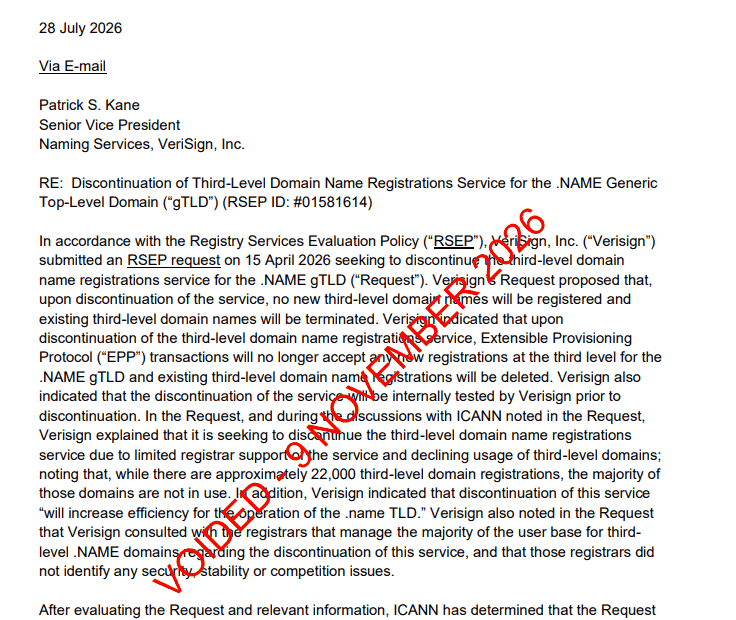
- April 15, 2026: Verisign files two Registry Service Evaluation Process (RSEP) requests, No. 2026013 for third-level registrations and No. 2026014 for email forwarding. It says it wants to align .name with other TLDs and cites limited registrar support and declining usage.
- May 7 to July 28, 2026: ICANN’s letter says it approved the request on May 7 and posted the approval on May 8, and finds no significant security, stability or competition issues. The letter itself is dated July 28.
- August 15, 2026: Verisign gives registrars 180 days’ notice. By our count that points to about February 11, 2027, while other coverage cites February 15.
- Early September 2026: owners learn of the plan from their registrars and object publicly, including filings with ICANN and a personal account that warned the vacated second-level names could be re-registered and used to hijack linked accounts. The owner wrote that he would “disappear from the Internet.”
- November 5, 2026: Verisign writes to ICANN’s Amanda Fessenden that it will keep supporting existing registrations on the condition above.
- November 9 to 10, 2026: ICANN’s July 28 letter is marked voided, and Domain Name Wire and the affected owner report the reversal.
What Verisign’s letter actually says
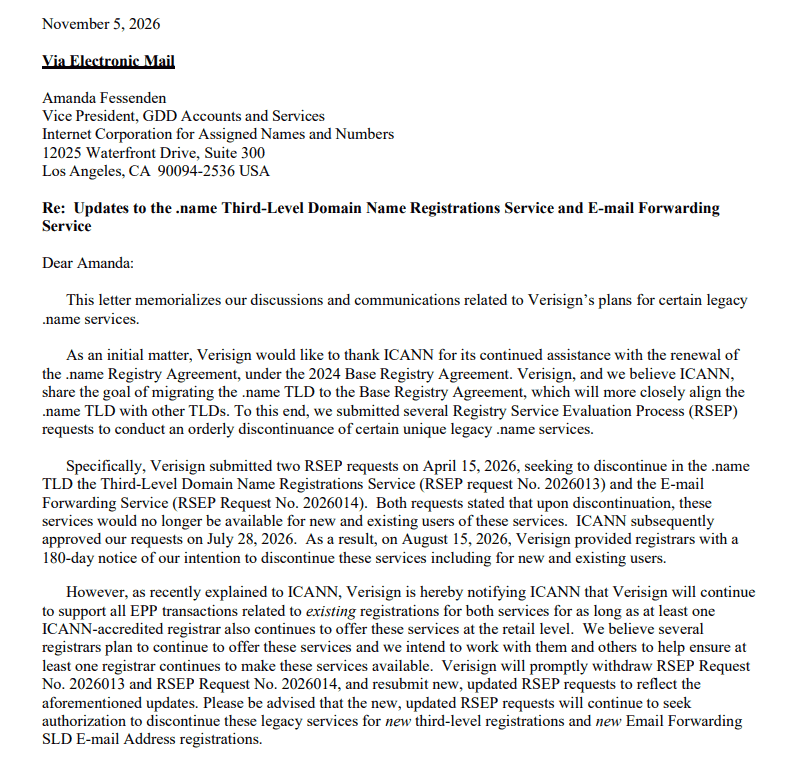
The letter is careful and lawyerly. It thanks ICANN for its help with renewing the .name Registry Agreement, restates the goal of migrating .name to ICANN’s standard Base Registry Agreement, and recounts the April filings and the July 28 approval. Then comes the turn: Verisign “will continue to support all EPP transactions related to existing registrations for both services for as long as at least one ICANN-accredited registrar also continues to offer these services at the retail level.” It adds that it believes several registrars plan to continue, and that it will work with them to make sure at least one does.
Two other points matter. First, Verisign will withdraw its two requests and resubmit updated ones that still seek to discontinue the services “for new third-level registrations and new Email Forwarding SLD E-mail Address registrations.” So the product is being closed to newcomers. Second, the letter does not say the original discontinuation was a mistake or promise anything beyond the registrar condition. Domain Name Wire describes the move as grandfathering existing domains so long as at least one registrar supports them, which matches the letter.
What this means, and our arithmetic
- Existing owners are safe for now, not for ever. The old plan had a date. The new one has a condition. If the last registrar that sells the service stops, the condition fails. That is the same weakness Verisign cited at the start, “limited registrar support,” turned into a safety net.
- About 22,000 names. If a majority of them were unused, as Verisign claimed in its filing, then fewer than 11,000 were in active use. We cannot verify usage, and a name that looks idle can still hold a decades-old email address.
- Time lost. From April 15 to November 5 is 204 days, about seven months, during which owners faced a deletion date and had to plan for it.
- Registrar support matters more than before. With no new registrations, fewer registrars have a commercial reason to keep the service, a risk we flag as our inference.
What owners can do (not advice)
- Ask your registrar in writing. Does it support third-level .name registrations and email forwarding today, and does it plan to keep doing so?
- Keep a backup email. Move critical logins (banking, work, domain registrar, password manager) to a second address you control on a stable domain, and keep the .name address as an alias.
- List what depends on it. Websites, API endpoints, devices, subscriptions and accounts that use the name or address. One owner reported having 211 accounts tied to a .name address.
- Do not rush to prepay. Check your registrar’s terms and refund policy before paying many years ahead. Renewal does not change the registrar condition.
- Beware of phishing. Moments like this produce fake “domain termination” and “urgent renewal” emails. Log in to your registrar directly instead of using email links.
- Watch ICANN and your registrar. ICANN publishes RSEP requests and letters. The updated requests will be public.
Many of the registrars we review, such as Namecheap, GoDaddy, Domain.com and Spaceship, sell domain products, but we have not checked which of them support third-level .name domains, so make no assumption. See our review method for what our registrar reviews do and do not cover.
The wider lesson for any domain owner
A domain is not property in the way a house is. It is a registration held under rules set by a registry, a regulator-like body and a registrar, and those rules can change. The .name case shows a decision made on usage numbers and consultations with “registrars that manage the majority of the user base” nearly wiping out addresses people had used for decades, until public pressure, lawyers, filings and trade press changed the outcome. For an individual, the practical protection is to avoid single points of failure: keep a second email, keep records and prefer widely supported extensions for anything essential.
What to watch next
- The updated RSEP requests from Verisign, and how ICANN handles them.
- Which registrars confirm that they will keep selling third-level .name domains and email forwarding.
- Any ICANN review of how the original decision was made. Domain Name Wire’s author hopes for a post-mortem; we have seen no announcement.
- The status of the reconsideration requests that owners filed with ICANN.
Frequently asked questions
Will my third-level .name domain be deleted in February 2027?
According to Verisign’s November 5 letter, existing registrations will continue to be supported as long as at least one registrar offers the service at retail. The earlier deletion plan is being withdrawn, though updated requests are coming.
Can I still register a new third-level .name domain?
Verisign says it will continue to seek authorization to end new third-level registrations and new email forwarding addresses.
Is my email at first@last.name safe?
Existing email forwarding is covered by the same registrar condition. Keep a backup address.
What about example.name?
Second-level .name registrations were not part of the termination plan in the coverage we read.
Did ICANN admit it made a mistake?
We did not find a statement to that effect. We saw only that ICANN’s July 28 approval letter is marked voided as of November 9, 2026.
Sources and method
- Verisign letter to ICANN, “Updates to the .name Third-Level Domain Name Registrations Service and E-mail Forwarding Service,” November 5, 2026 (our screenshot)
- ICANN letter to Verisign, July 28, 2026, now marked voided (our screenshot)
- Domain Name Wire, November 10, 2026
- Neil Fraser, “.name Grandfathered,” November 10, 2026, and “.name Termination,” September 3, 2026 (an affected registrant’s accounts)
Method: we read both letters on icann.org, captured the first page of each ourselves on November 11, 2026, and read the trade report and the registrant’s posts. We did not read the full RSEP filings or ICANN’s reconsideration documents, and we could not confirm which registrars will keep supporting the service. Statements about usage and registrar plans are Verisign’s, not ours. Dates and counts labelled “our count” are our own calculations. This is general information, not legal or technical advice. ToolReviewHub earns nothing from this article. See our review method.