Apache Axis 1.x CVE-2026-90436: End-of-Life Flaw on KEV
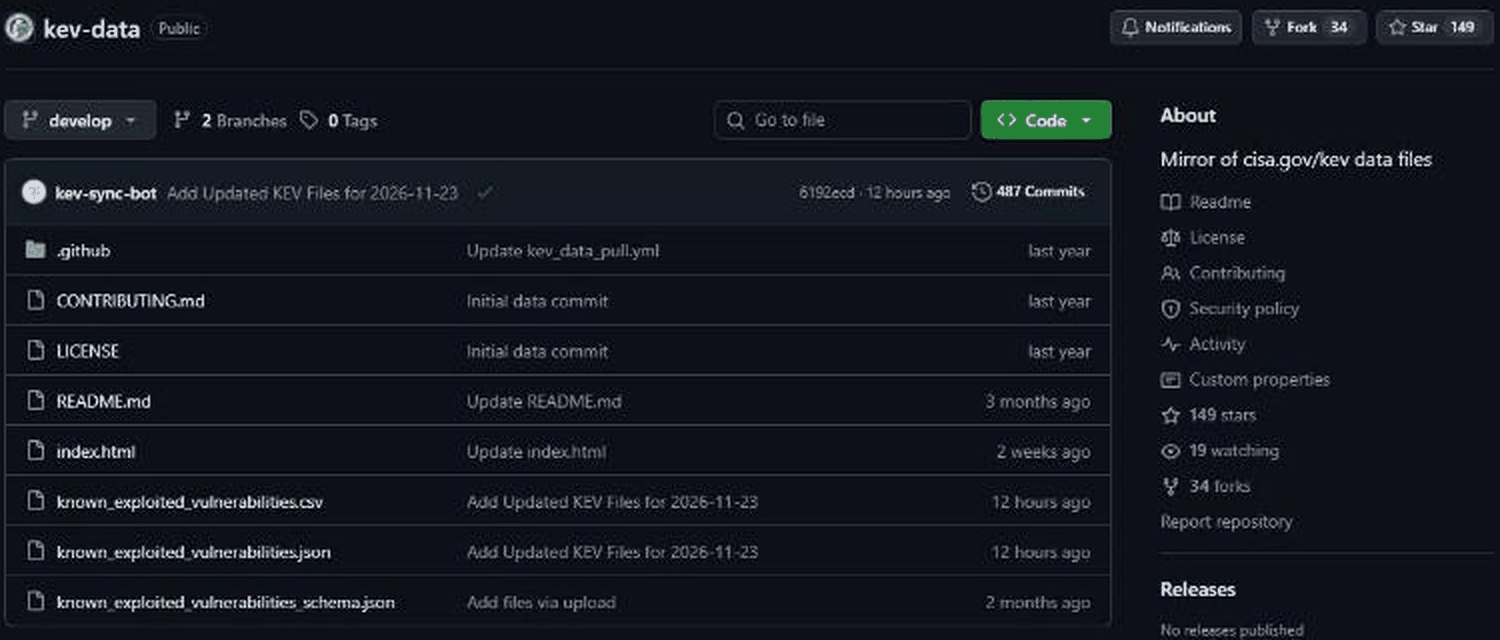
Published November 25, 2026. A news analysis of Apache Axis 1.x vulnerability CVE-2026-90436, built from the National Vulnerability Database (NVD) entry for CVE-2026-90436 and CISA’s Known Exploited Vulnerabilities (KEV) data as mirrored on CISA’s GitHub (both read on November 25, 2026). The screenshot is ours (the CISA data mirror on GitHub). CISA’s own website returned “Access Denied” to our automated browser, so we did not use it. This article contains no affiliate links and we have no commercial relationship with the Apache Software Foundation. ToolReviewHub is produced with the help of an AI assistant (Claude, made by Anthropic). We did not run Apache Axis or test the flaw. Descriptions are the vendors’ and CISA’s wording, and numbers marked “ours” are our own arithmetic.
Apache Axis 1.x CVE-2026-90436: the short version
- What it is: a flaw in how Apache Axis 1.x handles an incoming SOAP fault message. According to the NVD, an unauthenticated remote attacker can make the engine load and instantiate a class named in the message before it checks that the class is an AxisFault. Merely loading a class runs its static initializer, and with a suitable class on the classpath the result can be remote code execution.
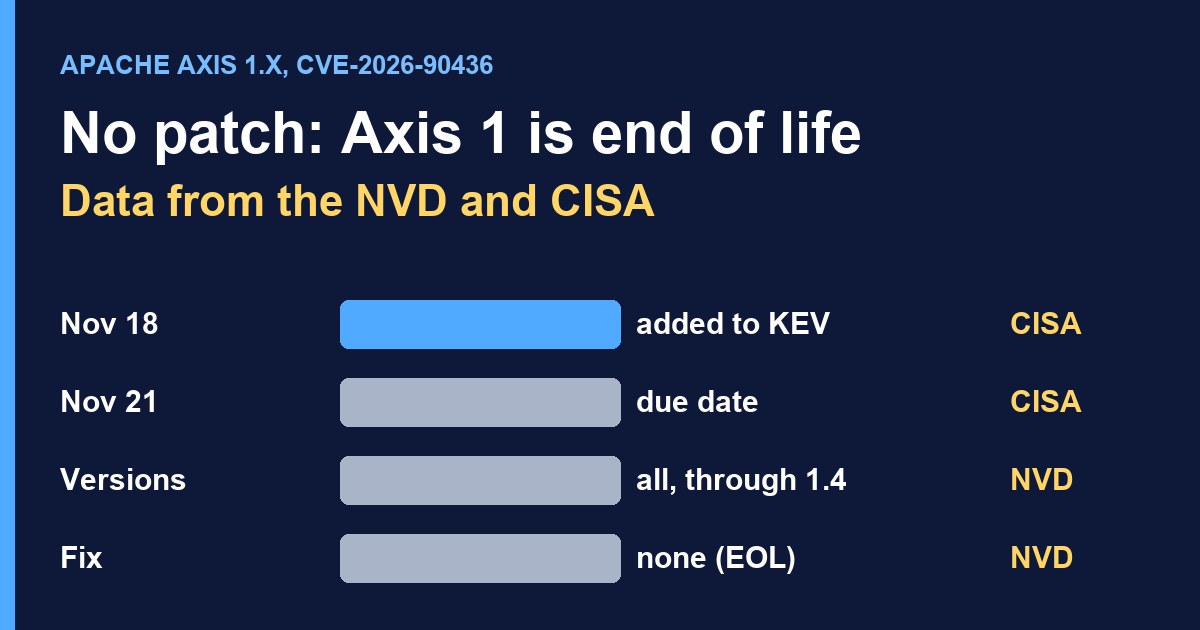
- Affected: all Axis 1.x versions, through 1.4. The NVD marks the entry “unsupported when assigned.” Axis 1 is end of life, so there is no patch to wait for.
- The detail that matters: the NVD says the fault is parsed while the engine works out which service the request targets, before the per-service handler chain runs, so authentication handlers do not protect against it.
- KEV status: CISA added it on November 18, 2026, with a November 21 due date. CISA’s note says the flaw may affect an open-source component used by different products.
- The practical answer: migrate off Axis 1, or isolate it. A product that bundles Axis 1 may be exposed even if you never installed Axis yourself.
What Axis 1 is, and why it is still around
Apache Axis is a Java library for SOAP web services, the XML-based messaging style that was popular in business software in the 2000s. Axis 1.x is the old generation: the NVD entry says the line is end of life and recommends moving to a different SOAP engine, and mentions the newer Axis 2 for Java as one option (the sentence continues beyond what we captured, so check the entry). Despite its age, Axis 1 jars are still bundled in countless products, from enterprise middleware to device management tools, and often sit in an application’s library folder without anyone remembering them. That is our general observation and not a figure from Apache.
That is the reason CISA’s KEV note says this entry may affect an open-source component that different products use. If a vendor ships Axis 1 inside its application, the vendor’s product may be exposed, and the vendor is the one who must ship the fix.
What the vulnerability is
The NVD description is technical but clear. When Axis receives a SOAP message that is a fault, the fault may carry a detail element with an exception name. Axis loads the named class and, if a string data element is present, it creates an instance of that class using the string constructor. Only afterwards does it check that the class is a real AxisFault. Loading a class alone runs its static initializer, and instantiating it calls a constructor. So an attacker who controls the message chooses which class gets loaded and constructed on the server.
Whether that leads to code execution depends on the classes available to the application. The NVD says that with a suitable class on the classpath the result is remote code execution. That kind of reliance on whatever happens to be installed is typical of this bug class: the flaw is in the engine, but the damage depends on what else is present.
The other crucial fact is the order of operations. The NVD says the fault is parsed while the engine resolves the target service, before any per-service handler chain runs. Authentication in Axis is usually done by handlers attached to a service. If the dangerous step happens before them, a login requirement on the service does not help. The attacker is unauthenticated, and the NVD’s text says it works remotely.
“Unsupported when assigned”: what it means
The NVD marks the record as “unsupported when assigned.” This is a label for vulnerabilities in products that the maintainers no longer support at the time the CVE is created. It means the project is not going to issue a fix. For defenders, the label is the difference between “patch and move on” and “you have a design decision to make.”
The decision has three branches. You can replace the library or the product that depends on it. You can stop using the vulnerable feature, if your use does not need Axis to accept inbound SOAP calls, for instance if you use it only as a client. Or you can wrap it, putting a gateway in front that rejects SOAP faults, limiting who can reach it. We are listing these as general options, not as Apache’s guidance, and none of them is proven here.
What the record says
| Item | Detail |
|---|---|
| Product | Apache Axis 1.x |
| Affected versions | All Axis 1.x versions through 1.4 |
| Status | End of life; NVD label “unsupported when assigned”; no fix |
| Weakness | CWE-470, use of externally controlled input to select classes |
| Attacker | Unauthenticated, remote |
| Mechanism | A SOAP fault names a class that is loaded and instantiated before the AxisFault check |
| KEV note | May affect an open-source component used by different products |
Timeline
| Date (2026) | Event | Source |
|---|---|---|
| November 18 | CISA adds CVE-2026-90436 to the KEV catalog | CISA KEV data |
| November 21 | KEV due date for U.S. federal civilian agencies | CISA KEV data |
The KEV entry refers to a discussion on the Apache mailing lists. We did not read that thread, so we do not know the details of how Apache handled the report. A three-day window (ours) is the short one described in our November KEV analysis. It ended on November 21.
What to do: a practical checklist
- Search for Axis 1 jars. Look in application servers and installers for files named axis-1.x (for example axis-1.4.jar) and for Axis-based product components, including old ones in backup or legacy folders.
- Identify which applications use them. Check whether the application receives SOAP calls from outside or only makes outbound calls. Inbound exposure is what matters here.
- Ask your vendors. If a product bundles Axis 1, ask the vendor in writing whether it is affected and what the remedy is. Their answer is the only real fix path.
- Block or limit access to SOAP endpoints that you cannot migrate yet. Use network rules, an API gateway or a web application firewall to allow only known clients.
- Consider rejecting SOAP faults on inbound endpoints at a gateway, if your services never legitimately receive them. Test first; this is our suggestion and not an Apache instruction.
- Watch for unusual class-loading or process activity on the servers that host Axis, and review outbound connections.
- Plan the migration. Put an end-of-life library on the retirement list with a date, so that the same issue does not return.
What we could not confirm
- Which products bundle Axis 1 and are therefore exposed: the KEV note says the component is used by different products, but gives no list.
- How the flaw is being exploited, by whom and with which classes: the KEV entry records exploitation without details.
- The exact end of the NVD’s migration advice, which continues past the text we captured.
- What Apache’s mailing-list discussion says: we did not read the thread.
- Whether any protective configuration setting exists: the record we read lists none.
- CISA’s own catalog page, which we could not open; the KEV facts come from CISA’s GitHub mirror (catalog version 2026.11.23).
Frequently asked questions
What is CVE-2026-90436?
A deserialization-style flaw in Apache Axis 1.x: a SOAP fault can make the engine load and instantiate a class named in the message, which can lead to remote code execution.
Is there a patch?
No. Axis 1 is end of life and the NVD marks the entry unsupported when assigned. The guidance is to migrate to another SOAP engine.
Does authentication protect me?
The NVD says the fault is parsed before the per-service handler chain runs, so authentication handlers do not protect against it.
Which versions are affected?
All Axis 1.x versions through 1.4.
What is the KEV deadline?
November 21, 2026 for U.S. federal civilian agencies. For everyone else it signals urgency and is not a legal deadline.
Method: details come from the NVD entry for CVE-2026-90436 and CISA KEV data (catalog version 2026.11.23), read on November 25, 2026. For how we research, see How We Review Tools.