CISA’s Known Exploited Vulnerabilities List in November 2026: 26 Additions in 23 Days, Cisco Expressway, SAP, VMware and What to Patch First
Published November 24, 2026. A news analysis built from the data files of the U.S. Cybersecurity and Infrastructure Security Agency (CISA) Known Exploited Vulnerabilities (KEV) catalog, read through CISA’s official GitHub mirror (cisagov/kev-data, catalog version 2026.11.23, released November 23, 2026), and from Cisco’s security advisory for CVE-2026-76466. CISA’s own website returned “Access Denied” to our automated browser, and we did not try to get around that, so every number below comes from the mirrored data files. The screenshot and cards are ours. This article contains no affiliate links and we have no commercial relationship with any company named here. ToolReviewHub is produced with the help of an AI assistant (Claude, made by Anthropic). We did not test any patch or exploit anything: numbers marked “ours” are our own counts of the catalog, and descriptions are CISA’s and the vendors’ wording.
CISA KEV in November 2026: the short version
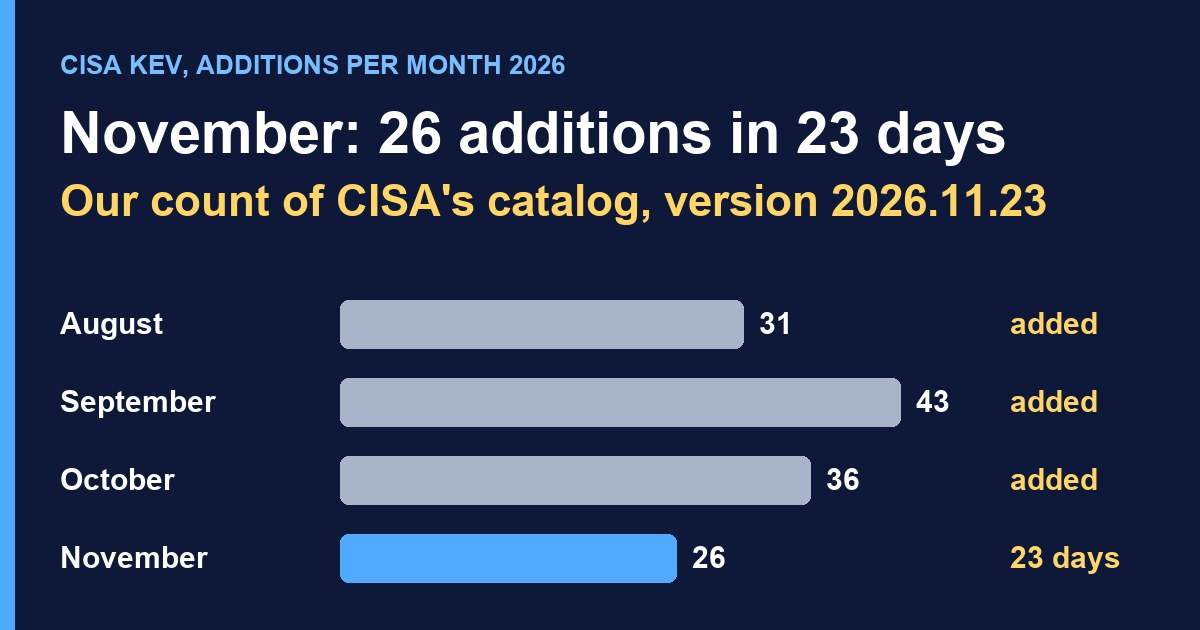
- 26 vulnerabilities were added to the CISA Known Exploited Vulnerabilities catalog between November 3 and November 23, 2026 (ours), across 23 vendors. The catalog now holds 1,792 entries.
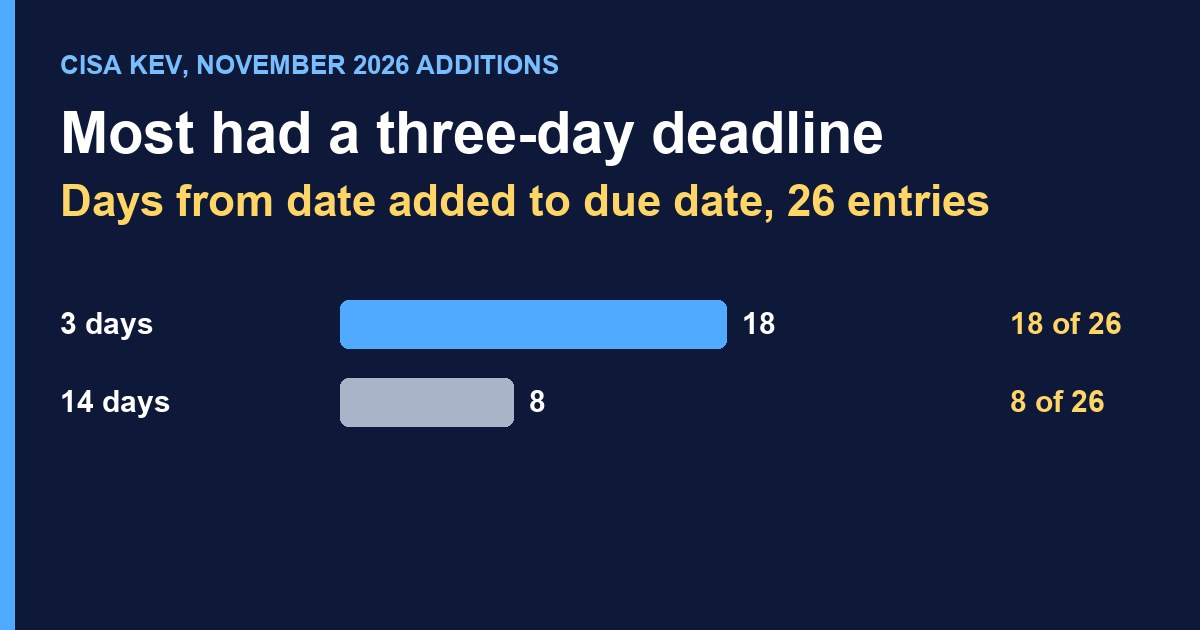
- Most came with a three-day deadline. For 18 of the 26, the due date is three days after the date added; for the other 8 it is 14 days (ours). The windows have shortened through 2026: in January 15 of 17 additions had a 21-day window, while from June onward three-day windows are the majority every month (ours).
- The newest four from November 20 are a Cisco Expressway Series flaw (CVE-2026-76466, hard-coded credentials, CVSS 9.8), SAP NetWeaver (CVE-2025-42884), VMware vCenter (CVE-2026-123890) and Apache Roller (CVE-2026-129448). Two more were added on November 23: Project MONAI’s MONAI Label (CVE-2026-133968) and N-able MailAssure (CVE-2026-134624).
- Only one November entry is flagged for known ransomware use: a Synology DiskStation Manager flaw (CVE-2024-10441), added on November 18.
- A useful detail from Cisco: on November 23 Cisco updated its advisory to say the Expressway flaw was added to the CISA KEV and that “Cisco does not have direct evidence of active exploitation.” A KEV entry and a vendor’s own evidence do not always say the same thing.
- What we could not do: open CISA’s catalog page, confirm who is exploiting any of these, or test any patch.
What the KEV catalog is and how to read a due date
The KEV catalog is CISA’s list of vulnerabilities that it says are being exploited in the wild. For each entry it records the vendor and product, a short description, the date added, a “required action” and a due date by which U.S. federal civilian agencies must act. Anyone can use it as a patch-priority list: if a flaw is on KEV, someone has used it against real systems, so it jumps the queue ahead of flaws that are only theoretically dangerous.
The required-action text on the November entries tells agencies to apply the vendor’s mitigations while complying with CISA’s BOD 26-04 “Prioritizing Security Updates Based on Risk” guidance and its “Forensics Triage Requirements,” to follow the BOD 26-04 guidance for cloud services or stop using the product if mitigations are unavailable, and to evaluate each asset’s internet exposure. We could not open those documents, so we describe only what the entries themselves say. The due date binds federal agencies, not you; but it is CISA’s own view of how urgent each fix is.
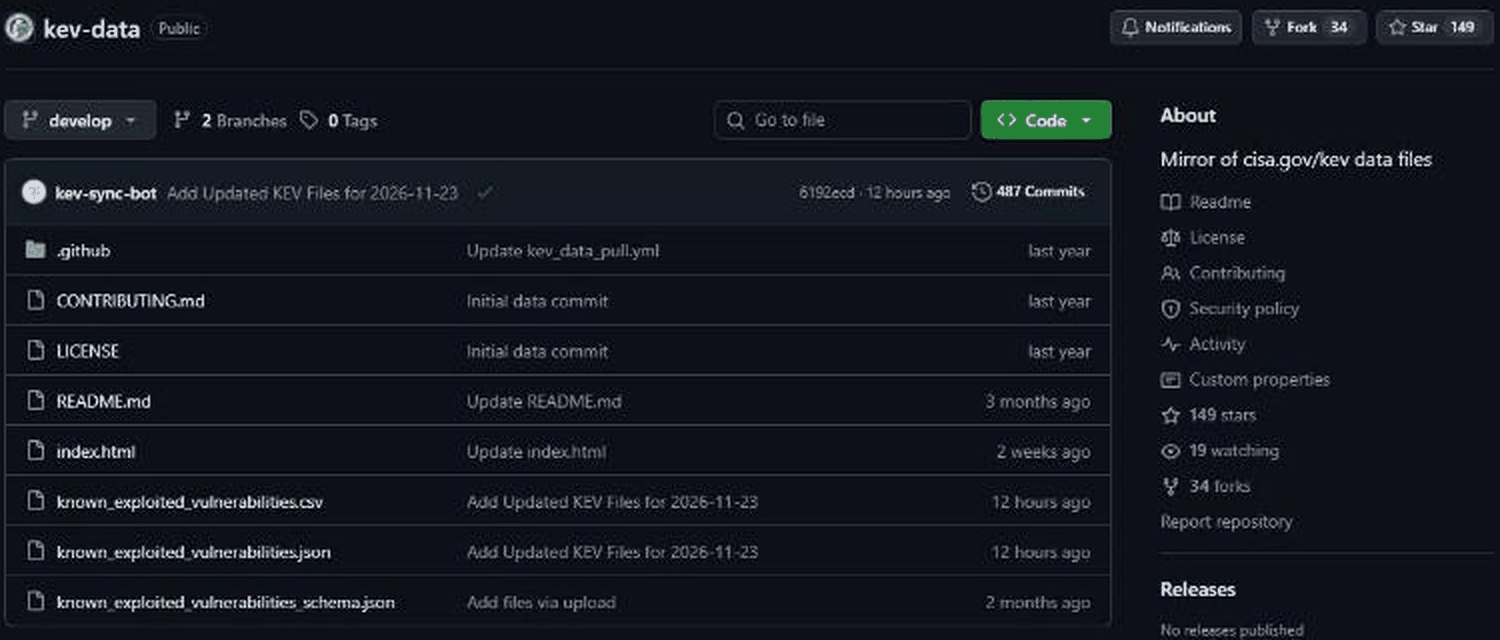
kev-data mirror on GitHub, updated with the KEV files for November 23, 2026.All 26 additions in November 2026
CISA’s catalog gives each entry a name that describes the weakness, not an attack. We summarize it in plain words in the third column. “Due” is the federal deadline in the data.
| Added | CVE | Vendor and product | Weakness, per CISA’s name | Due |
|---|---|---|---|---|
| Nov 23 | CVE-2026-133968 | Project MONAI, MONAI Label | Path traversal | Nov 26 |
| Nov 23 | CVE-2026-134624 | N-able, MailAssure (SpamExperts) | Server-side request forgery | Nov 26 |
| Nov 20 | CVE-2026-129448 | Apache, Roller | Deserialization of untrusted data | Nov 23 |
| Nov 20 | CVE-2026-123890 | Broadcom, VMware vCenter | Authentication bypass using an alternate path or channel | Nov 23 |
| Nov 20 | CVE-2025-42884 | SAP, NetWeaver (Enterprise Portal) | Improper neutralization of special elements in data query logic | Nov 23 |
| Nov 20 | CVE-2026-76466 | Cisco, Expressway Series | Use of hard-coded credentials | Nov 23 |
| Nov 18 | CVE-2024-10441 | Synology, DiskStation Manager (DSM) | Improper encoding or escaping of output (known ransomware use) | Nov 21 |
| Nov 18 | CVE-2026-40217 | BerriAI, LiteLLM | Unprotected alternate channel | Dec 2 |
| Nov 18 | CVE-2026-90436 | Apache, Axis | Unsafe reflection | Nov 21 |
| Nov 18 | CVE-2026-90817 | Vanderbilt University, REDCap | Code injection | Nov 21 |
| Nov 17 | CVE-2026-115731 | Perforce, Puppet Enterprise | Deserialization of untrusted data | Dec 1 |
| Nov 13 | CVE-2026-114713 | UnrealIRCd | Improper neutralization of delimiters | Nov 16 |
| Nov 13 | CVE-2026-123039 | Check Point, multiple products | Incorrect permission assignment for a critical resource | Nov 16 |
| Nov 10 | CVE-2026-111560 | Barracuda Networks, multiple products | OS command injection | Nov 13 |
| Nov 10 | CVE-2026-116606 | Barracuda Networks, Email Security Gateway | Authentication bypass | Nov 13 |
| Nov 10 | CVE-2026-111793 | Openwave Messaging, Webtop Media Transcode | Incorrect resource transfer between spheres | Nov 24 |
| Nov 10 | CVE-2026-124194 | Microsoft, Office (Outlook) | Missing user interaction for a potentially unsafe action | Nov 24 |
| Nov 10 | CVE-2026-125350 | Google, Chromium | Use-after-free | Nov 24 |
| Nov 10 | CVE-2026-20320 | Cisco, BroadWorks | XML external entity reference | Nov 24 |
| Nov 9 | CVE-2026-102895 | GPUStack | Improper authentication | Nov 12 |
| Nov 9 | CVE-2026-116779 | SignalWire, FreeSWITCH | Code injection | Nov 12 |
| Nov 9 | CVE-2026-123158 | OpenBSD, OpenSSH | Unexpected status code or return value | Nov 12 |
| Nov 9 | CVE-2026-123218 | IBM, Aspera Faspex | Incorrect authorization | Nov 12 |
| Nov 6 | CVE-2026-19868 | SonicWall, SonicOS SSLVPN | Use of single-factor authentication | Nov 20 |
| Nov 4 | CVE-2024-27834 | Apple, multiple products | Improper authentication | Nov 18 |
| Nov 3 | CVE-2026-119977 | WordPress, WordPress Core | Time-of-check time-of-use race condition | Nov 6 |
What the numbers show (our counts)
- The pace is steady, not a spike. The catalog gained 17, 28, 26, 31, 21, 23, 26, 31, 43 and 36 entries from January to October 2026 (282 in total, about 28 a month) and 26 so far in November (ours). November’s 26 in 23 days is about 1.1 a day, close to October’s 1.2 a day and below September’s peak of 1.4 (ours). If it continued at that rate, November would end near 34.
- Short deadlines now dominate, and that is a 2026 change. 18 of 26 November additions (69%) have a three-day window and 8 have 14 days. The table below shows how the mix moved during the year (ours). The entries do not explain why one product gets three days and another 14, but the shift fits the BOD 26-04 title, “Prioritizing Security Updates Based on Risk.”
- Several categories of software are on the list. There are firewalls and VPN products (SonicWall, Check Point, Barracuda), collaboration and mail products (Cisco Expressway and BroadWorks, N-able MailAssure, Barracuda Email Security Gateway), ordinary desktop software (Chromium, Microsoft Office, Apple), a content platform (WordPress Core), a network-attached-storage operating system (Synology DSM), and developer and AI infrastructure (LiteLLM, Puppet, GPUStack, MONAI Label).
- Old bugs still matter. Three entries have 2024 or 2025 CVE numbers: Apple CVE-2024-27834, Synology CVE-2024-10441 and SAP CVE-2025-42884 (ours). A flaw added to KEV this month may be older than the product you thought you had patched.
- Weakness types repeat. Deserialization of untrusted data (Apache Roller, Puppet Enterprise), authentication problems (vCenter, GPUStack, Barracuda ESG, Apple, SonicWall’s single-factor login) and command or code injection (Barracuda, FreeSWITCH, REDCap) each show up more than once. Those are weakness classes where one fix pattern, such as stricter input handling or mandatory second factors, helps several products.
- Vendors appear twice. Apache (Roller and Axis), Cisco (Expressway and BroadWorks) and Barracuda (two entries) each have two entries in the month (ours).
| Month (2026) | Additions | 3-day window | 14-day window | 21-day window | Share with a 3-day window |
|---|---|---|---|---|---|
| January | 17 | 2 | 0 | 15 | 12% |
| February | 28 | 4 | 0 | 22 | 14% |
| March | 26 | 5 | 14 | 7 | 19% |
| April | 31 | 8 | 23 | 0 | 26% |
| May | 21 | 7 | 13 | 0 | 33% |
| June | 23 | 17 | 6 | 0 | 74% |
| July | 26 | 22 | 4 | 0 | 85% |
| August | 31 | 22 | 9 | 0 | 71% |
| September | 43 | 34 | 9 | 0 | 79% |
| October | 36 | 29 | 7 | 0 | 81% |
| November (to the 23rd) | 26 | 18 | 8 | 0 | 69% |
A few entries had other windows (two days in February, five days in May), which is why some rows do not add up exactly to the additions column. Across 2026, 308 entries were added and 28 carry the known-ransomware-use flag, about 9%, against 1 of 26 in November (ours).
The Cisco Expressway entry, in detail
The most severe entry on the list by score is Cisco’s. Cisco’s advisory, rated Critical with a CVSS base score of 9.8, says a flaw in the database service of Cisco Expressway Series could let an unauthenticated, remote attacker with network access execute arbitrary operating system commands as root. It is due to the use of persistent cookies and to insufficient validation of client certificates when the TLS Verify Mode is enabled for clustering. An attacker who has the cookies could connect to the database service and call specific remote procedure commands. The advisory covers Expressway Core (Expressway-C) and Expressway Edge (Expressway-E), says Cisco has released software updates, and says there are no workarounds.
The timeline matters. Cisco first published the advisory on October 21, 2026 and updated it on November 23 to say the flaw was added to the CISA KEV, with the sentence “Cisco does not have direct evidence of active exploitation.” CISA’s entry, added on November 20 with a November 23 due date, describes an unauthenticated remote attacker with persistent cookies and network access executing commands as root on a clustered device. The advisory also credits Stefan Aleksic of Jane Street for reporting the vulnerability. If you run Expressway, the safe reading is simple: it is on a list of vulnerabilities CISA says are exploited, Cisco says it has not seen it directly, and in either case the fix is to move to a fixed release, since there is no workaround.
Other entries worth a closer look
- VMware vCenter (CVE-2026-123890). An authentication bypass. We covered the vendor’s advisory in our vCenter article.
- SAP NetWeaver (CVE-2025-42884). CISA says the Enterprise Portal flaw lets an unauthenticated attacker disclose or modify server information through injected JNDI environment properties or a URL used during a JNDI lookup. It carries a 2025 CVE number, so it may already have a fix in your patch history.
- Synology DSM (CVE-2024-10441). The one November entry marked as used in ransomware campaigns. This is a different flaw from the OAuth issue (CVE-2026-120382) we covered in our Synology article, so check which DSM version you run and apply all current updates.
- LiteLLM (CVE-2026-40217). The AI gateway flaw with the longest window, due December 2. See our LiteLLM article.
- OpenSSH (CVE-2026-123158). Covered in our OpenSSH article; the affected setup is specific, so check whether you run it.
- WordPress Core (CVE-2026-119977). A race-condition flaw added November 3 with a three-day deadline; see our WordPress 7.1.5 article for the release that followed.
- Deadlines still ahead as of November 24: MONAI Label and MailAssure (November 26), Puppet Enterprise (CVE-2026-115731, December 1) and LiteLLM (December 2). Four entries are due today, November 24: Openwave, Microsoft Office, Chromium and Cisco BroadWorks (ours).
What small sites and small teams should do this week
- Browsers and office software first. Update Chromium-based browsers and Microsoft Office or Outlook now; these are on every desktop and the November 10 deadlines are today.
- Anything exposed to the internet next. Firewalls, VPN gateways, mail gateways, remote-access tools and file-transfer servers (SonicWall, Check Point, Barracuda, Cisco, IBM Aspera, FreeSWITCH, OpenSSH) are the usual first targets. Check the product list against your own inventory.
- NAS and home-lab devices. If you run Synology DSM, check your version and update; a ransomware flag deserves attention even on a home device.
- Websites. Keep WordPress core and plugins on the latest release and enable automatic updates for security releases.
- Developer and AI tooling. Gateways and automation servers such as LiteLLM, Puppet, GPUStack and MONAI Label often hold keys and can reach other systems; patch them and keep them off the public internet where you can.
- Where a fix is not available, follow the vendor’s mitigation or remove the product from the internet, as the KEV required action says. Cisco notes there is no workaround for Expressway, so a fixed release is the only route.
- Check for signs of compromise, not only the patch. CISA’s required-action text refers to forensics triage requirements; if a system was exposed while vulnerable, review logs and credentials after patching.
What we could not confirm
- CISA’s own catalog page: it returned “Access Denied” to our browser. Our figures come from CISA’s GitHub mirror, and if the mirror lags the catalog, our counts will too.
- The meaning of the three-day and 14-day split: the entries do not say why a product received one or the other.
- Who is exploiting each flaw, how widely, or whether the exploitation is against your product version. KEV records that exploitation exists; it does not give details.
- Cisco’s statement and CISA’s entry differ on evidence of exploitation, and we cannot resolve that from public information.
- Fixed versions for each product: check each vendor’s advisory. We did not test any patch.
Frequently asked questions
What is the CISA KEV catalog?
CISA’s list of vulnerabilities that it says are being exploited in the wild, with a due date by which U.S. federal civilian agencies must fix them. It is widely used as a patch-priority list.
How many vulnerabilities were added to KEV in November 2026?
26 between November 3 and November 23, from 23 vendors, by our count of the catalog data (version 2026.11.23, which holds 1,792 entries).
Which KEV entry is flagged for ransomware?
Of the November additions, only Synology DiskStation Manager CVE-2024-10441 carries the known-ransomware-use flag.
Is the Cisco Expressway flaw being exploited?
CISA added it to the KEV catalog on November 20. Cisco says it does not have direct evidence of active exploitation. Cisco has released updates and there is no workaround, so upgrade to a fixed release.
Does a KEV due date apply to me?
Formally it applies to U.S. federal civilian agencies. For everyone else it is a signal of urgency from CISA, not a legal deadline.
Where can I check the list myself?
CISA publishes the catalog on its website, and its cisagov/kev-data repository on GitHub mirrors the JSON and CSV files, which is what we used.
Method: we downloaded known_exploited_vulnerabilities.json from CISA’s kev-data GitHub repository (catalog version 2026.11.23) on November 24, 2026 and counted entries by date added, vendor, due date and flags. Vendor descriptions come from Cisco’s advisory cisco-sa-vcs-static-cred-hr7EWZ8t. For how we research, see How We Review Tools.
In-depth articles on individual entries
We have written a detailed article for many of the entries on this list. Published so far:
- Cisco Expressway CVE-2026-76466
- MONAI Label CVE-2026-133968
- Apache Roller CVE-2026-129448
- N-able MailAssure CVE-2026-134624
- Puppet Enterprise CVE-2026-115731
- UnrealIRCd CVE-2026-114713
- Check Point CVE-2026-123039
- Barracuda CVE-2026-116606 and CVE-2026-111560
- Synology DSM CVE-2024-10441
- SonicWall SonicOS CVE-2026-19868
- IBM Aspera Faspex CVE-2026-123218
- SAP NetWeaver CVE-2025-42884
- Apache Axis 1.x CVE-2026-90436
- REDCap CVE-2026-90817
- Cisco BroadWorks CVE-2026-20320
- Openwave Webtop Media Transcoder CVE-2026-111793
- Microsoft Outlook CVE-2026-124194
- Google Chrome CVE-2026-125350
- GPUStack CVE-2026-102895
- FreeSWITCH CVE-2026-116779
- Apple CVE-2024-27834
- Earlier: VMware vCenter CVE-2026-123890, LiteLLM CVE-2026-40217 and OpenSSH CVE-2026-123158