Apache Roller CVE-2026-129448: Unauthenticated Code Execution Through XML-RPC, Fixed in 6.1.6 and on CISA’s Exploited List
Published November 24, 2026. A news analysis of Apache Roller vulnerability CVE-2026-129448, built from the National Vulnerability Database (NVD) entries for CVE-2026-129448 and the related CVE-2026-82384, the public pull request #171 in the apache/roller repository on GitHub, and CISA’s Known Exploited Vulnerabilities (KEV) data as mirrored on CISA’s GitHub. The screenshot is ours and was taken on November 24, 2026. CISA’s own website returned “Access Denied” to our automated browser, so we did not use it. This article contains no affiliate links and we have no commercial relationship with the Apache Software Foundation. ToolReviewHub is produced with the help of an AI assistant (Claude, made by Anthropic). We did not install Apache Roller or test the flaw. Descriptions are the Apache Software Foundation’s, GitHub’s and CISA’s wording, and numbers marked “ours” are our own arithmetic.
Apache Roller CVE-2026-129448: the short version
- What it is: a deserialization of untrusted data flaw (CWE-502) in Apache Roller’s XML-RPC endpoint. According to the CVE record, versions 4.0.0 through 6.1.4 let an unauthenticated remote attacker execute arbitrary code, and the record says the issue “is being actively exploited.”
- Severity: the Apache Software Foundation, as the CVE numbering authority, scores it CVSS 9.8 Critical. NIST’s own NVD assessment was “not yet provided” when we read the page.
- It is the same bug as CVE-2026-82384, which lists only Apache Roller 6.1.5 as affected. Together the two records cover every version from 4.0.0 through 6.1.5.
- The fix: upgrade to Apache Roller 6.1.6 or later. Until then, set the “enabledForExtensions” option to false in the web.xml file or remove the XML-RPC servlet mapping, then restart.
- Switching XML-RPC off in the admin screen is not enough, because older versions process the request before checking that setting.
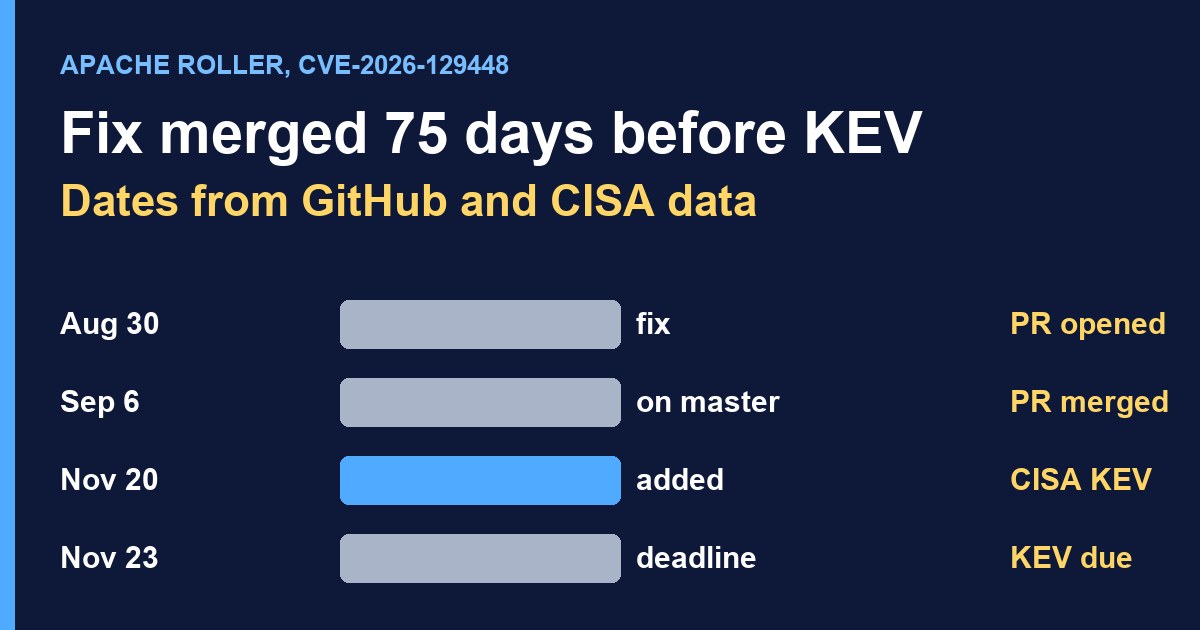
- KEV status: CISA added it to its Known Exploited Vulnerabilities catalog on November 20, 2026 with a November 23 due date.
What Apache Roller is
Apache Roller is an open-source blog server written in Java. It runs as a web application inside a servlet container such as Tomcat, supports multi-user and group blogs, and has been used by organizations that want to host many blogs on their own infrastructure. Because it is old, stable software, many installs are long-lived internal or niche sites that nobody has touched in years, which matters for a vulnerability that affects versions back to 4.0.0. We do not know how many Roller servers are reachable from the internet.
What the vulnerability is
The CVE record explains the mechanism in two parts. First, Roller’s XML-RPC servlet is configured to accept the underlying library’s non-standard “vendor extension” types. Second, those extension values are deserialized (turned back into objects) while the request is being parsed, before the server checks who is calling. If an application deserializes data an attacker controls, an attacker can sometimes make it run code. NVD’s description for CVE-2026-129448 says the XML-RPC endpoint accepts the vendor extension types and deserializes them before authenticating the requester, which allows an unauthenticated remote attacker to execute arbitrary code, for versions 4.0.0 through 6.1.4.
The related record, CVE-2026-82384, describes the same flaw for Apache Roller 6.1.5. It adds a detail that matters for defenders: “the servlet is mapped unconditionally,” so parsing happens even when the global XML-RPC feature is set to disabled, and “no non-default configuration is required for this path.” In plain terms, an administrator who had turned XML-RPC off in the Roller admin interface was still exposed, because the vulnerable parsing happened before the feature switch was consulted. CVE-2026-129448 says the same: disabling XML-RPC in the administration UI is not enough for older versions.
We are not describing how to craft such a request. Neither the CVE records nor CISA’s entry describe a working request, and a defender does not need one.
Two CVEs for one flaw
| Record | Versions it names | What it adds |
|---|---|---|
| CVE-2026-82384 | Apache Roller 6.1.5 | Servlet mapped unconditionally, so it parses even when XML-RPC is disabled; no non-default configuration needed |
| CVE-2026-129448 | Apache Roller 4.0.0 through 6.1.4 | States it is the same vulnerability as CVE-2026-82384; says it is actively exploited; gives the workaround |
Both are scored 9.8 Critical by the Apache Software Foundation with the vector CVSS:3.1/AV:N/AC:L/PR:N/UI:N/S:U/C:H/I:H/A:H (network, low complexity, no privileges, no user interaction, high impact). Read together, they say every release from 4.0.0 to 6.1.5 is vulnerable and 6.1.6 and later are fixed. If a scanner reports only one of the two CVEs against your version, that is a gap in the record, not in the flaw.
The fix: what the project changed
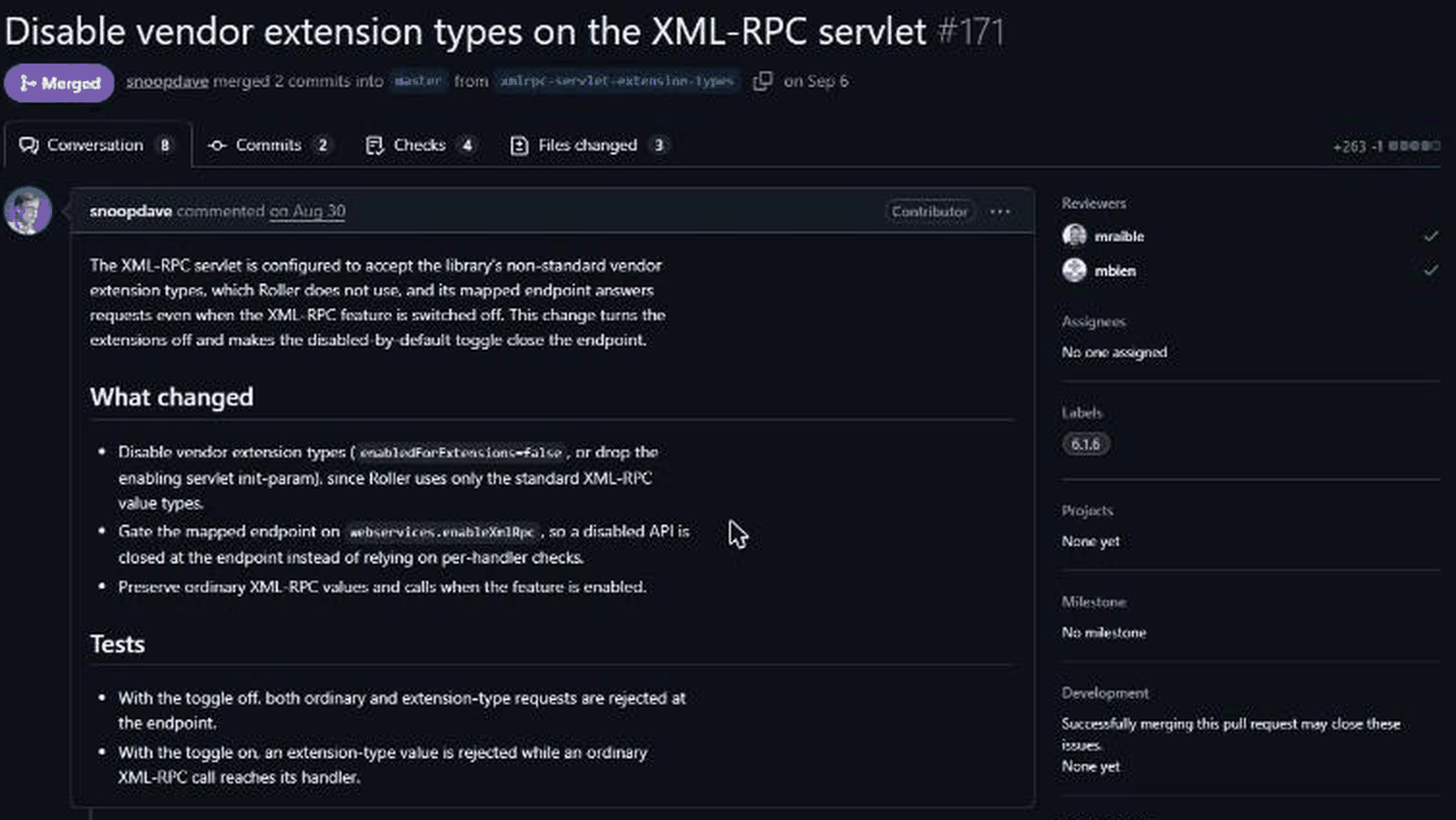
The public repository shows the change. Pull request #171, titled “Disable vendor extension types on the XML-RPC servlet,” was opened by the contributor snoopdave on August 30, 2026, labelled for the 6.1.6 release, approved by another contributor on August 31, and merged on September 6 as shown on the page (the GitHub API timestamp is September 5 UTC). It changes three files, with 263 lines added and one removed. According to its description it does three things: it turns the vendor extension types off (the “enabledForExtensions” setting), since Roller uses only the standard XML-RPC value types; it gates the mapped endpoint on the webservices.enableXmlRpc setting, so a disabled API is closed at the endpoint and not left to per-handler checks; and it preserves ordinary XML-RPC values and calls when the feature is enabled. Its tests check that, with the feature off, both ordinary and extension-type requests are rejected at the endpoint, and that, with it on, an extension-type value is rejected while an ordinary call still reaches its handler.
Two points follow. The code fix was merged about 75 days before CISA listed the flaw (September 6 to November 20, ours), and the fix reached users in version 6.1.6. We could not confirm the release date of 6.1.6: the GitHub mirror’s releases page lists only older releases, and the project’s own download page is the place to check. And because the pull request was public for weeks, anyone reading it could see the weakness it closed, which is a common reason to patch quickly once a fix is public.
The workaround, in the project’s terms
For users who cannot upgrade at once, the CVE record gives two options, both followed by a restart of Roller:
- Set the “enabledForExtensions” option to false in the WEB-INF/web.xml file, or
- Remove the XML-RPC servlet mapping, the path ending in /roller-services/xmlrpc, from the same file.
The record is explicit that turning XML-RPC off in the admin UI “is not enough” for older versions. If you do not use XML-RPC clients (older blog editors and some automation tools use it), removing the mapping also removes the attack surface. After upgrading to 6.1.6 or later, check the configuration again: if you added workarounds, keep them only if you understand why.
Timeline
| Date (2026) | Event | Source |
|---|---|---|
| August 30 | Pull request #171 opened for the 6.1.6 release | GitHub |
| August 31 | Pull request approved | GitHub |
| September 5 to 6 | Pull request merged to master | GitHub |
| Before November 20 | CVE-2026-82384 (Roller 6.1.5) and CVE-2026-129448 (4.0.0 to 6.1.4) are published; the latter says the flaw is actively exploited | NVD |
| November 20 | CISA adds CVE-2026-129448 to KEV, with a November 23 due date | CISA KEV data |
We did not find the publication dates of the two CVE records in the NVD pages we read, so we do not list them.
What to do: a practical checklist
- Find your Roller servers. Look for Roller web applications in your servlet containers, including old internal blogs. Check the version shown in the admin interface or in the application’s files.
- Upgrade to 6.1.6 or later. Every version from 4.0.0 to 6.1.5 is covered by the two CVE records.
- If you cannot upgrade today, apply the workaround in web.xml and restart, then confirm the XML-RPC path no longer answers.
- Do not rely on the admin switch. Turning XML-RPC off in the UI does not protect older versions.
- Reduce exposure. If a Roller instance does not need to be public, put it behind a VPN or an allow-list.
- Check for compromise. The CVE record says exploitation is active. Review web server and Roller logs for unexpected requests to the XML-RPC path, look for unfamiliar files or processes on the host, and consider rotating credentials the server held. CISA’s required-action text for November entries refers to forensics triage requirements.
- Run Roller with least privilege, as a dedicated service account with narrow file access.
What we could not confirm
- Who is exploiting the flaw, how widely, and against which deployments: the CVE record says “actively exploited,” CISA lists it, and we found no public attack report.
- The release date of Roller 6.1.6 and where to download it: we confirmed the fix pull request, not the release page.
- The publication dates of the two CVE records.
- The number of Roller servers exposed to the internet.
- Details of the exploit and of the underlying library: we did not test any version and are not describing exploitation.
- CISA’s own catalog page, which we could not open; the KEV facts come from CISA’s GitHub mirror (catalog version 2026.11.23).
Frequently asked questions
What is CVE-2026-129448?
A deserialization of untrusted data vulnerability in Apache Roller’s XML-RPC endpoint that allows an unauthenticated remote attacker to execute arbitrary code, for versions 4.0.0 through 6.1.4. It is the same flaw as CVE-2026-82384, which names version 6.1.5.
Which Apache Roller version fixes it?
6.1.6 or later, which disables the extension types and rejects XML-RPC requests when the feature is disabled.
I disabled XML-RPC in the Roller admin screen. Am I safe?
Not on older versions. The record says the request is deserialized before the setting is checked, so the admin switch is not enough. Upgrade, or apply the web.xml workaround.
Is it being exploited?
The CVE record says the issue is being actively exploited, and CISA added it to the Known Exploited Vulnerabilities catalog on November 20, 2026.
Do I need a password to exploit it?
No. The record describes an unauthenticated remote attacker, because the vulnerable processing happens before authentication.
What is the KEV deadline?
November 23, 2026 for U.S. federal civilian agencies. For everyone else it signals urgency and is not a legal deadline.
Method: details come from the NVD entries for CVE-2026-129448 and CVE-2026-82384, GitHub pull request #171 in apache/roller, and CISA KEV data (catalog version 2026.11.23), all read on November 24, 2026. For how we research, see How We Review Tools.