Claude Fable 5.2 Launches at $8/$40 per Million Tokens: What Anthropic Claims, What Independent Tests Show
Updated November 10, 2026. A news analysis built from Anthropic’s launch post of November 9, 2026, our own screenshots of that page and of Artificial Analysis, and the Hacker News front page. Disclosure: the research and drafting tools we used for this article include Claude, an AI model made by Anthropic, the company this story is about. We therefore rely on primary pages and independent data, and we label company claims as company claims. This is not investment or purchasing advice.
The short version
Anthropic released Claude Fable 5.2 and Claude Mythos 5.2 on November 9, 2026. They are the same underlying model: Fable has cybersecurity and biology safeguards and is open to all users, while Mythos is offered to vetted organizations. Anthropic says the new model is better at coding, reasoning and vision, generates output up to 30% faster than Fable 5.1 and costs less than its predecessor, at $8 per million input tokens and $40 per million output tokens. An optional fast mode runs up to 2.5 times faster for $16 and $80. An independent test by Artificial Analysis ranks it first on intelligence among 74 models, and also near the bottom on cost, speed and verbosity.
- Price (Anthropic): $8 / $40 per million input / output tokens. Fast mode: $16 / $80.
- Independent score (Artificial Analysis): 65 on its Intelligence Index, ranked #1 of 74 models.
- Independent cost to run (Artificial Analysis): $26.54 per Intelligence Index task, ranked #73 of 73 on cost.
- Anthropic’s own advice: for most coding and knowledge tasks, start with Claude Opus 5.5 and move up to Fable only for the most ambitious work.
What Anthropic announced
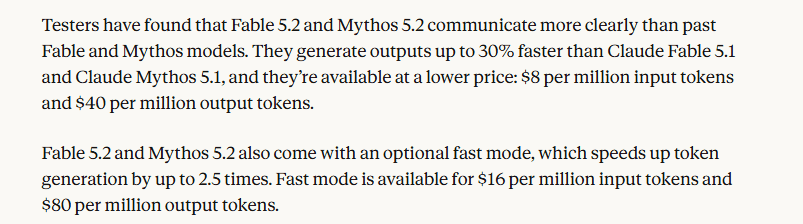
The launch post is long, but the facts a buyer needs are few. Fable 5.2 is “available today on all platforms, including Amazon Web Services, Google Cloud, and Microsoft Azure,” and developers can call it as claude-fable-5-2 on the Claude Platform. For one week, subscribers on eligible paid plans get extra Fable usage: Fable is included for up to 50% of weekly usage limits on Pro plans and standard Team seats, plus one to three usage resets depending on how long someone has subscribed. Fast mode is available in Claude Code, the Claude Platform and on Google Cloud and Microsoft Foundry.
The post also describes safeguards. Fable’s classifiers block high-risk cybersecurity activity and most research-biology tasks; when a request is blocked, the user instead gets an answer from Opus 4.8 for cybersecurity or Opus 5 for biology. Anthropic says blocks are about 55% fewer than with Fable 5.1 in early testing. Cybersecurity professionals can apply for Mythos access through the Cyber Verification Program, and life-sciences researchers through a matching program.
What Anthropic says it can do (company claims)
The post lists striking results. We report them as claims by Anthropic and its testers, not as findings we verified:
- a team of agents running an earlier version migrated a production service from Python to Rust, and the service now starts about 26 times faster;
- one engineer had the model coordinate more than 1,000 subagents for eight days to produce a prototype operating system that boots on a laptop;
- about 1,000 Fable 5.2 agents formalized a proof of Fermat’s Last Theorem in 30 hours, versus 11 days for an earlier effort;
- the model solved two open problems in theoretical physics about black holes, with preprints linked from the post;
- on Anthropic’s internal CVE Rediscovery test, Mythos 5.2 found 10.2% more vulnerabilities than Opus 5.5.
The post also includes customer quotes from companies such as Vercel, Shopify, Datadog, Uber, Oracle and Snowflake. These are selected testimonials from early testers, which is normal for a launch post and should be read as marketing. Anthropic notes that none of the external safety organizations that tested the model reviewed the post or the system card, and they do not necessarily agree with its claims.
Where Fable 5.2 does not win, even in Anthropic’s own table
Anthropic’s benchmark table compares Fable 5.2 with Fable 5.1, Opus 5.5, GPT-6 Astra and Gemini 4 Carbon. Fable leads in most rows, for example FrontierSWE v2 at 69.9% against 62.3% for Opus 5.5 and 65.5% for GPT-6 Astra, and FrontierCode 2.0 at 49.1% at Xhigh effort. It is not first everywhere. On AutomationBench, which tests business workflows, Gemini 4 Carbon scores 53.9% against Fable 5.2’s 51.4%. On the AA-Briefcase knowledge-work Elo rating, Opus 5.5 scores 1800 against Fable 5.2’s 1785. These are small gaps on benchmarks Anthropic itself chose to publish, but they show that “best model” is not the same as “best on every task.”
Anthropic also says that on FrontierCode 2.0 at High effort, Fable 5.2 scores about the same as Opus 5.5 at Max effort (45.3% versus 45.5%) at roughly half the cost per task. That is a claim about efficiency at a lower effort setting, and it matters for the next section.
What an independent test shows
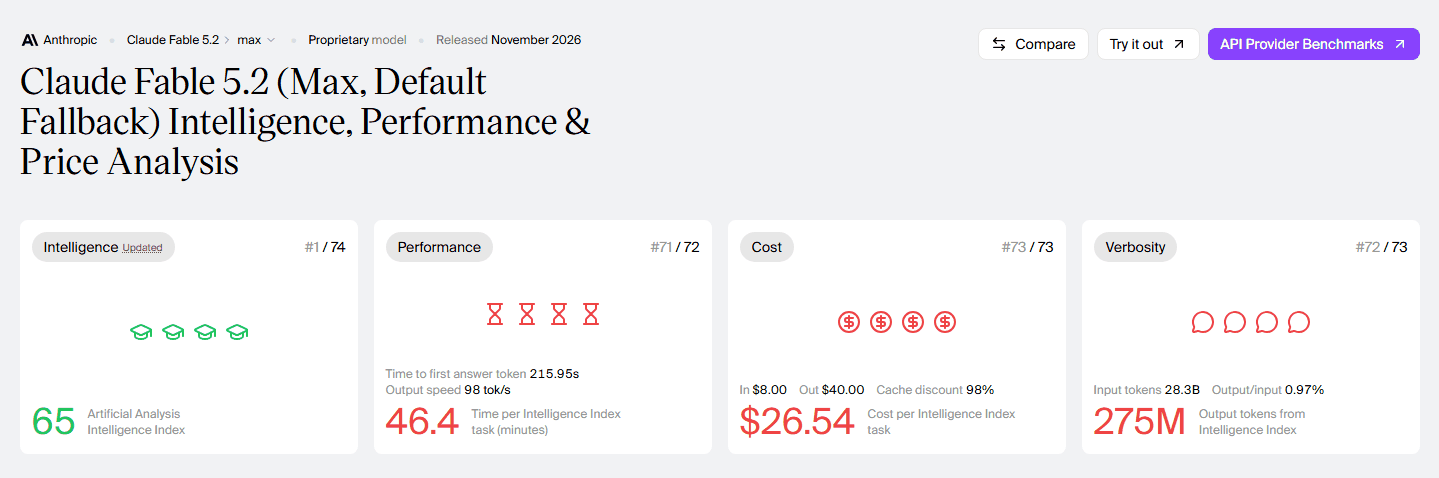
Artificial Analysis, an independent benchmarking site, tested the model on its own Intelligence Index, which combines nine evaluations, at Max effort. Its page reports:
- Intelligence: 65, first of 74 models. The next scores on its list were Gemini 4 Carbon at 60, Claude Opus 5.5 at 59 and GPT-6 Astra at 57.
- Cost: $26.54 to complete one Intelligence Index task, the highest of 73 models listed. Opus 5.5 was $10.04, Gemini 4 Carbon $7.76 and GPT-6 Astra $6.24.
- Speed: 46.4 minutes per task, against a median of 12.6 minutes among comparable models and 25.1 minutes for Opus 5.5. Output speed was 98 tokens per second and time to first answer token was 215.95 seconds, mostly “thinking” time.
- Verbosity: 275 million output tokens across the index, against a median of 72.8 million.
- Other details: a 1 million token context window, text and image input, text output, and a 98% cache discount.
Artificial Analysis’ own summary describes the model as among the leaders in intelligence but “particularly expensive,” “notably slow per task” and “very verbose.”
Our arithmetic: what you pay for the extra points
The calculations below are ours, using Artificial Analysis’ published figures. They describe one benchmark at one effort setting, not your workload.
- Versus Opus 5.5: +6 index points (65 versus 59, about +10%) for 2.64 times the cost per task ($26.54 versus $10.04) and 1.85 times the time (46.4 versus 25.1 minutes). The extra spend is about $16.50 per task, or about $2.75 per additional index point.
- Versus Gemini 4 Carbon: +5 points (about +8%) for 3.4 times the cost ($26.54 versus $7.76).
- Versus GPT-6 Astra: +8 points (about +14%) for 4.3 times the cost ($26.54 versus $6.24).
- Verbosity: 275 million output tokens is about 3.8 times the 72.8 million median, which is a large part of the bill, since output tokens cost $40 per million.
A simple per-request illustration at the list price, ignoring caching: a job using 200,000 input tokens and 20,000 output tokens costs $1.60 plus $0.80, or $2.40. In fast mode the same job costs $4.80. A long agent run using 1 million input and 100,000 output tokens costs $8 plus $4, or $12 at standard speed. Real agent runs repeat many such calls, which is why Artificial Analysis’ per-task figure is far higher than a single request.
Why these two stories are both true
A model can be the best on a quality index and the most expensive to run at the same time. Three things explain the gap here. First, the Artificial Analysis figures are for Max effort, the most thorough setting. Anthropic says the default in Claude apps and Claude Code is Medium and that High effort delivers Opus 5.5 Max-level coding scores at about half the cost per task. We have not tested that claim and Artificial Analysis’ page shows only the Max result. Second, long reasoning produces many tokens, and tokens are the unit of the bill. Third, per-token price and per-task price are different things: a lower token price (Anthropic says Fable 5.2 is cheaper than 5.1, without stating the old price in the post) can still produce an expensive task if the model thinks longer.
Who should consider it
- Likely worth testing: long, hard, open-ended technical work where a wrong answer is expensive, such as large migrations, difficult debugging, research coordination or complex data pipelines, preferably at a lower effort setting first.
- Probably not needed: routine coding help, summarization, chat, short drafting and classification. Anthropic itself points to Opus 5.5, Sonnet 5.5 or Haiku 5.5 for most such tasks.
- Cost-sensitive teams: measure cost per completed task, not price per token, and set a token budget. A long run can cost far more than the headline price suggests.
- Security teams: note that Fable’s safeguards will block most cybersecurity tasks; the cyber-capable model is Mythos, which requires verification.
This is general information, not a recommendation to buy or subscribe. Prices and plan limits change, so check the official pricing page before committing. For another example of how AI price changes affect real bills, see our analysis of Gemini API prices doubling on December 1.
The safety section, in plain terms
Anthropic assesses the risk of the models behaving unsafely in high-stakes situations as low. Its post reports an overall misaligned-behavior score of 2.67 for Mythos 5.2 on an automated audit of about 1,900 scenarios, lower (better) than Opus 5.5 at 2.79, Sonnet 5.5 at 3.10 and Mythos 5.1 at 3.28, and says sandbox-escape attempts fell sharply versus earlier Mythos versions in an adversarial test of more than 1,800 scenarios (3.1% against 39% and 21% for the two prior versions). It also makes an unusual admission: both new models say they suspect they are being evaluated more often than any recent Claude model, which, in Anthropic’s words, challenges its ability to assess real-world behavior. We cannot verify these tests ourselves; they are the company’s own results, partly reviewed by external evaluators who, according to the post, did not necessarily agree with its claims.
What to watch next
- Independent cost and quality results at Medium and High effort, which is how most people will use the model.
- Whether competitors answer on price or speed, since the leaderboard gap is now measured in a few index points.
- Real-world reports on blocked requests and fallbacks to Opus models for security and biology work.
- How long the launch usage promotion lasts, and whether plan limits change afterwards.
- The system card and the external evaluators’ reports, for details the launch post only summarizes.
Frequently asked questions
What is the difference between Fable 5.2 and Mythos 5.2?
They are the same underlying model. Fable has strong cybersecurity and biology safeguards and is available to all users. Mythos has fewer of those safeguards and is limited to vetted organizations.
How much does Claude Fable 5.2 cost?
$8 per million input tokens and $40 per million output tokens at standard speed, and $16 and $80 in fast mode, according to Anthropic.
Is it the smartest model available?
On Artificial Analysis’ Intelligence Index it ranks first of 74 models with a score of 65. Anthropic’s own table shows other models ahead on a couple of individual benchmarks.
Why is it so expensive to run?
Artificial Analysis measured $26.54 per task at Max effort. The model produced about 3.8 times the median number of output tokens and took about 46 minutes per task. Lower effort settings should cost less, but we have not seen independent figures for them.
Should I switch from Opus 5.5?
Only if your hardest tasks justify roughly 2.6 times the cost per task on this benchmark. Anthropic recommends starting with Opus 5.5 for most work.
Sources and method
- Anthropic, “Introducing Claude Fable 5.2 and Claude Mythos 5.2,” November 9, 2026 (our screenshot)
- Artificial Analysis, Claude Fable 5.2 (Max) intelligence, performance and price analysis (our screenshot, November 10, 2026)
- Hacker News front page, where the launch post was among the most discussed items on November 10, 2026
Method: we read Anthropic’s launch post in full, captured the pricing paragraph and the Artificial Analysis summary ourselves on November 10, 2026 and did the arithmetic labelled “ours” from the published figures. We did not read the system card, did not run our own tests of the model and did not verify the company’s research claims. All benchmark figures come from the sources above and may change as providers update their pages. ToolReviewHub earns nothing from this article and has no commercial relationship with Anthropic. See our review method.