Gemini 4 Hydrogen: Price, Dec 1 and Jan 1 Changes, What to Check
Updated November 13, 2026. A news analysis built from Google’s own announcement post “Introducing Gemini 4 Hydrogen” (November 12, 2026), the Gemini Developer API pricing page, our own screenshots of those pages, and the Hacker News front page. Disclosure: the research and drafting tools we use for these articles include Claude, an AI model made by Anthropic, which is a competitor of Google in this market. For that reason we rely on Google’s own pages, quote only short phrases, and label every number we compute as ours. We did not run any benchmark and did not call the model ourselves. This is not investment, legal or purchasing advice; check your own bill and your own tests.
The short version
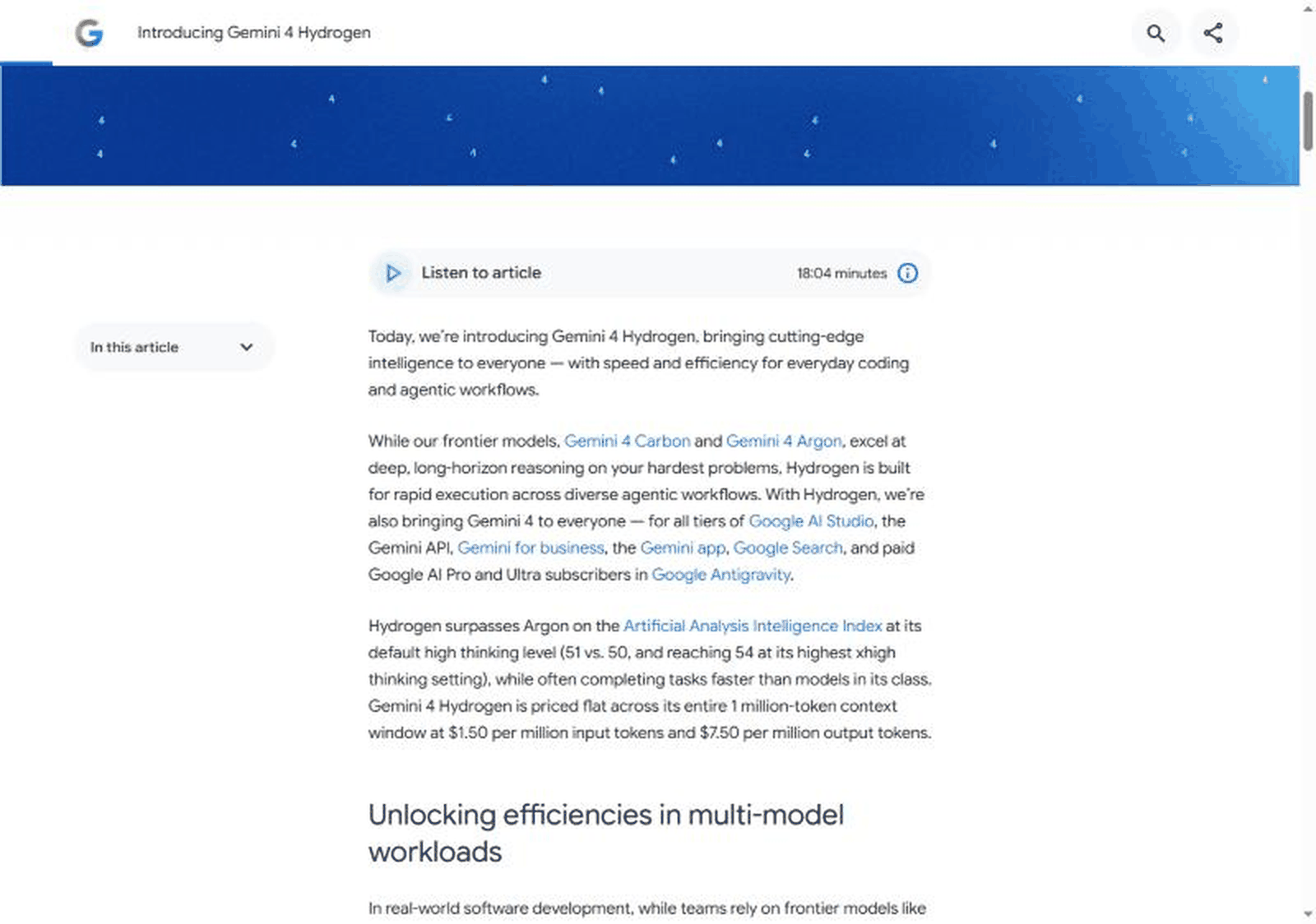
On November 12, 2026, Google announced Gemini 4 Hydrogen, a model it describes as built “for rapid execution across diverse agentic workflows” and for everyday coding. It sits below two other Gemini 4 models that Google calls its frontier models, Carbon and Argon. The two numbers most readers will care about are on the announcement page and the pricing page: Hydrogen costs $1.50 per million input tokens and $7.50 per million output tokens, flat across its 1 million-token context window. And the pricing page shows two price changes that matter just as much: Gemini 4 Carbon and Argon double on December 1, 2026, and Gemini 3.8 Flash doubles on January 1, 2027.
So the headline is not just a new model. It is a new price point that lines up with where Google’s cheaper tier is going. If you run workloads on the Gemini API, the practical question is whether Hydrogen replaces 3.8 Flash in your stack, and when.
Timeline
- November 12, 2026: Google publishes the announcement, written by Koray Kavukcuoglu (SVP, Google DeepMind and Chief AI Architect). The same day a second Google page about Hydrogen in Google Antigravity appears, and the announcement reaches the Hacker News front page (469 points when we checked).
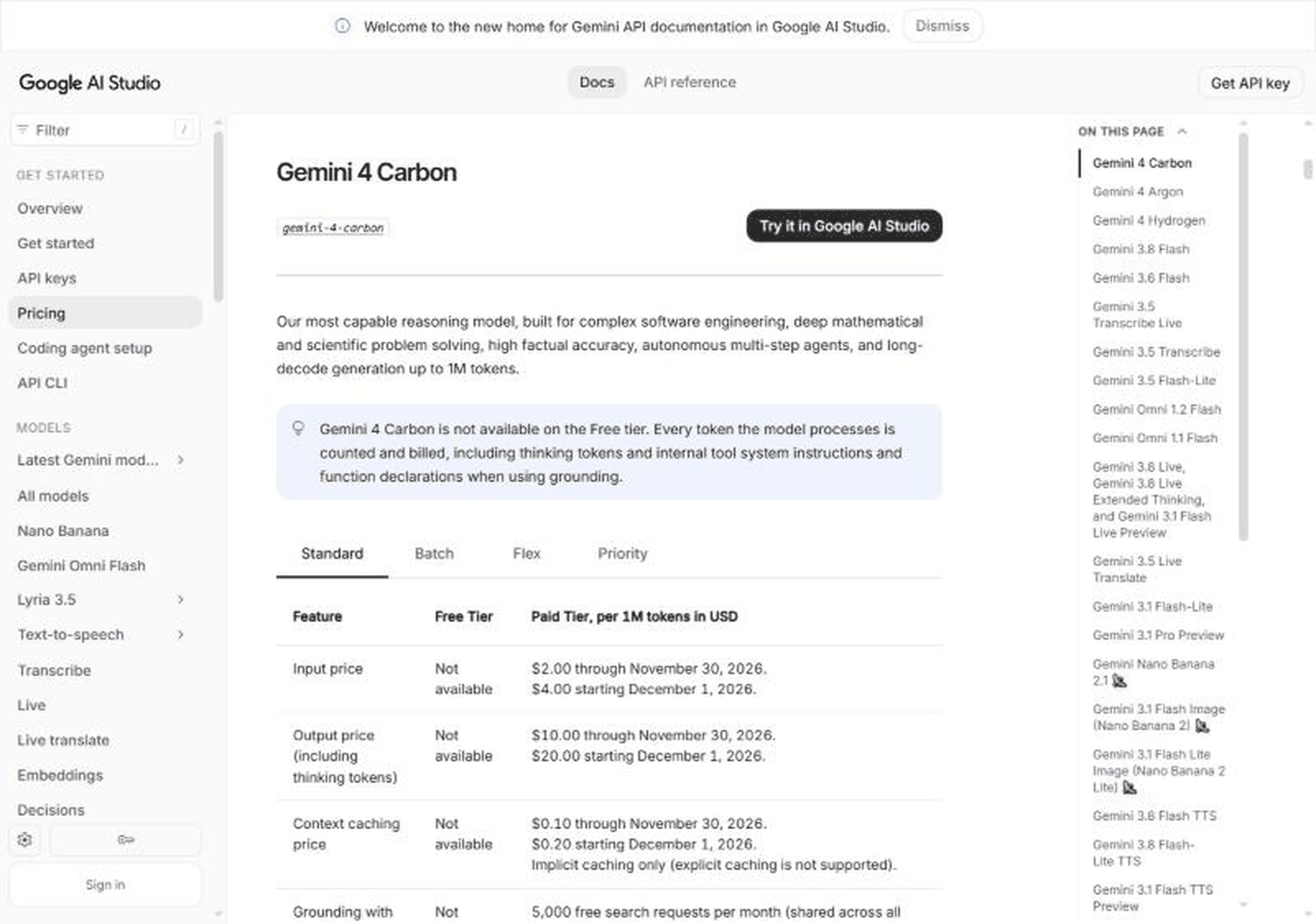
- November 30, 2026: last day of the current Standard price for Gemini 4 Carbon and Argon, which the pricing page lists as $2.00 input and $10.00 output per million tokens.
- December 1, 2026: per the pricing page, Carbon and Argon rise to $4.00 and $20.00. The same page lists automatic routing of the deprecated gemini-2.5-pro to Gemini 3.8 Flash and of gemini-2.5-flash to Gemini 3.5 Flash-Lite on that date.
- December 31, 2026: last day of the current Standard price for Gemini 3.8 Flash, $0.75 input and $3.75 output.
- January 1, 2027: Gemini 3.8 Flash moves to $1.50 input and $7.50 output, the same as Hydrogen.
What Google’s announcement says
The post positions Hydrogen as the fast, efficient member of the family. Google says Carbon and Argon “excel at deep, long-horizon reasoning on your hardest problems”, while Hydrogen is for speed on everyday coding and agent workflows, either on its own or paired with the larger models. It says Hydrogen is available to all tiers of Google AI Studio, the Gemini API, Gemini for business, the Gemini app and Google Search, and to paid Google AI Pro and Ultra subscribers in Google Antigravity. The post also lists Gemini in Google Sheets for eligible business subscriptions, and for Pro and Ultra subscribers.
The performance claims in the post are all Google’s own, and we list them so you can test them rather than take them on trust:
- On the Artificial Analysis Intelligence Index, Hydrogen scores 51 at its default high thinking level against 50 for Argon, and 54 at its highest “xhigh” setting.
- Against Gemini 3.8 Flash, Google says Hydrogen finishes tasks 2.5 times faster at the default setting, more than triples a Terminal-Bench 4.1 score (57% against 18.2%) and cuts fabricated claims by more than 5 times.
- In early partner testing on large repositories, Google reports runs 2x to 2.8x faster with 12% to 23% fewer tokens than 3.8 Flash.
- A new Orchestrator feature in Google Antigravity switches between models such as Carbon and Hydrogen in one session; on Terminal-Bench 4.0, Google says it reached near-Carbon success while using on average 24% less quota and finishing 19% faster.
- Hydrogen has four thinking levels, low, medium, high (the default) and a new xhigh.
- On safety, Google reports reductions of up to 81% in overreach and up to 79% in under-service in agentic tasks, a 96.7% score on its internal honesty evaluation, and 99.9% chain-of-thought legibility across more than 200,000 audited turns.
What the pricing page shows
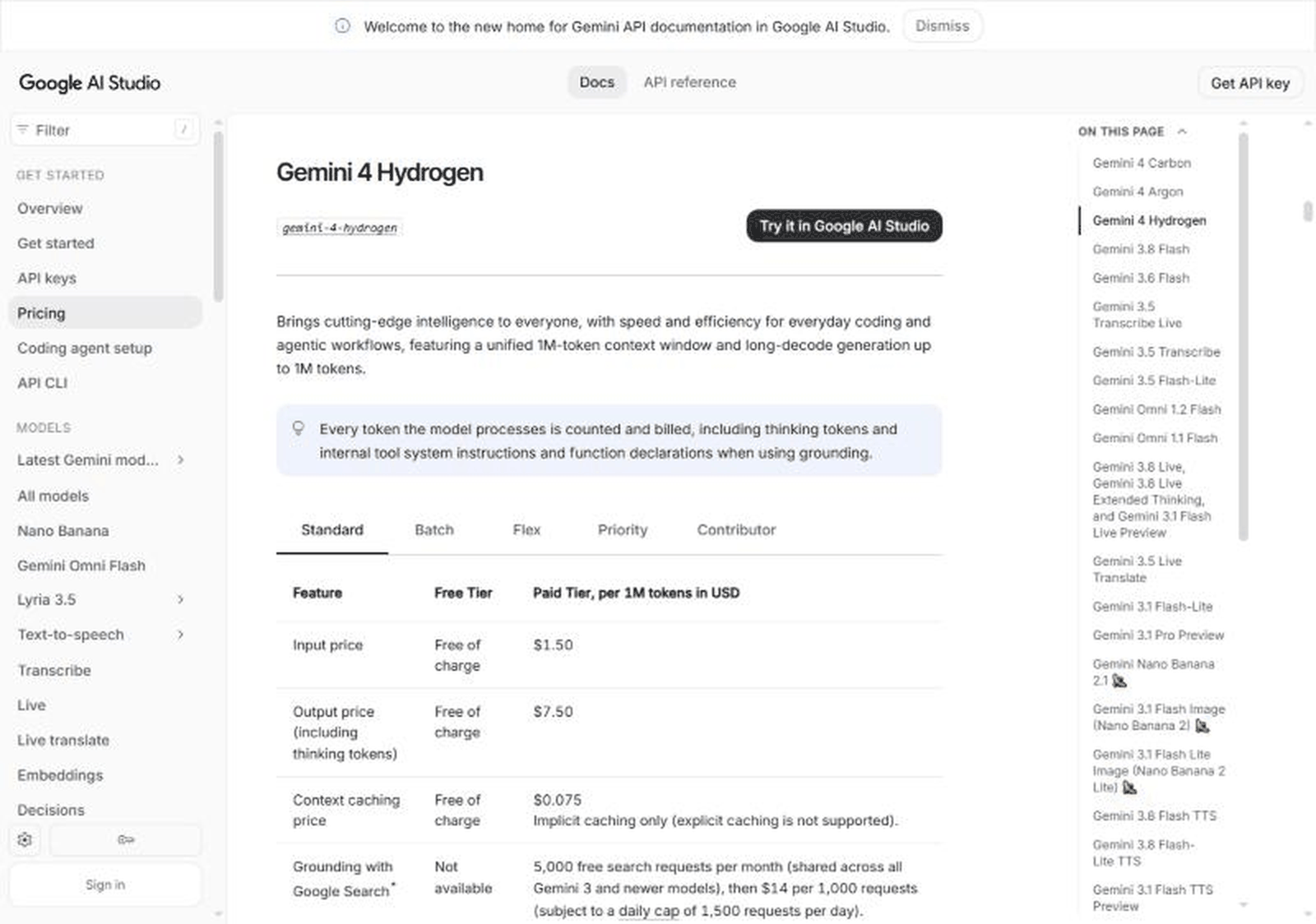
The Hydrogen section of the Gemini Developer API pricing page matches the announcement. On the Standard tab the paid tier is $1.50 per million input tokens, $7.50 per million output tokens (including thinking tokens) and $0.075 for context caching, with implicit caching only. The page says explicitly that every token the model processes is counted and billed, including thinking tokens and the internal tool and function instructions when you use grounding. The tabs also list Batch at $0.75 and $3.75, Flex at $0.75 and $3.75, Priority at $2.70 and $13.50, and a Contributor tab at $0.75 and $3.75, which we did not investigate.
Three details from the page change the calculation:
- The free tier. The Standard table shows “Free of charge” for Hydrogen on the Free Tier, but the “Used to improve our products” row says Yes for the free tier and No for the paid tier. Free here means your content can be used by Google. Carbon and Argon are not available on the free tier at all.
- Search grounding. The paid tier includes 5,000 free search requests per month, shared across all Gemini 3 and newer models, then $14 per 1,000 requests, with a default cap of 1,500 requests per day per project.
- Timed prices on neighbours. The Carbon and Argon rows read “$2.00 through November 30, 2026” and “$4.00 starting December 1, 2026” for input, and $10.00 then $20.00 for output. Gemini 3.8 Flash reads $0.75 through December 31, 2026 and $1.50 starting January 1, 2027 for input, and $3.75 then $7.50 for output.
Our own arithmetic (labelled as ours)
These figures are our own calculations from the published prices. They assume the Standard paid tier, no caching and no search grounding. A real bill depends on your token mix.
| Comparison (ours) | Input | Output |
|---|---|---|
| Hydrogen against Gemini 3.8 Flash today ($1.50 / $0.75 and $7.50 / $3.75) | 2.0 times | 2.0 times |
| Hydrogen against 3.8 Flash from January 1, 2027 | Same price | Same price |
| Hydrogen against Carbon or Argon until November 30 ($1.50 / $2.00 and $7.50 / $10.00) | 75% of the price | 75% of the price |
| Hydrogen against Carbon or Argon from December 1 ($1.50 / $4.00 and $7.50 / $20.00) | 37.5% of the price | 37.5% of the price |
| Google’s Terminal-Bench 4.1 score, 57 divided by 18.2 | About 3.13 times | |
A worked example: a job that sends 1 million input tokens and receives 200,000 output tokens. Our arithmetic gives, per job: Hydrogen Standard $3.00 (1.50 plus 0.2 times 7.50), Hydrogen Batch $1.50, Gemini 3.8 Flash today $1.50, 3.8 Flash from January 1, 2027 $3.00, Carbon or Argon until November 30 $4.00, and Carbon or Argon from December 1 $8.00.
One more calculation, because the speed claim and the price claim pull in opposite directions. If Hydrogen costs twice as much per token as today’s 3.8 Flash but uses 12% to 23% fewer tokens, as Google reports for some partners, the cost of the same task would be about 1.54 to 1.76 times higher than on 3.8 Flash at today’s price (2 times 0.77 and 2 times 0.88). That assumes the token savings apply to your workload, which you have to measure. From January 1, 2027, when the per-token prices are equal, the same savings would make Hydrogen cheaper per task. The time from today to the two price dates is 18 days to December 1 and 49 days to January 1.
Claimed versus what we could verify
| Claim | Source | Our status |
|---|---|---|
| Hydrogen costs $1.50 input and $7.50 output per million tokens | Announcement and pricing page | Verified on both pages (screenshots above) |
| Carbon and Argon rise to $4.00 and $20.00 on December 1, 2026 | Pricing page | Verified on the Carbon section; the Argon section lists the same Standard prices |
| Gemini 3.8 Flash rises to $1.50 and $7.50 on January 1, 2027 | Pricing page | Verified in the page’s markdown text; we did not capture a screenshot of that section |
| Hydrogen is available to all tiers across AI Studio, the Gemini API, the app and Search | Announcement | Stated by Google; we did not test each surface |
| Intelligence Index 51 against Argon’s 50 | Announcement | Google’s statement; we did not check the third-party index |
| 2.5 times faster and 3.13 times the Terminal-Bench score of 3.8 Flash | Announcement | Vendor benchmark; not independently reproduced |
| 12% to 23% fewer tokens and 2x to 2.8x faster in partner tests | Announcement | Vendor-reported partner results; not reproduced |
| Orchestrator uses 24% less quota and is 19% faster | Announcement | Vendor benchmark on one test set; not reproduced |
| Safety figures such as 96.7% honesty and 99.9% legibility | Announcement | Vendor internal evaluations; not independently checked |
Who is actually affected
Teams that call Gemini through the API and use 3.8 Flash or 3.6 Flash are the most affected, because Hydrogen is the model Google positions as the migration target and because both the new price and the January price change land in the next seven weeks. Teams that use Carbon or Argon for hard reasoning have a nearer deadline, since the December 1 price doubling applies to them first. People who only use the Gemini app or Google Search do not pay per token, but Google says Hydrogen is rolling out in those places too, so answers may change. Anyone still calling gemini-2.5-pro or gemini-2.5-flash should read the deprecation notices on the pricing page: the page says requests will be routed to other models on December 1, 2026, at those models’ rates.
Why this one is getting attention
Three things are visible on the pages themselves. A cheaper tier that claims to beat the second frontier model on a public index. A price that, on January 1, will be the same as the existing Flash model. And a calendar of price changes in the next two months. If you are choosing between model families, our earlier note on another Google developer launch, Gemini Decisions API: price, limits and a developer checklist, covers how to read a pricing page before you commit. For a different kind of developer-tool change that also needs a careful read of the primary source, see GitHub Actions lockfiles: what to check.
Checklist for developers and teams
- List every Gemini model ID your code calls, including scripts, notebooks and no-code tools. Look for gemini-2.5-pro and gemini-2.5-flash, which the pricing page says will be re-routed on December 1.
- Run your own evaluation set on gemini-4-hydrogen before you switch. The benchmark numbers in the announcement are Google’s, not yours.
- Measure tokens per task, not only price per token. Thinking tokens are billed as output, and the page says all tokens processed are counted.
- Test all four thinking levels. Low, medium, high and xhigh trade quality, speed and cost.
- Put non-urgent jobs on Batch or Flex, which the pricing page lists at half the Standard rate for Hydrogen.
- Check search grounding. After 5,000 free requests per month the page lists $14 per 1,000, with a daily cap of 1,500 requests per project.
- If you use the free tier, remember the page says content on the free tier may be used to improve Google’s products. Do not send confidential data there.
- If you rely on Carbon or Argon, decide before December 1 whether the doubled price is still worth it, and set a budget alert.
- If you use 3.8 Flash, plan for January 1, 2027, when its price rises to Hydrogen’s level.
- Re-read the pricing page and the terms before any large commitment. Pages change.
What to watch next
- Independent benchmark results and the Artificial Analysis page itself, to see whether the index scores quoted by Google hold.
- Whether the December 1 Carbon and Argon price change is revised or extended.
- Real-world reports on tokens per task for Hydrogen at each thinking level, which will decide whether it is cheaper in practice.
- Rate limits and any changes to the free tier terms.
Frequently asked questions
What is Gemini 4 Hydrogen
According to Google’s announcement, it is a Gemini 4 model built for speed and efficiency in everyday coding and agentic workflows, with a 1 million-token context window and up to 1 million output tokens. Google positions it below Carbon and Argon, its frontier models.
How much does it cost
On the Standard paid tier, $1.50 per million input tokens and $7.50 per million output tokens, flat across the full context window, per the announcement and the pricing page. Batch and Flex list at $0.75 and $3.75.
Is there a free tier
The pricing page shows Hydrogen as free of charge on the free tier, with the note that free-tier content may be used to improve Google’s products. Check the current limits on the page.
Is it better than Argon
Google says it scores 51 against Argon’s 50 on one index at the default setting. That is one benchmark chosen by the vendor. Argon is described as a frontier model for deep, long-horizon reasoning, so the two are designed for different jobs.
Should I switch from Gemini 3.8 Flash now
We cannot tell you that. Today Hydrogen costs twice as much per token as 3.8 Flash and from January 1, 2027 the same. Whether it is cheaper per task depends on the token savings and speed you measure yourself.
Does this change Google Search
Google says Hydrogen is upgrading Search to understand multi-part and typo-laden queries and to show more visual responses and a wider range of links. We did not test any change in results.
Sources and method
- Google, “Introducing Gemini 4 Hydrogen for Agentic Workflows”, blog.google, November 12, 2026. Read November 13, 2026.
- Gemini Developer API pricing page in Google AI Studio documentation, including the Gemini 4 Hydrogen, Carbon and Argon sections and the deprecation notices. Read November 13, 2026, rendered and in its markdown version.
- Hacker News front page, November 13, 2026, for discussion context.
Method: we opened each page in a clean browser window without signing in, read it in full and captured the three screenshots above. We did not accept any banner and we quote only short phrases. We did not run any benchmark or API call. Arithmetic rows are our own.
Risk note
This is a summary of public pages that can change after we read them. Benchmarks and partner results are Google’s own and we did not reproduce them. Prices and dates may differ for your account, region or enterprise agreement. Nothing here is financial, legal or purchasing advice. Check your own bill, your own tests and Google’s current terms before you change a production system.