MEXC Order Now Official: FinCEN’s Ban Takes Effect December 10, and the Federal Register Text Says $16.7 Billion
Updated November 11, 2026. A follow-up to our November 10 analysis of the MEXC order. This article uses the order as published in the Federal Register on November 10, 2026 (91 FR 72420), Treasury’s press release, our own screenshots of DefiLlama and Treasury, and trade reporting. It is general information, not legal or financial advice. Disclosure: our MEXC review contains an affiliate link, and we do not present MEXC as recommended while this is unresolved.
The short version
The U.S. Financial Crimes Enforcement Network (FinCEN) published its order against MEXC Global in the Federal Register on November 10, 2026, which fixes the date everyone was waiting for. The order takes effect on December 10, 2026, “with no cessation date,” meaning it has no end date. From then, a “covered financial institution” is prohibited from “engaging in any transmittal of funds from or to MEXC Global.” The Federal Register text also gives larger and more detailed numbers than the press release did, including a headline of USD 16.7 billion rather than “at least $16 billion.” Meanwhile, public flow data shows MEXC losing more money each day since the announcement.
- Effective date: December 10, 2026, 30 days after publication. That is 29 days from November 11.
- Legal basis: section 9714(a) of the Combating Russian Money Laundering Act, with MEXC found to be “of primary money laundering concern in connection with Russian illicit finance.”
- Scope: the order covers MEXC Global and its subsidiaries, branches, offices and successors outside the United States, and defines “transmittals of funds” as “the sending and receiving of funds, including CVC” (convertible virtual currency, i.e. crypto).
- Flexibility: FinCEN “reserves authority to impose conditions on certain transmittals of funds from or to MEXC Global and to grant appropriate exemptions.”
- Market data: DefiLlama shows MEXC with $4.08 billion in tracked assets and a 7-day net outflow of $340.8 million.
What the Federal Register text adds
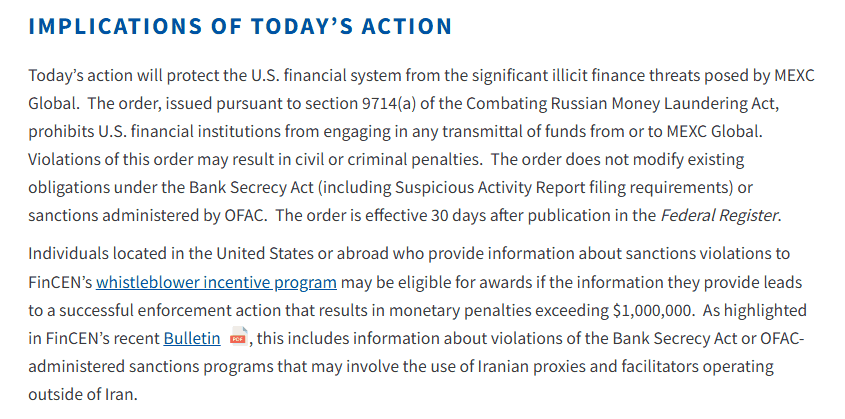
The press release was a summary. The order itself, published as 91 FR 72420 and spread over eight pages, contains the findings. We read the full text as published by the Government Publishing Office. Compared with the press release, notable details include:
- A bigger and more precise headline. FinCEN assesses that between May 2021 and May 2026 MEXC Global “facilitated the movement of USD 16.7 billion in funds connected to Russian illicit finance and other illicit activities,” and later describes “at least USD 16.7 billion in likely illicit activity.” The press release said “at least $16 billion.” Our arithmetic: 16.7 divided by 16 is about 4% higher. Neither figure says all of that money was proven criminal; the order itself uses the word “likely.”
- Russia: nearly USD 1.5 billion in direct and indirect exposure linked to Russian sanctions evasion, including USD 232 million in direct transactions with entities sanctioned by the U.S., EU or UK. Between May 2018 and July 2026 MEXC also directly handled transactions cumulatively worth “over USD 13 billion” with at least four high-risk exchangers sanctioned by the UK. About USD 2.9 billion went to Russian and other exchangers that allegedly collect no customer identification, and USD 8.5 million involved Russian darknet markets.
- Iran: nearly USD 2 billion connected to identified Iranian actors or known or suspected terrorist groups, including approximately USD 1.87 billion in exposure to Iran, and over USD 1 billion in direct transactions with more than 40 Iranian exchangers. About USD 22 million went to Iran’s central bank and the IRGC.
- Cybercrime: at least USD 1.99 billion in funds from or to illicit cyber actors, an average of more than USD 1 million a day, and more than USD 37.9 million in suspected ransomware payments between January 2022 and July 2024 with exposure to over 125 ransomware variants. One high-use ransomware-related deposit address received over USD 1.17 million.
- Named entities: the order lists affiliated entities in Seychelles, Estonia, Switzerland and the United Kingdom, and says the coverage “includes, but is not limited to” them.
- Legitimate use: FinCEN says it lacks full insight into MEXC’s legitimate activity and “assumes that a portion” is legitimate, but concludes that this is outweighed by the illicit risk.
Our arithmetic: how the categories add up
These are our calculations from the order’s figures, and the order’s categories may overlap, so they cannot simply be added.
- Russia (about $1.5 billion) plus Iran and terror-linked flows (about $2 billion) plus illicit cyber actors ($1.99 billion) is about $5.5 billion, roughly a third of the $16.7 billion headline. The rest is not itemised in the text we searched, and the order does not reconcile the categories to the total.
- $1.99 billion over May 2021 to May 2026 (about 1,826 days) is about $1.09 million a day, consistent with the order’s “more than USD 1 million per day.”
- The “over USD 13 billion” figure covers a longer window (May 2018 to July 2026) and is a cumulative total with high-risk exchangers, not part of the five-year headline. Reading it as additional is a mistake.
- For scale, the order says MEXC processed about USD 1 billion a day by June 2026. Spread over about 1,826 days, $16.7 billion works out to under $10 million a day, but MEXC was smaller in earlier years, so this ratio is only a rough yardstick.
What the order does, in plain terms
- It bars U.S. “covered financial institutions” from sending funds to or receiving funds from MEXC Global. The order defines the term by reference to the “financial institution” definition in 31 CFR 1010.100(t). We did not read that definition, but FinCEN’s usage is broad, and in our reading it can include firms such as banks and money services businesses, which would include U.S. crypto exchanges. Verify with a lawyer if this affects you.
- It covers crypto too. Because “transmittals of funds” includes CVC, the ban is not limited to bank wires. In our reading it can affect withdrawals and deposits between MEXC and U.S.-regulated platforms.
- It does not freeze customer balances or order MEXC to stop operating. The press release and order text we read do not do either.
- It has no end date. The order period is “effective December 10, 2026, with no cessation date.”
- Existing reporting duties remain. It does not modify Bank Secrecy Act or OFAC obligations, and the order notes that willful violations can bring criminal penalties.
What the market data shows
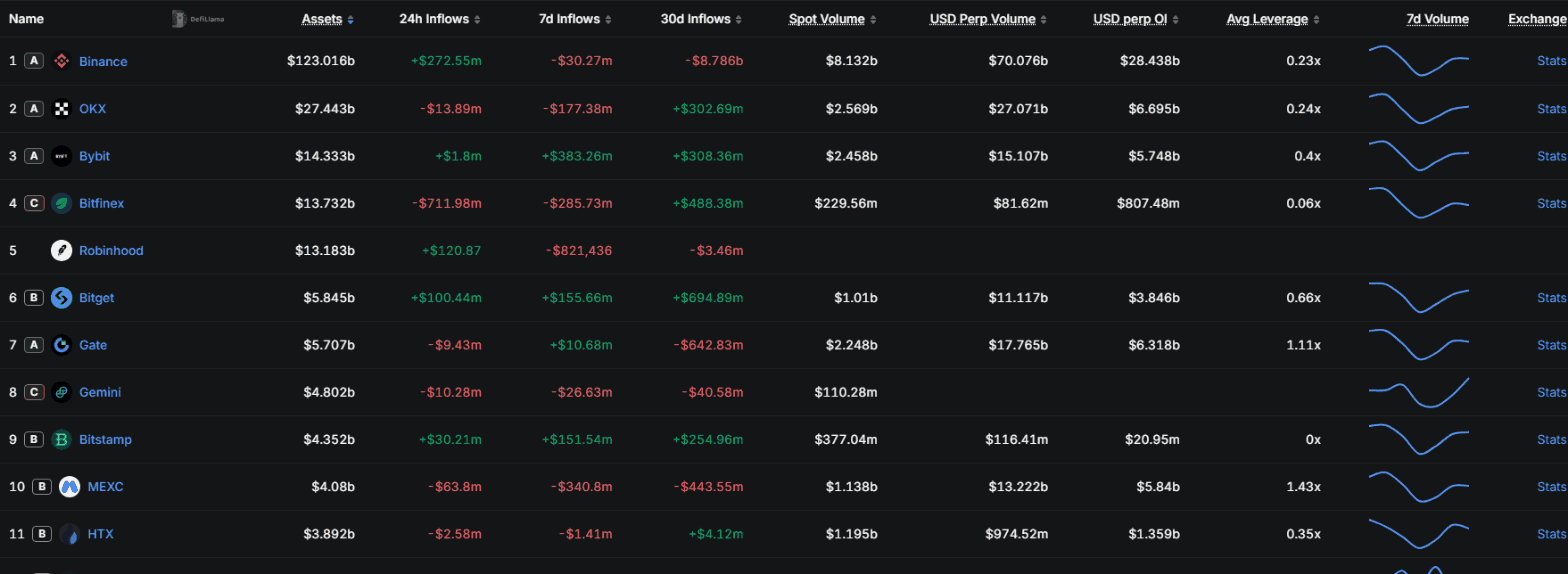
We have now captured the same table three times. The comparison:
- November 10 (our first capture): $4.173 billion in assets, +$6.48 million over 24 hours, -$271.92 million over 7 days, -$371.53 million over 30 days.
- November 11 (first check): $4.162 billion, -$0.2 million over 24 hours, -$277.51 million over 7 days, -$376.49 million over 30 days.
- November 11 (this capture): $4.08 billion, -$63.8 million over 24 hours, -$340.8 million over 7 days, -$443.55 million over 30 days.
Our arithmetic: assets are down about 2.2% from the first capture ($4.173 billion to $4.08 billion). The 7-day outflow grew by about $69 million, around 25% larger, and is about 8.4% of today’s tracked assets. On the same screen, OKX shows -$177.38 million on $27.443 billion (about -0.65%), Binance -$30.27 million on $123.016 billion (about -0.02%), and Bybit and Bitget are in net inflow of roughly +2.7% each. MEXC is the clear outlier. That is a steady drain, not a collapse, and the figures are DefiLlama’s estimates from tracked wallets. Average leverage on MEXC is 1.43x, the highest of the top eleven rows (Gate is next at 1.11x).
What MEXC has said
The latest company statement we saw was reported on November 7: MEXC’s CEO said deposits and withdrawals were running smoothly, that the platform had started an independent review of its anti-money-laundering and sanctions controls and that it intends to engage with FinCEN. We have not seen a published response to the specific figures in the order, and we have not seen a new statement since the Federal Register text appeared. Check MEXC’s official announcements for anything newer.
What this could mean for users (not advice)
- Know your routes. If you move funds between MEXC and a U.S.-based exchange, wallet service or bank, ask that provider how it will treat MEXC after December 10. This is the group the order most directly touches.
- Do not assume a freeze. The order restricts U.S. institutions, not your balance. But indirect effects, such as providers declining MEXC-linked transfers, can come before the date.
- Test small and early. If you plan to withdraw, test a small amount on the network you use, and avoid last-minute rushes around December 10 when providers may be slow.
- Keep records. Download trade and transfer history for tax and disputes.
- Beware of scams. Fake “MEXC migration” and “claim your balance” messages follow headlines like this. Use only the official app and site you already know.
- Do not hold more than you need there. Exchanges are custodians. Unneeded balances are exposed to regulatory and operational risk.
This list is general information, not financial, legal or tax advice, and we do not know your situation or your location’s rules.
What to watch next
- Any FinCEN guidance, conditions or exemptions before December 10, since the order reserves authority for both.
- Statements from U.S. exchanges and payment providers about how they will implement the ban.
- MEXC’s independent review: who is conducting it and whether results are published.
- Whether other jurisdictions follow, including those that already warned about MEXC.
- Daily DefiLlama flows, especially around December 10.
- Further actions under Treasury’s “Operation Economic Outcast,” which the press release says is continuing.
Frequently asked questions
When does the MEXC order take effect?
December 10, 2026, according to the Federal Register notice of November 10, 2026.
Does the order freeze my MEXC funds?
Not in the text we read. It prohibits covered U.S. financial institutions from transmittals of funds to or from MEXC Global. MEXC says it continues to operate.
Why does the order say $16.7 billion when Treasury said $16 billion?
The press release said “at least $16 billion.” The order text gives USD 16.7 billion, and calls it “likely illicit activity.” We could not find a reconciliation between the two phrasings.
Does the order cover crypto?
Yes. It defines transmittals of funds as sending and receiving funds, “including CVC.”
Can the order change before it takes effect?
FinCEN reserves authority to impose conditions and grant exemptions. We have not seen any announced.
Sources and method
- Federal Register, “Imposition of Special Measure Prohibiting the Transmittal of Funds Involving MEXC Global,” 91 FR 72420, November 10, 2026 (FR Doc. 2026-22962)
- U.S. Department of the Treasury, “Operation Economic Outcast Severs MEXC Global’s Access to the U.S. Financial System,” November 6, 2026 (our screenshot)
- DefiLlama, Crypto Exchange Reserves and Inflows (our screenshots, November 10 and 11, 2026)
- ToolReviewHub, our November 10 analysis
Method: we read the Federal Register order text via the Government Publishing Office and the Federal Register’s developer API for the effective date and citation, read the Treasury release, and captured the Treasury page and DefiLlama table ourselves. The Federal Register website’s own pages asked for a human check, which we did not bypass, and our screenshots of the government site were limited by browser problems, so we show the Treasury page instead. We did not read 31 CFR 1010.100(t) or any MEXC filings. Figures labelled “our arithmetic” are our calculations. This is general information, not legal or financial advice. See our review method.