U.S. Treasury Cuts MEXC Off From the American Financial System: What the $16 Billion Allegation Means for Users
Updated November 10, 2026. A news analysis built from the U.S. Treasury press release, our own capture of DefiLlama exchange data, and reports from CoinDesk, Coin Edition and PANews. Nothing here is financial advice.
The short version
On November 6, 2026 the U.S. Treasury’s Financial Crimes Enforcement Network (FinCEN) issued an order that effectively cuts MEXC Global off from the American financial system. Treasury says the exchange facilitated at least $16 billion in illicit transactions between May 2021 and May 2026, including flows linked to Russian and Iranian sanctions evasion. MEXC says its deposits and withdrawals are running normally and that it has opened an independent review of its anti-money-laundering controls. Four days later, the public data we checked shows an exchange that is still operating but has lost roughly 6% of its listed assets in a week.
- Who acted: FinCEN, under section 9714(a) of the Combating Russian Money Laundering Act, as part of what Treasury calls Operation Economic Outcast.
- What it does: bars U.S. financial institutions from transmitting funds to or from MEXC Global. It takes effect 30 days after publication in the Federal Register.
- What Treasury alleges: at least $16 billion in illicit flows, nearly $1.5 billion tied to Russian sanctions evasion and about $1 billion exchanged directly with more than 40 Iranian crypto exchangers.
- What MEXC says: operations are normal, withdrawals are orderly, and it will engage with FinCEN.
- What our data capture shows (November 10): MEXC lists $4.173 billion in assets, with a 7-day net outflow of $271.92 million.
What the Treasury actually announced
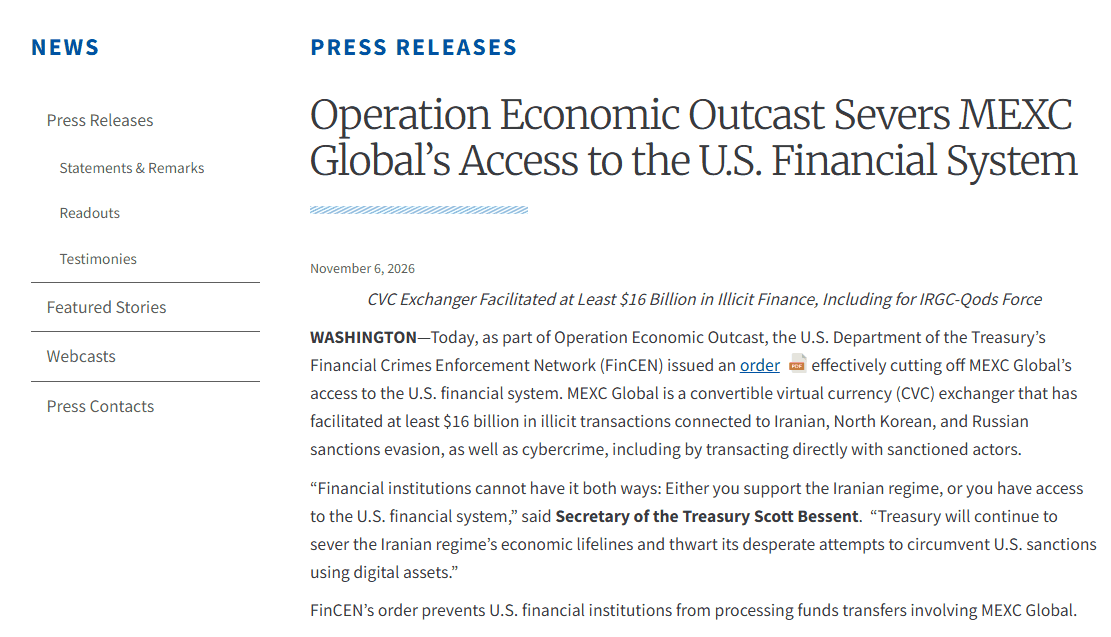
The headline is blunt: an order that is “effectively cutting off MEXC Global’s access to the U.S. financial system.” The press release describes MEXC Global as a convertible virtual currency exchanger founded in 2018 that, as of September 2026, processed more than $1 billion in daily transactions and held roughly $5 billion in reserves. Treasury places it among the 20 largest such platforms in the world, with trading in more than 50 currencies and access to over 3,000 crypto assets and tokenized assets.
Then come the allegations. Treasury says that although MEXC claims to run anti-money-laundering and customer-verification policies, and prohibits users from places such as Iran and North Korea, “severe deficiencies” in those controls let it become a conduit for illicit finance. The release gives a set of numbers for the period from May 2021 to May 2026:
- at least $16 billion in funds connected to sanctions evasion, cybercrime and other illicit activity;
- nearly $1.5 billion linked to Russian sanctions evasion, including $232 million in direct transactions with U.S., EU and UK sanctioned entities;
- continued processing of transactions with the sanctioned Russian exchange Garantex and its successor Grinex as recently as June 2026;
- at least $26 million benefiting the OFAC-sanctioned A7 network and almost $200 million connected to the A7A5 ruble-backed stablecoin;
- about $1 billion sent or received directly with more than 40 identified Iranian crypto exchangers, and about $22 million for the Central Bank of Iran and the Islamic Revolutionary Guard Corps, including its Qods Force.
Secondary coverage adds more detail that we could not find in the press-release text we read. Coin Edition reports $1.99 billion linked to cybercriminals and $37.9 million in ransomware payments from the order itself. We list those figures as reported, not as verified by us.
Our arithmetic: how much of the $16 billion is itemised?
This is our own back-of-envelope reading, not a Treasury figure. In the release text we read, the itemised amounts are about $1.5 billion for Russia and about $1.0 billion for Iranian exchangers, plus $22 million for Iranian state entities. That is roughly $2.5 billion, or about 16% of the $16 billion headline. If the $1.99 billion cybercrime figure reported by Coin Edition is added, the named categories reach about $4.5 billion, or 28%. The remainder is described in general terms (“sanctions evasion, cybercrime, and other illicit activity”) and we could not break it down from public text.
A second sanity check is scale. Treasury says MEXC handles over $1 billion a day. Over a year that would be above $365 billion, so $16 billion across five years is a small share of today’s turnover, about 4% if you use today’s volume as a crude yardstick. MEXC was almost certainly smaller in 2021, so the true share of historical volume could be higher. Neither ratio appears in the release; both are our illustrations and neither proves or disproves anything. What they do show is that a regulator can call an exchange a “primary money laundering concern” without claiming that most of its business is illicit.
What the order does, and what it does not do
- It restricts U.S. financial institutions, not MEXC’s servers. Banks, payment processors and other covered firms may not process funds transfers involving MEXC Global once the order takes effect. The release says the order does not modify existing Bank Secrecy Act duties or OFAC sanctions.
- It is not a freeze of user balances. Nothing in the release orders MEXC to stop withdrawals. Coin Edition makes the same point: the order targets covered U.S. institutions, not customer balances or MEXC’s global operations.
- It has a delayed start. The order takes effect 30 days after Federal Register publication. We did not confirm the publication date, so check federalregister.gov for the exact start.
- It is an administrative order, not a court judgment. Violations of the order can bring civil or criminal penalties for the institutions covered, but MEXC itself has not been convicted of anything in what we read.
CoinDesk framed the move as part of Treasury’s campaign against Iran while noting that the order itself rests on MEXC’s alleged role in Russian illicit finance. That detail matters: the legal basis in the release is the Russia-focused statute, which is why the Russian numbers are the ones Treasury leads with in the “primary money laundering concern” language.
What MEXC says
According to reports on November 7 from PANews (carried by Tapbit) and Coin Edition, MEXC CEO Vugar Usi said that deposit and withdrawal services were continuing smoothly and that the team was helping users complete transactions. Withdrawal volume had risen, he said, but stayed orderly. He also said MEXC takes the concerns in the FinCEN order seriously, intends to engage constructively with FinCEN and has begun an independent review of its AML and sanctions controls. The reports name no outside reviewer and no timeline.
The same reports say the blockchain-analytics firm Elliptic restored MEXC Global to its “exchange” category and removed an earlier special risk classification. That is MEXC’s account of a vendor’s decision as relayed by news outlets, and we did not see an Elliptic statement ourselves. Even if accurate, a vendor label is not an audit and does not answer the Treasury’s specific allegations about sanctioned counterparties. What MEXC has not done, in anything we found, is dispute the dollar figures one by one.
What the money is doing: our DefiLlama capture
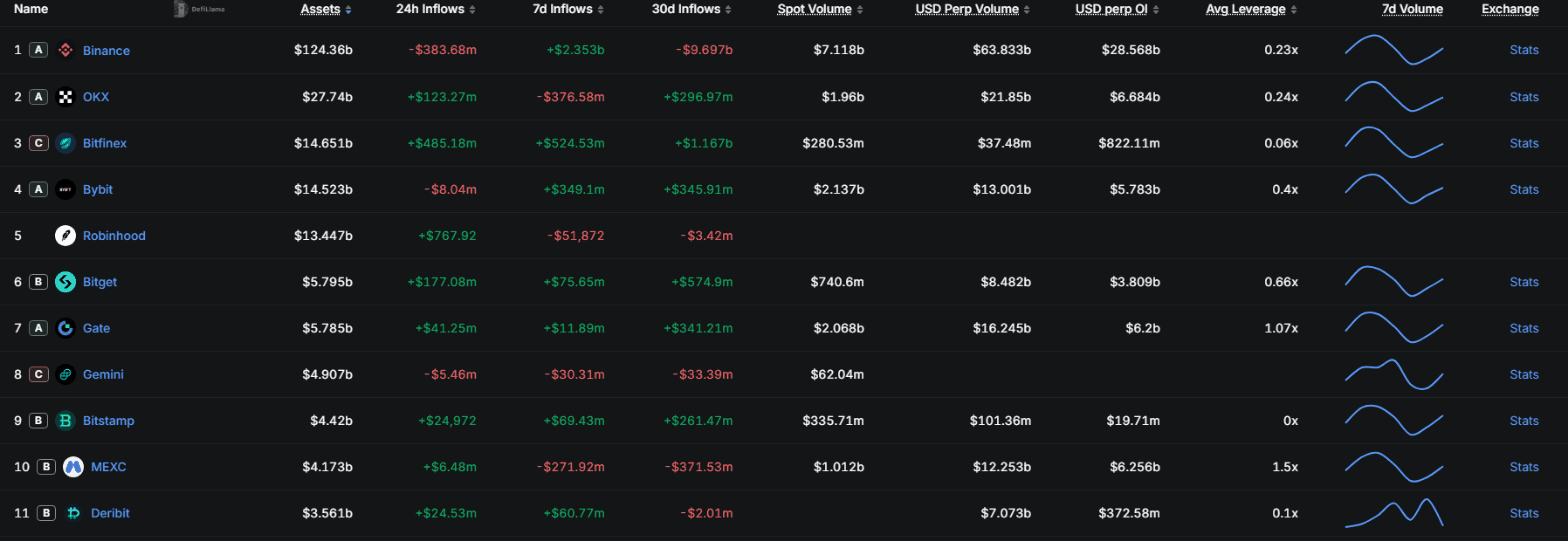
Public flow data is the closest thing to a live “vote” by users. On our capture, MEXC listed $4.173 billion in assets and an average leverage of 1.5x, the highest of the top eleven rows (Gate is next at 1.07x). Net flows were -$271.92 million over seven days and -$371.53 million over thirty. Our arithmetic: $271.92 million is about 6.5% of the $4.173 billion now listed, and about 6.1% of the roughly $4.445 billion that would have been listed before those outflows if prices were unchanged.
For comparison, on the same screen: Binance had +$2.353 billion over seven days on $124.36 billion (about +1.9%), Bybit +$349.1 million on $14.523 billion (about +2.4%), Bitget +$75.65 million on $5.795 billion (about +1.3%) and OKX -$376.58 million on $27.74 billion (about -1.4%). MEXC’s -6.5% is therefore the largest relative seven-day outflow among the large exchanges in our capture, but it is a drain, not a collapse. The 24-hour figure of +$6.48 million suggests the outflow was not accelerating on the day we looked, although a single 24-hour reading proves little.
Two caveats. First, DefiLlama’s numbers are estimates built from tracked on-chain wallets and can shift with price moves and wallet attribution. Second, Treasury’s “approximately $5 billion in reserves” for September and DefiLlama’s $4.17 billion for November use different methods and dates, so the gap between them should not be read as a precise loss. Our earlier coverage of the aftermath of the Binance incident used the same tool; see Binance net outflows hit $15 billion in a week for how we read these tables.
Allegation versus finding: how to read this
A fair reading keeps three layers separate. The first is what a government agency alleges. FinCEN published its reasoning and numbers, and the release is a primary source, but it is an agency’s case, not the result of an adversarial hearing. The second is what the exchange says: operations are normal, a review is under way, a vendor reclassified it. Those are statements by an interested party. The third is what the market data shows: a measurable but moderate outflow. None of the three alone settles whether MEXC is safe for any given user; together they describe a risk that was not visible on November 5 and is now.
It also helps to remember what kind of risk this is. Regulatory cut-offs are different from hacks. In a hack, assets leave the exchange. In a cut-off, the exchange may be fully solvent but lose banking partners, fiat on-ramps and counterparties, which can degrade service over months. The order does not say MEXC lacks the assets it owes users, and we have no evidence that it does. What it does say is that a major government considers its controls inadequate, and that carries operational, legal and reputational consequences that arrive on their own schedule.
Who is most exposed
- Users who fund or cash out through the banking system. Card purchases, bank transfers and wire routes that pass through U.S. institutions are the most likely to be disrupted after the order takes effect. This is our reading, not a Treasury list.
- Traders who rely on MEXC’s long tail of tokens. Illiquid tokens listed mainly on MEXC can gap down if market makers pull back, even if MEXC keeps running.
- Anyone holding a large balance for long periods. Exchanges are custodians. The longer funds sit there, the more of the exchange’s regulatory risk you absorb.
- Counterparties and peers. Reports on November 7 and 8 said users of other exchanges saw delays on deposits from MEXC; we could not verify these and do not treat them as established.
The behaviour angle: why exchange scares feed on themselves
Exchange runs are a coordination problem. Each depositor knows that if everyone withdraws, the exchange will struggle, and that the safest move is to be early. The more outflows are visible, the more rational early withdrawal looks, whether or not the exchange is solvent. That is why a calm, factual communication matters, and why users should be wary of two opposite mistakes: treating an official allegation as proof of insolvency, and treating a CEO’s statement as proof of safety. The sensible response to uncertainty is usually proportionate action rather than panic or denial: reduce what you leave idle, verify withdrawal routes, and keep records.
We saw the same pattern in the days after the Binance incident, when flow data swung widely and commentary ran ahead of the facts. Our Binance hack explainer and Bitcoin market analysis both show how much of the story was in the data rather than the headlines.
A practical checklist for MEXC users (not advice)
- Decide what you actually need on the exchange. Funds you are not trading do not need to sit with any custodian, MEXC included.
- Test a withdrawal. A small withdrawal on the network you use tells you more than any announcement does. Confirm it arrives before moving larger amounts.
- Beware of phishing. Moments like this attract fake “MEXC migration” or “claim your funds” emails and links. Use only the official site and app you already know.
- Keep records. Download trade and transfer history for tax and for any future dispute.
- Do not move funds in a hurry to an unknown platform. Rushing from one risk to a worse one is a common way to lose money. Compare options calmly, for example in our crypto exchange comparison.
- Check the rules where you live. Your local law and your bank’s terms matter more than headlines.
This list is general information. It is not personal financial, legal or tax advice, and we do not know your situation.
What to watch next
- The Federal Register publication, which sets the exact effective date of the order.
- Results or even a named reviewer for MEXC’s independent AML review.
- Whether MEXC publishes an updated proof-of-reserves snapshot, and whether it is verified by a third party.
- Further seven-day net flows on DefiLlama, and any change in banking or payment-partner support for MEXC.
- Whether regulators elsewhere, such as the ones that already warned about MEXC earlier, take new steps.
- Whether other exchanges are named under Operation Economic Outcast; the Treasury release says the campaign continues.
What this means for our MEXC review
We published a MEXC review on November 1 with fees, features, a risk warning and a section on regulatory history. That review contains an affiliate link, which we disclose. Because of this order we have added an update notice to the top of the review and we will not present MEXC as a recommended exchange while the situation is unresolved. Our BingX vs MEXC comparison carries the same notice. Our review method explains how we handle incidents and affiliate links.
Frequently asked questions
Is MEXC frozen or shut down?
Not according to the sources we read. Treasury’s order restricts U.S. financial institutions from transferring funds to or from MEXC Global. MEXC says its deposits and withdrawals continue. Check your own account rather than relying on any single report.
Is my money safe on MEXC?
We cannot tell you that. The order does not allege that MEXC is insolvent, and the data we captured shows an outflow rather than a collapse. But no exchange is risk-free, and a regulator’s finding of weak controls is a reason to hold less there.
Does this affect users outside the United States?
The order applies to U.S. financial institutions. Indirect effects, such as lost banking partners or counterparties, can reach users anywhere. Local regulators may also react.
When does the order take effect?
Thirty days after publication in the Federal Register, according to Treasury. We did not verify the publication date.
Are the $16 billion figures proven?
They are Treasury’s allegations, published in an official release. MEXC has acknowledged the concerns and started a review but, in what we found, has not published a line-by-line rebuttal.
Is this the same as a sanctions designation?
The release describes a FinCEN order under the Combating Russian Money Laundering Act and says it does not modify OFAC sanctions. It does not describe an OFAC designation of MEXC.
Sources and method
- U.S. Department of the Treasury, “Operation Economic Outcast Severs MEXC Global’s Access to the U.S. Financial System,” November 6, 2026 (our screenshot)
- DefiLlama, Crypto Exchange Reserves and Inflows (our screenshot, November 10, 2026)
- CoinDesk, November 7, 2026
- Coin Edition, MEXC CEO statement and Elliptic classification, November 7, 2026
- Tapbit News, relaying PANews, November 7, 2026
Method: we read the Treasury release in full, captured the Treasury page and the DefiLlama table ourselves on November 10, 2026, and checked the secondary reports against them. We did not read the FinCEN order PDF itself. All percentages and ratios labelled “our arithmetic” are our own calculations from the figures shown. Quotes are short and attributed. This article is general information, not financial advice. ToolReviewHub earns commissions from some exchange links, including MEXC, as disclosed in our reviews; that did not shape the content of this article.