Amazon Cut Ticket-Labeling Costs 98% by Replacing Claude Sonnet 4.6 With a Small Decision Model: What the Numbers Mean
Updated November 10, 2026. A news analysis built from the Strands Agents team’s blog post of November 9, 2026, our own screenshots of its two data tables, and the Hacker News front page. Disclosure: the research and drafting tools we use include Claude, an AI model made by Anthropic, and the story compares a Claude model with a cheaper alternative. We rely on the primary post and label vendor claims as claims. This is not purchasing or engineering advice.
The short version
Two Amazon engineers replaced Claude Sonnet 4.6 with a small “decision model” called Strands Decider to label tickets in one of the company’s largest internal ticketing systems. According to the Strands Agents team, which published the account on November 9, 2026, the swap “performed just as well at 98% less cost” and will save millions of dollars in token costs over a year. The post gives a rare level of detail: token counts per ticket, latency, instance prices and a safe rollout pattern. It also leaves open questions we flag below, because it was written by the team that makes the replacement.
- The task: assign each ticket one of 20 categories. Tickets range from customer escalations to capacity requests, automated alarms and security findings.
- The claim: about $0.0222 per ticket with Sonnet 4.6 versus about $0.0005 with Strands Decider, roughly $22,200 versus $500 per million tickets, 44 times cheaper.
- Speed: average time per call fell from 4,215 ms to 897 ms, a 78% improvement.
- Our caution: the post publishes no accuracy table, and the comparison baseline is a nine-month-old general model at list price.
What a “decision model” is
A large language model writes text. A decision model does not. According to the post, it is given a state and a question with a set of options, then returns a probability for each option plus a confidence score. It cannot generate text. For ticket labeling, the state is the ticket and the options are the label catalog. That narrow job is why it can be small: the team ran a Gemma-4-based “E4B” build of Strands Decider that used about 19 GiB of memory on a single 24 GB GPU.
The team first tried the original 2B version, found that the E4B build did clearly better on a test set of tickets, switched to it and then tuned how confident the model must be before a label is applied. The post says E4B beat production Sonnet on a separate set of tickets, but, in the text we read, it does not publish those accuracy figures.
The numbers Amazon’s engineers measured
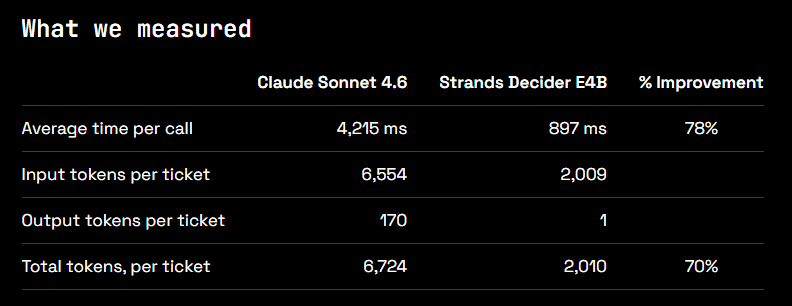
- Latency: 4,215 ms per call with Sonnet 4.6 versus 897 ms with Strands Decider. The post also reports average Lambda execution duration down 74% on the day Sonnet was switched off.
- Input tokens per ticket: 6,554 versus 2,009. The decision model’s window is 4,096 tokens, so the team rewrote each of the 20 labels as a one- or two-sentence criterion and sent them as the options of one choice question, plus a “none” option. On long tickets it drops the oldest comments to fit.
- Output tokens per ticket: 170 versus 1. Sonnet wrote a JSON answer with reasoning; the decision model returns a single choice.
- Total tokens: 6,724 versus 2,010, a 70% reduction.
What it costs, and our arithmetic
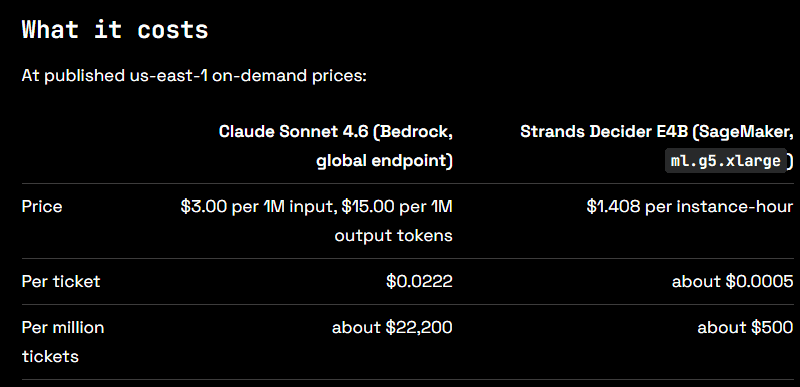
We recomputed the post’s figures from its own inputs. They hold up, which is worth saying because many vendor cost claims do not.
- Sonnet per ticket: 6,554 input tokens at $3.00 per million is $0.0197, and 170 output tokens at $15.00 per million is $0.0026, for $0.0222. About 88% of the Sonnet cost is input, because the long system prompt is sent on every ticket.
- Decider at full load: one instance at $1.408 per hour handling about 5,600 tickets an hour costs about $0.00025 per ticket, or $250 per million. The post’s “about $500 per million” in practice therefore implies roughly 50% utilization, an inference of ours from keeping “headroom for bursts.”
- The ratio: $22,200 divided by $500 is about 44, and the saving is about 98%. That matches the post.
- What “millions of dollars” means: the saving is about $21,700 per million tickets. Saving $2 million a year would take about 92 million tickets a year. This is our estimate from the post’s figures. The post does not state Amazon’s ticket volume.
- The small-volume trap: an always-on instance costs about $12,300 a year (1.408 x 24 x 365). At $0.0222 per ticket, Sonnet is cheaper than a single always-on instance below roughly 555,000 tickets a year, about 1,500 a day. The post says the endpoint autoscales, but we do not know its minimum capacity, so treat this as an estimate that shows why volume matters.
What the post does not show
- No accuracy numbers. “Performed just as well” and “beat production Sonnet on a separate set” are statements, not a table. For labeling, accuracy by category, the rate of wrong “security finding” labels and the handling of “none” are exactly what a buyer needs.
- A vendor-written account. The post is published by the Strands Agents team, which makes Strands Decider, about two Amazon engineers’ use of it. It is a case study, and we could not verify it independently.
- The baseline is not the cheapest large-model option. Sonnet 4.6 is described as nine months old, and the comparison uses the Bedrock global endpoint at list price. A newer small hosted model, caching of the long prompt or batch pricing could narrow the gap. The post does not test them, and we did not test them either.
- Costs left out. The team says the figures are list prices and exclude Lambda, which now runs for less time. The post does not count engineering effort, evaluation work, hosting a model or on-call costs.
- A fragile detail. The team found that sending the same content with JSON keys in a different order moved output probabilities by up to 0.19. They now send every request with sorted keys.
The most reusable idea: a three-way switch
The part the authors say they would copy “regardless of model” is how they rolled it out. The labeling function reads a setting from AWS AppConfig on every message with three values: BEDROCK (Sonnet labels every ticket), DUAL (both models run in parallel, Sonnet’s result is applied and compared with the decision model’s) and DECIDER (the decision model labels every ticket). Running both on real traffic and judging every disagreement, they say, taught them more than any offline test, and going back was a 45-second configuration change. That pattern, often called shadow mode, applies to any model swap, whether the new model is smaller, larger or from another vendor.
When this idea works, and when it does not
The authors list their own conditions: a closed choice from a known catalog, high volume, and latency that mattered. They say a decision model probably cannot replace an LLM if the labels need explanation text, if the catalog changes weekly or if the useful context cannot fit in a few thousand tokens. We would add three practical checks of our own:
- Measure your real token split. If most of your bill is a long prompt resent on every call, shorter prompts, caching or a smaller model may help before you change architecture.
- Compute break-even volume. Fixed hosting costs only pay off with enough traffic. Use the arithmetic above with your own prices.
- Require an accuracy table before switching. Compare per-category errors on your own tickets in shadow mode, not on a vendor’s summary.
How this fits the wider AI-cost story
This story sits at the opposite end of the spectrum from the frontier-model launch we covered earlier today. In our analysis of Claude Fable 5.2, an independent test measured $26.54 per benchmark task for the top-ranked model. Here, a team made one narrow job about 44 times cheaper by using a much smaller tool. The common lesson is that cost per completed task, not price per token or a leaderboard rank, decides whether an AI feature is affordable. For another example of price changes feeding into real bills, see Gemini API prices doubling on December 1.
What to watch next
- Independent evaluations of Strands Decider on other labeling tasks, especially with published accuracy.
- Whether the Strands team publishes the test sets or per-category results mentioned in the post.
- Competing small models or routing tools aimed at the same classification workloads.
- Changes in list prices for hosted models, which move the break-even point.
Frequently asked questions
Is a decision model the same as a small language model?
Not exactly. According to the post, a decision model cannot generate text. It takes a state and a set of options and returns a probability for each option plus a confidence score.
Did Amazon really save 98%?
That is the Strands Agents team’s reported figure, and our arithmetic from its own numbers reproduces the ratio. It covers token and instance list prices for one task at Amazon’s scale, and does not include engineering or evaluation costs.
Would this work for my chatbot?
Probably not. The authors say it fits closed-choice tasks from a known list of options. Open-ended answers, explanations and changing catalogs are better suited to a general model.
Does it prove Claude Sonnet is overpriced?
No. It shows that a general model can be the wrong tool for a narrow, high-volume job. The comparison is against a nine-month-old model on one task.
What is the single best takeaway?
Run any replacement in shadow mode on real traffic, compare every disagreement and keep a fast way back.
Sources and method
- Strands Agents blog, “Amazon saves millions by replacing Sonnet 4.6 with Strands Decider,” November 9, 2026 (our screenshots)
- Hacker News front page, where the post appeared on November 10, 2026
Method: we read the blog post in full, captured its two data tables ourselves on November 10, 2026, and recomputed per-ticket, per-million, utilization, annual-volume and break-even figures (“ours”) from the numbers it publishes. We did not run Strands Decider or Sonnet, did not see the underlying test sets and did not verify the case study with Amazon. Figures can change as providers update prices. ToolReviewHub earns nothing from this article and has no commercial relationship with Amazon, Anthropic or the Strands project. See our review method.