Apple CVE-2024-27834: 2024 WebKit Bug Now on CISA KEV
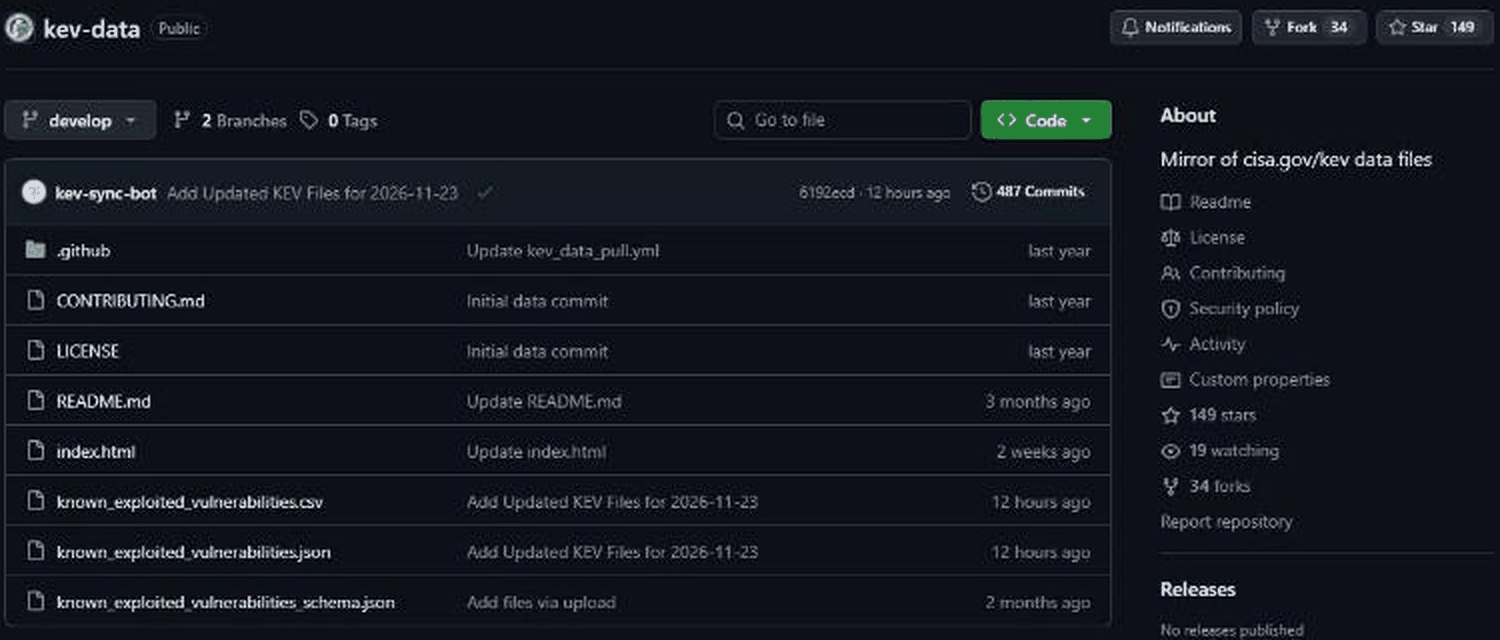
Published November 25, 2026. A news analysis of Apple WebKit vulnerability CVE-2024-27834, built from Apple’s security-content pages for the May 13, 2024 releases that CISA lists (read on November 25, 2026) and CISA’s Known Exploited Vulnerabilities (KEV) data as mirrored on CISA’s GitHub. The screenshot is ours (the CISA data mirror on GitHub). CISA’s own website returned “Access Denied” to our automated browser, so we did not use it. This article contains no affiliate links and we have no commercial relationship with Apple. ToolReviewHub is produced with the help of an AI assistant (Claude, made by Anthropic). We did not test the flaw. Descriptions are the vendors’ and CISA’s wording, and numbers marked “ours” are our own arithmetic.
Apple CVE-2024-27834: the short version
- What it is: a WebKit issue that Apple describes, in the macOS Sonoma 14.5 notes, as one where an attacker with arbitrary read and write capability may be able to bypass Pointer Authentication. Apple says it was addressed with improved checks. CISA’s catalog uses its own label, “improper authentication” (CWE-287).
- Fixed: in the May 13, 2024 releases: Safari 17.5, iOS 17.5 and iPadOS 17.5, iOS 16.7.8 and iPadOS 16.7.8, macOS Sonoma 14.5, tvOS 17.5 and watchOS 10.5.
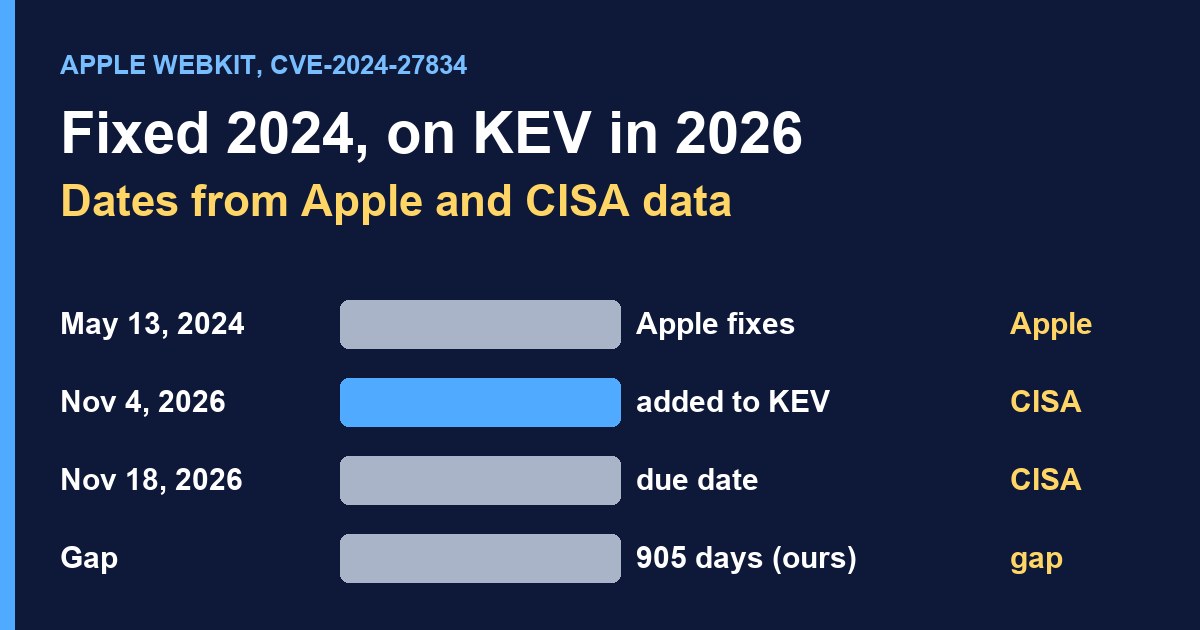
- The surprise: CISA added it to the Known Exploited Vulnerabilities catalog on November 4, 2026, about two and a half years later (905 days, ours), with a November 18 due date.
- Credit: Apple credits Manfred Paul (@_manfp) working with Trend Micro’s Zero Day Initiative.
- What it means: if exploitation is happening now, the targets are devices that never took the 2024 updates, or that cannot. We do not know any details.
What Pointer Authentication is
Pointer Authentication (often shortened to PAC) is a hardware-backed protection on Apple’s newer processors. It attaches a cryptographic signature to certain pointers, the values that tell a program where to go next in memory, so that a pointer an attacker has tampered with fails a check. It is meant to make memory-corruption attacks harder: even when an attacker can read and write memory, forging a valid code pointer should not be easy. This is general background and not a quote from Apple’s notes.
That context explains the wording of Apple’s entry. The precondition is that an attacker already has arbitrary read and write capability, which is what a successful memory-corruption bug in the browser engine would give. The flaw then lets the attacker bypass the protection that is supposed to limit what they can do with it. In exploit chains, a bypass like this is a middle link: it does not start an attack, it helps one finish.
What Apple says
The entry we read is in Apple’s security content for macOS Sonoma 14.5, published May 13, 2024. Under the WebKit heading, it lists: impact, an attacker with arbitrary read and write capability may be able to bypass Pointer Authentication; description, the issue was addressed with improved checks; WebKit Bugzilla 272750; and the credit to Manfred Paul working with Trend Micro’s Zero Day Initiative. Apple does not describe exploitation in that entry.
CISA’s KEV entry lists six Apple pages in its notes. We opened them all and confirmed their titles and dates: Safari 17.5, iOS 16.7.8 and iPadOS 16.7.8, tvOS 17.5, watchOS 10.5, macOS Sonoma 14.5 and iOS 17.5 and iPadOS 17.5, all released May 13, 2024. We read the WebKit entry in detail on the macOS page only, so we do not repeat it for the others.
CISA’s label for the weakness is CWE-287, improper authentication. Apple’s text speaks of Pointer Authentication, a hardware code-signing feature, and not user authentication. We think the label reflects the word “authentication,” but we do not know CISA’s reasoning, and we flag the mismatch so that you do not read it as a login bug.
What older Apple devices should do
Many people hold on to old iPhones and iPads as media players, kitchen screens or spare devices, and they keep browsing the web on them. That is exactly the situation in which a two-year-old browser-engine fix matters. Apple’s notes list which releases carry the fix, and a device that cannot be moved to one of them should not be used for banking, work email or any sign-in that matters.
If you manage devices for a family or a small business, a short audit is worth the effort: list each device, its model and its software version, and mark the ones that cannot update any further. Replace or retire those, and make sure that the rest are set to update automatically. That is general advice and not a statement from Apple or CISA about this CVE.
Why would a 2024 bug appear in 2026?
As in the Synology case that we covered, a KEV listing means that CISA has evidence of exploitation, whatever the age of the fix. A 905-day gap (ours, from May 13, 2024 to November 4, 2026) suggests that attackers are still finding devices that missed the update. Apple’s notes do not say whether the bug was exploited in 2024, and we do not know whether it was part of a chain that also used other flaws.
For readers, the lesson is not about this CVE. It is that old iPhones, iPads, Apple TVs, Apple Watches and Macs that stopped receiving updates are a standing target. One of the six pages (iOS 16.7.8 and iPadOS 16.7.8) is for an older release line, which Apple kept updated for devices that could not move to iOS 17 (our reading of why such releases exist). It is a reminder that hardware outside the newest software line still needs patching.
The Apple pages CISA lists
| Apple security-content page | Released |
|---|---|
| Safari 17.5 | May 13, 2024 |
| iOS 17.5 and iPadOS 17.5 | May 13, 2024 |
| iOS 16.7.8 and iPadOS 16.7.8 | May 13, 2024 |
| macOS Sonoma 14.5 | May 13, 2024 |
| tvOS 17.5 | May 13, 2024 |
| watchOS 10.5 | May 13, 2024 |
Timeline: two and a half years
| Date | Event | Source |
|---|---|---|
| May 13, 2024 | Apple releases the fixes (macOS Sonoma 14.5, iOS 17.5 and others) | Apple |
| November 4, 2026 | CISA adds CVE-2024-27834 to the KEV catalog | CISA KEV data |
| November 18, 2026 | KEV due date for U.S. federal civilian agencies | CISA KEV data |
The 14-day window (ours) is the longer one explained in our November KEV analysis, and it ended on November 18.
What to do: a practical checklist
- Check the OS version on every Apple device you manage. Anything below iOS 17.5, iPadOS 17.5, macOS Sonoma 14.5, tvOS 17.5 or watchOS 10.5 (or iOS and iPadOS 16.7.8 on the older line) lacks the 2024 fix. Safari on macOS should be 17.5 or later.
- Update to the latest supported release. Do not stop at the minimum: newer releases carry later fixes too.
- Identify devices that cannot update. If hardware is too old for a current release, plan its replacement, and until then keep it off sensitive networks and away from untrusted web browsing.
- Turn on automatic updates for personal and managed devices, and use mobile device management to report versions across your fleet.
- Consider Lockdown Mode for people at higher risk, such as journalists and activists. We did not test it against this bug.
- Do not use old devices for sensitive logins while they remain unpatched.
- Review your asset list for forgotten Apple TVs and watches that no one updates.
What we could not confirm
- Why CISA added a 2024 flaw in November 2026, and how it is being exploited: the KEV entry records exploitation without details.
- Whether the bug was exploited in 2024 or only recently, and whether it is part of an exploit chain.
- The WebKit entries on the other five Apple pages: we confirmed titles and dates, and read the entry in detail only on the macOS Sonoma 14.5 page.
- Why CISA labels the weakness “improper authentication” when Apple describes a Pointer Authentication bypass.
- How many devices remain on versions without the fix.
- CISA’s own catalog page, which we could not open; the KEV facts come from CISA’s GitHub mirror (catalog version 2026.11.23).
Frequently asked questions
What is CVE-2024-27834?
A WebKit issue that, per Apple, may let an attacker with arbitrary read and write capability bypass Pointer Authentication. It was fixed on May 13, 2024.
Which updates fix it?
Safari 17.5, iOS 17.5 and iPadOS 17.5, iOS 16.7.8 and iPadOS 16.7.8, macOS Sonoma 14.5, tvOS 17.5 and watchOS 10.5, or later.
Why is it on the KEV list in 2026?
CISA adds flaws with evidence of exploitation. The entry does not say why it came now, 905 days after the fix (ours).
Is my up-to-date iPhone at risk?
Apple fixed this in 2024, so a device that has taken updates since then has the fix. Older devices that did not update are the concern.
What is the KEV deadline?
November 18, 2026 for U.S. federal civilian agencies. For everyone else it signals urgency and is not a legal deadline.
Method: details come from Apple’s security-content pages for the May 13, 2024 releases and CISA KEV data (catalog version 2026.11.23), read on November 25, 2026. For how we research, see How We Review Tools.