Synology DSM CVE-2024-10441: Old NAS Bug Now on CISA KEV
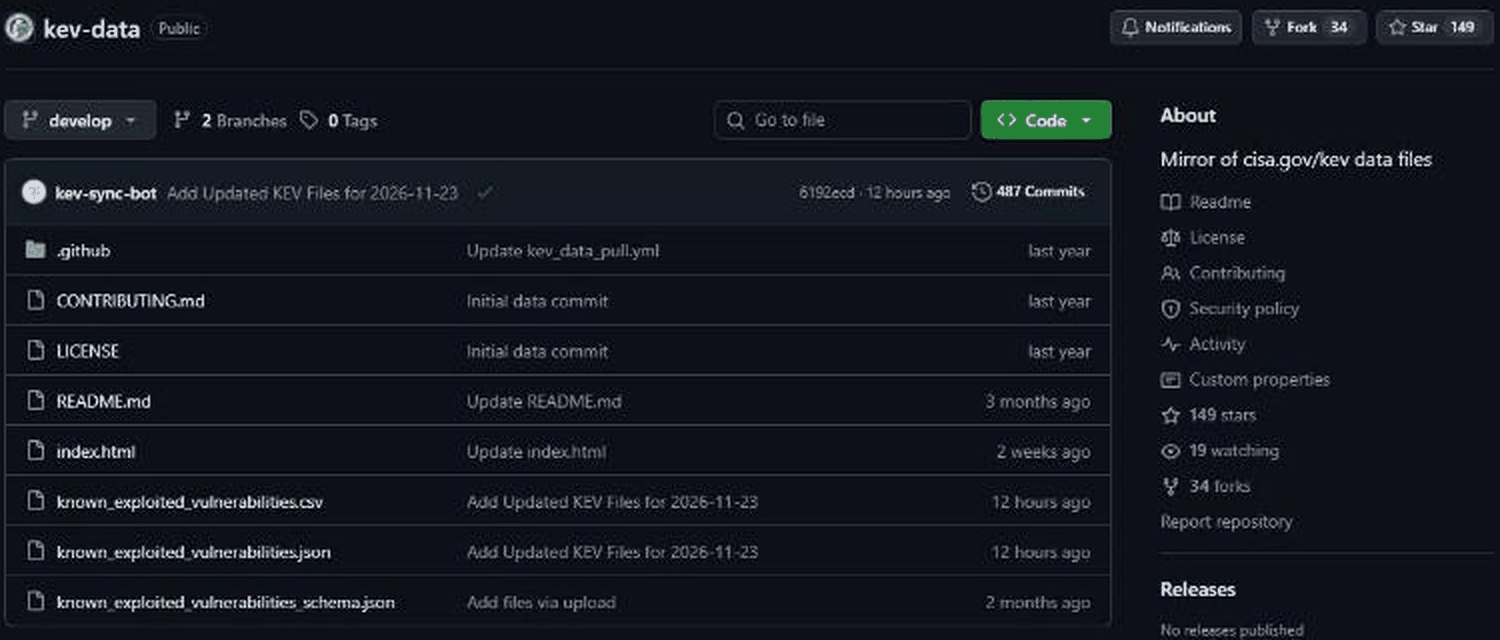
Published November 25, 2026. A news analysis of Synology DiskStation Manager vulnerability CVE-2024-10441, built from Synology’s security advisory Synology-SA-24:20 (read on Synology’s website on November 25, 2026), the National Vulnerability Database entry and CISA’s Known Exploited Vulnerabilities (KEV) data as mirrored on CISA’s GitHub. The screenshot is ours (the CISA data mirror on GitHub). CISA’s own website returned “Access Denied” to our automated browser, so we did not use it. This article contains no affiliate links and we have no commercial relationship with Synology. ToolReviewHub is produced with the help of an AI assistant (Claude, made by Anthropic). We did not use a Synology device for this article or test the flaw. Descriptions are the vendors’ and CISA’s wording, and numbers marked “ours” are our own arithmetic.
Synology CVE-2024-10441: the short version
- What it is: a critical flaw (CVSS 9.8) in the system plugin daemon of Synology DiskStation Manager (DSM) and BeeStation OS (BSM). Synology’s advisory says remote attackers can execute arbitrary code. The National Vulnerability Database describes the cause as improper encoding or escaping of output.
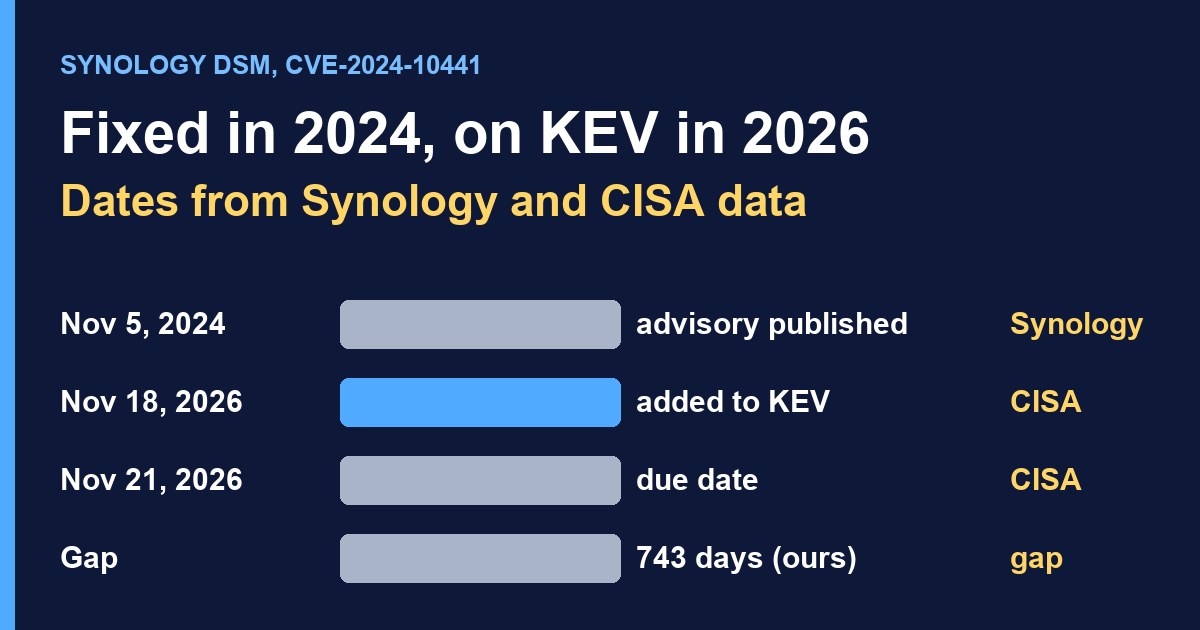
- The surprise: the advisory dates from November 5, 2024. CISA added the flaw to the Known Exploited Vulnerabilities catalog on November 18, 2026, about two years later (743 days, ours), with a November 21 due date.
- Ransomware flag: CISA’s data marks this entry as “known” for ransomware campaign use. That field is CISA’s own assessment, and the entry gives no details.
- Fixed in: DSM 7.2.2-72806-1, 7.2.1-69057-6, 7.2-64570-4 and (for the 7.1 line) 7.1.1-42962-7, or newer. BeeStation OS is fixed from 1.1-65374. Synology lists no mitigation other than updating.
- Why it matters now: network-attached storage (NAS) devices are often set up once and forgotten. An unpatched one that is reachable from the internet is the kind of target that old exploits keep finding.
What DSM is, and why NAS devices attract attackers
Synology DiskStation Manager is the operating system on Synology’s NAS devices. People use these boxes to store backups, photos and company files, and many expose a web interface or file services to reach them from outside the home or office. BeeStation OS is the software of the company’s BeeStation line, which the advisory also covers. A NAS tends to hold exactly the data a ransomware group wants to encrypt or steal, and it often has no endpoint security software on it. That is general background and not a statement from Synology.
The flaw is in the “system plugin daemon.” The advisory does not describe how a remote attacker reaches it, and the NVD entry says the attack uses “unspecified vectors.” We therefore cannot say whether a default configuration is exposed, and we did not try to find out.
What the vulnerability is
Synology-SA-24:20 groups several issues reported through the Pwn2Own contest in 2024, a hacking competition where researchers show working attacks to vendors. Its abstract says that remote attackers can execute arbitrary code (tracked by the Zero Day Initiative as ZDI-CAN-25403), that another issue allows reading specific files (ZDI-CAN-25613), and that an adjacent attacker positioned between a device and the network could write specific files (ZDI-CAN-25617). The advisory’s severity is Critical and the status is Resolved. Under mitigation, it says None.
CVE-2024-10441 is the first of these. The NVD entry gives it CVSS 3 9.8: attack over the network, low complexity, no privileges and no user interaction needed, high impact on confidentiality, integrity and availability. In words, a remote, unauthenticated attacker may run code on the device. The cause is described as improper encoding or escaping of output in the system plugin daemon.
Who should worry most
Home users and small businesses that bought a Synology box years ago and let it run are the most likely to be behind on updates, and they are also the least likely to have a security team watching. Organizations that rely on a NAS for backups face a second risk: if the backup target is reachable from the same network as the systems it protects, ransomware that gets onto the NAS can destroy the safety net as well as the data. That is general guidance for backups, not a statement from Synology or CISA.
Why would a 2024 bug land on a 2026 list?
The KEV catalog does not list new bugs; it lists bugs known to be exploited. Adding a 2024 flaw in November 2026 means that CISA has evidence of exploitation now, whatever the age of the patch. Two points follow. First, old flaws stay useful to attackers because many devices are never updated. Second, CISA marks this entry as known ransomware use. We do not know which groups, which victims or how many.
We are careful about the second point. The ransomware field in the KEV data says that CISA is aware of use in ransomware campaigns. It does not mean every attack on this flaw is ransomware, and it does not tell you whether your device is at risk.
Fixed versions
| DSM line | Fixed in (Synology) | Note |
|---|---|---|
| DSM 7.2.2 | 7.2.2-72806-1 and above | Critical |
| DSM 7.2.1 | 7.2.1-69057-6 and above | Critical |
| DSM 7.2 | 7.2-64570-4 and above | Critical |
| DSM 7.1 | 7.1.1-42962-7 and above | Critical |
| DSM 6.2 | 6.2.4-25556-8 and above | Moderate (another issue in the advisory) |
| BeeStation OS (BSM) | 1.1-65374 and above | NVD wording: before 1.1-65374 |
The table follows the advisory and the NVD entry. The NVD text says the code-execution flaw affects BSM before 1.1-65374 and DSM before 7.2-64570-4, 7.2.1-69057-6 and 7.2.2-72806-1. The advisory also lists the 7.1 and 6.2 lines; the 6.2 row concerns a different, lower-rated issue in the same advisory (CVE-2024-50629, a moderate flaw in the web API, CVSS 5.3), so do not read it as the fix for the critical flaw. Check the advisory for the exact row that matches your model.
Timeline: almost two years
| Date | Event | Source |
|---|---|---|
| November 5, 2024 | Synology publishes Synology-SA-24:20 with fixes | Synology |
| March 28, 2025 | Advisory last updated | Synology |
| November 18, 2026 | CISA adds CVE-2024-10441 to the KEV catalog; ransomware use marked as known | CISA KEV data |
| November 21, 2026 | KEV due date for U.S. federal civilian agencies | CISA KEV data |
The gap between the advisory and the KEV listing is 743 days (ours). This is the longest wait of any entry in the group of articles we are writing about November’s KEV additions. As we noted in our analysis of the month’s entries, KEV is also a signal that old devices are being scanned and attacked. The due date has passed.
What to do: a practical checklist
- Check your DSM version. In the control panel’s update section, note the exact build and compare it with the table.
- Update now if you are behind. Install a fixed build for your line. If your model no longer receives updates, treat it as end-of-life and plan its replacement.
- Remove direct internet exposure. If you can reach the NAS from outside, put it behind a VPN instead of opening its web interface or other ports. Check your router for forwarded ports you forgot.
- Review admin and user accounts. Delete accounts you do not use, turn on two-factor authentication for administrators, and check the list of recent logins.
- Check for odd scheduled tasks and installed packages you did not create. Ransomware operators and others often leave persistence.
- Protect your backups. Keep at least one backup copy that the NAS cannot overwrite (offline or immutable), so that an encrypted share is not the end of the story.
- If you find signs of compromise, disconnect the device, preserve logs, and restore from a known-good backup after reinstalling a patched build.
What we could not confirm
- How a remote attacker reaches the system plugin daemon: the NVD says “unspecified vectors” and the advisory gives no technical detail.
- Which ransomware groups used the flaw, how many victims there are, and what versions they hit.
- Whether the default configuration of a Synology device exposes the vulnerable component to the internet.
- The exact fix row for each hardware model: check the advisory for your model.
- Why CISA added the flaw two years after the fix: the KEV entry does not say.
- CISA’s own catalog page, which we could not open; the KEV facts come from CISA’s GitHub mirror (catalog version 2026.11.23).
Frequently asked questions
What is CVE-2024-10441?
A critical remote code execution flaw in the system plugin daemon of Synology DiskStation Manager and BeeStation OS, fixed in 2024 and reported through Pwn2Own.
Which versions fix it?
DSM 7.2.2-72806-1, 7.2.1-69057-6, 7.2-64570-4 or 7.1.1-42962-7 and newer for their lines, and BeeStation OS 1.1-65374 or newer.
Why was it added to the KEV catalog in 2026?
CISA adds vulnerabilities that it has evidence of being exploited. The entry does not say why it came two years after the fix, but it flags known ransomware use.
Is there a workaround?
Synology’s advisory lists no mitigation. The remedy is to update, and to keep the device off the open internet.
What is the KEV deadline?
November 21, 2026 for U.S. federal civilian agencies. For everyone else it signals urgency and is not a legal deadline.
Method: details come from Synology-SA-24:20 (published November 5, 2024, last updated March 28, 2025), the NVD entry for CVE-2024-10441 and CISA KEV data (catalog version 2026.11.23), read on November 25, 2026. For how we research, see How We Review Tools.