Apple’s Foundation Models Framework Adds Claude and Gemini: What to Check
Updated November 13, 2026. A news analysis built from two pages on Apple’s developer website, “Foundation Models framework” and “Accessing Private Cloud Compute”, our own screenshots of those pages, and the Hacker News front page. Disclosure: this story names Claude (a model from Anthropic) and Gemini (from Google) as supported third-party models, and the research and drafting tools we use for these articles include Claude. We therefore rely on Apple’s own wording, quote only short phrases and label every number we compute as ours. We did not build or run any app with the framework. This is not legal, financial or engineering advice.
The short version
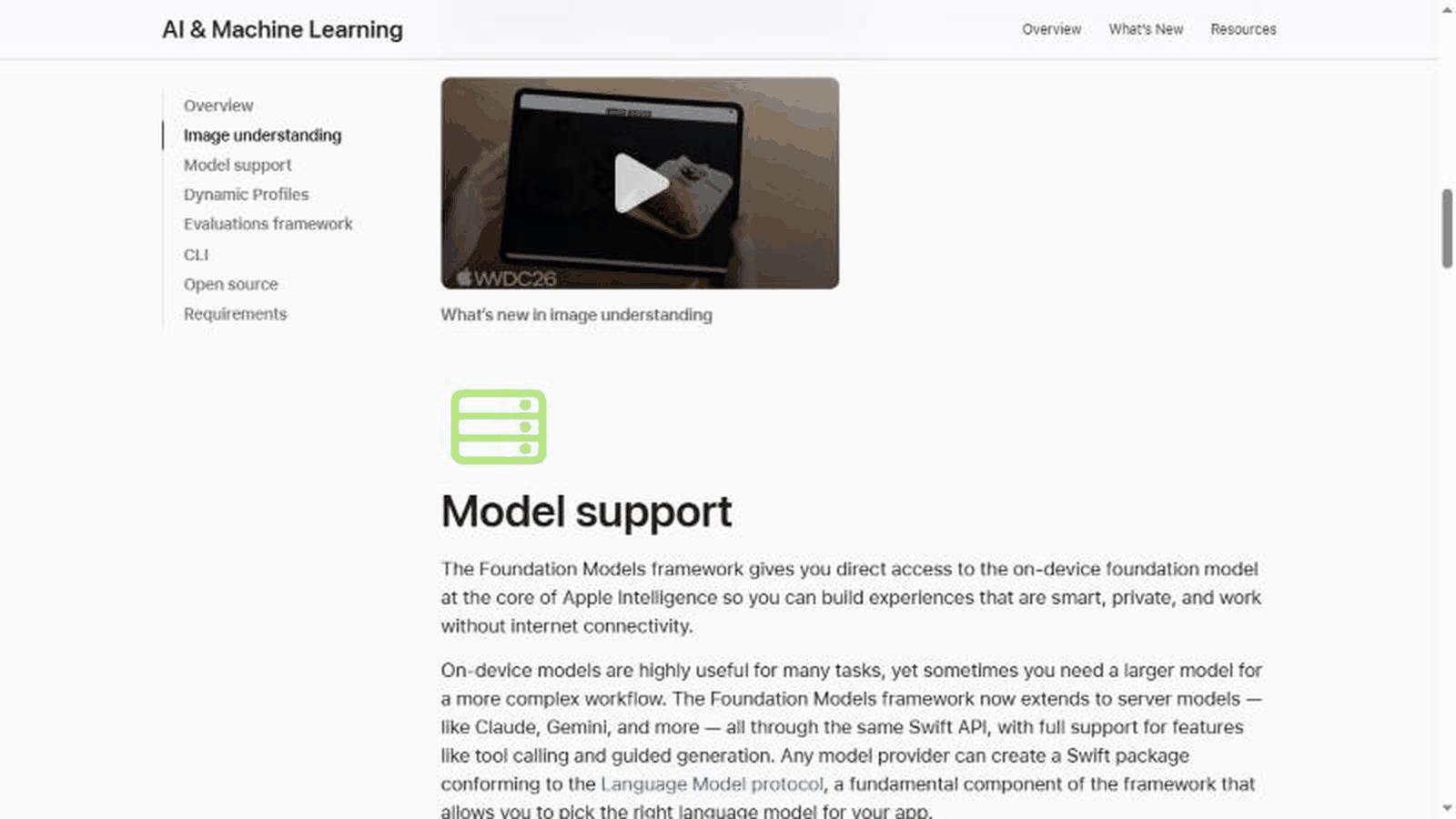
Apple’s developer page for the Foundation Models framework now describes it as “the best way to use any large language model in your app”. The framework is a native Swift API that started as access to Apple’s on-device model. According to the page it now extends to server models “like Claude, Gemini, and more” through the same Swift API, including tool calling and guided generation, and any model provider can publish a Swift package that conforms to a Language Model protocol. The page lists supported third-party models as Core AI Language Models, MLX Language Models, Claude, Gemini and Private Cloud Compute.
The detail with the biggest money angle sits on a second page. Developers in the App Store Small Business Program with fewer than 2 million first-time App Store downloads can use Apple Foundation Models running on Private Cloud Compute (PCC) “with no cloud API cost”. A footnote adds that these server features are subject to daily usage limits and that expanded access “will be available for a fee in the future”. In plain terms: free to start, with limits, and a paid tier is planned.
Timeline
- Date of the announcement: the framework page itself carries no date. It links WWDC26 session videos for each feature, including ones on the new Apple Foundation Model on Private Cloud Compute, on the Evaluations framework and on the
fmcommand line tool, which suggests the material comes from Apple’s WWDC26 developer conference. We could not confirm the exact date from the pages we read, so we do not state one. - November 13, 2026: we read both pages. The Hacker News post linking the framework page had 162 points when we checked.
- Ahead: the footnote says expanded access to server-side Apple Intelligence features “will be available for a fee in the future”. No date or price is given.
What Apple’s framework page says
The page is organised into eight sections: overview, image understanding, model support, Dynamic Profiles, the Evaluations framework, the CLI, open source and requirements. The main claims are:
- Native Swift API. It gives direct access to the Apple Foundation Models on-device and in Private Cloud Compute, with guided generation, tool calling, image understanding and Dynamic Profiles built in.
- Image understanding. You can pass images alongside text in a prompt. The Vision framework is integrated, with OCR and barcode reading, “all on-device”.
- Model support. The on-device model is described as the core of Apple Intelligence and works without internet connectivity. For larger workflows the framework extends to server models through the same API.
- Evaluations framework. A way to test prompts and validate features “going beyond what unit tests alone can catch”, useful when you change instructions, switch models or tune a Dynamic Profile.
- The
fmCLI. A command line tool in macOS 27 for scripting and automating model workflows, with a Python SDK. - Open source. A framework utilities package with experimental abstractions, including custom skills, context-management helpers and a Chat Completions client that connects to a hosted model of your choice, plus a Foundation Models SDK for Python.
- Requirements. Acceptable Use Requirements that list prohibited uses of Apple Foundation Models, and, citing Article 53(1)(b) of the EU AI Act, documentation for providers who plan to integrate “AFM 3 Cloud” into their AI systems.
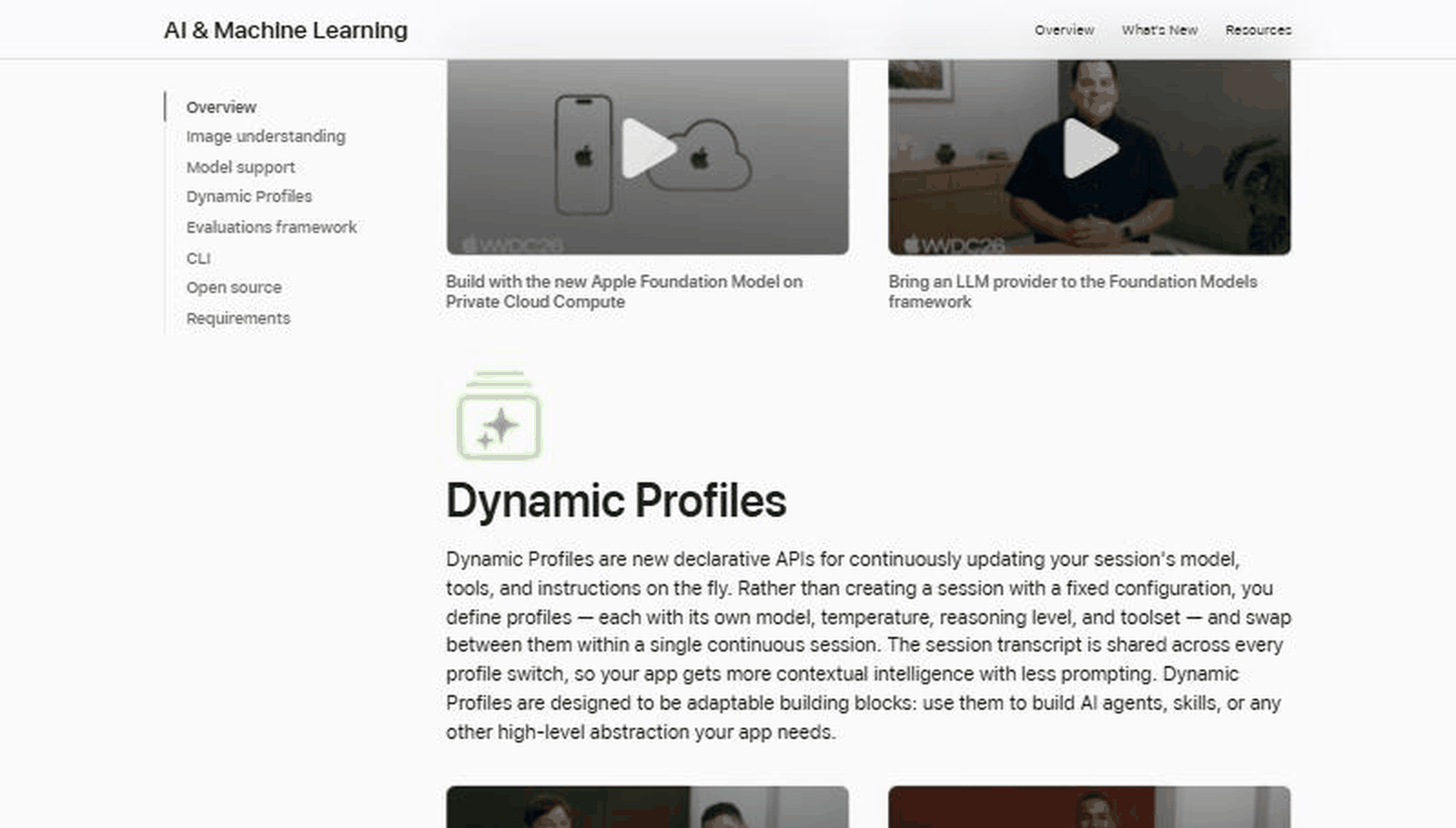
Dynamic Profiles deserve a closer look because they are the part aimed at AI agents. The page says you define profiles, “each with its own model, temperature, reasoning level, and toolset”, and swap between them inside one session while the session transcript is shared across every switch. Apple describes them as building blocks for agents, skills or other high-level abstractions. For teams that mix a fast local model with a larger remote one, that is a built-in way to do it. We have not tested how well it works.
What the Private Cloud Compute page says
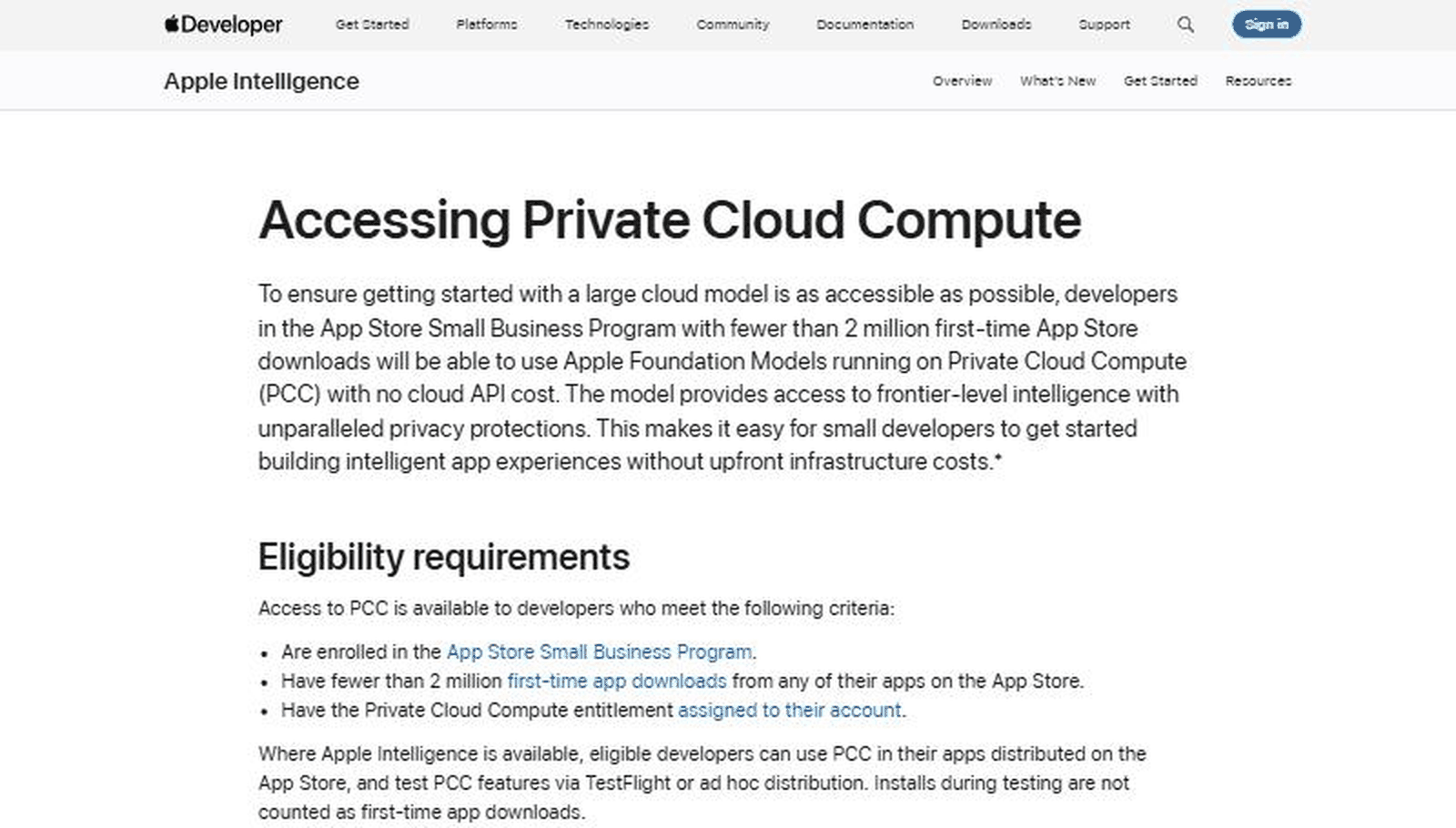
The eligibility rules are specific. Access is available to developers who meet three criteria: they are enrolled in the App Store Small Business Program, they have fewer than 2 million first-time app downloads from any of their apps on the App Store, and they have the Private Cloud Compute entitlement assigned to their account. Eligible developers can use PCC in apps distributed on the App Store, and can test PCC features through TestFlight or ad hoc distribution, where the page says installs during testing are not counted as first-time downloads. The feature applies “where Apple Intelligence is available”.
The exit clause matters as much as the free tier. If any app later passes 2 million first-time downloads, or the developer leaves the Small Business Program, Apple says the developer will be notified and “must migrate to an alternative solution within 6 months”. First-time download counts are available in Analytics in App Store Connect. The footnote repeats that server features have daily usage limits, which vary “by feature, request complexity, system demand, system policies, and other factors”, and that Apple Intelligence terms apply.
Our own arithmetic (labelled as ours)
These figures are our own calculations from numbers on the two pages. They are not published by Apple.
| What we computed | Result (ours) |
|---|---|
| The migration window of 6 months after a developer is notified | About 183 days, roughly half a year |
| Time to reach 2 million first-time downloads at 10,000 a day | 200 days, so a hit app could cross the threshold in under 7 months |
| Time to reach 2 million at 1,000 a day | 2,000 days, about 5.5 years |
| Eligibility criteria that must all be true | 3 (Small Business Program, under 2 million first-time downloads, entitlement) |
| Third-party model categories listed on the page | 5 (Core AI Language Models, MLX Language Models, Claude, Gemini, Private Cloud Compute) |
| Sections in the framework page navigation | 8 |
The point of the download rows is planning, not prediction. A successful app can cross a round-number threshold faster than a team can rebuild its back end, so it is worth deciding early what you would switch to.
Claimed versus what we could verify
| Claim | Source | Our status |
|---|---|---|
| The framework extends to server models like Claude and Gemini through the same Swift API | Apple framework page | Stated by Apple; we did not build anything or check the provider packages |
| Small-business developers under 2 million first-time downloads can use PCC with no cloud API cost | Apple framework and PCC pages | Verified on both pages (screenshots above), with conditions |
| Daily limits apply and expanded access will cost money in the future | Footnote on both pages | Verified; limits and prices are not given |
| Exceeding the threshold requires migrating within 6 months | Apple PCC page | Verified by reading the page |
| On-device models work without internet and are private | Apple framework page | Apple’s claim; not independently tested |
| PCC gives “frontier-level intelligence” with “unparalleled privacy protections” | Apple PCC page | Marketing wording; not verified |
| Costs of using Claude or Gemini through the framework | Not on the pages we read | Unknown. Each provider’s own pricing and terms would apply; check them |
| Which Apple devices and regions are supported | “Where Apple Intelligence is available” | Not specified on these pages |
Who is actually affected
Independent iOS and macOS developers and small studios are the main audience, because the free PCC tier is aimed at them and the 2 million threshold is high enough that most will never reach it. Teams that already call a third-party model from a Swift app may find the unified API useful, since the page says provider packages can conform to a common protocol. Larger publishers face a different calculation: above the threshold, or outside the Small Business Program, the page offers no free tier at all. App users are affected only indirectly, through apps that choose to send data to a server model, which depends on each app’s own design and privacy policy.
Why this one is getting attention
Two reasons are visible on the pages. Apple is positioning its framework as a neutral layer over several model providers, including competitors, rather than only its own model. And a free cloud model for small developers changes the cost side of building AI features in an app, at least until the paid tier appears. For a related look at how the model market is pricing, see our note on Gemini 4 Hydrogen and its price changes, and for another case of packaging agent behaviour as plain files, Jane Street’s Socratic Tutor skill.
Checklist for app developers
- Check whether you are enrolled in the App Store Small Business Program and look up your first-time download count in App Store Connect.
- Apply for the Private Cloud Compute entitlement on your account before you plan a release around it.
- Test through TestFlight or ad hoc distribution first, since the page says test installs do not count toward the threshold.
- Design for daily limits: handle “limit reached” cleanly and have a fallback to the on-device model.
- Write down your exit plan. If you pass 2 million downloads you have 6 months to migrate, so know the cost of an alternative provider now.
- If you use Claude, Gemini or another provider through the framework, read that provider’s pricing and data terms separately. The Apple pages do not cover them.
- Read the Acceptable Use Requirements and your privacy policy before you send any user content to a server model.
- Use the Evaluations framework to test prompts whenever you change model, instructions or profile.
- If you serve users in the EU, look at the AFM 3 Cloud documentation Apple links under the AI Act section and consult a professional where needed.
What to watch next
- The actual daily limits and the price of “expanded access”, which the footnote says will come later.
- Which provider packages appear for the Language Model protocol and how they are maintained.
- Whether the free PCC tier stays tied to the 2 million threshold.
- Real-world reports on latency, quality and limits from small developers.
Frequently asked questions
Is the Private Cloud Compute model really free
For eligible developers there is “no cloud API cost”, according to Apple, but daily usage limits apply and Apple says expanded access will cost money in the future.
Who is eligible
Developers in the App Store Small Business Program with fewer than 2 million first-time App Store downloads and the Private Cloud Compute entitlement on their account.
What happens if my app becomes very popular
If an app exceeds 2 million first-time downloads or you leave the Small Business Program, Apple says you will be notified and must migrate to another solution within 6 months.
Does the framework work with Claude and Gemini
Apple says it extends to server models like Claude and Gemini through the same Swift API. Their own pricing and terms are separate and are not described on Apple’s pages.
Does it work offline
The on-device model does, according to Apple. Server models and Private Cloud Compute need a connection.
What is Dynamic Profiles
A set of declarative APIs to swap a session’s model, tools and instructions on the fly while keeping one shared transcript.
Sources and method
- Apple Developer, “Foundation Models framework” (developer.apple.com/foundation-models-framework). Read November 13, 2026.
- Apple Developer, “Accessing Private Cloud Compute” (developer.apple.com/private-cloud-compute). Read November 13, 2026.
- Hacker News front page, November 13, 2026, for discussion context.
Method: we opened both pages in a clean browser window without signing in, read them in full and captured the three screenshots above. We quote only short phrases. We did not build an app, request an entitlement or test any model. Arithmetic rows are our own.
Risk note
This is a summary of public pages that can change after we read them. Terms, limits and eligibility may differ for your account and region, and Apple says fees are planned. Nothing here is legal, financial or engineering advice. Read Apple’s current terms and the providers’ terms before you build or ship a product that depends on them.