Barracuda CVE-2026-116606 and CVE-2026-111560 on CISA KEV
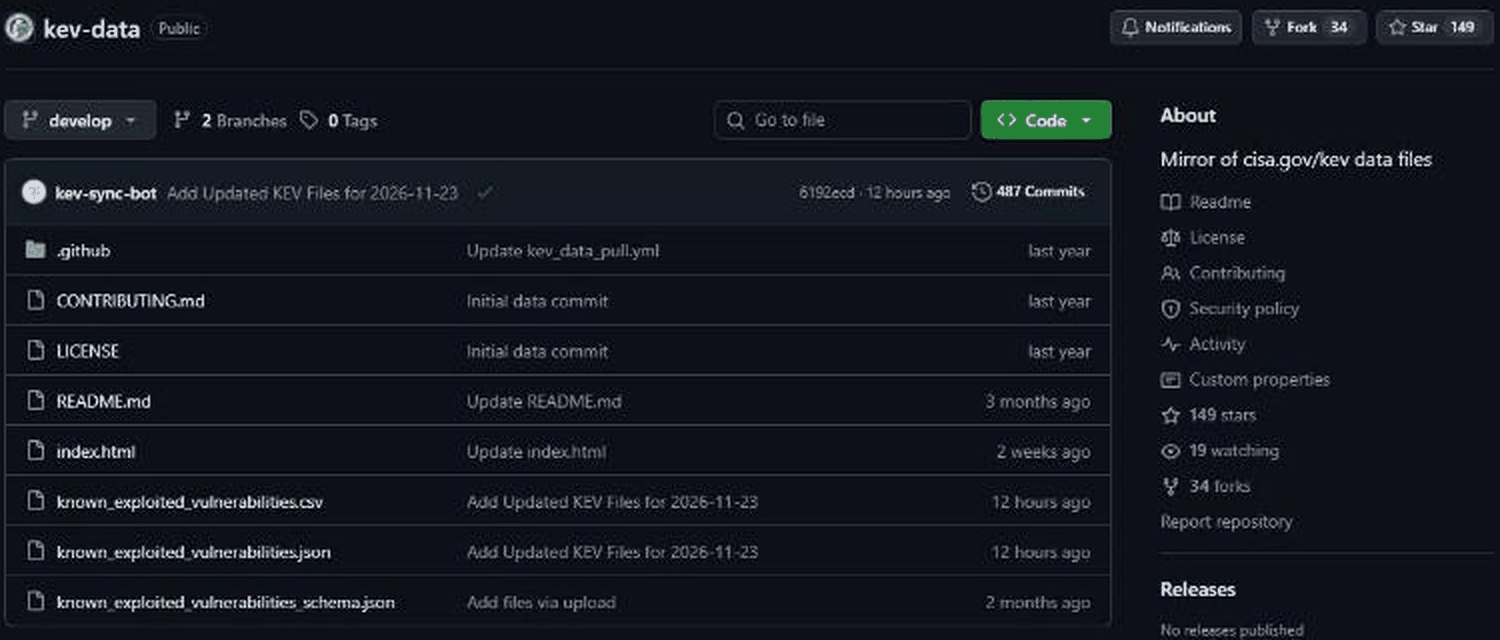
Published November 25, 2026. A news analysis of the Barracuda vulnerabilities CVE-2026-116606 and CVE-2026-111560, built from Barracuda’s trust-center notice “Pre-Authentication Authorization Bypass and Command Injection Vulnerabilities in Certain Barracuda Products” (read on November 25, 2026) and CISA’s Known Exploited Vulnerabilities (KEV) data as mirrored on CISA’s GitHub. The screenshot is ours (the CISA data mirror on GitHub). CISA’s own website returned “Access Denied” to our automated browser, so we did not use it. This article contains no affiliate links and we have no commercial relationship with Barracuda Networks. ToolReviewHub is produced with the help of an AI assistant (Claude, made by Anthropic). We did not run any Barracuda product or test the flaws. Descriptions are the vendors’ and CISA’s wording, and numbers marked “ours” are our own arithmetic.
Barracuda CVE-2026-116606 and CVE-2026-111560: the short version
- What they are: two flaws that Barracuda describes as a pre-authentication authorization bypass (CVE-2026-116606) and a command injection (CVE-2026-111560). Together they can let an attacker bypass authorization controls and get root on the device.
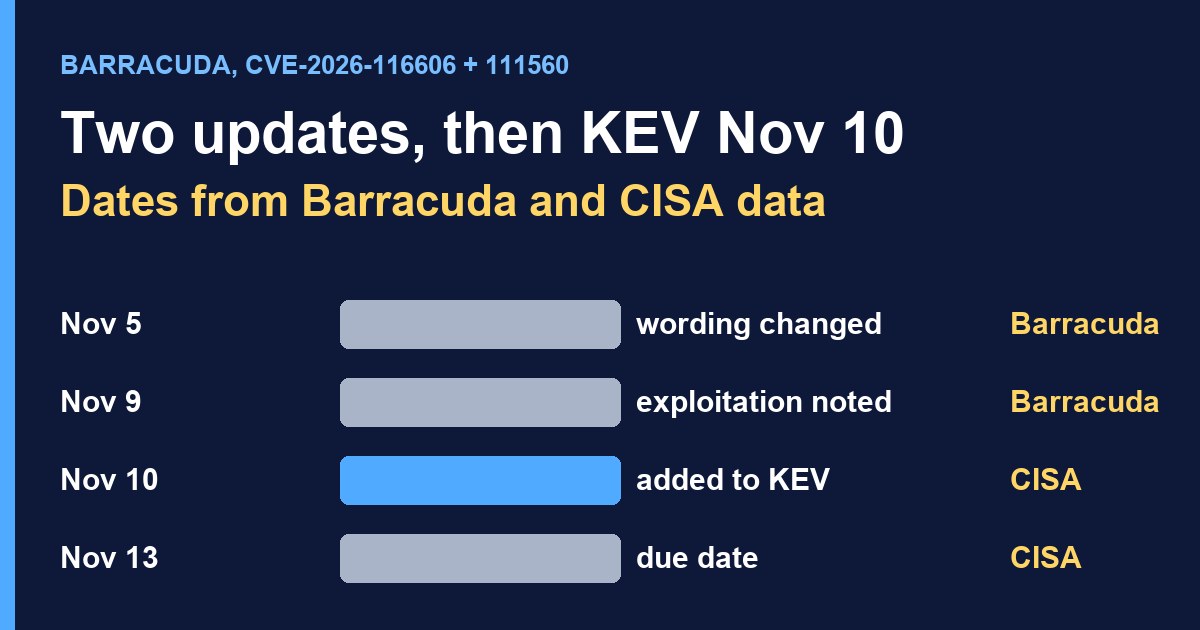
- The condition that matters: Barracuda says exploitation requires that the attacker can reach the device’s administrative interface. On November 5, 2026 the company changed its wording for CVE-2026-116606 from “authentication required: yes, administrative access” to “no, but the administrative UI must be accessible.”
- Products: Email Security Gateway (ESG) is affected by both flaws. Load Balancer ADC, Message Archiver, WAF Control Center, Web Application Firewall and Web Security Gateway are affected by the command injection only. Barracuda has released patches for each.
- Exploitation: on November 9, 2026, Barracuda added that exploitation activity has been observed affecting a small number of organizations. CISA added both CVEs to the Known Exploited Vulnerabilities catalog on November 10, 2026, with a November 13 due date.
- Exposure test: can your administrative interface be reached from the internet or from untrusted networks? If the answer is yes, close that today, whatever your patch status.
What the affected products are
Barracuda sells security appliances and services. The notice names six products: the Email Security Gateway (ESG), which filters mail; the Load Balancer ADC; the Message Archiver; the WAF Control Center; the Web Application Firewall; and the Web Security Gateway. All of them sit at network edges or hold copies of sensitive traffic, which is why a root compromise is more serious than the usual “server bug.” That is our reading of the product types and not a statement from Barracuda. We do not know how many of each product are deployed.
What the vulnerabilities are
Barracuda’s notice describes two issues. CVE-2026-116606 is a pre-authentication authorization bypass, which means that the device can be made to accept a request that should have required authorization, before a login takes place. CVE-2026-111560 is a command injection, a class of flaw where text supplied by a user ends up being run as an operating-system command. Each one is serious on its own terms. The notice says that used together they allow an attacker to bypass authorization controls and obtain root on the device.
Only the ESG has both. For the other five products, Barracuda lists just the command injection. That is an important distinction. For those products the question is what an attacker needs to reach the vulnerable function; the notice does not spell that out in the part we read, and we will not guess.
The company’s notice also says that successful exploitation requires access to the administrative interface. That is a good sign for people who keep management interfaces off the internet, and a bad sign for people who do not. Barracuda’s own guidance says that organizations whose admin interfaces are not publicly accessible are less exposed, and recommends restricting admin access to trusted internal networks.
The wording change on November 5
The most informative detail in the notice is the update history. The original table said that CVE-2026-116606 required authentication (“yes, administrative access”). On November 5, 2026, at 2:30 pm Eastern, Barracuda changed it to “no (administrative UI access required).” In plain terms: the attacker does not need a login, but does need to be able to reach the admin interface. For defenders the difference is large. “Needs an admin login” suggests a stolen-credentials problem. “Needs only network access to the admin page” is an exposure problem that you can fix by changing who can reach that page.
On November 9, at 9:00 pm Eastern, Barracuda added that it had observed exploitation activity affecting a small number of organizations. Note the sequence, which we reconstruct from the notice’s update notes: first a correction that made the flaw sound easier to use, then a statement that it was being used. We do not know whether the two are connected.
Patches by product
| Product | Affected by | Patch (Barracuda) |
|---|---|---|
| Email Security Gateway (ESG) | CVE-2026-116606 and CVE-2026-111560 | BNSF-40425 (version 9.4.017 and later) and BNSF-40430 (versions before 9.4.017) |
| Load Balancer ADC | CVE-2026-111560 | BNADC-16586 |
| Message Archiver (BMA) | CVE-2026-111560 | BNMA-32468 |
| WAF Control Center (WCC) | CVE-2026-111560 | BNWF-60060 |
| Web Application Firewall (WAF) | CVE-2026-111560 | BNADC-16586 |
| Web Security Gateway (WSG) | CVE-2026-111560 | BNYF-24789 |
The patch identifiers above are as Barracuda lists them. We do not know how patches are delivered to each customer: appliances of this type often receive updates through a vendor update service, but the notice excerpt we read does not say how or whether it is automatic. Confirm with Barracuda that your device actually received the patch.
Timeline
| Date (2026) | Event | Source |
|---|---|---|
| November 5 (2:30 pm Eastern) | Barracuda changes CVE-2026-116606 from “authentication required” to “no, admin UI access required” | Barracuda notice |
| November 9 (9:00 pm Eastern) | Barracuda adds that exploitation was observed affecting a small number of organizations | Barracuda notice |
| November 10 | CISA adds both CVEs to the KEV catalog | CISA KEV data |
| November 13 | KEV due date for U.S. federal civilian agencies | CISA KEV data |
We do not know the date of the original notice, because the part of the page we read shows only the update entries. The KEV listing came one day after the exploitation note (ours), with a three-day deadline, as described in our November KEV analysis. That deadline has passed.
What to do: a practical checklist
- List every Barracuda appliance and cloud instance from the six product lines, with the version. Include ones that only archive or inspect traffic.
- Check who can reach the administrative interface. From an outside network, try to reach the admin page. If it answers, restrict access to a trusted management network or VPN first.
- Apply the patch for your product using the table. For ESG, choose the patch that matches your version range. Confirm in the device’s version or update log that it was installed.
- Review admin accounts and recent changes. Look for administrators you did not create, configuration changes you did not make, and unexpected scheduled tasks.
- Look for signs of a compromise before you assume a patch fixed it. Patching closes the hole; it does not remove someone who already got in. Check outbound connections from the device, and keep logs.
- Rotate credentials stored on or reachable from the device if you find evidence of access, such as API keys, directory bind accounts and certificates.
- Ask Barracuda if you need indicators of compromise; the notice we read does not list any.
What we could not confirm
- How the attacks work, who is behind them and how many organizations were hit: Barracuda says “a small number,” without a figure.
- What an attacker needs to exploit the command injection on the five products that lack the authorization bypass.
- The date and wording of the original notice: we saw only the update entries.
- How and when patches reach each customer’s device.
- Indicators of compromise: the notice excerpt we read does not list any.
- CISA’s own catalog page, which we could not open; the KEV facts come from CISA’s GitHub mirror (catalog version 2026.11.23).
Frequently asked questions
What are CVE-2026-116606 and CVE-2026-111560?
A pre-authentication authorization bypass and a command injection in certain Barracuda products. On the Email Security Gateway, they can be combined to bypass authorization and get root.
Do I need to be logged in to exploit them?
Barracuda updated its notice on November 5, 2026 to say that authentication is not required for CVE-2026-116606, but the attacker must be able to reach the administrative interface.
Which products are affected?
Email Security Gateway (both CVEs), and Load Balancer ADC, Message Archiver, WAF Control Center, Web Application Firewall and Web Security Gateway (CVE-2026-111560 only).
Is it exploited?
Barracuda said on November 9, 2026 that exploitation activity was observed affecting a small number of organizations, and CISA added both CVEs to the KEV catalog on November 10.
What is the KEV deadline?
November 13, 2026 for U.S. federal civilian agencies. For everyone else it signals urgency and is not a legal deadline.
Method: details come from Barracuda’s trust-center notice (updates of November 5 and November 9, 2026) and CISA KEV data (catalog version 2026.11.23), read on November 25, 2026. For how we research, see How We Review Tools.