Brave Search API Accepts x402 Agent Payments: $0.005 per Request
Updated November 13, 2026. A news analysis built from Brave’s blog post “The Brave Search API now accepts agentic payments via the x402 protocol” (published November 12, 2026), Brave’s Search API documentation pages “Agent payments” and “Pricing”, our own screenshots of those pages and the Hacker News front page. We did not create a wallet, send any payment or call the API, so everything below describes what Brave’s pages say. Numbers we compute are labelled as ours. This is not financial, tax or engineering advice.
The short version
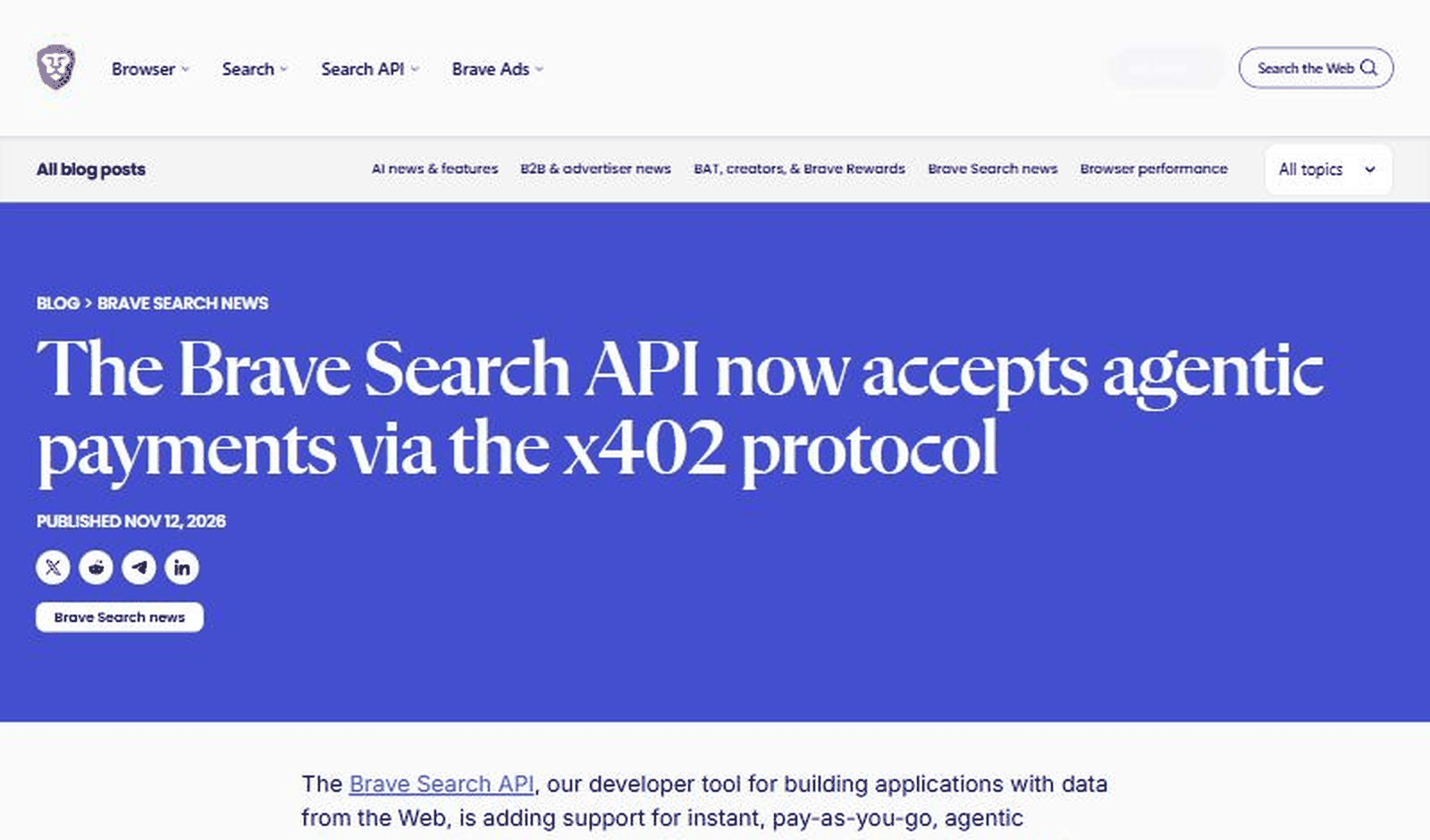
Brave says its Search API can now be paid for per request, with no account and no API key. According to the announcement, developers and autonomous AI agents can query Brave’s search index, “ground agent responses” and settle each request “in real time” using the open x402 payment protocol. A request without payment gets an HTTP 402 “Payment Required” answer that states the price; the agent signs a USDC stablecoin payment on the Base blockchain for that amount and retries. Brave says the price follows its published API rates: $0.005 per request, or $5 per 1,000, for its LLM Context endpoint and for web, news, image, video and local search.
For developers building agents, the practical change is that a payment replaces the credential. For everyone else, it is an early, concrete example of machines paying for services by the request, using stablecoins. It also comes with limits and risks that the announcement mentions only briefly, and we list them below.
Timeline
- November 11, 2026: Brave publishes a related post on how Google’s anti-scraping move pushed scrapers toward Brave Search. It is listed beside the new article; we did not read it in full.
- November 12, 2026: Brave publishes the x402 announcement. The same day it appears on Hacker News (12 points when we first saw it).
- November 13, 2026: we read the announcement, the “Agent payments” guide and the “Pricing” page.
- “Limited time”: the announcement says Base network gas fees “will be covered for a limited time”. No end date is given.
- “Soon”: acceptance on other networks and with other stablecoins is described as “incoming soon”, with no date.
How it works, according to Brave
The announcement and the guide describe the same flow. The agent sends a normal search request to Brave’s agent endpoint, search.agent.s.brave.app. With no payment attached, the server answers 402 and lists the payment options for that exact request. The agent signs a payment for that amount in USDC on the Base network and retries with the signed payment attached. Once Brave’s own “facilitator” verifies the payment, the search runs and the results come back “with a receipt of the transaction”. The guide puts it this way: the signed payment “is the credential”. Today each request carries its own payment; nothing is bought in advance.
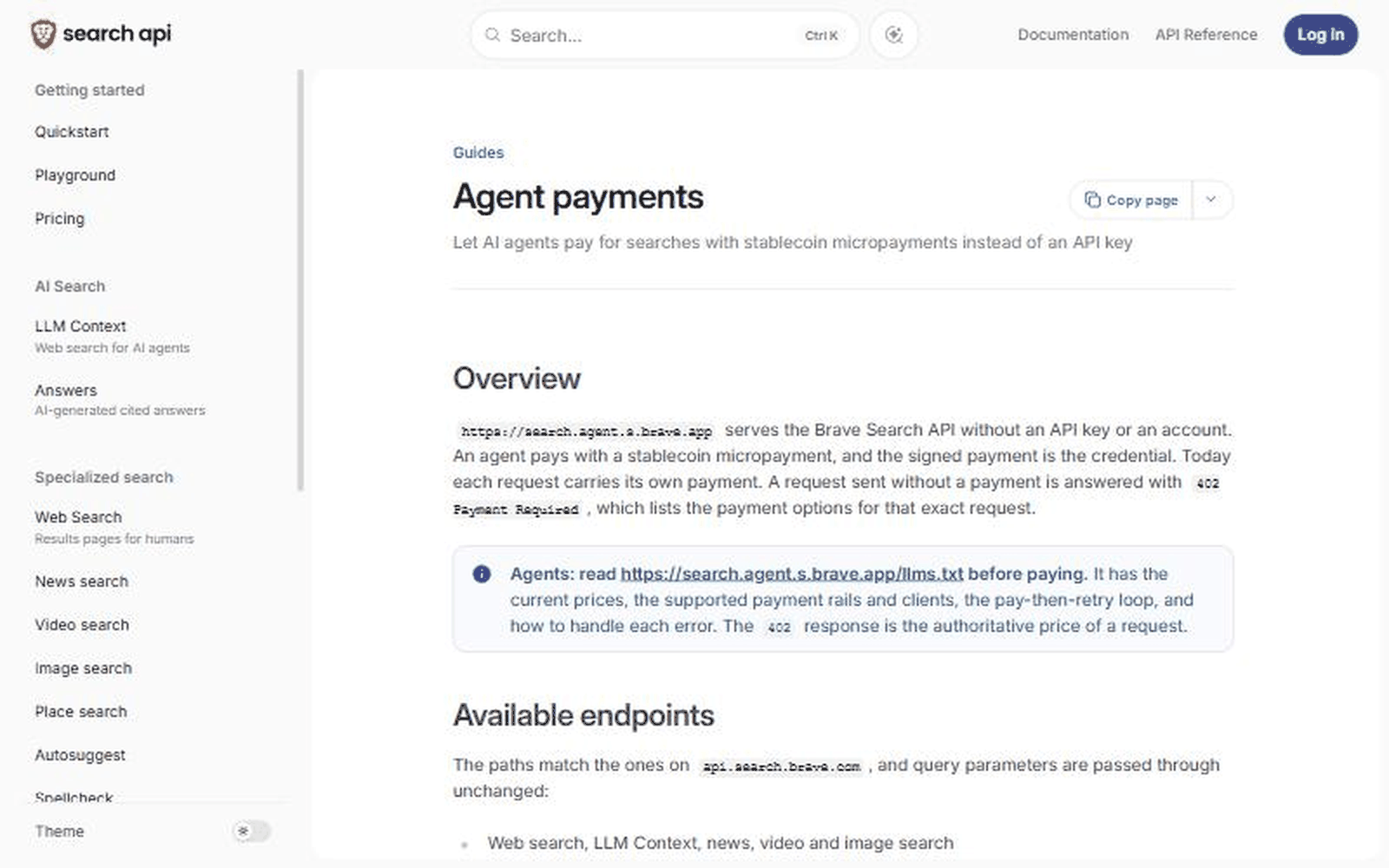
The guide adds practical details. The paid paths match the ones on the normal API host and query parameters are passed through unchanged. Web search, LLM Context, news, video and image search are available, along with place search, points of interest and descriptions. “Answers, Autosuggest and Spellcheck are not sold here yet”, and those still need an API key. A machine-readable price list is available at an openapi.json address, and agents are told to read an llms.txt file “before paying” because “the 402 response is the authoritative price of a request”. The example command uses a client called purl with a cap of 10000 base units, which the guide says is $0.01. The announcement names Purl Wallet, “a Stripe-developed CLI wallet”, as the easiest way to start.
Pricing, side by side
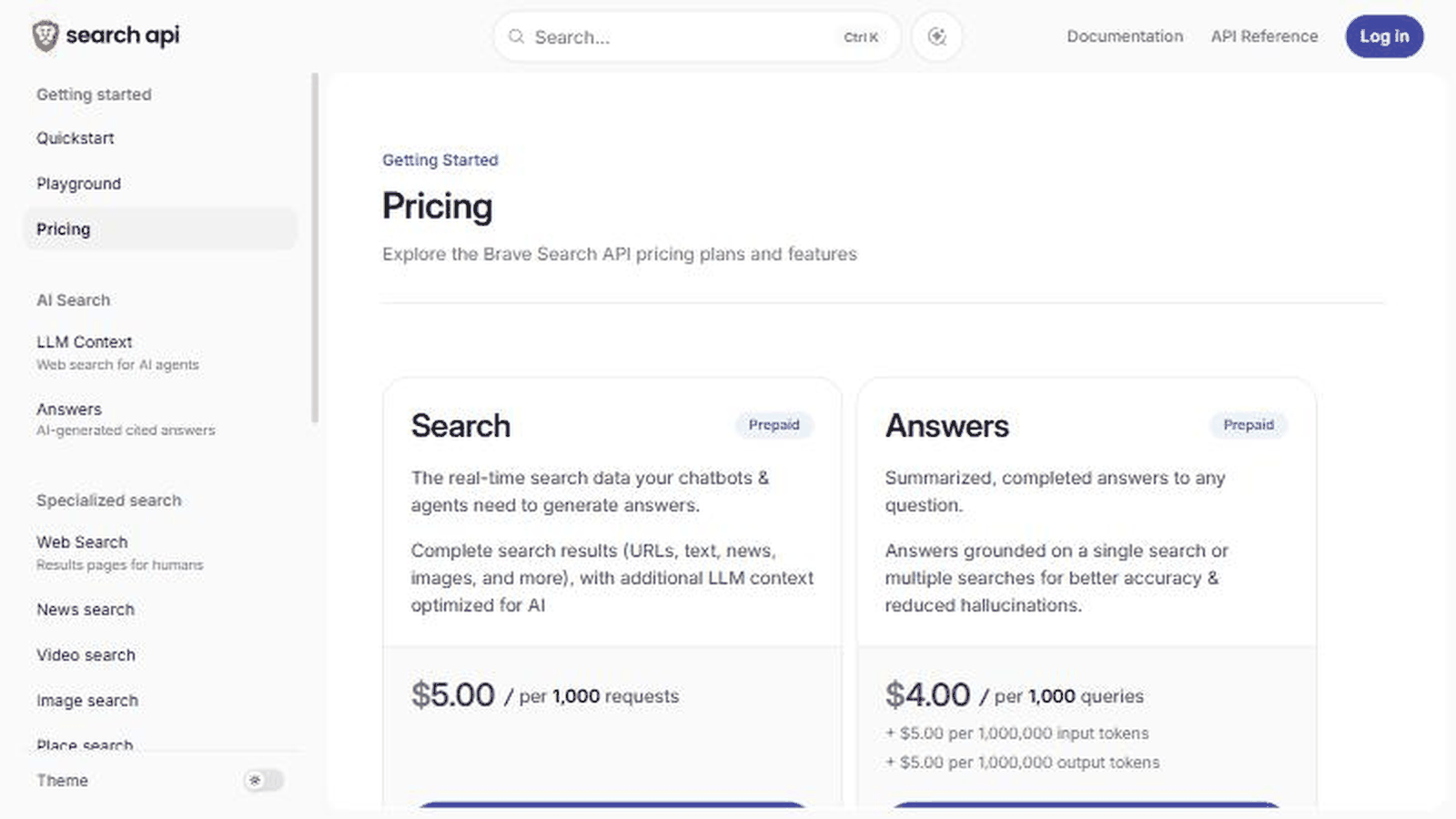
- Search (account plan): $5.00 per 1,000 requests, prepaid, with “free $5 in credits every month” and capacity of 50 requests per second. It includes web search, LLM Context, news, videos and images.
- Answers (account plan): $4.00 per 1,000 queries plus $5.00 per million input tokens and $5.00 per million output tokens, with 2 requests per second.
- Spellcheck and Autosuggest: $5.00 per 10,000 requests each, with 100 requests per second.
- Enterprise: custom terms, “Full-funnel Zero Data Retention”, agreements, invoicing and support on request.
- x402 route: $0.005 per request, the same $5 per 1,000 as the account price for the endpoints listed above, with no monthly credit mentioned.
Our own arithmetic (labelled as ours)
These figures are our own calculations from the published numbers. They assume the list prices and ignore taxes, wallet costs and any network fees.
| What we computed | Result (ours) |
|---|---|
| Price per request at $5 per 1,000 | $0.005, or 200 requests per dollar |
| The free $5 monthly credit on the account plan | 1,000 requests a month at list price |
| The guide’s example payment cap, 10000 base units, which it says is $0.01 | One base unit is $0.000001, so $0.005 is 5,000 base units and the example cap allows two requests’ worth |
| 100,000 requests in a month | $500 at list price ($495 on the account plan after the $5 credit) |
| 1,000,000 requests in a month | $5,000 at list price |
| One Answers query with an assumed 2,000 input and 500 output tokens | $0.004 + $0.01 + $0.0025 = $0.0165, about 3.3 times a $0.005 search. Answers is not sold through x402 yet |
| Full use of the account plan’s 50 requests per second for one day | 4.32 million requests, which at list price would be $21,600. The x402 rate limits are not stated |
The Answers row uses our own token assumptions and is only an illustration of how the pricing is built, not a Brave figure.
Claimed versus what we could verify
| Claim | Source | Our status |
|---|---|---|
| The Search API accepts per-request x402 payments in USDC on Base | Blog post and guide | Described identically on both Brave pages; we did not test a payment |
| No account or API key is needed for these endpoints | Blog post and guide | Stated by Brave; Answers, Autosuggest and Spellcheck still need a key |
| Price is $0.005 per request ($5 per 1,000) | Blog post and pricing page | The figure matches the account-plan price on the pricing page (screenshot above) |
| Gas fees covered for a limited time | Blog post | No end date or amount given |
| More networks and stablecoins are coming soon | Blog post | No date given |
| Free monthly credits | Pricing page | Listed for account plans; not mentioned for x402 |
| Rate limits for x402 requests | Not on the pages we read | Unknown; the 50 per second figure belongs to the account plan |
| Data handling and privacy for x402 users | Not on the pages we read | Unknown; the documentation sidebar links to a privacy notice and terms that we did not review |
Who is actually affected
Developers who build AI agents that need web search are the main audience. An agent that can pay for its own searches does not need a human to sign up, choose a plan and store a key, which suits autonomous or short-lived agents and experiments. Teams that already have an account plan lose nothing; the account route and its free credit still exist. People who run agents on behalf of others should think about who holds the wallet and who is responsible for the spending. Readers who are not developers are affected only indirectly, as this is an early sign of services pricing access per request for software clients.
Why this one is getting attention
Three reasons are visible on the pages. The credential-free design is new for a mainstream search API. The price is simple and the same as the account price. And it links two fast-moving topics, AI agents and stablecoin payments. For other recent stories in this area, see our notes on a local 145-billion-parameter model that avoids per-token fees and on Gemini 4 Hydrogen and its price changes, which show the two ends of the cost question: pay per call to a cloud service, or run it yourself.
Checklist for developers and teams
- Test with a tiny balance first. Load a small amount of USDC on Base and make one request, as the guide’s example does.
- Always set a maximum payment per request. The guide’s example uses a cap, and the 402 response is described as the authoritative price.
- Limit the wallet balance to what the agent may spend. An agent that can sign payments can also lose money through bugs or through hostile web content that tricks it into spending, so treat prompt injection as a financial risk.
- Keep the receipts. Brave says results come with a transaction receipt; you will need records for accounting and taxes, and tax rules for crypto vary by country.
- Compare costs with the account plan: the unit price is the same, but the account plan includes a free monthly credit and published rate limits.
- Check which endpoints you need. Answers, Autosuggest and Spellcheck are not available through x402 yet.
- Do not rely on the covered gas fees or on the current network lineup. Both are described as temporary or incoming.
- Read Brave’s terms and privacy notice for the agent endpoint, and confirm how your own users’ queries are handled.
- Re-read the 402 response and the price list regularly. Prices and payment options can change.
What to watch next
- When the gas-fee subsidy ends and what the effective price becomes.
- Which other networks and stablecoins are added, and when.
- Whether Answers, Autosuggest and Spellcheck join the x402 route.
- Rate limits, usage reports and the terms that apply to wallet-based users.
- Whether other API providers follow with per-request payment.
Frequently asked questions
Do I need a Brave account to use it
Not for the endpoints sold through the agent address. Brave says “a Brave Search API account is no longer needed” for them, and the signed payment is the credential.
How much does a search cost
$0.005 per request, or $5 per 1,000, for LLM Context and for web, news, image, video and local search, according to Brave.
What do I pay with
USDC on the Base network today. Brave says other networks and stablecoins are coming.
Is there a free tier
The account plan lists a free $5 credit each month. The announcement does not say the same applies to x402 payments.
What is HTTP 402
The “Payment Required” status code. Brave uses it to tell the client the price and payment options for a request that came without payment.
Is this safe for my agent
That depends on how you set it up. Use a small balance, a per-request cap and tight limits on what the agent may do, and treat the wallet like cash.
Sources and method
- Brave, “The Brave Search API now accepts agentic payments via the x402 protocol”, brave.com, November 12, 2026. Read November 13, 2026.
- Brave Search API documentation, “Agent payments” and “Pricing” (api-dashboard.search.brave.com). Read November 13, 2026.
- Hacker News front page, November 13, 2026, for discussion context.
Method: we opened each page in a clean browser window without signing in, read it in full and captured the three screenshots above. We quote only short phrases. We did not create a wallet, make a payment or call the API. Arithmetic rows are our own.
Risk note
This is a summary of public pages that can change after we read them. Paying with stablecoins involves the risk of losing funds through errors, scams or software bugs, and it may have tax consequences. Prices, payment options and limits may change. Nothing here is financial, tax, legal or engineering advice. Read Brave’s current documentation and terms before you build or spend.