Edge0-145B: Local 145B Model Claims Against Hugging Face Numbers and License
Updated November 13, 2026. A news analysis built from Edge0’s own announcement “Introducing Edge0-145B: Frontier AI Capabilities on Your Own Computer” (November 12, 2026), the model’s Hugging Face page, our own screenshots of both and the Hacker News front page. Disclosure: the announcement compares its model with Claude-Opus-4.6 (a model from Anthropic), and the research and drafting tools we use for these articles include Claude. We therefore rely on Edge0’s own pages, quote only short phrases and label every number we compute as ours. We did not download or run the model and we did not reproduce any benchmark. This is not engineering, legal or purchasing advice.
The short version
On November 12, 2026, a company called Edge0 announced that it was “open-sourcing Edge0-145B and Edge0-120B”, two large language models that it says run on a personal computer. It calls Edge0-145B “the world’s first open-source on-device AI model with 145 billion parameters” and says its coding, reasoning and agent results rival those of “specific frontier cloud models”. The post reached the Hacker News front page the same day (128 points when we first looked).
We read the announcement and the model’s Hugging Face page and compared them. The headline numbers are consistent in places: the benchmark averages recompute correctly from the table. But the memory and speed figures come from different setups on the two pages, the benchmark results are the company’s own and not yet reproducible by outsiders, and the licence is not a standard open-source licence. This article lays those out side by side so you can see which claims are checkable.
Timeline
- September 10, 2026: per the announcement, Edge0 released a smaller model, Edge0-35B, aimed at phones. The post says it topped Hugging Face’s Trending chart and had passed 1.2 million views on its launch day.
- November 12, 2026: the Edge0-145B and Edge0-120B announcement is published, together with an inference framework, deployment tools and a desktop app. The same day it reaches Hacker News.
- November 13, 2026: we read the announcement and the Hugging Face model page for the 4-bit “NVFP4” build. The model page showed 68 likes, and the organisation 1.65 thousand followers.
- Still pending: the announcement says the “complete evaluation setup, hardware environment, and reproduction instructions are being released with our technical report”. We found no report on the pages we read.
What the announcement claims
- Runs on a laptop. “Reported peak memory of 29GB” and “decoding above 80 tokens/s” on “a compatible laptop”, with 1,100+ tokens per second prefill, roughly 120W typical power and 128K to 256K context.
- Efficient design. Of 145 billion total parameters, “only approximately 10B participate in computation on each inference step”, using a mixture-of-experts design that shares large matrices across experts.
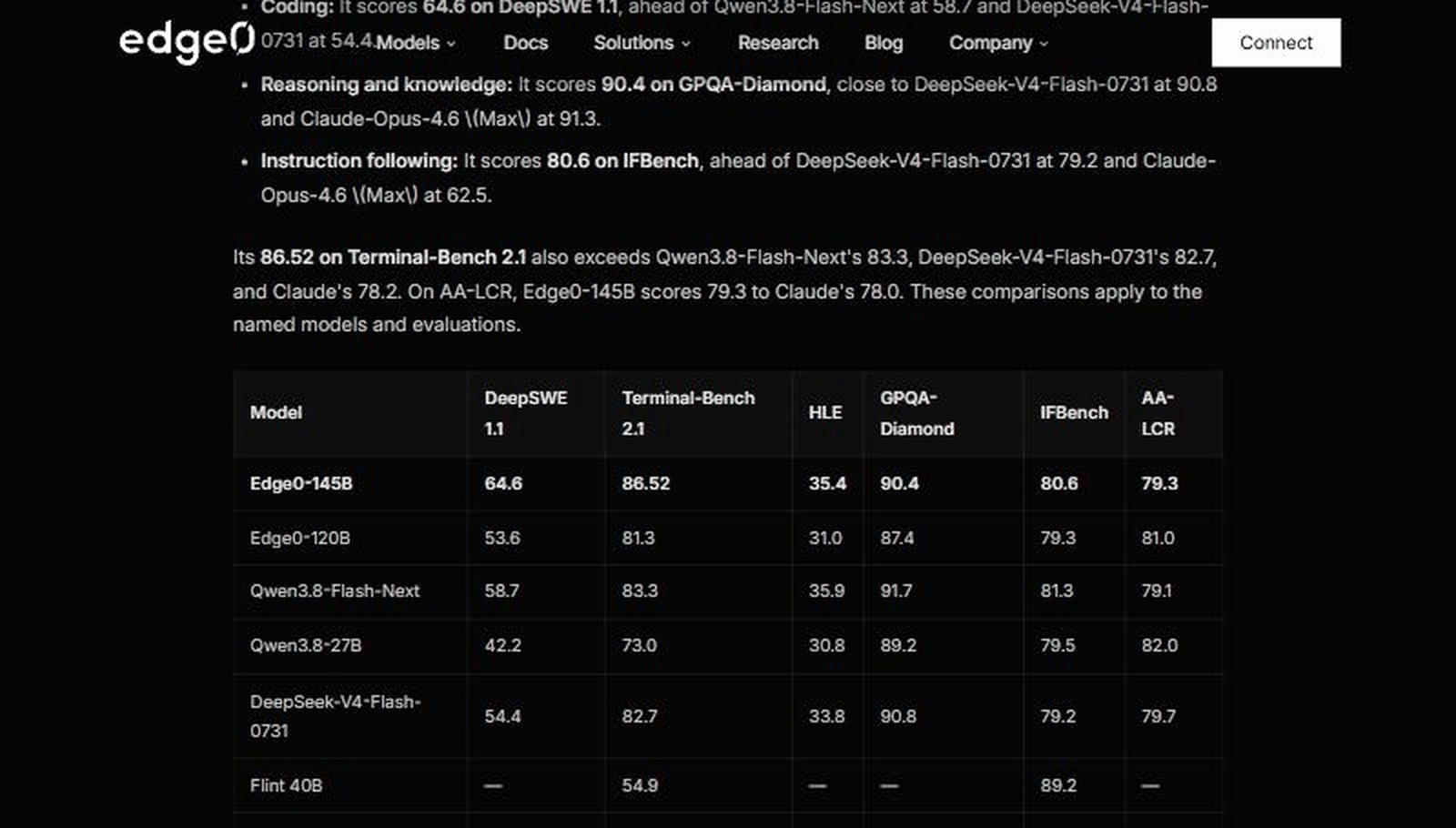
- Benchmarks. 64.6 on DeepSWE 1.1, 86.52 on Terminal-Bench 2.1, 35.4 on HLE, 90.4 on GPQA-Diamond, 80.6 on IFBench and 79.3 on AA-LCR, compared with Qwen3.8-Flash-Next, DeepSeek-V4-Flash-0731 and Claude-Opus-4.6 (Max), among others. The post says Edge0, Qwen, DeepSeek and Claude results “come from Edge0’s internal evaluations”.
- Cost and privacy. Local inference “incurs no corresponding cloud-model token or API fees; data can stay on the computer, and core capabilities keep working offline. Hardware and electricity still cost money.”
- Demonstrations. A video made locally in under an hour, a Manhattan 3D scene in Blender, a medieval city, drone code and a PCB design in KiCad, each said to have run entirely on the machine.
- Company scale. 200 models across four families in a year, coverage of 95 percent of mainstream chip platforms, more than 5 million production devices, 15 million downloads in three months and more than 110,000 customer organisations by October 2026. The post says these portfolio figures “come from company papers and internal testing”.
What the Hugging Face page shows
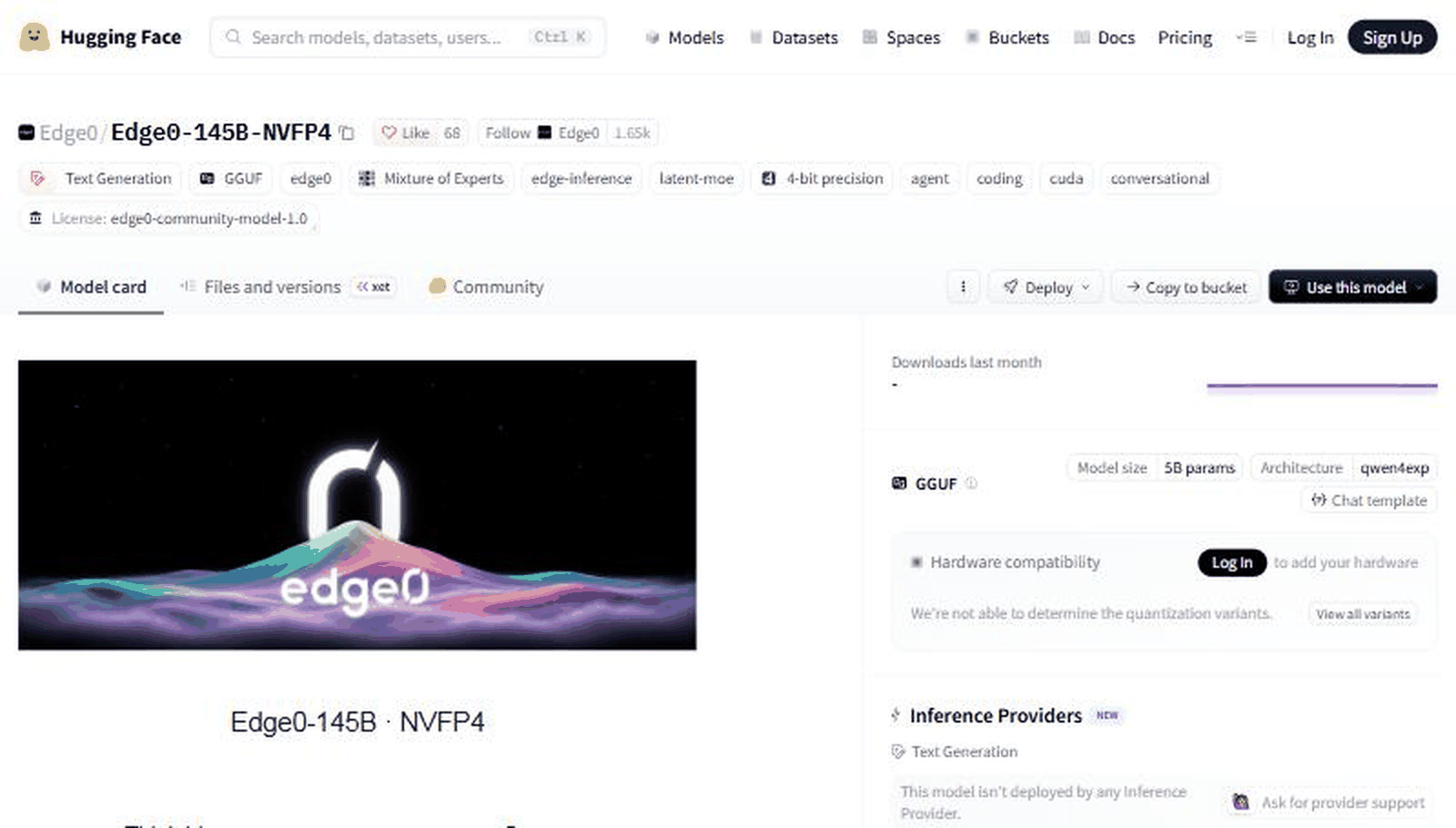
The model page gives a more specific, more hardware-bound picture. Its headline figures are 98.3 tokens per second of agent decode, 3,165.7 tokens per second of 16K prefill and 86.5 on Terminal-Bench 2.1, all “measured on RTX 5090 D 24 GB” with the NVFP4 build. It describes a sparse mixture-of-experts model with 48 layers, 512 experts per layer, 10 routed plus 1 shared expert active per token, 10.12 billion active parameters and a 256K context. It lists two builds: Q3_K at 40.81 GiB and NVFP4 at 47.79 GiB. With the memory-residency setting on, the NVFP4 build used 23.25 GiB of video memory plus 38.27 GiB of host RAM on that GPU.
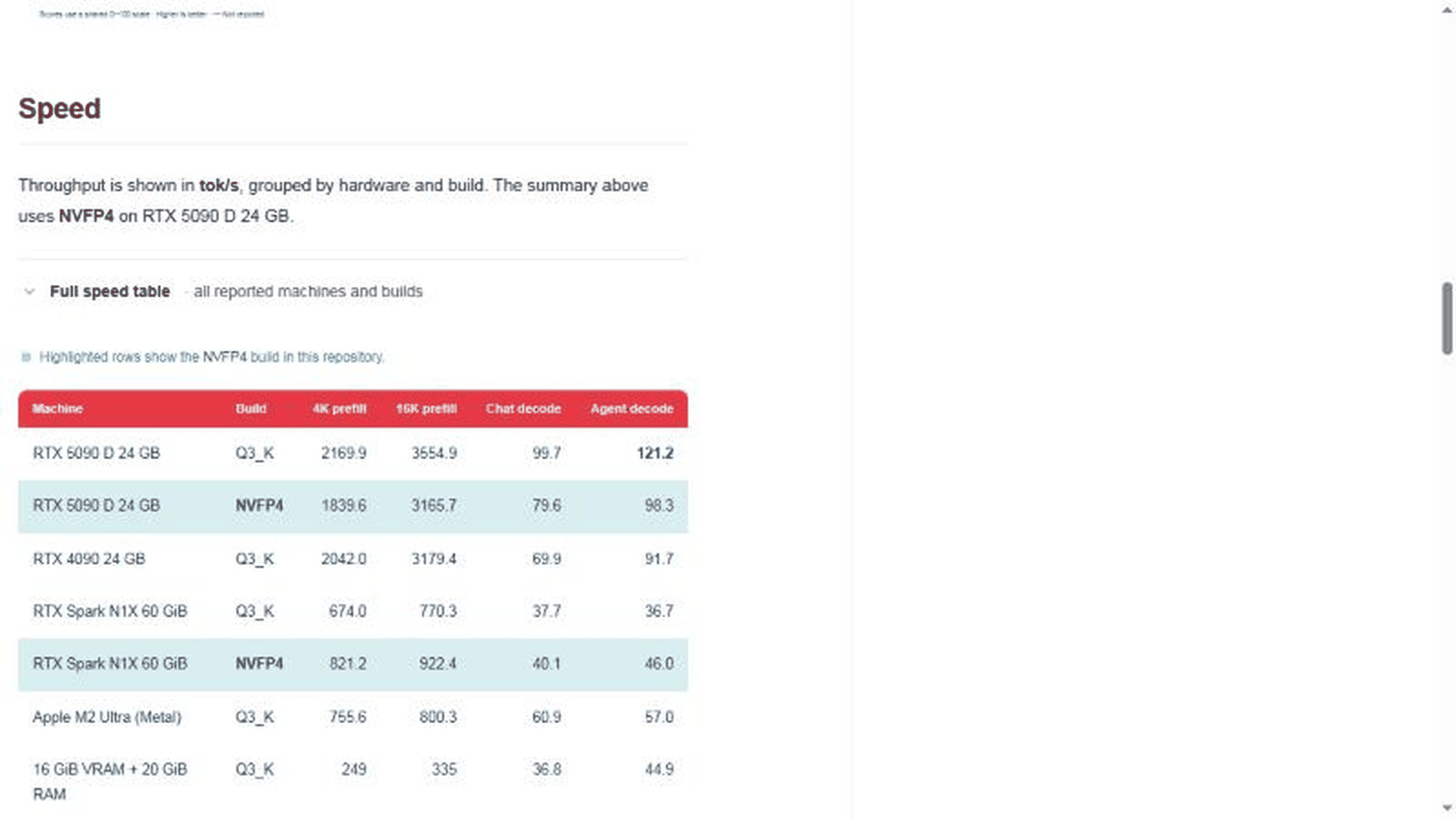
The speed table lists several machines. The model page adds two caveats worth noting. The build instructions target NVIDIA GPUs with CUDA 13 on Linux or Windows, and the Apple M2 Ultra measurements “use Metal; they do not establish macOS release availability”. The base model is shown as Qwen/Qwen3.8-Flash-Next, and the page thanks the Qwen and Strata teams, saying Edge0 extends the Strata engine with latent mixture-of-experts support.
The licence
The page lists the licence as “edge0-community-model-1.0”, not Apache-2.0 or MIT. It says Edge0-specific contributions are provided under that licence only to the extent Edge0 owns or is authorized to license them, that Qwen materials remain under the Qwen Community License 1.0, and that “both sets of applicable terms must be followed”. The Edge0 licence “permits personal use, research, modification, noncommercial sharing, internal use, and commercial use of generated outputs, subject to applicable upstream conditions”. Selling or commercially bundling the model, operating a commercial model service, or offering an independent commercial coding or office assistant using it requires a separate written Edge0 licence. Framework code keeps its Apache-2.0 licence and Strata keeps its MIT licence. In plain terms, you can use and modify the weights for many purposes, but the model is not free of commercial restrictions, which is narrower than what many people mean by “open source”.
Our own arithmetic (labelled as ours)
We recomputed what we could from the numbers on the two pages. These figures are our own calculations.
| What we computed | Result (ours) |
|---|---|
| Mean of the six benchmarks for Edge0-145B (64.6, 86.52, 35.4, 90.4, 80.6, 79.3) | 72.80, matching the 72.8 in the announcement |
| Same mean for Qwen3.8-Flash-Next, DeepSeek-V4-Flash-0731 and Edge0-120B | 71.67, 70.10 and 68.93, matching 71.7, 70.1 and 68.9 |
| Edge0-145B against Qwen3.8-27B on Terminal-Bench and DeepSWE | 86.52 / 73.0 is +18.5 percent and 64.6 / 42.2 is +53.1 percent, matching the post |
| Edge0-145B against Qwen3.8-Flash-Next, benchmark by benchmark | Ahead on DeepSWE (+5.9), Terminal-Bench (+3.22) and AA-LCR (+0.2); behind on HLE (-0.5), GPQA-Diamond (-1.3) and IFBench (-0.7). That is 3 ahead and 3 behind |
| Against Claude-Opus-4.6 (Max) in Edge0’s own table (DeepSWE has no Claude score) | Ahead on Terminal-Bench (+8.32), IFBench (+18.1) and AA-LCR (+1.3); behind on HLE (-4.6) and GPQA-Diamond (-0.9). That is 3 ahead and 2 behind of 5 |
| Active parameters: 10.12 billion of 145 billion | About 7 percent of the parameters per token |
| Memory: the post’s 29GB against its estimated 70GB for Qwen3.8-Flash-Next | About 41 percent, close to the post’s “about 40%”. Against DeepSeek’s estimated 87GB it is about 33 percent. The baseline figures are estimates |
| Hugging Face combined memory (23.25 GiB video memory plus 38.27 GiB host RAM) against the post’s 29GB | 61.52 GiB, about 2.1 times the post’s figure. The two numbers probably measure different things and the pages do not reconcile them |
| Decode speed: 60.9 tokens per second on the Apple M2 Ultra table row against the post’s “80+” | About 76 percent. The RTX 5090 D NVFP4 row is 79.6, just under 80 |
| Downloads: 15 million in about three months (about 90 days) | About 167,000 per day on average, a company-wide figure that is not specific to this model |
Two readings come out of this. The averages and relative gains are arithmetically sound, so the post is not making up its table. And the picture is “competitive on some tests, behind on others”, not a clean win: on three of six tests Edge0-145B is behind Qwen3.8-Flash-Next, a model it was built on, according to the post’s own numbers.
Claimed versus what we could verify
| Claim | Source | Our status |
|---|---|---|
| Weights, framework and an app were released | Announcement | The Hugging Face model page and links exist (screenshots above); we did not download or run anything |
| “World’s first open-source on-device model with 145B parameters” | Announcement | Not verifiable by us. The licence is a custom community licence with commercial restrictions, so “open source” is arguable |
| Benchmark table and averages | Announcement | Arithmetic checks out; the scores are Edge0’s internal evaluations and not independently reproduced |
| “Competitive with specific frontier cloud models” | Announcement | Mixed in the post’s own table: ahead on 3 of 5 tests against Claude-Opus-4.6 (Max), behind on 2 |
| Runs on a laptop with 29GB peak memory at 80+ tokens per second | Announcement | Not matched by the model page, which reports 61.52 GiB of combined video memory and RAM on a desktop GPU and lower speeds on the Apple row; the pages do not reconcile this |
| Local use avoids cloud token fees | Announcement | True in principle; the post itself adds that hardware and electricity still cost money |
| Demonstrations (video, 3D scenes, drone, PCB) ran fully locally | Announcement | Not verified; we saw no independent reproduction. The cost comparisons are Edge0’s estimates |
| 15 million downloads, 110,000 customer organisations, 5 million devices | Announcement | Company figures, stated to come from internal testing and papers; not verified |
Who is actually affected
People with a high-end NVIDIA graphics card and plenty of system memory are the most likely to be able to try the model, based on the model page’s hardware figures and CUDA instructions. Developers who want a local coding or agent model without sending code to a cloud service have a reason to look. Companies planning to build a product or service on the weights must read the licence carefully, because several commercial uses need a separate written licence and Qwen’s own licence also applies. Ordinary laptop users should check the real memory requirement first: the model page’s figures are well above those of a typical machine, and the post itself says a compatible laptop is needed.
Why this one is getting attention
Three reasons are visible on the pages. The size: 145 billion parameters is far above the few billion that on-device models usually carry. The promise: coding and agent work with no per-token fees and the data staying on your machine. And the comparisons with well-known cloud models, which draw clicks even when the details are conditional. For another story that mixes model access, pricing and who can use what, see our note on Apple’s Foundation Models framework, and for how a cloud model’s price compares, Gemini 4 Hydrogen: price and changes.
Checklist if you want to try it
- Compare your hardware with the model page rather than the headline: 23.25 GiB of video memory and 38.27 GiB of host RAM were used on the reference GPU, and the instructions target NVIDIA CUDA 13.
- Do not assume it will run on a Mac. The page says its Apple measurements do not establish macOS release availability.
- Read the Edge0 Community Model Licence 1.0 and the Qwen Community License 1.0 before any commercial use. Selling, bundling or running a commercial service on the model needs a separate licence.
- Download only from the links on Edge0’s own pages and the Hugging Face organisation, and verify file sizes against the 40.81 GiB and 47.79 GiB figures.
- Run your own tests on your own code tasks. The benchmark numbers are internal and the full evaluation setup was not yet published when we looked.
- Measure real speed and power on your machine, including long prompts, before you rely on it for work.
- Remember that local does not automatically mean secure. You are still responsible for your machine, your network and anything the agent is allowed to run.
- Check the Edge0 technical report when it appears and any independent evaluation.
What to watch next
- The promised technical report with the full evaluation setup and reproduction instructions.
- Independent benchmark runs on the Hugging Face weights, especially for Terminal-Bench and DeepSWE.
- Whether Apple Silicon and mainstream laptop support appears with real measurements.
- Any clarification of the licence and of what “open source” means here.
Frequently asked questions
What is Edge0-145B
A 145-billion-parameter mixture-of-experts language model from Edge0 that the company says runs locally and is aimed at coding and agent tasks. About 10 billion parameters are active per token, according to the model page.
Is it really open source
The weights are published under a custom “Edge0 Community Model License 1.0” that allows many uses but restricts selling or bundling the model and running a commercial model service. Whether that counts as open source is a question of definition; it is not a standard permissive licence.
Can I run it on my laptop
The announcement says a compatible laptop is enough, with 29GB peak memory. The model page reports much more combined memory on a desktop GPU and does not establish macOS availability. Check the requirements for your exact machine.
Does it beat Claude
In Edge0’s own table it is ahead of Claude-Opus-4.6 (Max) on three of five shared tests and behind on two. These are Edge0’s internal evaluations and have not been independently reproduced.
Is local really free
There are no per-token fees from a cloud provider, but you pay for hardware and electricity, as the announcement itself says.
Sources and method
- Edge0, “Introducing Edge0-145B: Frontier AI Capabilities on Your Own Computer”, edge0.ai, November 12, 2026. Read November 13, 2026.
- Hugging Face, Edge0/Edge0-145B-NVFP4 model page. Read November 13, 2026.
- Hacker News front page, November 13, 2026, for discussion context.
Method: we opened both pages in a clean browser window without signing in, read them in full, recomputed the benchmark averages and relative gains from the printed tables, and captured the three screenshots above. We quote only short phrases. We did not download the weights, run the software or contact Edge0. Arithmetic rows are our own.
Risk note
This is a summary of public pages that can change after we read them. Benchmark and performance figures are the company’s own and were not reproduced by us. Licence terms can be complicated and we are not lawyers, so read the licence texts yourself and seek advice before commercial use. Nothing here is legal, financial or engineering advice.