Chrome CVE-2026-125350: Exploited XML Use-After-Free Bug
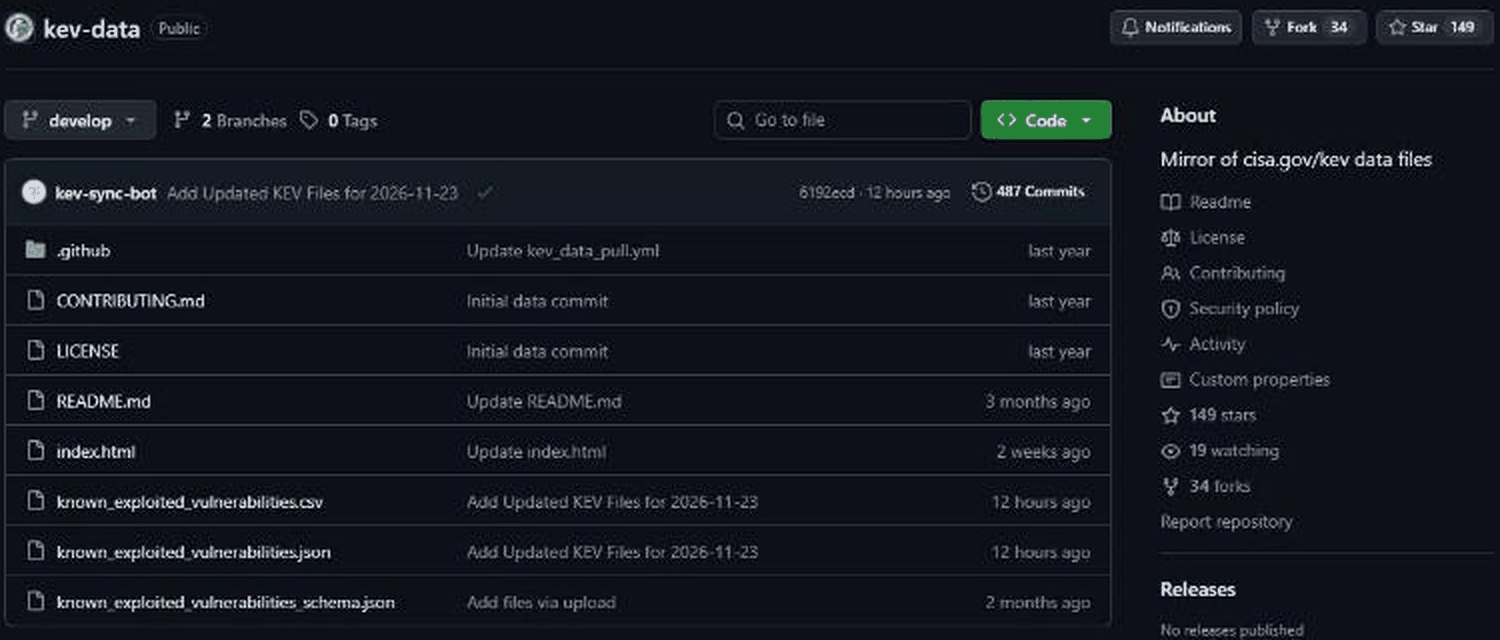
Published November 25, 2026. A news analysis of Google Chrome (Chromium) vulnerability CVE-2026-125350, built from Google’s Chrome Releases blog post “Stable Channel Update for Desktop” of November 9, 2026 (read on November 25, 2026) and CISA’s Known Exploited Vulnerabilities (KEV) data as mirrored on CISA’s GitHub. The screenshot is ours (the CISA data mirror on GitHub). CISA’s own website returned “Access Denied” to our automated browser, so we did not use it. This article contains no affiliate links and we have no commercial relationship with Google. ToolReviewHub is produced with the help of an AI assistant (Claude, made by Anthropic). We did not test the flaw or the exploit. Descriptions are the vendors’ and CISA’s wording, and numbers marked “ours” are our own arithmetic.
Chrome CVE-2026-125350: the short version
- What it is: a high-severity use-after-free in the XML component of Chromium, the engine behind Chrome. Google says it is aware that an exploit for CVE-2026-125350 exists in the wild.
- Fixed in: Chrome 157.0.8103.50 and .51 for Windows and Mac, and 157.0.8103.50 for Linux, released to the Stable channel on November 9, 2026 and rolling out over days and weeks.
- Reporters: Arni Hardarson of Neonix Security (reported on October 12, 2026) and an anonymous reporter (November 6, 2026), according to Google’s post.
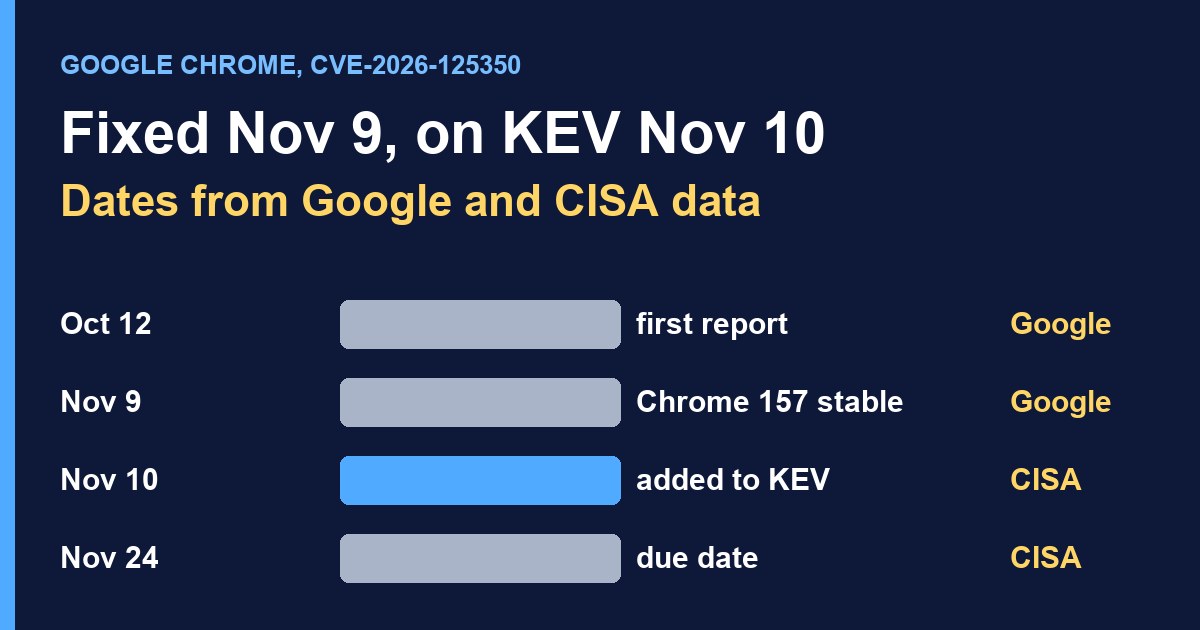
- KEV status: CISA added it to the Known Exploited Vulnerabilities catalog on November 10, 2026, one day after the release, with a November 24 due date.
- Same update: the release fixes nine security issues. Five others are rated High and two Medium, and none of them is flagged by Google as exploited.
What a use-after-free is
A use-after-free is a memory-safety bug. A program releases a piece of memory, and then keeps using it. If an attacker can arrange for that memory to hold data they chose, the program’s later use of it can be steered. In a web browser, such bugs are common targets because the browser processes untrusted content from any site. Browsers lessen the harm with sandboxes, which limit what a compromised web-content process can do, so a single bug like this often needs a second one to escape the sandbox. That is general background and not a statement about this specific flaw.
Google’s post labels the bug “Use after free in XML” and rates it High. As is its usual practice, Google keeps details of the bug restricted until most users have updated, and says it may keep them restricted longer if a third-party library is involved. So the public information is limited to the label, the severity, the reporters and the sentence about exploitation.
What Google says
The announcement is the standard weekly-style post: the Stable channel has been updated to 157.0.8103.50 and .51 for Windows and Mac and 157.0.8103.50 for Linux, which will roll out over the coming days and weeks. It lists nine security fixes. The bug for CVE-2026-125350 appears with two tracking numbers, which fits the two reports on different dates. The note at the end of the list reads, in short, that Google is aware an exploit for CVE-2026-125350 exists in the wild.
Notice what is missing. Google does not say who is using the exploit, how it is delivered or whether it was part of a chain. It does not say whether the exploit was targeted or broad. We do not know either. The credit line names a security researcher who reported the bug on October 12, and an anonymous reporter on November 6. We do not know if either of them is connected to the exploit that Google mentions, and nothing in the post says so.
How Chrome updates work, and why rollout lag matters
Google says the Stable channel update “will roll out over the coming days/weeks.” In practice, Chrome checks for updates in the background on a schedule, downloads the new version, and applies it at the next restart. That design is good for security overall, because it gets fixes to most users without effort. But it creates a gap. A person who never closes the browser may run an old build for a long time, and a machine that is off for a few weeks misses the whole window. For an exploited bug, that gap is exactly what attackers count on.
For organizations the lag is a management problem. Enterprise policies can delay browser updates, and some teams hold back new versions to test internal web applications. If you do that, an exploited-in-the-wild notice is the reason to shorten the delay. A simple rule many teams use, which is our suggestion and not a Google instruction, is to treat any Chrome release that mentions an exploit in the wild as an emergency change, to be rolled out within days and verified by checking the installed version on each device.
It is also worth knowing how to read the numbers. Chrome version strings have four parts. The first number, 157 here, is the major release. The last parts identify the build. When the post says 157.0.8103.50 or .51, either build number carries the fix for Windows and Mac, so a device on .51 is not behind one on .50.
The other eight fixes
The same release patches eight other issues, and Google does not mark any as exploited. Five are rated High: uninitialized resource in WebGL (CVE-2026-125345), incorrect authorization in FileSystem (CVE-2026-125347), buffer overflow in Compositing (CVE-2026-125343), out-of-bounds write in GPU (CVE-2026-125348) and type confusion in V8 (CVE-2026-125344). Two are Medium: uninitialized resource in GPU (CVE-2026-125349 and CVE-2026-125342). Several were reported by Google itself. The practical point is that updating for one exploited bug also removes the others, which is a reason to take the update even when you do not follow the CVE details.
What the release lists
| CVE | Severity | Component and type |
|---|---|---|
| CVE-2026-125350 | High | XML, use after free (exploit in the wild) |
| CVE-2026-125345 | High | WebGL, uninitialized resource |
| CVE-2026-125347 | High | FileSystem, incorrect authorization |
| CVE-2026-125343 | High | Compositing, buffer overflow |
| CVE-2026-125348 | High | GPU, out of bounds write |
| CVE-2026-125344 | High | V8, type confusion |
| CVE-2026-125349 and CVE-2026-125342 | Medium | GPU, uninitialized resource |
Timeline: one day to KEV
| Date (2026) | Event | Source |
|---|---|---|
| October 12 | First report of the bug (Arni Hardarson, Neonix Security) | |
| November 6 | Second report (anonymous) | |
| November 9 | Chrome 157.0.8103.50 / .51 released to Stable | |
| November 10 | CISA adds CVE-2026-125350 to the KEV catalog | CISA KEV data |
| November 24 | KEV due date for U.S. federal civilian agencies | CISA KEV data |
A day between the fix and the KEV listing (ours) fits the pattern for browsers: CISA tends to list flaws that the vendor itself calls exploited. As explained in our KEV analysis, this one got the 14-day window, which ended on November 24. For consumers, though, the rollout is gradual, so some users may not have received the update when the due date arrived.
What to do: a practical checklist
- Update Chrome now. Open the browser menu, go to Help and About Google Chrome, let it check for updates, and restart. You need 157.0.8103.50 or later (Windows and Mac .50 or .51).
- Restart after updating. The update does not protect you until the browser restarts. Many people leave a browser open for weeks.
- Update other Chromium-based browsers. Microsoft Edge, Brave, Opera, Vivaldi and others use the same engine code and ship their own updates on their own schedule. Check each vendor’s release notes for CVE-2026-125350. We did not check their status for this article.
- Update embedded Chromium. Electron apps and other software that bundle Chromium need the vendor to ship a new build. Ask those vendors if you depend on them.
- For managed fleets, push the update with your management tooling and verify the installed version across devices. Do not wait for automatic rollout alone.
- Reduce risk while updating: avoid opening untrusted links, and keep site isolation and other default protections turned on.
- Check extensions you do not use, and remove them.
What we could not confirm
- How the exploit works, who uses it and against whom: Google’s post says only that one exists in the wild.
- Whether the exploit needs another bug to escape the browser sandbox.
- Whether the two reports (October 12 and November 6) relate to the exploit that Google mentions.
- The status of other Chromium-based browsers and embedded copies of Chromium.
- The bug’s technical details, which Google restricts for now.
- CISA’s own catalog page, which we could not open; the KEV facts come from CISA’s GitHub mirror (catalog version 2026.11.23).
Frequently asked questions
What is CVE-2026-125350?
A high-severity use-after-free in the XML component of Chromium, for which Google says an exploit exists in the wild.
Which Chrome version fixes it?
Chrome 157.0.8103.50 (Linux) and 157.0.8103.50 or .51 (Windows and Mac), released to Stable on November 9, 2026.
Do I need to restart Chrome?
Yes. The update takes effect only after the browser restarts.
Does it affect Edge and other browsers?
They share Chromium code, but each vendor ships its own update. Check the vendor’s notes; we did not verify them.
What is the KEV deadline?
November 24, 2026 for U.S. federal civilian agencies. For everyone else it signals urgency and is not a legal deadline.
Method: details come from Google’s Chrome Releases post of November 9, 2026 and CISA KEV data (catalog version 2026.11.23), read on November 25, 2026. For how we research, see How We Review Tools.