Microsoft Outlook CVE-2026-124194: NTLM Leak on CISA KEV
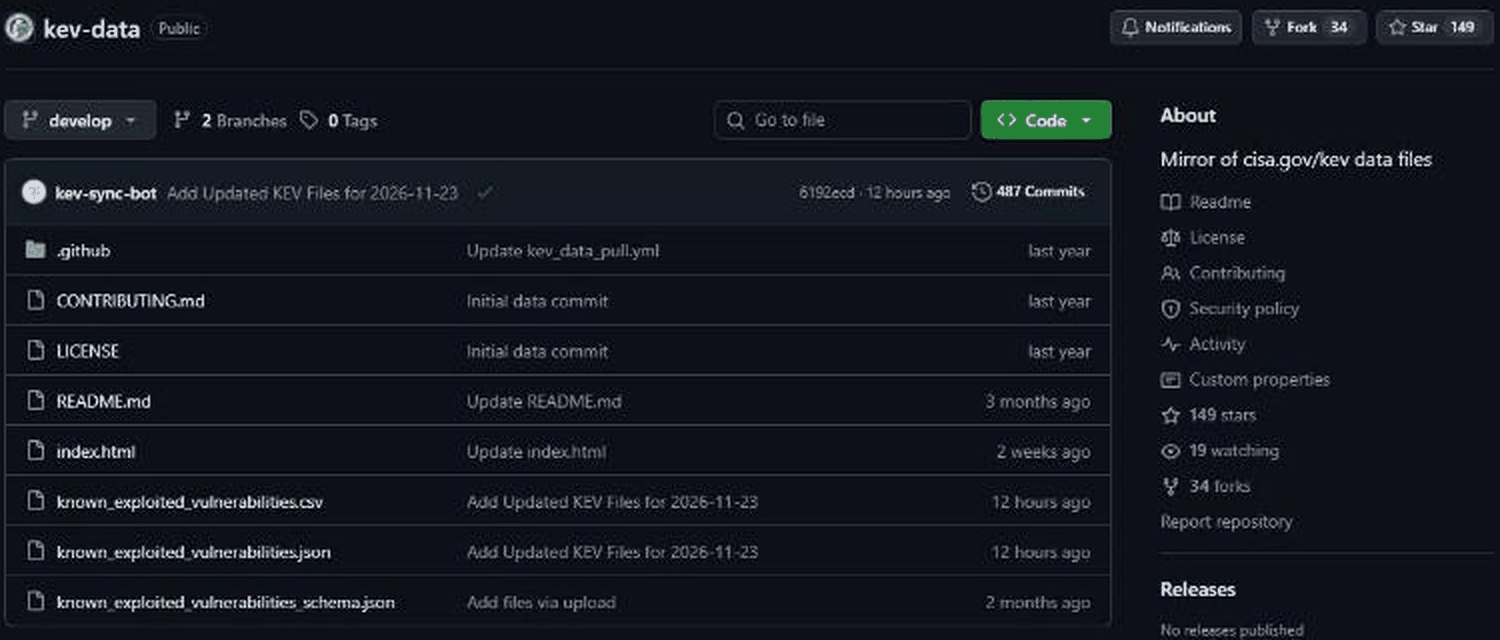
Published November 25, 2026. A news analysis of Microsoft Outlook vulnerability CVE-2026-124194, built from Microsoft’s Security Update Guide entry for CVE-2026-124194 (read on November 25, 2026) and CISA’s Known Exploited Vulnerabilities (KEV) data as mirrored on CISA’s GitHub. The screenshot is ours (the CISA data mirror on GitHub). CISA’s own website returned “Access Denied” to our automated browser, so we did not use it. The Microsoft page loaded in our browser, but we relied on its text and did not capture it. This article contains no affiliate links and we have no commercial relationship with Microsoft. ToolReviewHub is produced with the help of an AI assistant (Claude, made by Anthropic). We did not use Outlook for this article or test the flaw. Descriptions are the vendors’ and CISA’s wording, and numbers marked “ours” are our own arithmetic.
Microsoft Outlook CVE-2026-124194: the short version
- What it is: Microsoft calls it “Microsoft Outlook Spoofing Vulnerability” (weakness CWE-356, product UI does not warn the user of unsafe actions). A crafted message file, when opened, can make Outlook connect to an attacker-controlled network location without the usual external-content warning, and that leaks the user’s NTLMv2 hash.
- Why the hash matters: Microsoft says the attacker could use the NTLMv2 hash to authenticate as the user.
- Severity: Microsoft rates it Moderate, CVSS 3.1 base 6.5 and temporal 6.2, with exploit code maturity High. The “Exploited” field on Microsoft’s page says Yes (exploitation detected), and “Publicly disclosed” says No.
- Not the Preview Pane: Microsoft says the Preview Pane is not an attack vector. The user has to open the file.
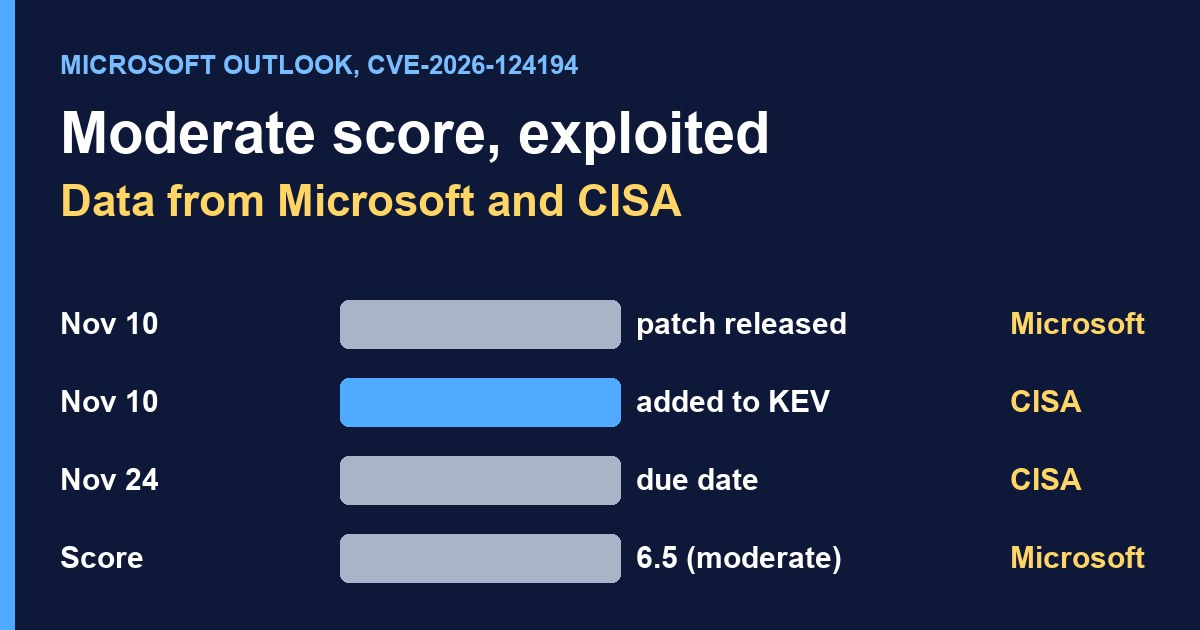
- KEV status: Microsoft released the fix on November 10, 2026, and CISA added the flaw to the KEV catalog the same day, with a November 24 due date.
What NTLM and a “hash leak” mean
NTLM is a long-standing Windows authentication protocol. When Windows is asked to log in to a network resource, it can prove the user’s identity by answering a challenge with a value derived from the user’s password, which is the NTLMv2 hash response. If an attacker controls the server that Windows connects to, they can collect that response. Microsoft’s FAQ says that the attacker could use it to authenticate as the user. Defenders sometimes call this a “hash leak” or credential-forwarding risk. This explanation of NTLM is general background, and not a quote from Microsoft’s page.
That is why a bug that makes Outlook connect to an attacker’s server without warning is more serious than it sounds. Normally, Outlook displays a notice before loading content from outside, because loading it tells the sender something. This flaw is the missing notice.
What Microsoft says about the vulnerability
Microsoft’s executive summary is a single sentence: the product user interface does not warn the user of unsafe actions in Microsoft Office Outlook, which allows an unauthorized attacker to perform spoofing over a network. The FAQ gives the practical picture. An unauthenticated attacker could send a specially crafted message file and convince a user to open it in an affected version of Outlook. Opening the file could cause Outlook to connect to an attacker-controlled network location without displaying the usual external-content warning, potentially disclosing authentication information that could be used to impersonate the user. The attack needs network connectivity and user interaction.
Two details limit the picture. The Preview Pane is not an attack vector, so merely selecting the message in the reading pane is not enough, according to Microsoft. And the user has to be persuaded to open the file. A message file is a saved email, so the attack is a form of phishing that depends on an attachment.
The CVSS vector on Microsoft’s page, CVSS:3.1/AV:N/AC:L/PR:N/UI:R/S:U/C:H/I:N/A:N, rates the impact as high for confidentiality and none for integrity and availability. Combined with the need for user interaction, that produces a 6.5 base score, which Microsoft labels Moderate. The temporal score, which takes the state of exploitation and the fix into account, is 6.2.
Moderate does not mean low priority
Microsoft’s own page shows the pattern we keep running into in this series: a modest score with an “Exploited: Yes” marker. The Exploitability section says that the flaw was not publicly disclosed at the time of publication, that exploitation was detected, and the temporal metric lists exploit code maturity as High. Together with CISA’s KEV listing on the day of the patch, these entries say that attackers used the flaw before the fix was available, or very close to it.
For a mail client, the combination of user interaction and a moderate score can mislead. Phishing needs a user to open something, but users open things every day. If attackers have a working technique, the volume of phishing, not the score, drives the risk.
A note on the acknowledgement
Microsoft’s acknowledgements list “Benoit Sevens using Claude with Anthropic” among the people credited for the report. This site is also written with the help of Claude, an AI assistant made by Anthropic, as we state at the top of every article. We have no connection to that finding, and we mention it only so that you can weigh our commentary with the same context.
What Microsoft lists
| Item | Detail |
|---|---|
| Title | Microsoft Outlook Spoofing Vulnerability |
| Released | November 10, 2026 |
| Impact / severity | Spoofing / Moderate |
| Weakness | CWE-356, product UI does not warn user of unsafe actions |
| CVSS 3.1 | Base 6.5, temporal 6.2; AV:N/AC:L/PR:N/UI:R/S:U/C:H/I:N/A:N |
| Exploitability | Publicly disclosed: No. Exploited: Yes. Exploit code maturity: High |
| Products we saw listed | Microsoft 365 Apps for Enterprise (32-bit and 64-bit), Office LTSC 2024 and Office LTSC 2021 (32-bit and 64-bit) |
| Preview Pane | Not an attack vector |
The product list above is the set of rows we captured on Microsoft’s page. The page may list more products, so check it for your edition. Build numbers are published at the Office security releases page that Microsoft links from the entry.
Timeline: patch and KEV on the same day
| Date (2026) | Event | Source |
|---|---|---|
| November 10 | Microsoft publishes CVE-2026-124194 and the security updates | Microsoft |
| November 10 | CISA adds CVE-2026-124194 to the KEV catalog | CISA KEV data |
| November 24 | KEV due date for U.S. federal civilian agencies | CISA KEV data |
The 14-day window (ours) matches the longer deadline described in our November KEV analysis. It ended on November 24.
What to do: a practical checklist
- Update Office. Install the November 10, 2026 security updates for Microsoft 365 Apps, Office LTSC 2024 or Office LTSC 2021, and confirm the build number against Microsoft’s list.
- Block outbound NTLM where you can. Restrict NTLM authentication to external servers, and block outbound SMB (port 445) at the network edge. Microsoft documents NTLM restrictions, but we did not read the guidance for this article, so check it before changing policy.
- Warn users about saved message files. Tell staff not to open message files (.msg) that arrive as attachments from unknown senders.
- Review mail-gateway rules for attachments of that type, and consider quarantining them from outside senders.
- Look for odd outbound authentication attempts from user workstations to external addresses in your firewall or proxy logs, since early November.
- If you see such attempts, reset the affected users’ passwords and check for suspicious sign-ins, because the hash may have been captured.
- Enable multi-factor authentication where possible, so that a captured credential alone is not enough for services outside the Windows domain.
What we could not confirm
- How attackers are using the flaw, who they are and how many users were affected: Microsoft says exploitation was detected, without details.
- The complete list of affected products: we captured six Office rows and the page may include others.
- The exact build numbers that contain the fix: Microsoft points to an Office security releases page that we did not open.
- Whether Outlook on the web, the new Outlook for Windows or Outlook for Mac are affected: the rows we saw did not list them.
- Whether the blocking of outbound NTLM would fully stop the attack in your environment.
- CISA’s own catalog page, which we could not open; the KEV facts come from CISA’s GitHub mirror (catalog version 2026.11.23).
Frequently asked questions
What is CVE-2026-124194?
A spoofing vulnerability in Microsoft Outlook: opening a crafted message file can make Outlook connect to an attacker-controlled location without the usual warning, leaking the user’s NTLMv2 hash.
Is the Preview Pane a risk?
Microsoft says no. The user has to open the file.
Is it exploited?
Yes, according to Microsoft’s page (exploitation detected) and CISA’s KEV catalog. It was not publicly disclosed when the fix came out.
How do I fix it?
Install the November 10, 2026 Office security updates for your edition. Check build numbers against Microsoft’s page.
What is the KEV deadline?
November 24, 2026 for U.S. federal civilian agencies. For everyone else it signals urgency and is not a legal deadline.
Method: details come from Microsoft’s Security Update Guide entry for CVE-2026-124194 (released November 10, 2026) and CISA KEV data (catalog version 2026.11.23), read on November 25, 2026. For how we research, see How We Review Tools.