Cisco BroadWorks CVE-2026-20320: XXE Flaw on CISA KEV
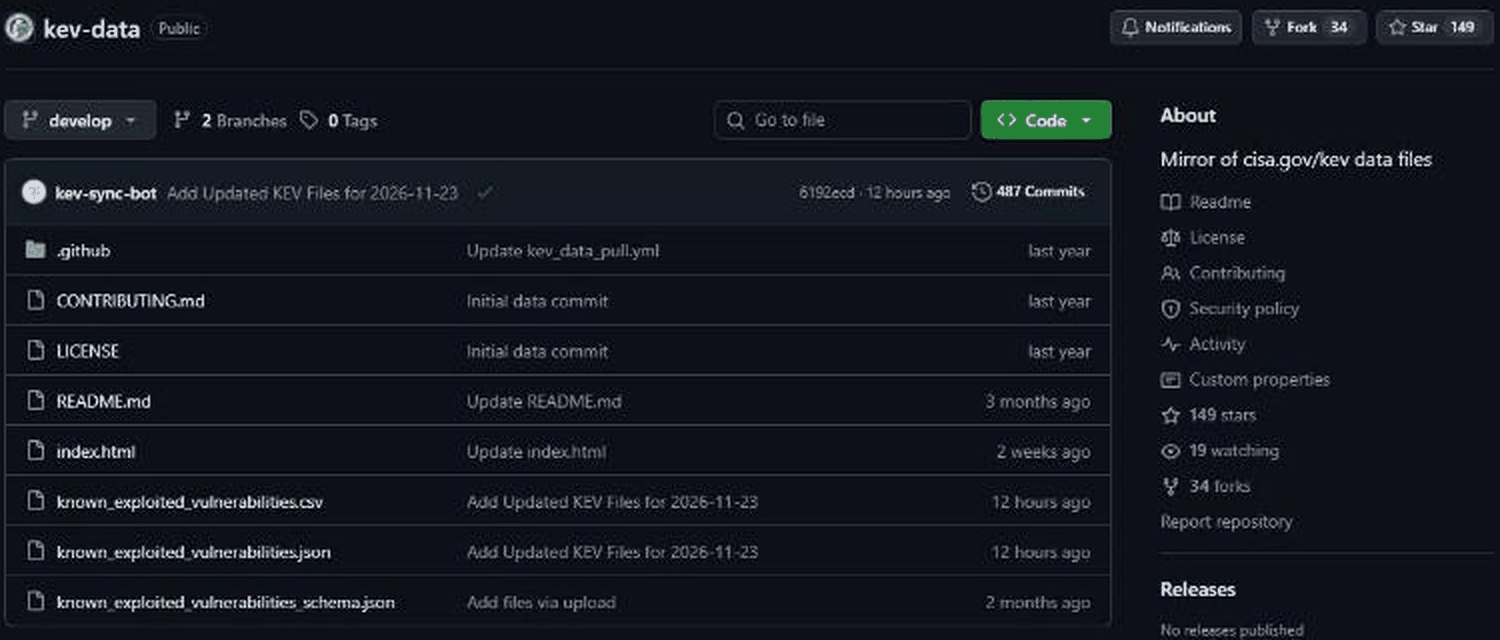
Published November 25, 2026. A news analysis of Cisco BroadWorks vulnerability CVE-2026-20320, built from Cisco’s security advisory cisco-sa-bworks-xxe-uwUd7CEt (read on Cisco’s website on November 25, 2026) and CISA’s Known Exploited Vulnerabilities (KEV) data as mirrored on CISA’s GitHub. The screenshot is ours (the CISA data mirror on GitHub). CISA’s own website returned “Access Denied” to our automated browser, so we did not use it. Cisco’s advisory pages have frozen our capture tool before, so we did not screenshot it. This article contains no affiliate links and we have no commercial relationship with Cisco. ToolReviewHub is produced with the help of an AI assistant (Claude, made by Anthropic). We did not run BroadWorks or test the flaw. Descriptions are the vendors’ and CISA’s wording, and numbers marked “ours” are our own arithmetic.
Cisco BroadWorks CVE-2026-20320: the short version
- What it is: an out-of-band blind XML external entity (XXE) injection in the Open Client Interface (OCI) XML parser of Cisco BroadWorks. Cisco says an unauthenticated remote attacker can read sensitive configuration information by sending a crafted XML message to the OCI-P service, which exposes files with the privileges of the BroadWorks user.
- Severity: High, CVSS 7.5, weakness CWE-611, Cisco bug ID CSCwv48590. There are no workarounds.
- Affected regardless of configuration: the Application Delivery Platform, Application Server, Profile Server and Xtended Services Platform. Cisco lists RI.2026.07 as the fixed release for builds earlier than it.
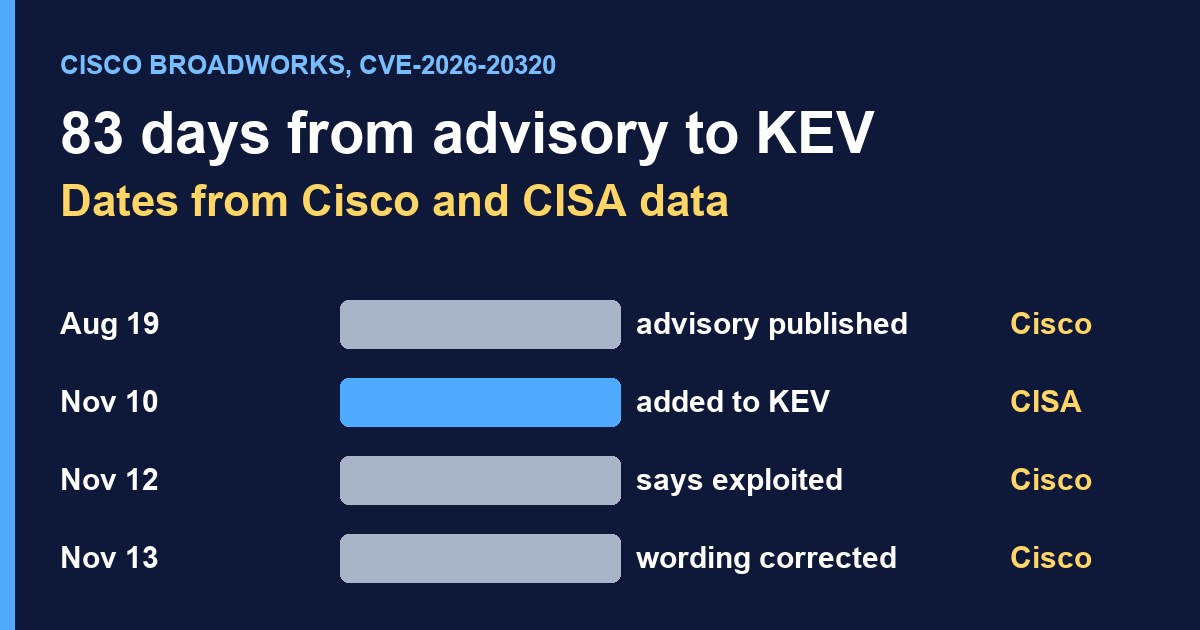
- The wording correction: on November 12, Cisco updated the advisory to reflect known active exploitation. On November 13 it corrected itself to say the flaw was added to CISA’s KEV catalog and that Cisco has no direct evidence of exploitation.
- KEV status: CISA added it on November 10, 2026, 83 days (ours) after the advisory first appeared on August 19. The due date was November 24.
What BroadWorks is
BroadWorks is Cisco’s platform for cloud and carrier voice and collaboration services. Service providers run it to offer business phone systems and related features to their customers. The advisory names four components that are affected: the Application Delivery Platform, the Application Server, the Profile Server and the Xtended Services Platform. We did not read Cisco’s product documentation for this article, so we do not describe what each component does beyond their names. The advisory says they are affected regardless of configuration.
Because BroadWorks is mostly run by service providers and large enterprises, individual customers of a phone provider are not the ones who patch it. If your phone service comes from a provider that uses BroadWorks, your action is to ask the provider, not to install anything yourself.
What the vulnerability is
Cisco’s advisory title is “Cisco BroadWorks Out-of-Band Blind XML External Entity Injection Vulnerability.” XML External Entity (XXE) injection happens when an XML parser is allowed to follow references to external resources defined in the incoming document. An attacker can then make the parser read local files or contact other hosts. “Blind” means that the parser does not return the file contents in its response, and “out-of-band” means the data has to be carried out through some other channel, such as a request to a server the attacker controls.
The advisory locates the flaw in the XML parser of the Open Client Interface (OCI). The XML entries are not parsed safely, so external entity resolution is allowed. An unauthenticated remote attacker who sends a crafted XML message to the OCI-P service can view sensitive files on the file system with the privileges of the BroadWorks user, which Cisco summarizes as reading sensitive configuration information. Reading configuration files can expose passwords, keys and internal addresses, but the advisory does not list what a given system would reveal, and we have not tested anything.
The score of 7.5 matches a network attack with low complexity, no privileges and no user interaction, and a high impact on confidentiality only (our reading of the typical vector for that score; the advisory page shows the number and the weakness class). That is the profile of an information-disclosure bug: it takes without changing, and its harm depends on what is in the files.
Fixed releases
Cisco states that there are no workarounds, so the fix is to move to a fixed release. The advisory lists builds earlier than RI.2026.07 as needing an upgrade to RI.2026.07. The table in the advisory has a footnote about OCS and OCI over SOAP for one of the rows, which we did not read in detail, so check the exact row for your component in Cisco’s own table.
Advisory facts
| Item | What Cisco says |
|---|---|
| Title | Cisco BroadWorks Out-of-Band Blind XML External Entity Injection Vulnerability |
| Severity | High, CVSS 7.5 |
| Weakness / bug ID | CWE-611 / CSCwv48590 |
| Affected components | Application Delivery Platform, Application Server, Profile Server, Xtended Services Platform (regardless of configuration) |
| Fixed in | RI.2026.07 for earlier builds (see Cisco’s table for footnotes) |
| Workarounds | None |
| Credit | Sandesh M Gawai |
The revision history tells a story
The advisory’s version history is where this article gets interesting. Version 1.0 appeared on August 19, 2026. Version 1.1 on November 12 was “updated to reflect known active exploitation.” Version 1.2 on November 13 was “corrected to state that this vulnerability was added to the CISA KEV catalog,” with the statement that Cisco does not have direct evidence of active exploitation. So Cisco first said that exploitation was known, then walked back its own wording to say that it was CISA’s listing that it was reflecting. This is the same pattern as in the Cisco Expressway advisory that we covered, where Cisco and CISA differed in the same way.
How should a reader take this? Cisco’s position is that it did not itself observe attacks. CISA’s position, by being in the KEV catalog, is that there is evidence of exploitation. The two statements do not contradict each other, because CISA may have information that Cisco does not. For a defender, the safe reading is that someone has evidence of exploitation, whoever that is, and that you should treat the flaw as exploited.
Timeline: 83 days to KEV
| Date (2026) | Event | Source |
|---|---|---|
| August 19 | Cisco publishes the advisory (version 1.0) | Cisco |
| November 10 | CISA adds CVE-2026-20320 to the KEV catalog | CISA KEV data |
| November 12 | Cisco updates the advisory to reflect known active exploitation (version 1.1) | Cisco |
| November 13 | Cisco corrects the wording: added to the KEV catalog, no direct evidence of exploitation (version 1.2) | Cisco |
| November 24 | KEV due date for U.S. federal civilian agencies | CISA KEV data |
The 83 days between the advisory and the KEV listing (ours, from August 19 to November 10) give a long window in which affected systems could have been patched but were not. The due date, 14 days after the listing (ours), is the longer window described in our November KEV analysis. It ended on November 24.
What to do: a practical checklist
- Identify your BroadWorks components and versions if you operate the platform. Check each of the four affected components.
- Upgrade to RI.2026.07 or the fixed build in Cisco’s table for your component. There is no workaround.
- Limit access to the OCI-P service. Allow only known provisioning systems and management networks to reach it. This is general hygiene that reduces exposure while you patch; it is not a substitute for the fix.
- Review OCI-P logs for unusual XML requests, especially from unknown addresses, since August.
- Consider the files at risk. If the platform may have been probed, rotate secrets stored in configuration files that the BroadWorks user can read, such as database credentials and keys.
- If you are a customer, ask your voice provider whether it runs BroadWorks and whether it has applied the fix. Get the answer in writing.
- Watch for outbound connections from the BroadWorks servers to unfamiliar hosts, which could be the out-of-band channel.
What we could not confirm
- Whether anyone has exploited the flaw: Cisco says it has no direct evidence, while CISA’s catalog lists it as exploited, and neither gives details.
- Which files an attacker could read on a real system: the advisory says sensitive configuration information, without a list.
- The exact fixed-release row for each component: the advisory has a footnote that we did not read closely.
- How many providers run affected builds.
- The CVSS vector string: we saw the score, 7.5, and the weakness class.
- CISA’s own catalog page, which we could not open; the KEV facts come from CISA’s GitHub mirror (catalog version 2026.11.23).
Frequently asked questions
What is CVE-2026-20320?
An out-of-band blind XML external entity injection in the OCI XML parser of Cisco BroadWorks that lets an unauthenticated remote attacker read sensitive configuration information.
Which release fixes it?
Cisco lists RI.2026.07 as the fixed release for earlier builds. There are no workarounds.
Is it exploited?
CISA lists it in the Known Exploited Vulnerabilities catalog. Cisco says it has no direct evidence of exploitation, after first updating the advisory to say it was known.
Do I need to patch if I am a phone customer?
Not yourself. Your provider operates BroadWorks, so ask it whether it applied the fix.
What is the KEV deadline?
November 24, 2026 for U.S. federal civilian agencies. For everyone else it signals urgency and is not a legal deadline.
Method: details come from Cisco’s advisory cisco-sa-bworks-xxe-uwUd7CEt (first published August 19, 2026, version 1.2 of November 13, 2026) and CISA KEV data (catalog version 2026.11.23), read on November 25, 2026. For how we research, see How We Review Tools.