Cisco Expressway CVE-2026-76466: Critical Hard-Coded Credentials Flaw on CISA’s Exploited List, While Cisco Says It Has No Direct Evidence of Exploitation
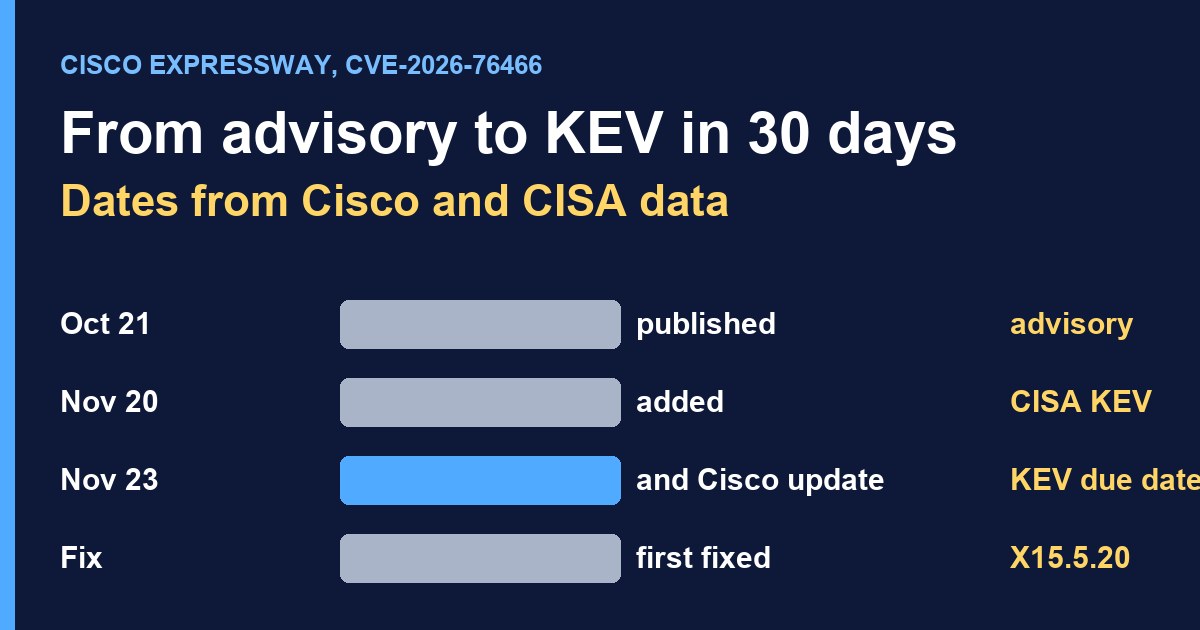
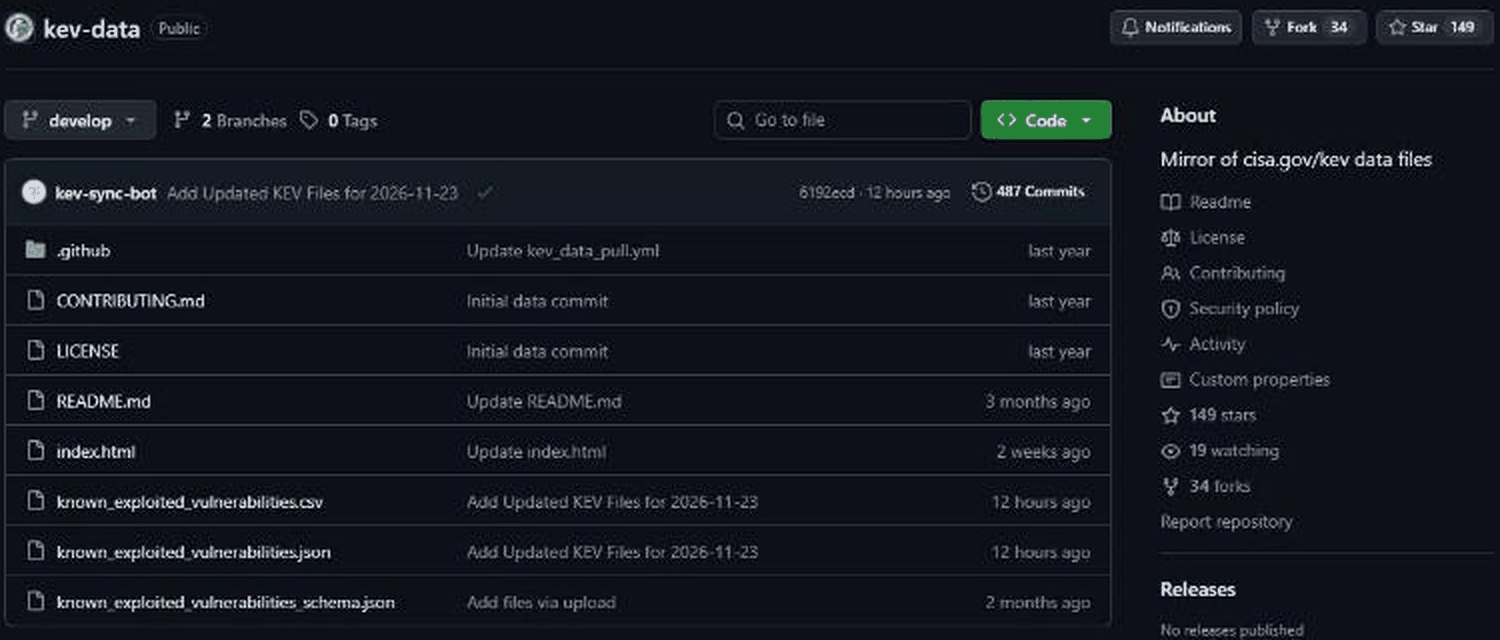
Published November 24, 2026. A news analysis of Cisco Expressway Series vulnerability CVE-2026-76466, built from Cisco’s security advisory cisco-sa-vcs-static-cred-hr7EWZ8t and its companion advisory cisco-sa-exwy-hardening-FhcqBVcs (both read on November 24, 2026), the National Vulnerability Database entry, and the data files of the U.S. Cybersecurity and Infrastructure Security Agency (CISA) Known Exploited Vulnerabilities (KEV) catalog as mirrored on CISA’s GitHub. CISA’s own website returned “Access Denied” to our automated browser, so we did not use it. We could not capture a screenshot of Cisco’s page (it froze our capture tool), so the images here are our own timeline card and, in the related article, a capture of CISA’s data mirror. This article contains no affiliate links and we have no commercial relationship with Cisco. ToolReviewHub is produced with the help of an AI assistant (Claude, made by Anthropic). We did not test the vulnerability or any patch. Descriptions are Cisco’s and CISA’s wording, and numbers marked “ours” are our own arithmetic.
Cisco Expressway CVE-2026-76466: the short version
- What it is: a critical flaw in the database service of Cisco Expressway Series (Expressway-C and Expressway-E) that, according to Cisco, lets an unauthenticated attacker who can reach the device over the network run operating system commands as root. Cisco’s CVSS base score is 9.8, and the weakness is listed as CWE-798, use of hard-coded credentials.
- Who is affected: Expressway-C and Expressway-E, both virtual and appliance, running a vulnerable release and configured in a cluster, per Cisco.
- The fix: Cisco says it has released software updates. For release X15.5.3 and earlier the first fixed release is X15.5.20; for X14 and earlier Cisco says to migrate to a fixed release. There are no workarounds.
- KEV status: CISA added the flaw to its Known Exploited Vulnerabilities catalog on November 20, 2026 with a due date of November 23, 2026. On November 23 Cisco revised its advisory to say it was added to the KEV and that it does not have direct evidence of active exploitation.
- Timeline: Cisco published the advisory on October 21, 2026, 30 days before the KEV addition (ours).
- What to do now: check whether you run Expressway in a cluster, find your release, upgrade to a fixed release, and review the device for signs of compromise afterwards.
What Cisco Expressway is, and why this product matters
Cisco Expressway Series is the pair of products that sit between a company’s internal collaboration systems and the outside world: Expressway-C (Core) sits inside the network, and Expressway-E (Edge) sits at the boundary so that people outside can join video calls and so that separate organizations can connect their voice and video systems. The advisory describes the family only as Expressway Core (Expressway-C) and Expressway Edge (Expressway-E) devices. We did not use the product, and we do not know how many organizations expose one to the internet, but products at the network edge are a natural target: they are reachable, they trust other systems, and a compromise at the edge can be a stepping stone inward.
What the vulnerability is
Cisco’s description is specific about the mechanism, and the details matter for who is exposed:
- The flaw is in the database service feature of Expressway.
- It is “due to the use of persistent cookies.”
- In addition, there is insufficient validation of client certificates when the TLS Verify Mode is set to Enabled for clustering, “which means that client certificates are not validated.”
- Per Cisco, an attacker who holds the cookies can connect to the database service and invoke specific remote procedure call (RPC) commands.
- A successful exploit could let the attacker run arbitrary commands as root on the underlying operating system.
In plain terms, Cisco says the cluster’s internal database service relies on a secret that is reused (hence the hard-coded credentials weakness) and does not check who is connecting even when certificate checking is switched on. NVD records Cisco’s score as 9.8 Critical with the vector CVSS:3.1/AV:N/AC:L/PR:N/UI:N/S:U/C:H/I:H/A:H, meaning network-reachable, low complexity, no privileges, no user interaction and high impact on confidentiality, integrity and availability. NIST’s own assessment was “not yet provided” when we read the page. CISA’s KEV entry describes the same thing in its own words: an unauthenticated remote attacker with persistent cookies and network access running commands as root on a clustered device through the database service.
We are deliberately not explaining how the cookies could be obtained or how the RPC commands work. Neither Cisco nor CISA describes that, and spelling it out would not help a defender.
Which versions and configurations are affected
| Question | What Cisco’s advisory says |
|---|---|
| Which products? | Cisco Expressway-C and Expressway-E, both virtual and appliance versions |
| Which configuration? | Devices configured in a cluster, running a vulnerable release |
| Which releases? | X14 and earlier: migrate to a fixed release. X15.5.3 and earlier: first fixed release is X15.5.20 |
| Workarounds? | None |
| Cisco bug ID | CSCww27732 |
| Weakness | CWE-798, use of hard-coded credentials |
| Not affected? | Cisco says only products in the Vulnerable Products section are known to be affected |
The clustering condition is the most useful fact for triage. A single, non-clustered Expressway is not described as vulnerable to this specific flaw, but Cisco’s companion advisory says its hardening release affects devices “regardless of device configuration,” so a non-clustered device still needs the update. Upgrade anyway.
The companion advisory: October 2026 hardening release
The same day, October 21, 2026, Cisco published a second advisory, “Cisco Expressway Series Security Hardening Release: October 2026” (cisco-sa-exwy-hardening-FhcqBVcs), rated High with a CVSS base score of 8.6, last updated October 27. Cisco says its engineers ran a broad internal security review that produced a hardening release addressing several internally discovered vulnerabilities, found in testing and not known to be actively exploited. To simplify disclosure, Cisco grouped the issues by weakness class (CWE) and gave each group a single CVE, among them CVE-2026-76490, CVE-2026-76491 and CVE-2026-76492, with weaknesses including CWE-248, CWE-377 and CWE-476. This advisory also lists no workarounds and says it affects Expressway-C and Expressway-E, virtual and appliance, regardless of configuration.
The advisory for CVE-2026-76466 states that its fix is also part of the broader hardening improvements. So one upgrade to a fixed release covers both. The practical lesson is that if you only read the KEV entry you would see one CVE, but the upgrade also addresses a larger set of weaknesses that Cisco found itself.
Timeline: from advisory to KEV
| Date (2026) | Event | Source |
|---|---|---|
| October 21 | Cisco publishes the Expressway advisories (Critical, CVSS 9.8) and the hardening advisory (High, 8.6) | Cisco |
| October 27 | Cisco updates the hardening advisory (version 1.1) | Cisco |
| November 20 | CISA adds CVE-2026-76466 to KEV, with a November 23 due date | CISA KEV data |
| November 23 | Due date. Cisco revises the advisory to say it was added to KEV and that it has no direct evidence of active exploitation | Cisco, CISA KEV data |
The gap between the advisory and the KEV entry is 30 days, and the deadline gave federal agencies three days (ours). That is typical of the pattern we described in our analysis of the November 2026 KEV additions, where 18 of 26 entries had a three-day window.
Is it being exploited? Reading Cisco and CISA together
The two sources look like they disagree. CISA’s catalog exists to list vulnerabilities that are exploited in the wild. Cisco’s revision of November 23 notes that the flaw was added to the CISA KEV and adds, in the revision history, that Cisco has no direct evidence of active exploitation. There are several honest ways to read that. CISA may have evidence Cisco has not seen, such as reports from other organizations. Cisco may be saying it has not observed exploitation on its own telemetry or in the cases it handles. Or the wording may reflect different thresholds for what counts as evidence. Public information does not let us decide. For a defender the decision is the same: a critical, unauthenticated route to root on an edge device, with a fix available and no workaround, is a reason to upgrade now whatever the evidence says. Cisco continues to strongly recommend upgrading to a fixed software release.
Cisco credits Stefan Aleksic of Jane Street with reporting the vulnerability, which suggests it came through responsible disclosure and not an incident response case.
What to do: a practical checklist
- Find every Expressway. List Expressway-C and Expressway-E instances, virtual and appliance, including lab and failover devices.
- Check clustering and release. Note which devices are clustered, and which release each runs. X15.5.3 and earlier need X15.5.20 or later; X14 and earlier need migration to a fixed release.
- Upgrade to a fixed release. There is no workaround, so the update is the fix, and it also contains the October 2026 hardening changes. If you cannot get the software, Cisco says to contact its Technical Assistance Center with the product serial number and the advisory URL.
- Reduce exposure while you plan. Cisco does not list mitigations, so this is general hygiene and not a Cisco instruction: keep management and cluster traffic on restricted networks and allow only the hosts that need to reach those services.
- Check for compromise after patching. CISA’s required-action text for November entries refers to “forensics triage requirements,” and a device that was reachable while vulnerable deserves a log review, a check of user accounts and configuration changes, and a look at outbound connections from the device.
- Record what you did. If you are in the federal supply chain or a regulated industry, keep evidence of the date you patched.
What we could not confirm
- Whether the flaw is being exploited, by whom, and how: CISA lists it, Cisco says it has no direct evidence, and we found no public attack report.
- The fixed-release table for the hardening advisory in full: we read the CVE-2026-76466 table (X14 and earlier, X15.5.3 and earlier, X15.5.20) and only the beginning of the other.
- How many Expressway devices are exposed to the internet or run in clusters.
- Anything about the product’s internals beyond Cisco’s description; we did not test any version.
- CISA’s own catalog page, which we could not open; the KEV facts come from CISA’s GitHub mirror (catalog version 2026.11.23).
Frequently asked questions
What is CVE-2026-76466?
A critical vulnerability in Cisco Expressway Series that Cisco says could let an unauthenticated remote attacker run commands as root through the database service on a clustered device. Cisco rates it CVSS 9.8.
Which Cisco Expressway versions are fixed?
Release X15.5.20 is the first fixed release for X15.5.3 and earlier. For X14 and earlier, Cisco says to migrate to a fixed release.
Is there a workaround?
No. Cisco says there are no workarounds that address the vulnerability.
Is CVE-2026-76466 actively exploited?
CISA added it to the Known Exploited Vulnerabilities catalog on November 20, 2026. Cisco says it does not have direct evidence of active exploitation. Treat it as urgent either way.
Does it affect a single, non-clustered Expressway?
Cisco describes the vulnerable configuration as devices configured in a cluster. The hardening release, which also contains the fix, affects devices regardless of configuration, so upgrade every device.
Who found the vulnerability?
Cisco thanks Stefan Aleksic of Jane Street for reporting it.
Method: details come from Cisco’s advisories cisco-sa-vcs-static-cred-hr7EWZ8t (version 1.1, November 23, 2026) and cisco-sa-exwy-hardening-FhcqBVcs (version 1.1, October 27, 2026), the NVD entry for CVE-2026-76466, and CISA KEV data (catalog version 2026.11.23). For how we research, see How We Review Tools.