VMware vCenter CVE-2026-123890: Critical Authentication Bypass Exploited as a Zero-Day Before Broadcom’s November 19 Patch, and What to Check
Published November 23, 2026. A news analysis built from primary sources: Broadcom’s security advisory VMSA-2026-0009 and its supplemental FAQ, the Google Threat Intelligence Group and Mandiant blog post of November 20, 2026, and the CISA Known Exploited Vulnerabilities (KEV) catalog as mirrored on GitHub, plus our own screenshots of the pages. This article contains no affiliate links and we have no commercial relationship with Broadcom, VMware, Google or any vendor named here. We did not install the patches, run vCenter or test anything, and we publish no technique for exploiting the flaw: we leave out the technical mechanism and the tool details that Google’s post describes. Dates and durations marked “ours” are our own arithmetic.
The short version
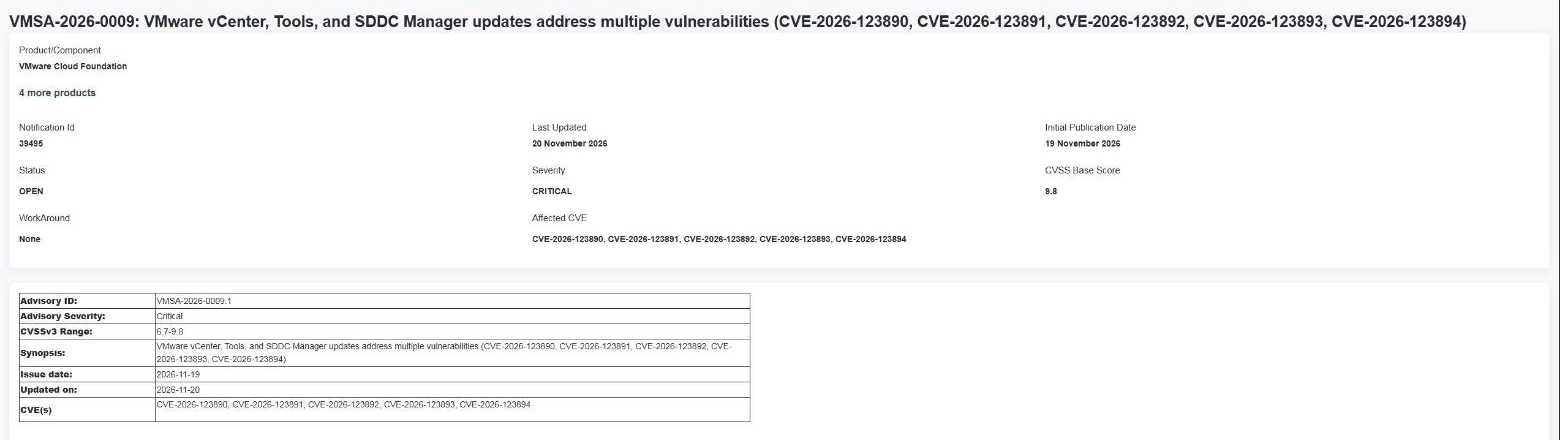
- What happened: on November 19, 2026 Broadcom published advisory VMSA-2026-0009 with fixes for five vulnerabilities in VMware vCenter, SDDC Manager and VMware Tools. The worst, CVE-2026-123890, is an authentication bypass in the vCenter Directory Service rated Critical, CVSS 9.8 out of 10. There is no workaround.
- It was used before the patch. The advisory does not say so. Google Threat Intelligence Group and Mandiant say, in a post dated November 20, that a suspected China-linked espionage group they call ARMORY CASTLE exploited this flaw in early September 2026, in what the post calls post-compromise activity. Mandiant also reported the flaw to Broadcom.
- CISA agrees it is exploited. The flaw was added to the KEV catalog on November 20, with a federal due date of November 23, today (ours: three days).
- Who needs to act: every vCenter below the fixed versions: 9.1.1.0200, 9.0.2.0200, 8.0 U3m, 5.2.5 for the vCenter shipped with VMware Cloud Foundation 5.x. vSphere 7.0 is out of general support and needs an extended-support contract. Broadcom says older versions should be presumed affected.
- Two catches: installing 8.0 U3m or 9.0.2.0200 blocks an upgrade to VCF 9.1.1 until 9.1.2 arrives, and this is a separate flaw from the one fixed on July 29, so earlier patching does not cover it.
- Not a VM escape. Broadcom says none of the five issues allows code to run on an ESX host from a virtual machine, and ESX itself is not affected.
The five flaws, in one table
The advisory is rated Critical overall, with scores from 6.7 to 9.8 on CVSS version 3.1. Only the first one is in vCenter; three are in SDDC Manager and one is in VMware Tools for Windows. The table is copied from the advisory, with no calculation of ours.
| CVE | Component | Type, as Broadcom words it | Score | Severity |
|---|---|---|---|---|
| CVE-2026-123890 | vCenter | Authentication bypass in the VMware Directory Service | 9.8 | Critical |
| CVE-2026-123891 | SDDC Manager | SQL injection (authenticated attacker) | 8.1 | Important |
| CVE-2026-123892 | SDDC Manager | Authenticated command injection | 7.2 | Important |
| CVE-2026-123893 | SDDC Manager | Local privilege escalation (needs administrative privileges) | 6.7 | Moderate |
| CVE-2026-123894 | VMware Tools for Windows | SAML token signature bypass | 6.7 | Moderate |
For CVE-2026-123890 the advisory says: “A malicious actor with network access to vCenter may exploit this issue to bypass authentication and gain unauthorized access to the system.” It thanks Mandiant for reporting it. It credits a researcher from NATO NCSC for the SDDC Manager SQL injection and a named researcher for the VMware Tools issue; we did not read the credits for the other two.
Which versions are fixed
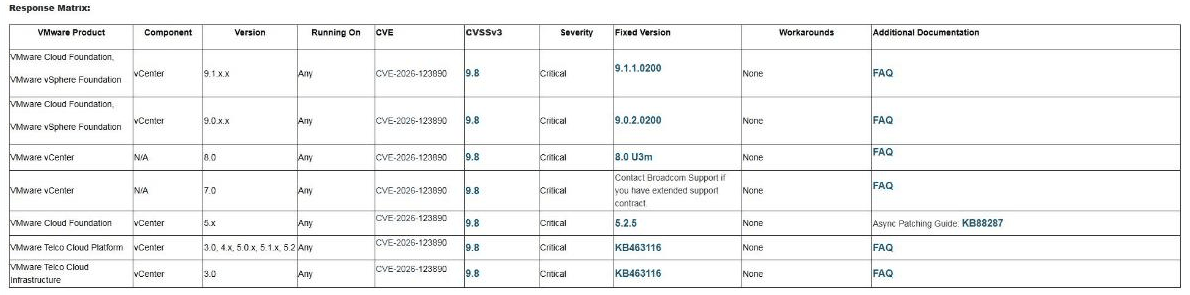
This is Broadcom’s response matrix for the vCenter flaw. All rows show “Any” for the platform it runs on and “None” for workarounds.
| Product | Version | Fixed version |
|---|---|---|
| VMware Cloud Foundation, vSphere Foundation (vCenter) | 9.1.x.x | 9.1.1.0200 |
| VMware Cloud Foundation, vSphere Foundation (vCenter) | 9.0.x.x | 9.0.2.0200 |
| VMware vCenter | 8.0 | 8.0 U3m |
| VMware vCenter | 7.0 | Contact Broadcom Support if you have an extended support contract |
| VMware Cloud Foundation (vCenter) | 5.x | 5.2.5, applied through the asynchronous patching process in KB 88287 |
| VMware Telco Cloud Platform (vCenter) | 3.0, 4.x, 5.0.x, 5.1.x, 5.2 | KB 463116 |
| VMware Telco Cloud Infrastructure (vCenter) | 3.0 | KB 463116 |
The SDDC Manager and VMware Tools fixes are in the same advisory: SDDC Manager 9.1.1.0200, 9.0.2.0100 or 5.2.5, and VMware Tools 13.1.5.0 for the 13.x line and 12.5.5 for 12.3 to 12.5. Patches are cumulative, so newer versions than those listed also contain the fixes. The FAQ adds that a system already on SDDC Manager 9.1.1.0 is protected against the SDDC Manager issues, though Broadcom recommends the latest version.
What the advisory does not say: it was already being used
We searched the advisory page for the words “exploited,” “exploitation” and “in the wild” and found none. The FAQ uses “exploited” once, about the VMware Tools issue, in a sentence on what an attacker needs. Neither document says that the vCenter flaw was used in attacks. The advisory says only that the vulnerabilities were “privately reported” to Broadcom.
The evidence of use comes from two other places:
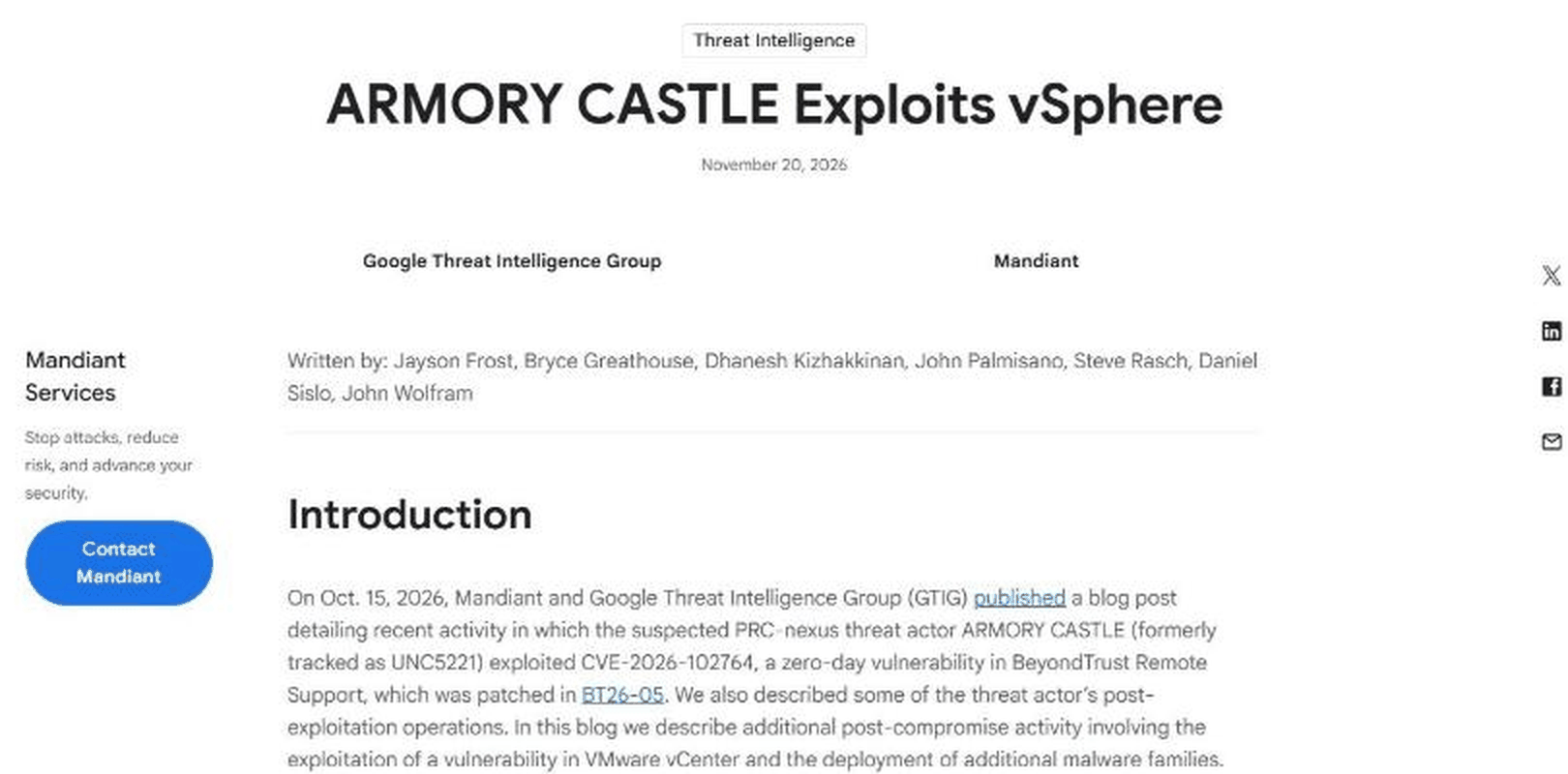
- Google and Mandiant (November 20): their post, titled “ARMORY CASTLE Exploits vSphere,” says that on November 19 VMware disclosed CVE-2026-123890 and that ARMORY CASTLE “exploited this vulnerability in early September 2026,” according to forensic evidence. GTIG attributes the activity to a suspected PRC-nexus espionage actor, formerly tracked as UNC5221. The post says the group exploited two zero-days in the campaign and deployed three sets of malware built for the devices it targeted.
- CISA (November 20): the catalog lists the flaw as a VMware vCenter authentication bypass using an alternate path or channel. Its description matches Broadcom’s. It requires federal agencies to apply the vendor’s mitigations under its directive BOD 26-04 and to follow CISA’s forensic triage requirements. The field for known ransomware use reads “Unknown.”
Two points keep this in proportion. First, the attribution is Google’s word, “suspected,” and we cannot check it. Second, Google describes this as post-compromise activity that follows the operation in its earlier post of October 15, which concerned a zero-day in BeyondTrust Remote Support, patched in BT26-05. In plain terms, the report does not present vCenter as the front door; it presents vCenter as a high-value target once the attacker was already inside a network.
A timeline, and what it says about the gap
| Date (2026) | Event | Source |
|---|---|---|
| July 29 | A different vCenter authentication flaw, CVE-2026-59309, is disclosed in VMSA-2026-0006 | Broadcom FAQ, Google |
| Before July 29 | Mandiant says it has evidence the group knew of CVE-2026-123890 before that disclosure | |
| Early September | Forensic evidence of exploitation of CVE-2026-123890 in a victim network | |
| October 15 | Google publishes the first post on the group, about the BeyondTrust zero-day | |
| November 19 | Broadcom publishes VMSA-2026-0009 | Broadcom |
| November 20 | Google publishes its vSphere post; CISA adds the flaw to KEV | Google, KEV |
| November 23 | CISA’s due date for federal agencies | KEV |
| About 10 to 11 weeks | From early September to the patch (ours) | Our calculation |
| More than 16 weeks | From the July 29 disclosure of the earlier flaw to the November 19 patch (ours: 113 days) | Our calculation |
Google also says the custom tool it analysed was compiled more than a month before it was used in the intrusion, which it reads as a sign that it was built for wider operations. We cannot verify that, and we do not take it further. The practical reading of the timeline is simple: a patch that arrives weeks after first use is a reason to look backward, not only forward. If you run an exposed or poorly segmented vCenter, patching closes the door; it does not tell you whether someone has already been through it.
This is not the July flaw
Broadcom’s FAQ answers the obvious question directly: CVE-2026-123890 “is a new and distinct issue,” and all systems below the fixed versions need this update, including those that already installed the July fix. Google’s post says the two flaws share some overlap but lists key differences. We do not repeat the technical detail. The takeaway for administrators is that a vCenter patched in July is still in scope.
Older versions and the “back-in-time” catch
Two points in Broadcom’s FAQ change what “just patch it” means in practice:
- End of support. For vSphere 6.5 and 6.7, the FAQ says to presume that they are affected: Broadcom does not evaluate products past their End of General Support date for security advisories, and versions the advisory does not list should be assumed to be affected. For vSphere 7.0, the answer is yes, it is affected; 7.0 reached End of General Support on October 2, 2025, and customers with an active extended support contract should use that channel. Broadcom strongly encourages customers on older versions to upgrade to VCF 9.1.
- Upgrades in progress. The FAQ warns that these updates cause a “back-in-time” restriction: vCenter 8.0 U3m and 9.0.2.0200 block upgrades to VCF 9.1.1, and customers should wait briefly for VCF 9.1.2. Teams in the middle of an upgrade can wait or speed up: upgrading vCenter to 9.1.1 first allows applying the security update there. Broadcom points to KB 67077 for the compatibility rules.
Broadcom also frames the vCenter issue as an emergency change in ITIL terms, and says the exact timing depends on each organization’s circumstances and its information security staff.
What to check: a practical list
This list combines the advisory, the FAQ and Google’s hardening advice with general practice. We have not tested it. Where a step is our own suggestion we say so.
- Find every vCenter you run. Standalone, inside VMware Cloud Foundation or vSphere Foundation, and in Telco Cloud products. Include test and lab vCenters and any that were set up by a team outside IT. Note each version and build.
- Compare against the response matrix. Use the fixed version for your line: 9.1.1.0200, 9.0.2.0200, 8.0 U3m or, for VCF 5.x, 5.2.5 via KB 88287. If you run Telco Cloud, follow KB 463116.
- Plan around the back-in-time rule if an upgrade to VCF 9.1.1 is under way: read the FAQ and KB 67077 first.
- Do not wait for a workaround. The advisory lists none. Patching is the fix.
- Limit who can reach vCenter. The advisory’s condition is network access. List which systems and networks can reach the vCenter management interfaces. Google argues that the appliance’s built-in firewall has limits: it lacks port-specific control, and it is managed through the same management interface an attacker may reach. Google points to its own defender’s guide for vSphere. We did not test any of this; read the remediation section of Google’s post for its reasoning.
- Look backward, not only forward. If your vCenter was exposed or you had a recent incident elsewhere on the network, treat the patch as the start of a review, not the end. Google’s post lists indicators of compromise and detection guidance; read it rather than relying on our summary. Also consider CISA’s forensic triage requirements if you are a federal agency. This is partly our suggestion.
- Do the smaller fixes too. SDDC Manager and VMware Tools fixes are in the same advisory and are cumulative.
- Check support status. If you are on 7.0 or older, decide now whether to buy extended support or upgrade. This is our suggestion.
What we could not confirm
- That the patches work. We installed nothing and tested nothing.
- The attribution to ARMORY CASTLE, or that the group is state-linked. That is Google’s assessment, and it says “suspected.”
- How many organizations were affected, or whether anyone other than the group in Google’s report used the flaw. Neither CISA’s entry nor Broadcom says.
- Whether your own vCenter was exposed. That depends on your network, which we cannot see.
- The acknowledgments for CVE-2026-123892 and CVE-2026-123893, which we did not read.
- The content of the Broadcom knowledge-base articles referenced in the matrix (KB 88287, KB 463116, KB 67077), which we did not open.
- Google’s indicators of compromise and detection rules, which we did not read in full and do not reproduce.
- Whether the 7.0 extended-support fix is already available. The advisory only says to contact Broadcom Support.
- Other vendors’ entries added to KEV on the same day, including Cisco Expressway, SAP NetWeaver and Apache Roller. We did not read their advisories.
Frequently asked questions
What is CVE-2026-123890?
An authentication bypass in the VMware Directory Service of vCenter. Broadcom rates it Critical, CVSS 9.8, and says an actor with network access to vCenter may exploit it to gain unauthorized access. There is no workaround.
Is it being exploited?
Yes, according to Google and Mandiant, who say a suspected espionage group used it in early September 2026, and CISA, which added it to its KEV catalog on November 20. Broadcom’s own advisory does not say so.
Which versions fix it?
vCenter in VCF or vSphere Foundation 9.1.1.0200 or 9.0.2.0200, vCenter 8.0 U3m, and 5.2.5 for VCF 5.x. For vSphere 7.0, Broadcom says to contact Support if you have an extended support contract.
I patched in July. Am I covered?
No. Broadcom says this is a new and distinct issue and that systems already patched for the July flaw still need this update.
Is this a VM escape, and does it affect ESX?
Broadcom says no to both: none of the five issues allows code execution on an ESX host from a virtual machine, and ESX is not affected.
Where are the sources?
Broadcom’s advisory VMSA-2026-0009 and its questions and answers, the Google Threat Intelligence and Mandiant post, and the CISA KEV data repository on GitHub. All screenshots are ours, taken November 23, 2026.
Related reading
- LiteLLM Flaw CVE-2026-40217 Added to CISA Exploited List: Rated Moderate by Its Maker, 8.8 by Others, and What to Check
- OpenSSH 10.6p2 Fixes CVE-2026-123158, a Password Bypass on musl Linux Now on CISA’s Exploited List
- Firefox 160 Security Update: 99 CVEs, 13 Sandbox Escapes, and Why 160.0.1 Matters
- Hosting reviews