FreeSWITCH CVE-2026-116779: SIP MESSAGE Command Execution
Published November 25, 2026. A news analysis of SignalWire FreeSWITCH vulnerability CVE-2026-116779, built from the GitHub security advisory GHSA-mg63-h38w-8p9p for the signalwire/freeswitch project (read on November 25, 2026) and CISA’s Known Exploited Vulnerabilities (KEV) data as mirrored on CISA’s GitHub. The screenshot is ours (the CISA data mirror on GitHub). CISA’s own website returned “Access Denied” to our automated browser, so we did not use it. This article contains no affiliate links and we have no commercial relationship with SignalWire. ToolReviewHub is produced with the help of an AI assistant (Claude, made by Anthropic). We did not run FreeSWITCH or test the flaw. Descriptions are the vendors’ and CISA’s wording, and numbers marked “ours” are our own arithmetic.
FreeSWITCH CVE-2026-116779: the short version
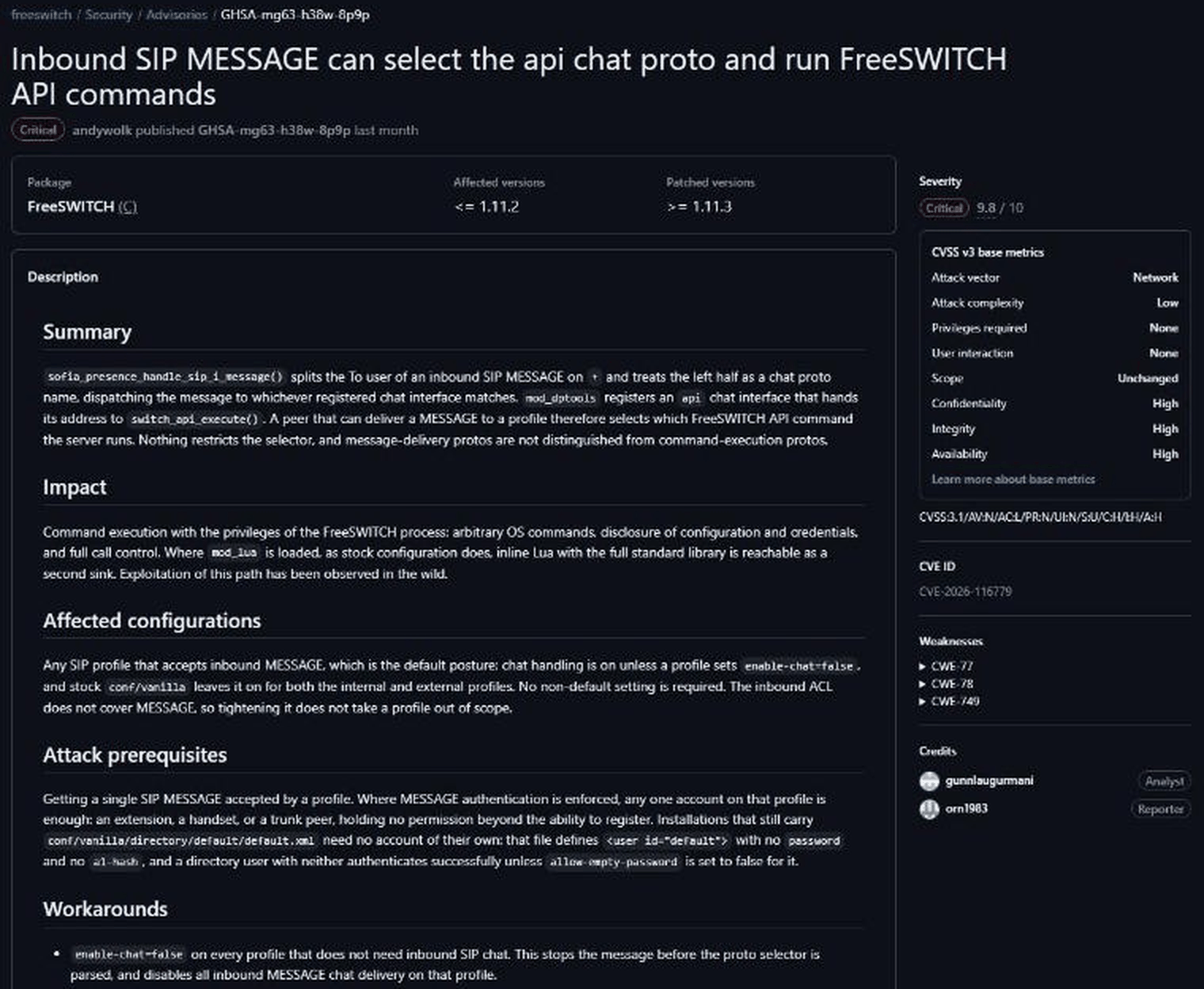
- What it is: a flaw in how FreeSWITCH handles an inbound SIP MESSAGE (a chat-style message). The part of the destination before a plus sign is treated as the name of a chat protocol, and one registered protocol, “api,” passes its address to the function that runs FreeSWITCH API commands. A peer that can deliver a MESSAGE can therefore choose which API command the server runs.
- Impact: command execution with the privileges of the FreeSWITCH process, including arbitrary operating-system commands, disclosure of configuration and credentials, and full call control. The advisory says exploitation of this path has been observed in the wild.
- Default exposure: any SIP profile that accepts inbound MESSAGE is affected, which is the default posture, and the stock configuration leaves chat on for the internal and external profiles.
- Score and fix: CVSS 3.1 9.8 (Critical), CWE-77, CWE-78 and CWE-749. Affected: 1.11.2 and earlier. Fixed: 1.11.3, which adds a per-profile enable-chat-api-proto setting that is off unless set.
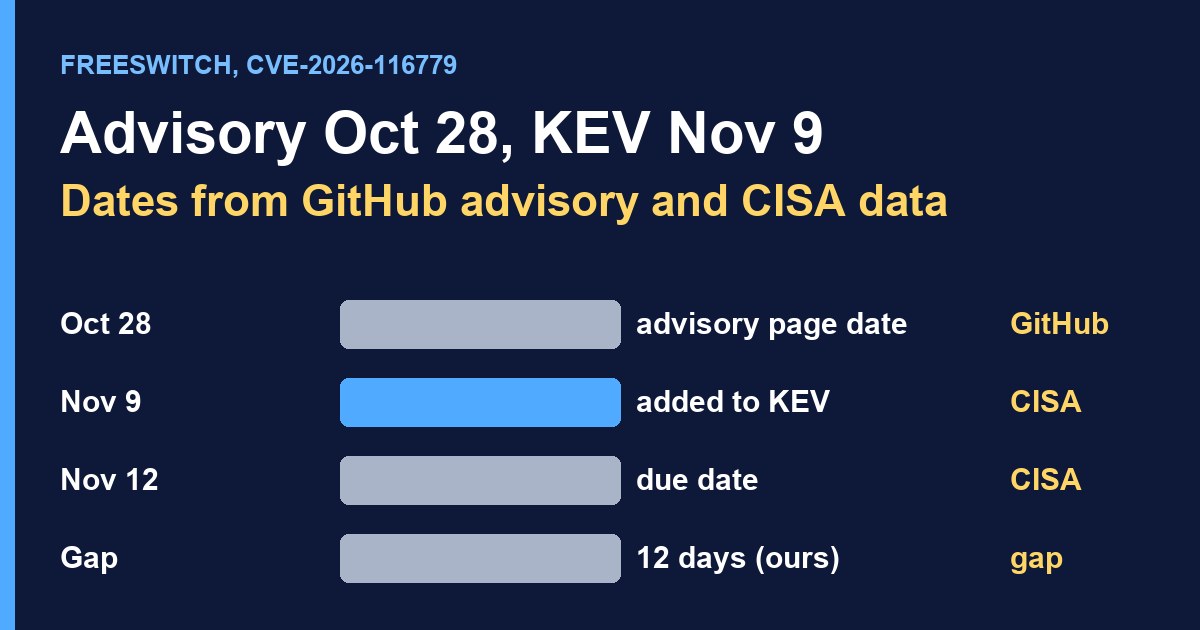
- KEV status: CISA added it on November 9, 2026, 12 days (ours) after the advisory page’s date of October 28, with a November 12 due date.
What FreeSWITCH is
FreeSWITCH is open-source telephony software. Companies and service providers use it to build voice systems: PBXs, softswitches, conferencing and call centers. It speaks SIP, the signaling protocol of internet telephony, through modules called profiles. A server often listens for SIP traffic from the internet so that remote phones and trunk providers can reach it. This is general background, not something the advisory states.
SIP also has a MESSAGE method for sending short text messages between endpoints. FreeSWITCH supports it, and the stock configuration processes inbound MESSAGE on both the internal and external profiles. That is where this bug lives.
What the vulnerability is
The advisory is titled “Inbound SIP MESSAGE can select the api chat proto and run FreeSWITCH API commands.” It explains the code path. A function that handles inbound MESSAGE splits the “To” user on a plus sign and treats the left half as the name of a chat protocol, then dispatches the message to whichever registered chat interface matches. One module registers a chat interface called “api,” which hands its address to the function that executes FreeSWITCH API commands. Nothing restricts which protocol name the sender may pick, and message-delivery protocols are not separated from command-execution ones.
The result is blunt: a peer that can get a MESSAGE delivered to a profile selects which API command the server runs. The advisory lists the consequences as command execution with the privileges of the FreeSWITCH process, including arbitrary operating-system commands, disclosure of configuration and credentials, and full call control. Where the Lua module is loaded, inline Lua with the full standard library is reachable as a second path. The advisory says exploitation of this path has been observed in the wild.
This article does not describe the exact message format beyond what the advisory says, and we have not tried to reproduce anything.
Who can reach it: the “default” problem
The advisory’s section on affected configurations is the most important part for operators. Any SIP profile that accepts inbound MESSAGE is in scope, and chat handling is on unless a profile sets enable-chat to false. The stock sample configuration leaves it on for both profiles. No non-default setting is required. The inbound access control list does not cover MESSAGE, so tightening it does not take a profile out of scope.
The attacker’s prerequisite is to get one MESSAGE accepted by a profile. Where MESSAGE authentication is enforced, any one account on that profile is enough: an extension, a handset or a trunk peer, with no permission beyond the ability to register. And installations that still carry the stock default directory file need no account at all, because that file defines a user called “default” with no password and no password hash, and the advisory says a directory user with neither authenticates successfully unless the empty-password option is turned off for it.
In other words, the practical barrier ranges from a stolen low-level phone credential to nothing at all, depending on how clean your configuration is.
Mitigations and the fix
| Item | What the advisory says |
|---|---|
| Best workaround | Set enable-chat to false on every profile that does not need inbound SIP chat. This stops the message before the protocol name is parsed, and turns off inbound MESSAGE chat on that profile |
| auth-messages | Not sufficient alone. It is on by default from 1.10.7. With the removal of every directory user lacking a password or hash (the stock files have two), it reduces the problem to authenticated command execution but does not close it |
| disable_system_api_commands | Worth setting, but it removes only the system API, not the route to other APIs such as module loading and call origination |
| Fix | 1.11.3: a per-profile enable-chat-api-proto setting, off unless set. A MESSAGE selecting that protocol where it is not enabled is answered with 403 and logged with the source and the requested command |
| Affected / fixed | Affected: 1.11.2 and earlier. Patched: 1.11.3 and later |
Timeline
| Date (2026) | Event | Source |
|---|---|---|
| October 28 | GitHub advisory page date (publication) | GitHub |
| November 9 | CISA adds CVE-2026-116779 to the KEV catalog | CISA KEV data |
| November 12 | KEV due date for U.S. federal civilian agencies | CISA KEV data |
Twelve days from the advisory to the KEV listing (ours) is quick, and the advisory’s own sentence that exploitation was observed is probably what CISA relied on, although CISA does not say. The three-day window (ours) is the short one explained in our KEV analysis, and it ended on November 12. The advisory credits Orn Arnarson and Gunnlaugur.
What to do: a practical checklist
- Find every FreeSWITCH server, including those inside phone systems or products you did not build, and note the version.
- Upgrade to 1.11.3 or later. Do not turn on enable-chat-api-proto unless you really need the api chat protocol.
- Set enable-chat to false on every profile that does not need inbound SIP chat. This is the advisory’s recommended workaround.
- Remove users without passwords. Delete the stock default and Skinny example users, or give them credentials, and do not allow empty passwords.
- Keep SIP signaling limited. If remote phones need access, allow only known addresses at the firewall, and use a session border controller where appropriate.
- Search the logs for inbound MESSAGE requests that name the api protocol, and for 403 responses after the fix. Look also for new processes started by the FreeSWITCH user and for outbound connections that do not belong.
- Treat credentials on the box as exposed if you find signs of abuse: SIP trunk passwords, database logins and API keys all live in FreeSWITCH configuration. Telephony fraud is another reason to act fast, as attackers can place expensive calls.
What we could not confirm
- Who is exploiting the flaw, how many systems were hit and what the attackers did: the advisory says only that exploitation was observed.
- The exact request format: the advisory describes the mechanism in words and we did not test it.
- Whether products that embed FreeSWITCH are affected and patched: CISA’s note says the component may be used by other products, without a list.
- Whether the advisory date of October 28 is its original publication date: it is the date the page shows.
- How many FreeSWITCH servers are exposed to the internet.
- CISA’s own catalog page, which we could not open; the KEV facts come from CISA’s GitHub mirror (catalog version 2026.11.23).
Frequently asked questions
What is CVE-2026-116779?
A flaw in FreeSWITCH that lets an inbound SIP MESSAGE select the “api” chat protocol and run FreeSWITCH API commands, leading to command execution.
Is the default configuration affected?
Yes. The advisory says chat handling is on by default, and the stock configuration leaves it on for the internal and external profiles.
Which version fixes it?
FreeSWITCH 1.11.3, which adds the enable-chat-api-proto setting. Versions up to 1.11.2 are affected.
What is the quickest workaround?
Set enable-chat to false on every profile that does not need inbound SIP chat.
What is the KEV deadline?
November 12, 2026 for U.S. federal civilian agencies. For everyone else it signals urgency and is not a legal deadline.
Method: details come from the GitHub security advisory GHSA-mg63-h38w-8p9p (page dated October 28, 2026) and CISA KEV data (catalog version 2026.11.23), read on November 25, 2026. For how we research, see How We Review Tools.