GPUStack CVE-2026-102895: Loopback Admin Bypass on KEV
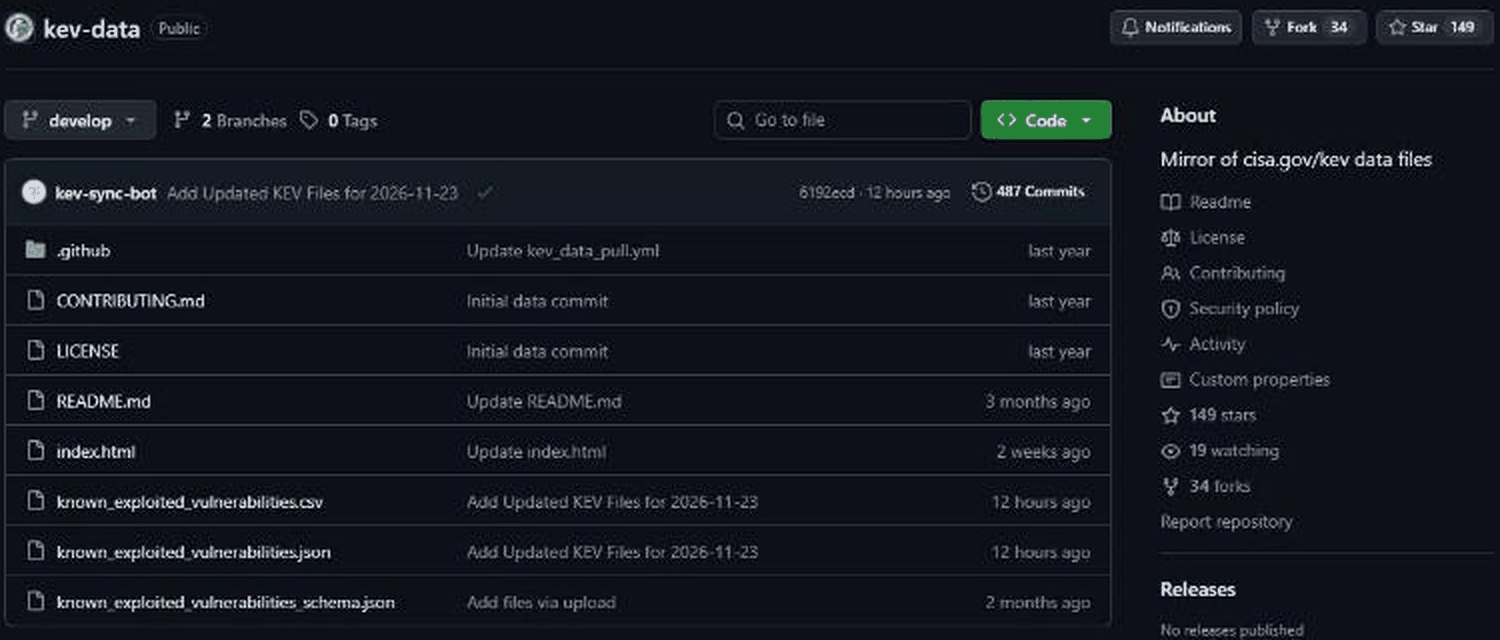
Published November 25, 2026. A news analysis of GPUStack vulnerability CVE-2026-102895, built from the GitHub security advisory GHSA-gj9m-f8ph-pmhr for the gpustack project (read on November 25, 2026) and CISA’s Known Exploited Vulnerabilities (KEV) data as mirrored on CISA’s GitHub. The screenshot is ours (the CISA data mirror on GitHub). CISA’s own website returned “Access Denied” to our automated browser, so we did not use it. This article contains no affiliate links and we have no commercial relationship with GPUStack. ToolReviewHub is produced with the help of an AI assistant (Claude, made by Anthropic). We did not run GPUStack or test the flaw. Descriptions are the vendors’ and CISA’s wording, and numbers marked “ours” are our own arithmetic.
GPUStack CVE-2026-102895: the short version
- What it is: an authentication bypass in GPUStack, open-source software for managing GPU clusters and AI model serving. Before version 2.2.0, any request whose source looked like the local machine was treated as the built-in administrator, and the software can be made to see an outside request as local in two ways.
- Impact: full, unauthenticated administrative access over the network. Combined with an admin-only feature to define inference backends from YAML, the advisory says it leads to code execution on worker hosts.
- Exploited: the advisory says it has been observed exploited in the wild against a v2.1.1 deployment, with attacker-created custom backends running reverse shells. The exploitation was reported by Javier Sixto (ulex.fr).
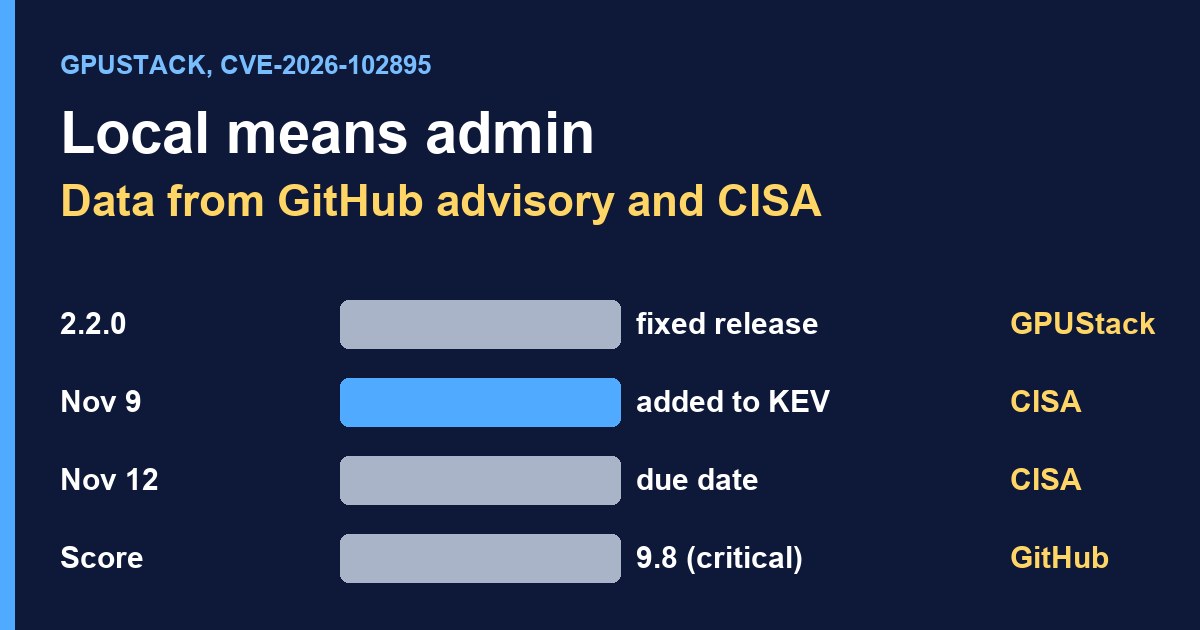
- Score and fix: CVSS 3.1 9.8 (Critical), weaknesses CWE-287, CWE-290 and CWE-346. Affected: versions before 2.2.0. Fixed: 2.2.0.
- KEV status: CISA added it on November 9, 2026, with a November 12 due date. CISA’s note says the flaw may affect an open-source component used by other products.
What GPUStack is
GPUStack is an open-source platform for running AI models across GPU machines. In the advisory’s language there are administrators, models, workers and “inference backends.” A central server manages the workers, and an administrator can define how models are served. That makes the admin account very powerful: whoever holds it can decide what code runs on the worker machines. This is our summary of the terms in the advisory, and we did not read GPUStack’s documentation.
The project is also an example of the fast-growing class of AI infrastructure tools that organizations deploy quickly, often on powerful and expensive GPU servers, and sometimes without the hardening that older enterprise products receive. We do not have any numbers on how many GPUStack servers are exposed.
What the vulnerability is
The advisory is titled “Authentication bypass via trusted loopback source (reverse-proxy TCP peer or X-GPUStack-Real-IP header) grants unauthenticated admin.” Its description is precise. A function in the authentication code promotes any request whose source is considered loopback (the local machine, 127.0.0.1) to the built-in administrator account when a setting called force_auth_localhost is False, which is the default.
Trusting “local” requests is a common shortcut, since a request from the same machine is assumed to be the operator. It fails when something else on that machine forwards outside traffic. The advisory describes two ways in which the source can be made to look local without any credentials.
- Same-host reverse proxy. In the common self-hosted layout, GPUStack sits behind a reverse proxy on the same machine, which forwards to 127.0.0.1. Every remote request then arrives at GPUStack from the proxy, so its network peer is the local machine, and the loopback shortcut triggers. No header or credential is needed. The advisory says this was verified end to end.
- A forged header. A request carrying an X-GPUStack-Real-IP header with the value 127.0.0.1 can make the software treat the request source as local.
Either route yields full administrative access over the network: the advisory lists enumerating and changing users, models, workers and configuration, and minting personal access tokens. Paired with the admin-only function to create inference backends from YAML, this results in code execution on worker hosts.
What this says about “trusted localhost” designs
The root cause in the advisory is a design assumption: the network source of a request, a socket peer or a header that a client controls, was used as proof of identity. That is a familiar pattern in internal tools, where the developers assume that only the operator can reach the service from the same machine. The assumption breaks the moment a reverse proxy, a container network or a tunnel puts untrusted traffic behind a local address.
If you run other self-hosted tools, it is worth asking the same question of each: does it treat local requests as already authenticated? Many do, as a convenience for first-time setup. The safe pattern is to require real credentials for every request, to accept forwarded-address headers only from a proxy you control, and to strip those headers from outside traffic. This is general engineering guidance, not something the GPUStack advisory spells out beyond its own workarounds.
Exploited in the wild, with reverse shells
The advisory states that this vulnerability has been observed exploited in the wild against a v2.1.1 deployment, and that the attackers created custom backends that ran reverse shells. A reverse shell is a connection from the compromised machine back to an attacker, giving remote command access. That is a clear description of what an attacker did with the admin access, and it matches the code-execution path above.
The advisory credits several people for independent reports (Nikko Enggaliano, Wei Yunzhou, and Rui Yang and Haoyu Wang of Johns Hopkins University), and credits Javier Sixto of ulex.fr for reporting the active exploitation. Several independent finders suggest the flaw was easy to see for anyone who looked at the authentication code.
Fix and workarounds
| Item | What the advisory says |
|---|---|
| Affected | gpustack (pip) before 2.2.0 |
| Fixed in | 2.2.0: the loopback auto-admin path was removed and client-IP and forwarding-header handling was hardened |
| Workaround 1 | Set force_auth_localhost to true, so that loopback requests also need authentication |
| Workaround 2 | Make sure the reverse proxy cannot cause external traffic to look like loopback |
| Workaround 3 | Strip any client-supplied X-GPUStack-Real-IP header at the edge, and accept a real-client-IP header only from a trusted gateway |
| Score | CVSS 3.1 9.8, AV:N/AC:L/PR:N/UI:N/S:U/C:H/I:H/A:H |
Timeline
| Date (2026) | Event | Source |
|---|---|---|
| Not confirmed | GitHub advisory published (its page carries a timestamp of July 31, 2026, which we could not tie to publication) | GitHub |
| November 9 | CISA adds CVE-2026-102895 to the KEV catalog | CISA KEV data |
| November 12 | KEV due date for U.S. federal civilian agencies | CISA KEV data |
The GitHub page shows a timestamp of July 31, 2026. We read it as the advisory’s date, but we could not confirm that, so we do not state a gap in days. What we can say is that the three-day window (ours, November 9 to 12) was the short one explained in our KEV analysis, and it has passed.
What to do: a practical checklist
- Find every GPUStack server in your organization, including research and test clusters set up by individual teams.
- Upgrade to 2.2.0 or later. The fix removes the loopback shortcut.
- If you cannot upgrade today, set force_auth_localhost to true, and strip any client-supplied X-GPUStack-Real-IP header at your proxy.
- Check whether the server is reachable from the internet. A GPU management console should sit behind a VPN or an authenticated gateway.
- Review inference backends. Look for custom backends that you did not create, or that run commands that open outbound connections. Remove them.
- Review users and tokens. Delete accounts and personal access tokens you cannot account for, and rotate the rest.
- Treat worker hosts as potentially compromised if you find unknown backends. Check them for reverse-shell activity and for stored credentials and cloud keys, which GPU machines often hold.
What we could not confirm
- The advisory’s publication date: the GitHub page shows a timestamp of July 31, 2026, which we could not tie to the publication.
- How many deployments were attacked, by whom and what they did beyond creating reverse-shell backends.
- Whether versions other than the v2.1.1 mentioned in the advisory were attacked.
- Whether other products embed GPUStack: CISA’s note says the component may be used by other products, but names none.
- How many GPUStack servers are exposed to the internet.
- CISA’s own catalog page, which we could not open; the KEV facts come from CISA’s GitHub mirror (catalog version 2026.11.23).
Frequently asked questions
What is CVE-2026-102895?
An authentication bypass in GPUStack: requests that appear to come from the local machine are treated as the built-in administrator, and that can be forced through a same-host reverse proxy or a forged header.
Which version fixes it?
GPUStack 2.2.0. Versions before it are affected.
Is there a workaround?
Yes: set force_auth_localhost to true, make sure the reverse proxy cannot make outside traffic look local, and strip client-supplied X-GPUStack-Real-IP headers.
Is it exploited?
The advisory says it was observed exploited against a v2.1.1 deployment with reverse-shell backends, and CISA added it to the KEV catalog on November 9, 2026.
What is the KEV deadline?
November 12, 2026 for U.S. federal civilian agencies. For everyone else it signals urgency and is not a legal deadline.
Method: details come from the GitHub security advisory GHSA-gj9m-f8ph-pmhr and CISA KEV data (catalog version 2026.11.23), read on November 25, 2026. For how we research, see How We Review Tools.