GeoServer’s Five-Step Attack Chain: Two Flaws Are Already Being Probed, Fixed in 3.0.2, 2.28.6 and 2.27.7
Published November 25, 2026. A news analysis of five GeoServer vulnerabilities published on November 23, 2026, two of which are being probed in the wild, built from the GeoServer project’s security advisories on GitHub (read on November 26, 2026), SecurityWeek’s report of November 25, 2026 and CISA’s Known Exploited Vulnerabilities (KEV) data as mirrored on CISA’s GitHub. Both screenshots are ours (GeoServer’s advisory pages on GitHub, cropped). This article contains no affiliate links and we have no commercial relationship with the GeoServer project or the researchers named. ToolReviewHub is produced with the help of an AI assistant (Claude, made by Anthropic). We did not run GeoServer or test any of the flaws, and we do not describe how to trigger them. Descriptions are the vendors’ and CISA’s wording, and numbers marked “ours” are our own arithmetic.
GeoServer CVE-2026-120705 and CVE-2026-129243: the short version
- What happened: on November 23, 2026, the GeoServer project published advisories for five vulnerabilities that a researcher reported as one chain leading to unauthenticated remote command execution. All five are fixed in GeoServer 3.0.2, 2.28.6 and 2.27.7.
- Already probed: SecurityWeek reports that the security firm watchTowr has seen attempts to exploit two of them, CVE-2026-120705 and CVE-2026-129243, apparently to identify vulnerable servers. No successful compromise had been reported at the time.
- The two being probed: CVE-2026-120705 lets a single unauthenticated request read local files or make the server fetch a URL (High, 8.6). CVE-2026-129243 lets unauthenticated users run operations that are meant for administrators when they are protected only by service security rules (High, 8.8).
- The worst step: CVE-2026-129245 is a predictable remember-me key that, together with a leaked password digest, lets an attacker forge an administrator login (Critical, 9.2).
- Exposure: SecurityWeek cites Eye Security’s count of more than 3,000 internet-accessible GeoServer instances. GeoServer is widely used by government agencies and utilities.
What GeoServer is
GeoServer is open-source server software for publishing and sharing geospatial data: maps, layers and features that other applications request over standard web protocols such as WMS and WFS. SecurityWeek notes that government agencies use it widely and utilities deploy it too. It is the kind of service that is often reachable from the internet on purpose, because its job is to serve map data to other systems.
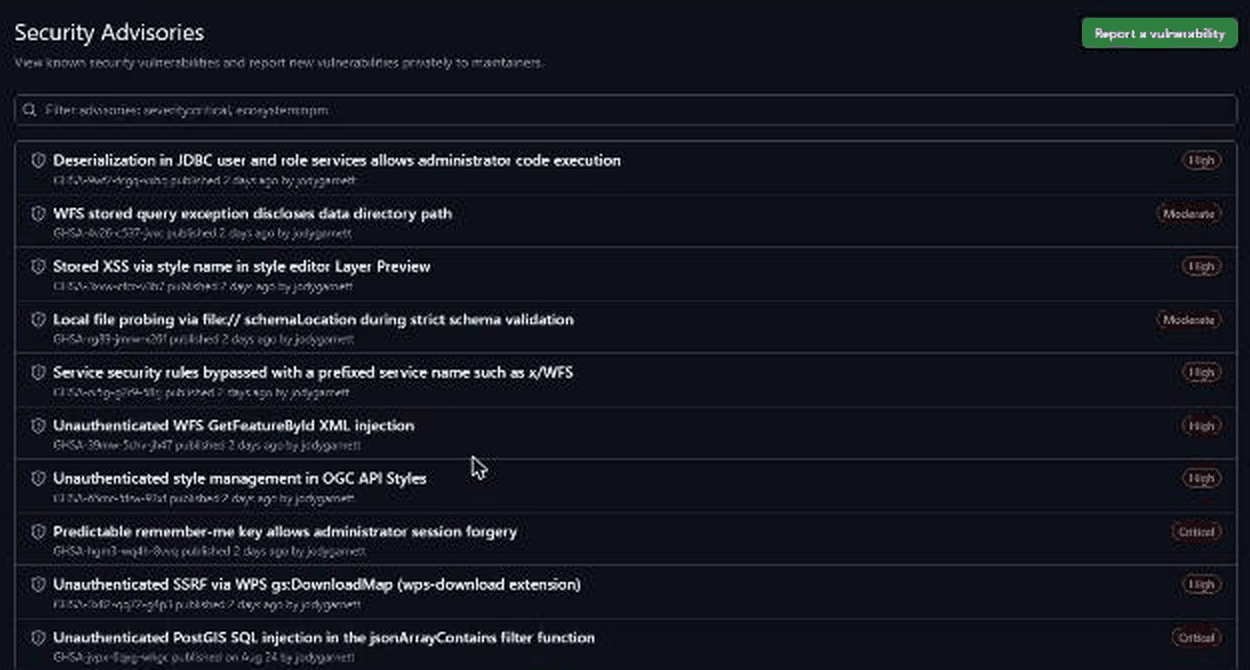
GeoServer has been a target before. CISA’s catalog lists two older GeoServer flaws as exploited, CVE-2024-36401 (added July 2024) and CVE-2025-58360 (added December 2025), and SecurityWeek recalls an August 2026 zero-day that was exploited before a fix. The project’s own advisory list shows that August issue, a SQL injection in the jsonArrayContains filter function, rated Critical.
The five-step chain
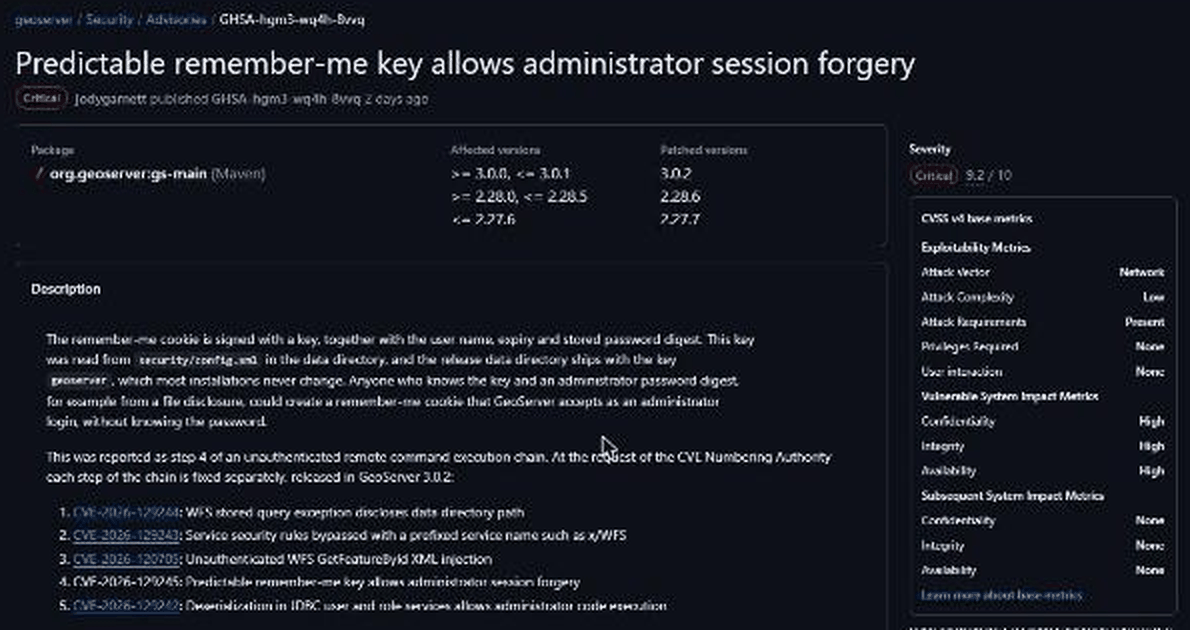
The advisory for the remember-me flaw explains that the issues were reported as steps of one unauthenticated remote command execution chain, and that at the request of the CVE numbering authority each step was fixed and numbered separately. The advisory lists them in order. We describe what each does at a high level, from the advisories, and leave out the mechanics.
- CVE-2026-129244, WFS stored query exception discloses data directory path (Moderate): an error message reveals where GeoServer keeps its data directory.
- CVE-2026-129243, service security rules bypassed with a prefixed service name (High, 8.8): GeoServer chose the service from a prefixed name but checked security rules against the unresolved name, so operations restricted only by service security ran without a role check. With default rules, anonymous users could create and delete WFS stored queries.
- CVE-2026-120705, unauthenticated WFS GetFeatureById XML injection (High, 8.6): a built-in stored query inserted the caller’s ID into an XML template without escaping and parsed it without GeoServer’s entity resolver. One unauthenticated request can read a local text file readable by the GeoServer process or fetch an attacker-chosen URL (server-side request forgery).
- CVE-2026-129245, predictable remember-me key (Critical, 9.2): the key used to sign the remember-me login cookie ships as a default value that most installations never change, so anyone with that key and an administrator’s password digest, for example from a file disclosure, can create a cookie that GeoServer accepts as an administrator login.
- CVE-2026-129242, deserialization in JDBC user and role services (High): once an attacker is an administrator, this allows code execution.
Read together, the chain shows how modest flaws add up. A path disclosure and a file read are not dramatic on their own. Combined with a default signing key, they become an administrator login, and administrator access plus a deserialization flaw becomes code execution on the server. SecurityWeek adds that Eye Security independently found an unauthenticated route to code execution on Linux and Windows by combining CVE-2026-120705, CVE-2026-129245 and a third flaw, CVE-2026-120704.
What is being probed
According to SecurityWeek, watchTowr observed attempts to exploit CVE-2026-120705 and CVE-2026-129243, and quoted the firm as saying that attackers sent error-based probes to check whether a server is vulnerable by creating and invoking stored queries. That matches the advisories: CVE-2026-129243 is what lets an anonymous user create a stored query, and the GeoServer advisory calls stored queries created this way “the entry point” for CVE-2026-120705. SecurityWeek says watchTowr had not reported any successful exploitation, and that there appeared to be no other reports of attempts at the time of writing.
Probing is often the step before real attacks, and SecurityWeek says the researcher who found the chain, Jonah Burgess of Rapid7 (known as CryptoCat), published technical details and proof-of-concept code this week. Public exploit code plus active probing is a combination that usually shortens the time to real attacks.
CISA’s catalog (version 2026.11.25) does not list any of the five new CVEs at the time of writing. That is not reassurance; it means CISA had not yet added them when we checked.
The five CVEs (GeoServer advisories)
| CVE | Issue | Severity | Fixed in |
|---|---|---|---|
| CVE-2026-129244 | WFS stored query exception discloses data directory path | Moderate | 3.0.2 (per the chain advisory; see its own advisory for other branches) |
| CVE-2026-129243 | Service security rules bypassed with a prefixed service name | High 8.8 (CVSS 4.0) | 3.0.2, 2.28.6, 2.27.7 |
| CVE-2026-120705 | Unauthenticated WFS GetFeatureById XML injection | High 8.6 (CVSS 3.1) | 3.0.2, 2.28.6, 2.27.7 (GeoTools 35.2, 34.6, 33.7) |
| CVE-2026-129245 | Predictable remember-me key allows administrator session forgery | Critical 9.2 (CVSS 4.0) | 3.0.2, 2.28.6, 2.27.7 |
| CVE-2026-129242 | Deserialization in JDBC user and role services allows administrator code execution | High | 3.0.2, 2.28.6, 2.27.7 |
Affected ranges in the advisories are 3.0.0 to 3.0.1, 2.28.0 to 2.28.5, and 2.27.6 and earlier, depending on the flaw. The fix for the remember-me key also changes behavior: the key is no longer stored in the data directory, each node uses a random key, existing remember-me cookies are invalidated on upgrade, and clusters set a shared key with an application property. Expect users to have to log in again after the upgrade.
Mitigations the advisories give
For anyone who cannot upgrade at once, the advisories list stopgaps. For CVE-2026-120705, restrict or disable the WFS service for anonymous users through service security, or disable WFS if it is not needed. For CVE-2026-129243, block requests whose service parameter contains a slash at a proxy in front of GeoServer, and review the stored query folders in the data directory for stored queries you did not create. For CVE-2026-129245, remove remember-me from the web filter chain, or change the key to a long random value and protect the data directory. The advisory also says that if you suspect exposure, change administrator passwords.
These are the project’s own mitigations. They buy time; the upgrade is the fix.
Timeline
| Date (2026) | Event | Source |
|---|---|---|
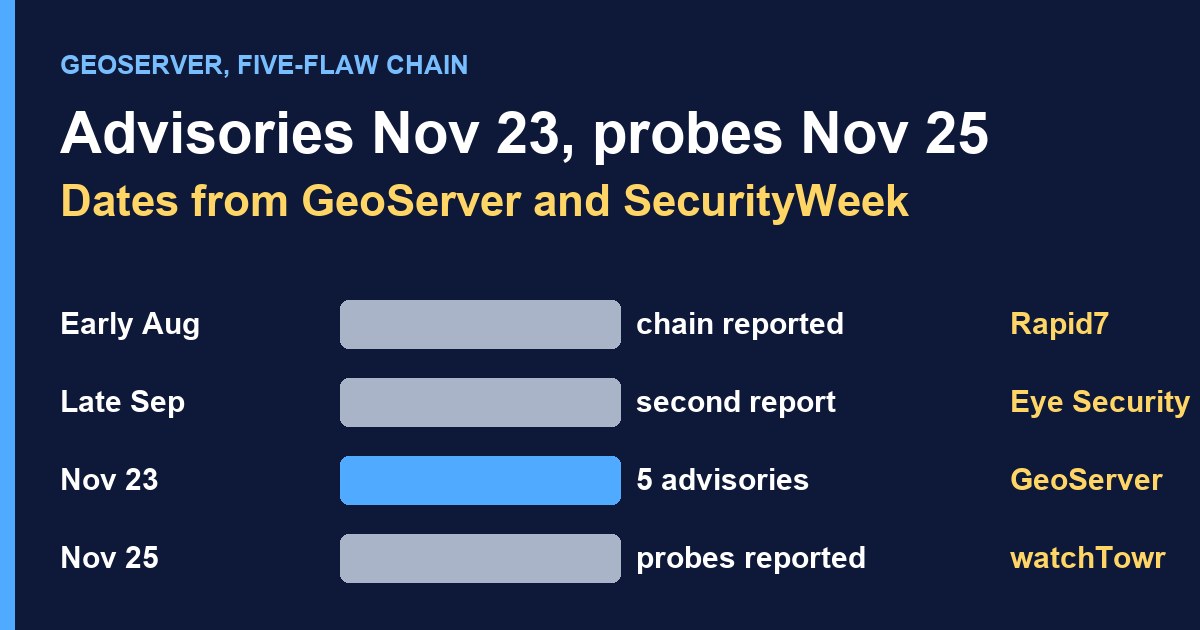
| Early August | Jonah Burgess (Rapid7) reports the chain to GeoServer developers | SecurityWeek |
| Late September | Eye Security reports its findings to the vendor | SecurityWeek |
| Weeks before November | Fixed GeoServer releases published | SecurityWeek |
| November 23 | GeoServer publishes the five advisories on GitHub | GeoServer |
| November 25 | SecurityWeek reports watchTowr has seen exploitation probes for two of the flaws | SecurityWeek |
What to do: a practical checklist
- Find every GeoServer instance, including ones run by GIS teams or contractors, and note the version.
- Upgrade to 3.0.2, 2.28.6 or 2.27.7 on the matching branch. Plan for remember-me cookies to be invalidated.
- If you cannot upgrade today, apply the advisories’ mitigations: restrict WFS for anonymous users, block service names containing a slash at your proxy, and remove or change the remember-me key.
- Check for stored queries you did not create in the data directory’s WFS query folders, as the advisory recommends.
- Change administrator passwords if the server was exposed, since a password digest leak is part of the chain.
- Look at logs for unusual WFS requests and error responses from unknown addresses since mid-November, and for new administrator sessions.
- Reduce exposure. If a GeoServer instance does not need to be public, put it behind a VPN or an authenticated gateway.
What we could not confirm
- Whether any GeoServer server has been compromised through this chain: watchTowr’s reported activity is probing, according to SecurityWeek.
- Who is behind the probes.
- The details of CVE-2026-120704, which Eye Security used in its own chain: we did not read that advisory.
- The exact release dates of the fixed versions: SecurityWeek says they shipped several weeks before the advisories.
- The 3,000-plus instance count, which comes from Eye Security via SecurityWeek.
- CISA’s own catalog page, which we could not open; the KEV facts come from CISA’s GitHub mirror (catalog version 2026.11.25).
Frequently asked questions
Which GeoServer versions fix these flaws?
GeoServer 3.0.2, 2.28.6 and 2.27.7, according to the project’s advisories.
Are the flaws being exploited?
SecurityWeek reports that watchTowr has seen attempts against CVE-2026-120705 and CVE-2026-129243 aimed at finding vulnerable servers, with no successful compromise reported at the time.
Do attackers need a login?
No for the first steps: CVE-2026-120705 and CVE-2026-129243 work without authentication. The last step, CVE-2026-129242, needs administrator access, which the chain obtains through CVE-2026-129245.
What can I do before upgrading?
Restrict WFS for anonymous users, block service names containing a slash at a proxy, remove or change the remember-me key, and check for stored queries you did not create.
Are they on CISA’s KEV list?
Not in the catalog version we checked (2026.11.25).
Method: details come from the GeoServer project’s GitHub security advisories published on November 23, 2026, SecurityWeek’s report of November 25, 2026 and CISA KEV data (catalog version 2026.11.25), read on November 26, 2026. For how we research, see How We Review Tools.