REDCap CVE-2026-90817: Survey Route RCE on CISA KEV List
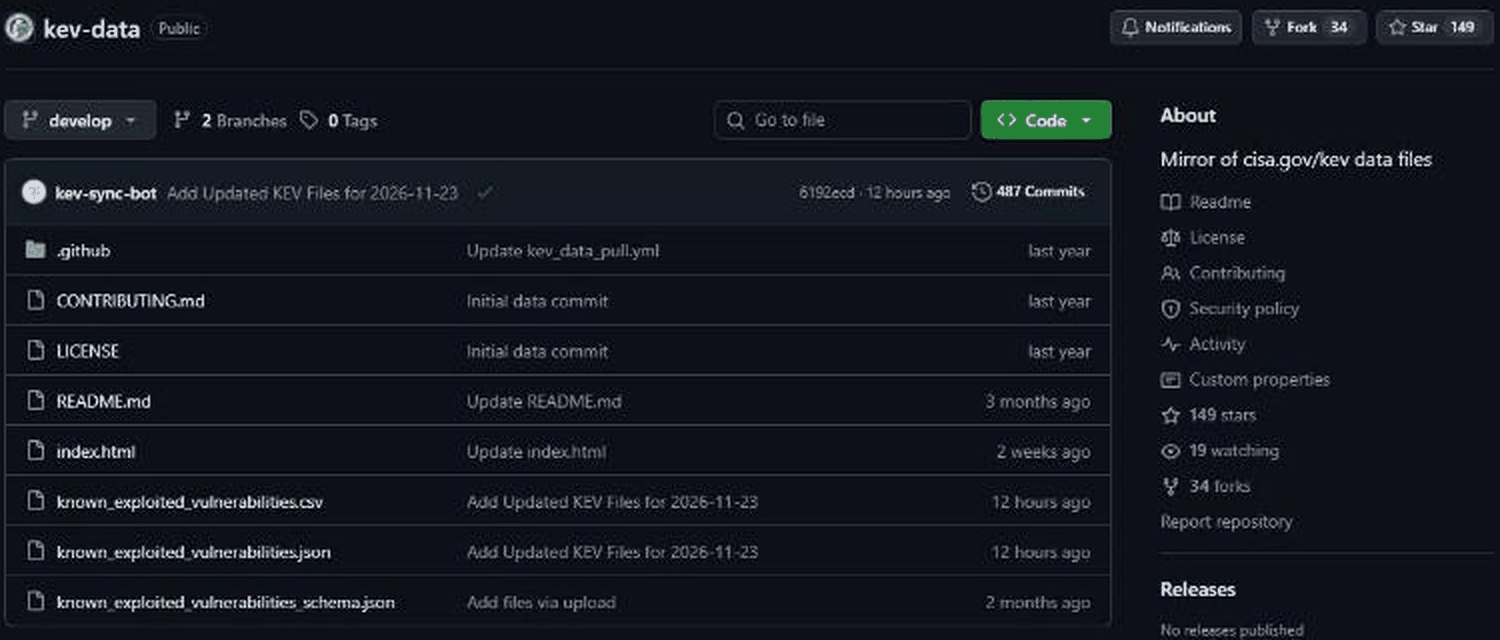
Published November 25, 2026. A news analysis of Vanderbilt REDCap vulnerability CVE-2026-90817, built from the National Vulnerability Database (NVD) entry for CVE-2026-90817 and CISA’s Known Exploited Vulnerabilities (KEV) data as mirrored on CISA’s GitHub (both read on November 25, 2026). The screenshot is ours (the CISA data mirror on GitHub). CISA’s own website returned “Access Denied” to our automated browser, so we did not use it. REDCap’s community site sits behind a login, which we do not have, so we did not read the vendor’s notice. This article contains no affiliate links and we have no commercial relationship with Vanderbilt University Medical Center and the REDCap consortium. ToolReviewHub is produced with the help of an AI assistant (Claude, made by Anthropic). We did not run REDCap or test the flaw. Descriptions are the vendors’ and CISA’s wording, and numbers marked “ours” are our own arithmetic.
REDCap CVE-2026-90817: the short version
- What it is: according to the NVD entry, an unauthenticated remote code execution flaw in REDCap’s survey passthrough routing and Data Import processing. An attacker manipulates HTTP requests so that a public survey context reaches an unintended controller route, together with a crafted file-path or stream parameter during import handling.
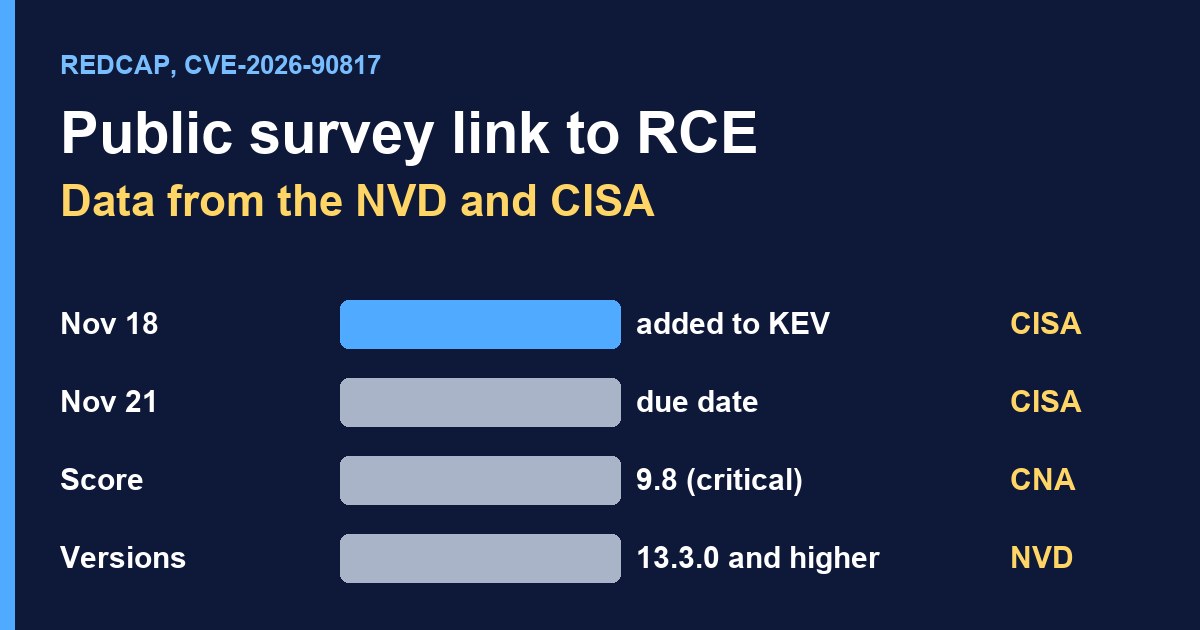
- Affected: REDCap 13.3.0 and higher, according to the NVD. We could not determine which release fixes it.
- Score: CVSS 3.1 9.8 (Critical), assigned by the CNA, Securifera, Inc. The record adds that no authentication is needed but the attacker must know a valid public survey hash.
- KEV status: CISA added it on November 18, 2026, with a November 21 due date. CISA’s notes point to REDCap’s community resources page, which needs a login.
- Why it matters: REDCap is widely used in research for collecting data, including data about people. A survey link is public by design, which makes the key precondition easier than it sounds.
What REDCap is
REDCap (Research Electronic Data Capture) is a web application, developed at Vanderbilt University Medical Center and shared with a consortium of institutions, that researchers use to build surveys and databases. Many universities and hospitals run their own installation. REDCap surveys can be sent to participants by public link, so that a person does not need an account to answer. We did not read REDCap’s own documentation for this article, and the description of its purpose is general background.
The data inside such systems can include health information and personal data about research participants. That is why a remote code execution flaw in REDCap is not only an IT problem, but also a privacy and compliance matter for the institutions that run it. We do not know whether any installation has been breached.
What the vulnerability is
The NVD entry, published by the CNA Securifera, describes an unauthenticated remote code execution in two places: the survey passthrough routing and the Data Import processing. An attacker can manipulate HTTP requests so that a request arriving in a public survey context is routed to a controller that was never meant to be reachable from it, and then supply a crafted file-path or stream parameter that the import handling mishandles. The combined effect is that the attacker can run code on the server.
Two qualifiers are important. First, “unauthenticated” means the attacker needs no REDCap account. Second, the record says the attacker needs to know a valid public survey hash, the identifier in a public survey’s link. For a survey that has been sent out, that hash is not a secret: anyone who received the link has it. So the precondition narrows the field to “people who can see any public survey link on that installation,” which in practice may include anyone on the internet if the survey link is posted publicly. The NVD entry does not say how the hash could be obtained by an outsider, and we did not examine that.
The flaw is stated to exist in REDCap 13.3.0 and higher. This is a wide range, because it starts at an older release and continues through the current ones. Without the vendor’s notice, we cannot say which release closes it.
Questions for the team that runs it
If you use REDCap as a researcher and do not run the server, the most useful thing you can do is ask the people who do. Ask which version the installation runs, whether it has been updated since the middle of November, and whether the team has read the vendor’s notice for this CVE. Ask whether public survey links are limited to the surveys that need them, and whether the server’s access logs are kept long enough to look back at the weeks before a patch.
A second question is about segregation. REDCap servers that share a network with other research systems give an attacker more places to go after the first foothold. Ask whether the web server can reach the rest of the research network, and whether the database credentials in its configuration have only the rights REDCap needs. These are general good practices and not instructions from the REDCap consortium, but the answers will tell you how much a successful attack could cost.
Reading the 9.8
A CVSS 3.1 score of 9.8 corresponds to a network attack, low complexity, no privileges, no user interaction, and high impact on confidentiality, integrity and availability. The record we read gives the start of the vector, AV:N/AC:L/PR:N/UI:N, and the 9.8 score. A score from the CNA, rather than from the product’s maker or the NVD, is worth noting. Securifera is a security firm, and the CNA role means it assigned the CVE and the score, which is common for researcher-reported flaws. The NVD’s own assessment is separate.
The need to know a valid survey hash is not reflected as a privilege in the score. It is a condition rather than an account. As a defender, treat the score as accurate for a server that has any public survey.
What the record says
| Item | Detail |
|---|---|
| Product | Vanderbilt REDCap |
| Affected versions | 13.3.0 and higher (NVD) |
| Fixed version | Not captured: the vendor notice needs a login |
| Attacker | Unauthenticated, needs a valid public survey hash |
| Where | Survey passthrough routing and Data Import processing |
| Score | CVSS 3.1 9.8 Critical (CNA Securifera, Inc.) |
| KEV note | Points to REDCap community resources (login required) |
Timeline
| Date (2026) | Event | Source |
|---|---|---|
| November 18 | CISA adds CVE-2026-90817 to the KEV catalog | CISA KEV data |
| November 21 | KEV due date for U.S. federal civilian agencies | CISA KEV data |
We do not have the date of the CVE record’s publication or of the vendor’s fix. The three-day window (ours) matches the short deadlines we described in our November KEV analysis, and it ended on November 21.
What to do: a practical checklist
- Find out who runs REDCap in your organization and which version. Institutions often have a central research-computing team that owns it.
- Get the vendor’s notice. Log in to the REDCap community resources, read the notice for CVE-2026-90817, and upgrade to the release it names. This article cannot name the fixed version.
- Review public surveys. Look at which surveys are open to the public and which links are posted openly. Close the ones that are no longer needed.
- Limit exposure. If your installation does not need to be reachable from the whole internet, restrict it, or put a web application firewall in front.
- Check the server and the application logs for unusual requests to survey and import endpoints, and for new or modified files in the web directory.
- Review who can reach the database and file storage from the web server, and limit them to what is needed.
- Talk to your privacy office if you find signs of access. Research data may carry notification duties.
What we could not confirm
- The fixed REDCap release and the vendor’s own advisory text: the community resources sit behind a login.
- How an outsider would learn a valid public survey hash: the record says one is needed, but we did not examine how.
- How the flaw is being exploited, by whom and against whom: the KEV entry records exploitation without details.
- The full CVSS vector: we captured only the first part, which shows a network path, low complexity, no privileges and no user interaction.
- Whether any configuration reduces the risk.
- CISA’s own catalog page, which we could not open; the KEV facts come from CISA’s GitHub mirror (catalog version 2026.11.23).
Frequently asked questions
What is CVE-2026-90817?
An unauthenticated remote code execution flaw in REDCap’s survey passthrough routing and Data Import processing, according to the NVD.
Do I need an account to exploit it?
No account is needed, but the attacker must know a valid public survey hash.
Which versions are affected?
REDCap 13.3.0 and higher, according to the NVD. We could not determine the fixed release.
Is it exploited?
CISA added it to the Known Exploited Vulnerabilities catalog on November 18, 2026. We found no public detail about the attacks.
What is the KEV deadline?
November 21, 2026 for U.S. federal civilian agencies. For everyone else it signals urgency and is not a legal deadline.
Method: details come from the NVD entry for CVE-2026-90817 and CISA KEV data (catalog version 2026.11.23), read on November 25, 2026. For how we research, see How We Review Tools.