Palo Alto Networks Patches Fragnesia (CVE-2026-46300) Four Weeks After CISA Listed It, After Attackers Chained It With PHP2Shell to Root Firewalls
Published November 25, 2026. A news analysis of the Palo Alto Networks PAN-OS fix for the Linux kernel flaw Fragnesia (CVE-2026-46300) and the PHP2Shell attack chain, built from two Palo Alto Networks security advisories (PAN-SA-2026-0015 and the CVE-2026-109618 advisory), SecurityWeek’s report of November 25, 2026 and CISA’s Known Exploited Vulnerabilities (KEV) data as mirrored on CISA’s GitHub (all read on November 26, 2026). Both screenshots are ours (Palo Alto Networks’ advisory pages, cropped). CISA’s own website returned “Access Denied” to our automated browser, so the KEV facts come from CISA’s GitHub mirror. This article contains no affiliate links and we have no commercial relationship with Palo Alto Networks. ToolReviewHub is produced with the help of an AI assistant (Claude, made by Anthropic). We did not run a PAN-OS firewall or test either flaw. Descriptions are the vendors’ and CISA’s wording, and numbers marked “ours” are our own arithmetic.
Palo Alto Networks Fragnesia fix (CVE-2026-46300): the short version
- What happened: Palo Alto Networks published PAN-SA-2026-0015 on November 25, 2026, with PAN-OS releases that fix CVE-2026-46300, a Linux kernel local privilege escalation nicknamed Fragnesia.
- It was already being used: the company says exploitation has been observed against the management interface of PAN-OS devices exposed to the internet. SecurityWeek reports that a China-linked group chained PHP2Shell, a PHP remote code execution flaw, with Fragnesia to get root on 24 firewalls and one internal management server.
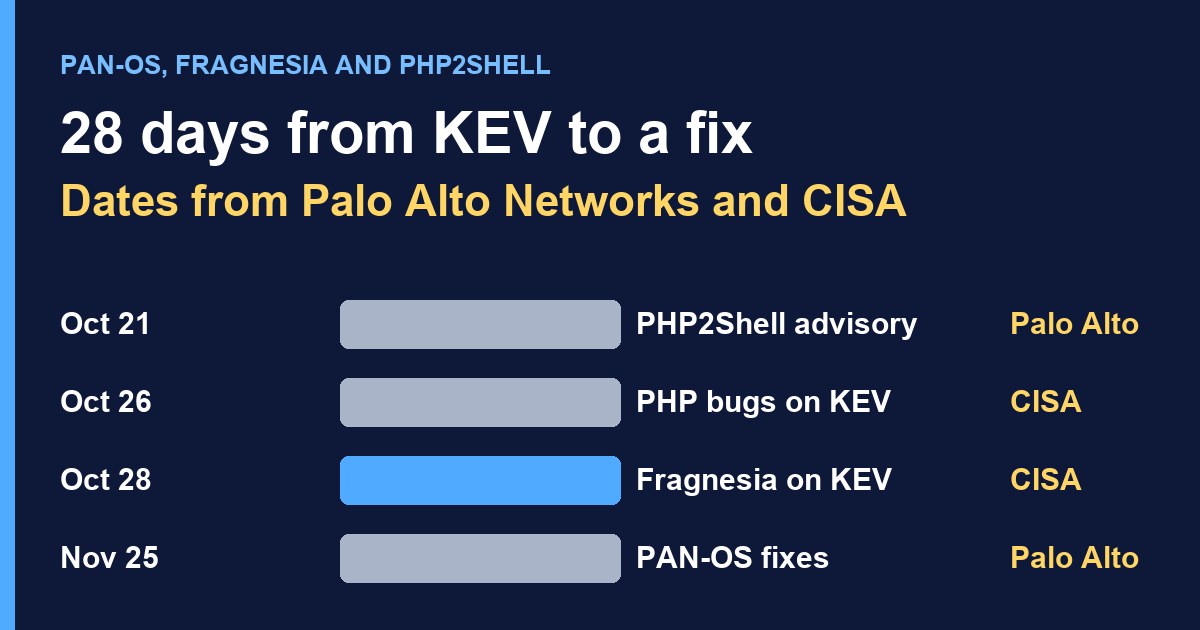
- The gap: CISA added the kernel flaw to its Known Exploited Vulnerabilities catalog on October 28, 2026. The PAN-OS fix came 28 days later (ours).
- Palo Alto’s own risk statement: the only known way to exploit Fragnesia on PAN-OS is to first exploit PHP2Shell through an internet-exposed management interface. If you are running a PAN-OS release fixed for PHP2Shell, the company says you are protected.
- What to do: take the management interface off the internet, upgrade to a fixed release, and look for signs of earlier compromise.
Two bugs, one attack chain
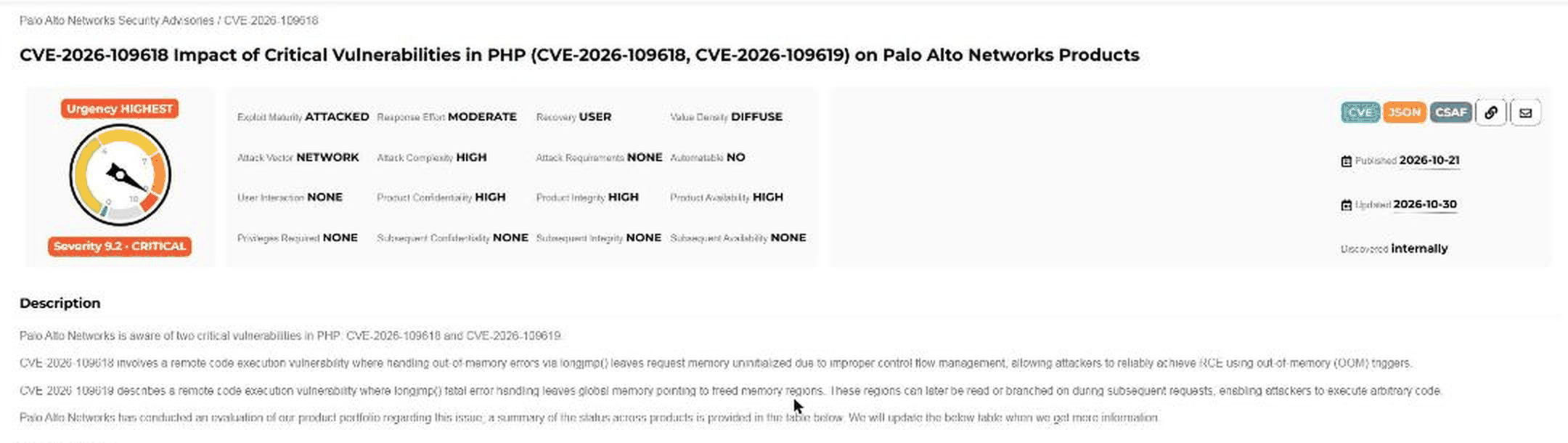
This story has two vulnerabilities, and the order matters. The first is what Palo Alto Networks calls PHP2Shell in its advisory titled “Impact of Critical Vulnerabilities in PHP (CVE-2026-109618, CVE-2026-109619) on Palo Alto Networks Products.” The advisory says these are remote code execution bugs in PHP, and it ties the risk to the PAN-OS management interface. CVE-2026-109618 involves handling out-of-memory errors in a way that leaves request memory uninitialized, which lets an attacker reliably achieve code execution by triggering out-of-memory conditions. CVE-2026-109619 leaves global memory pointing at freed regions that later requests can read or branch on. No special configuration is needed to be affected. Palo Alto rates the issue 9.2, Critical, on CVSS 4.0, marks exploit maturity as “attacked,” and says the risk is highest when management access is allowed from the internet.
The second bug is Fragnesia, tracked as CVE-2026-46300. According to SecurityWeek, it was disclosed in May 2026 as a privilege escalation bug in the Linux kernel’s XFRM ESP-in-TCP subsystem, which lets unprivileged attackers overwrite sensitive system files to gain root. CISA’s catalog labels it a Linux kernel “missing initialization of a variable” vulnerability. On its own, it needs the attacker to already be running code on the machine. That is where PHP2Shell comes in: it gave attackers code execution on the firewall’s management interface, and Fragnesia turned that into root.
What was observed
Here is what SecurityWeek reports about the attacks, which we have not verified against the original research. On October 26, the security firm Dream warned that a Chinese-speaking threat actor had exploited the PHP2Shell bugs and the Linux kernel weakness to hack two servers of a US government-affiliated organization. As part of what SecurityWeek describes as AI-assisted attacks, the actor compromised 25 servers in total, 24 firewalls and one internal firewall management server, using PHP2Shell to get remote code execution and a Fragnesia exploit to deploy webshells with root privileges. On October 29, Palo Alto Networks confirmed that the actor had hit PAN-OS firewalls with internet-exposed management interfaces. By October 30, the company had released PHP2Shell patches for all supported PAN-OS versions, which closed the known initial-access path.
Palo Alto’s own advisories are plainer. They say that exploitation of CVE-2026-46300 has been observed targeting the management interface exposed to the internet, and that all observed exploitation has been against devices whose management interface is exposed, “a configuration our best practices advise against.” We read the phrase “AI-assisted” as SecurityWeek’s description of Dream’s findings. Palo Alto’s advisories do not use it.
What the fix covers
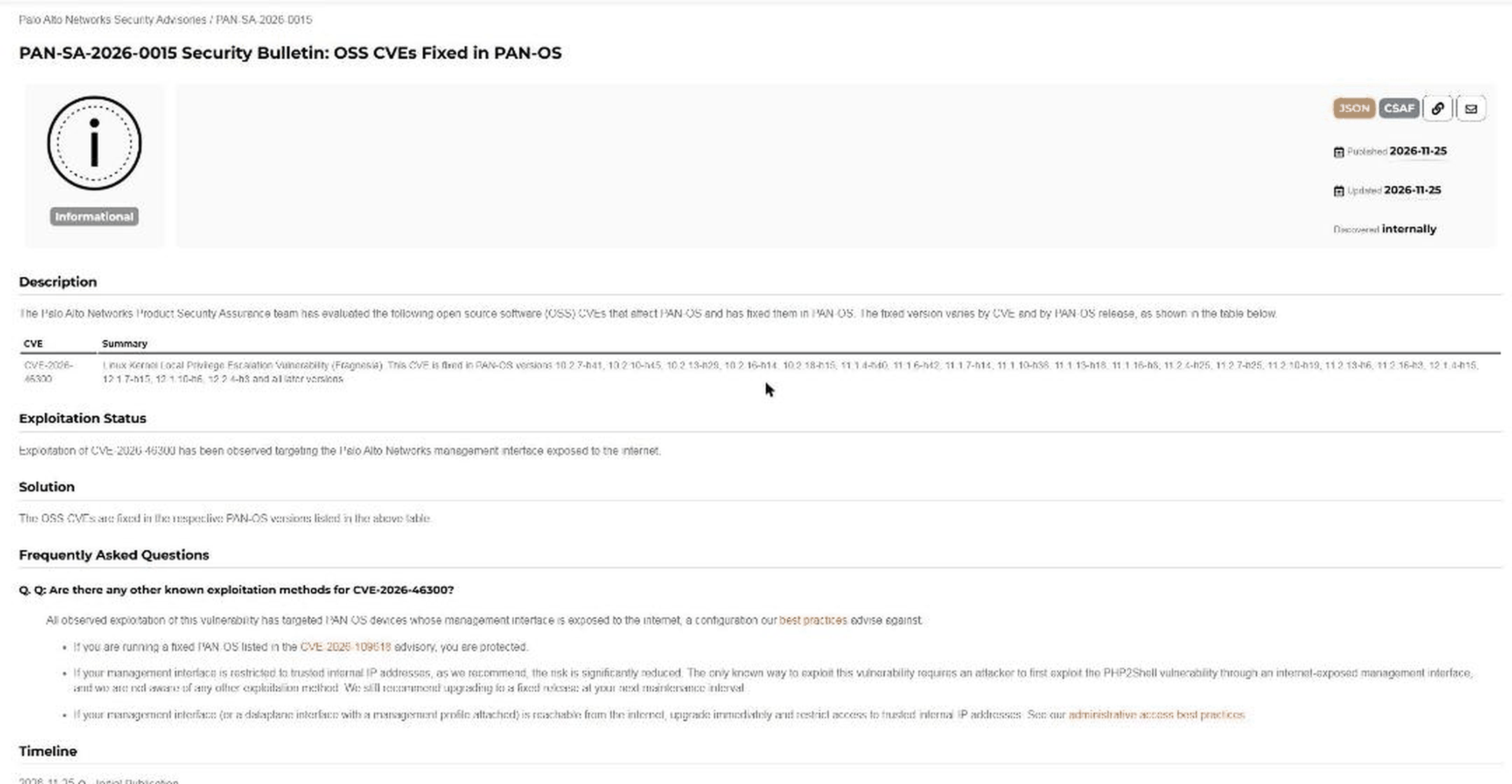
Palo Alto’s bulletin, PAN-SA-2026-0015, is classed Informational, was published on November 25, 2026 and was discovered internally. It lists the Fragnesia fix for each PAN-OS branch. SecurityWeek dates the announcement to Tuesday, November 24, while Palo Alto’s page is dated November 25, so we use the company’s date.
The company’s guidance is in its FAQ. If you run a PAN-OS release that is fixed for PHP2Shell, it says, you are protected, because the only known way to exploit Fragnesia on PAN-OS is to first exploit PHP2Shell through an internet-exposed management interface. If the management interface is restricted to trusted internal addresses, the risk is “significantly reduced.” It still recommends upgrading to a fixed release at your next maintenance interval. If the management interface, or a dataplane interface with a management profile attached, is reachable from the internet, it says to upgrade immediately and restrict access to trusted internal addresses.
PAN-OS releases that fix CVE-2026-46300 (Palo Alto)
| Branch | Fixed releases (and all later) |
|---|---|
| 10.2 | 10.2.7-h41, 10.2.10-h45, 10.2.13-h29, 10.2.16-h14, 10.2.18-h15 |
| 11.1 | 11.1.4-h40, 11.1.6-h42, 11.1.7-h14, 11.1.10-h38, 11.1.13-h18, 11.1.16-h6 |
| 11.2 | 11.2.4-h25, 11.2.7-h25, 11.2.10-h19, 11.2.13-h6, 11.2.16-h3 |
| 12.1 | 12.1.4-h15, 12.1.7-h15, 12.1.10-h6 |
| 12.2 | 12.2.4-h3 |
We took the 12.1 and 12.2 entries from SecurityWeek’s list of the same releases, because the part of the bulletin we read was cut off at that point; they match what we could see of the bulletin. Check Palo Alto’s page for the release that applies to your device. Palo Alto’s PHP2Shell advisory says the PHP issue applies to PAN-OS on PA-Series and VM-Series firewalls and on Panorama, virtual and M-Series. It lists no currently affected cloud products, and notes that Cortex XCORE (SaaS) and WildFire Cloud, previously affected, were remediated on October 21 and October 22.
Timeline
| Date (2026) | Event | Source |
|---|---|---|
| May | Fragnesia (CVE-2026-46300) disclosed as a Linux kernel privilege escalation | SecurityWeek |
| October 21 | Palo Alto publishes its PHP2Shell advisory (CVE-2026-109618 and CVE-2026-109619) | Palo Alto Networks |
| October 26 | CISA adds the two PHP bugs to the KEV catalog (due October 29); Dream warns of attacks | CISA KEV data; SecurityWeek |
| October 28 | CISA adds CVE-2026-46300 to the KEV catalog (due October 31) | CISA KEV data |
| October 29 | Palo Alto confirms attacks on PAN-OS devices with exposed management interfaces | SecurityWeek |
| October 30 | PHP2Shell patches released for all supported PAN-OS versions | SecurityWeek; Palo Alto (advisory updated) |
| November 25 | Palo Alto publishes PAN-SA-2026-0015 with PAN-OS fixes for Fragnesia | Palo Alto Networks |
From CISA’s listing of Fragnesia on October 28 to the PAN-OS fix on November 25 is 28 days (ours). That is the headline gap, but it is less alarming than it sounds if Palo Alto’s claim holds: the entry point, PHP2Shell, was patched on October 30, two days after the kernel flaw was listed, and a patched device is protected. The gap matters for anyone who did not apply the PHP2Shell fix, whose firewall was therefore open to the whole chain, and for anyone whose management interface was reachable. As we explained in our November KEV analysis, CISA’s deadlines are short, and the three-day due dates for both entries passed weeks ago.
It also fits a point that OpenAI made in its Linux research: a low-privileged foothold on a system with an unpatched kernel should be treated as the equivalent of root. We covered that in our article on OpenAI’s Linux kernel pipeline.
What to do: a practical checklist
- Take the management interface off the internet. Palo Alto’s advice is to allow access only from a trusted management network or through a VPN, and to use a jump box as the only system that can reach it.
- Check dataplane interfaces too. The bulletin warns that a dataplane interface with a management profile attached can expose management access as well.
- Upgrade to a release fixed for PHP2Shell first, then to one fixed for Fragnesia. Use the releases in Palo Alto’s advisories for your branch.
- Assume compromise if the interface was exposed since October. Look for webshells and unexpected files on the firewall and on Panorama, new administrator accounts and unusual outbound connections. Palo Alto’s guidance and your incident responders should lead here, as we do not have indicators to give you.
- Rotate credentials and keys stored on or reachable from devices that were exposed, including administrator passwords and certificates.
- Review other Linux appliances. A kernel flaw that is not fixed in a vendor’s release leaves every device of that vendor open to the same step, so ask other appliance vendors which kernel fixes they have shipped.
- Write the fix dates down. Record when each device reached a fixed release, since auditors and insurers may ask.
What we could not confirm
- How the attackers worked in detail, who they are and what they did on the devices: we rely on SecurityWeek’s summary of Dream’s research and did not read Dream’s report.
- The “AI-assisted” description of the attacks: it is SecurityWeek’s wording for Dream’s findings, and Palo Alto’s advisories do not mention AI.
- Whether any attacker used Fragnesia on PAN-OS without PHP2Shell: Palo Alto says it is aware of no other method.
- The full list of fixed releases for the 12.x branches: the bulletin text we read was cut off, and we used SecurityWeek’s list for those entries.
- How many devices were compromised: the 25 servers figure comes from Dream’s report as relayed by SecurityWeek.
- CISA’s own catalog page, which we could not open; the KEV facts come from CISA’s GitHub mirror (catalog version 2026.11.25).
Frequently asked questions
What is Fragnesia?
CVE-2026-46300, a Linux kernel privilege escalation in the XFRM ESP-in-TCP subsystem that lets an unprivileged attacker overwrite sensitive files to gain root, according to SecurityWeek. CISA lists it as a missing initialization of a variable.
Is my Palo Alto firewall at risk?
Palo Alto says the only known way to exploit Fragnesia on PAN-OS is to first exploit PHP2Shell through an internet-exposed management interface. If your management interface is not exposed and you run a fixed PAN-OS release, the risk is significantly reduced.
Which PAN-OS versions fix it?
Fixed releases include 10.2.18-h15, 11.1.16-h6, 11.2.16-h3, 12.1.10-h6 and 12.2.4-h3 and the earlier hotfix releases listed in the table, and all later versions.
Why does it matter that CISA listed it on October 28?
Listing means CISA had evidence of exploitation. Palo Alto’s fix came on November 25, 28 days later.
What is PHP2Shell?
Palo Alto’s name for two critical PHP remote code execution flaws, CVE-2026-109618 and CVE-2026-109619, which it rates 9.2 Critical and says are being attacked through exposed PAN-OS management interfaces.
Method: details come from Palo Alto Networks’ advisories PAN-SA-2026-0015 and CVE-2026-109618, SecurityWeek’s report of November 25, 2026 and CISA KEV data (catalog version 2026.11.25), read on November 26, 2026. For how we research, see How We Review Tools.