LiteLLM Flaw CVE-2026-40217 Added to CISA Exploited List: Rated Moderate by Its Maker, 8.8 by Others, and What to Check
Published November 23, 2026. A news analysis built from primary sources: the CISA Known Exploited Vulnerabilities (KEV) catalog as mirrored on GitHub, the LiteLLM security advisory GHSA-wxxx-gvqv-xp7p on GitHub, the National Vulnerability Database (NVD) entry for CVE-2026-40217, the Red Hat CVE page, and the package listings on PyPI, plus our own screenshots of the pages. This article contains no affiliate links and we have no commercial relationship with BerriAI, Red Hat or any vendor named here. We did not install LiteLLM, run it, or test the flaw or the fix, and we publish no technique for exploiting it. Dates marked “ours” are our own arithmetic.
The short version
- What happened: on November 18, 2026 CISA added CVE-2026-40217, a code-execution flaw in the LiteLLM AI gateway, to its Known Exploited Vulnerabilities catalog. A listing there means CISA has evidence of exploitation. The entry gives a federal due date of December 2, 2026.
- It is not a new bug. The CVE was public on April 10, 2026, and the fixed versions were on PyPI by April 19 and April 22. The catalog entry came about seven months after the fix (ours: 210 days after the second fixed release).
- The severity does not agree. LiteLLM’s own advisory rates it Moderate, 5.9 out of 10. MITRE, which issued the CVE, and Red Hat both give 8.8, High or Important. NVD itself had not provided an assessment when we looked.
- Who is exposed: the advisory says the vulnerable endpoint needs a proxy-admin credential in default configurations, and that the proxy runs as root in the default Docker image. Anyone who runs a LiteLLM proxy with a version from 1.81.8 up to but not including 1.83.10 is in the affected range.
- What to do: upgrade to the current release (PyPI listed 1.110.2 when we looked), or at least to a version the advisory names as patched. If you cannot upgrade today, the advisory says to block one endpoint at your reverse proxy or API gateway.
- A pattern: this is the fourth LiteLLM entry in the KEV catalog in 2026.
What LiteLLM is, and why a flaw in it matters
LiteLLM is an open-source Python project from BerriAI that many teams use as a gateway, or “proxy,” in front of AI model providers. Applications talk to one LiteLLM server in a common format, and the server forwards each request to whichever provider is configured. The proxy typically holds the provider API keys, the spend limits and the access rules for many users. That is why a flaw that lets someone run code inside the proxy process is more than an inconvenience: the process sits next to credentials that can spend money and read prompts.
Because LiteLLM can route to many providers, including Anthropic’s Claude models, a disclosure is due: this site uses Claude as one of its drafting tools. We have no relationship with BerriAI, and nothing in this article depends on any one model provider.
What the advisory says
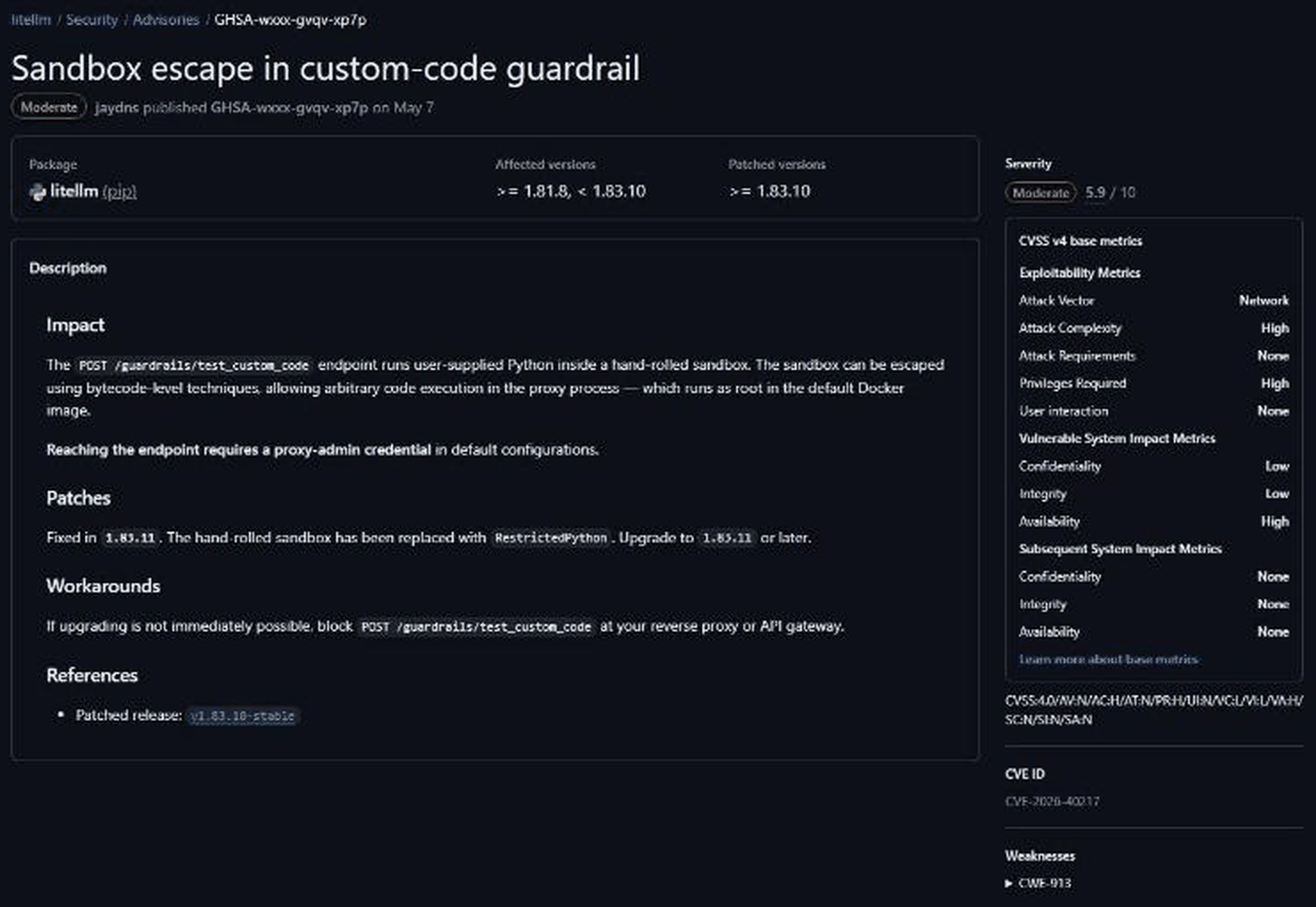
The advisory is titled “Sandbox escape in custom-code guardrail.” Its facts, in order:
- Package and versions: litellm on PyPI. Affected versions are 1.81.8 up to but not including 1.83.10. The page lists patched versions as 1.83.10 and later.
- The impact in the advisory’s words: an endpoint that runs user-supplied Python inside a hand-built sandbox can be escaped with bytecode-level techniques. That allows arbitrary code execution in the proxy process, which runs as root in the default Docker image.
- The condition: “Reaching the endpoint requires a proxy-admin credential” in default configurations.
- The fix: the hand-built sandbox was replaced with an existing restricted-execution library, RestrictedPython.
- The workaround: if you cannot upgrade, block
POST /guardrails/test_custom_codeat your reverse proxy or API gateway. - The score: Moderate, 5.9 out of 10 on CVSS v4.0, with attack complexity High and privileges required High.
We say nothing here about how the escape works. The advisory deliberately says no more than “bytecode-level techniques,” and we follow that.
One flaw, three severity ratings
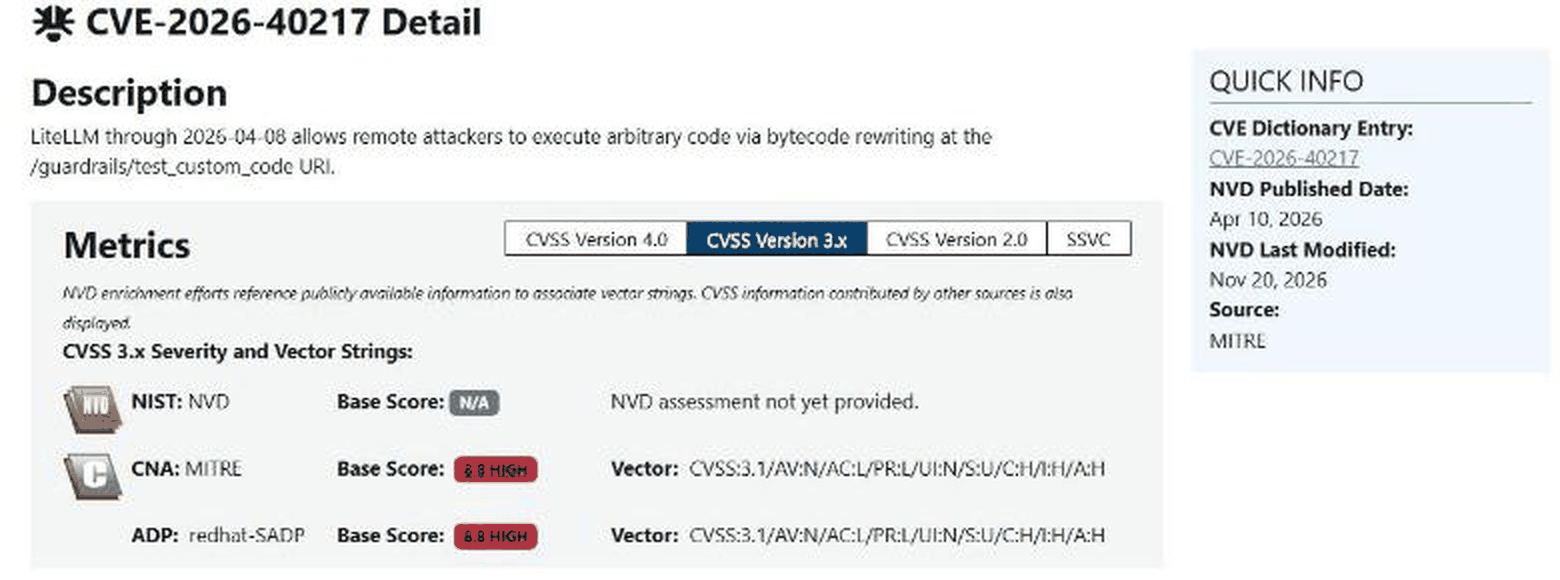
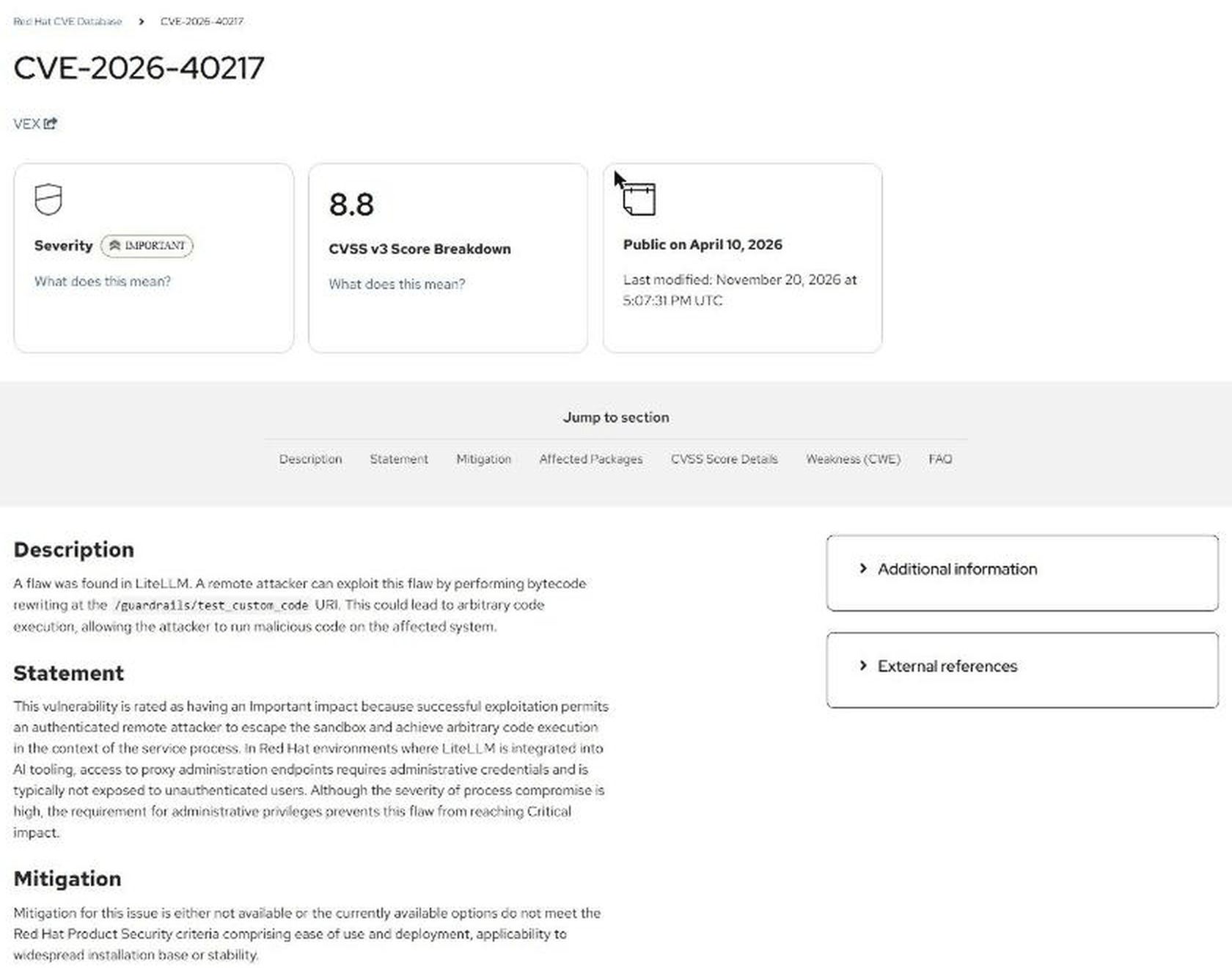
This is the part the headline numbers hide. We read three severity assessments of the same CVE. They are on different CVSS versions, so the scores are not strictly comparable, but the vectors tell a story.
| Source | Rating | Score | Privileges required | Attack complexity |
|---|---|---|---|---|
| LiteLLM advisory on GitHub (CVSS v4.0) | Moderate | 5.9 | High | High |
| MITRE, the CVE issuer, shown on NVD (CVSS v3.1) | High | 8.8 | Low | Low |
| Red Hat (CVSS v3.1) | Important | 8.8 | Low (same vector as MITRE) | Low |
| NIST’s own NVD assessment | “NVD assessment not yet provided” | N/A | N/A | N/A |
The gap comes down to two inputs. The maker rates the privileges required to reach the endpoint as High, because the advisory says a proxy-admin credential is needed, and the attack complexity as High. MITRE and Red Hat use the vector AV:N/AC:L/PR:L, which says low privileges and low complexity. Red Hat’s own written statement, though, agrees with the advisory on the practical point: it calls the attacker “authenticated,” says administration endpoints “require administrative credentials,” and says that requirement keeps the flaw from being Critical. In other words, Red Hat’s prose and its numeric vector do not describe the same attacker as neatly as one would expect. We do not know why, and we are not guessing.
What matters for a reader: the score you see depends on which page you open, and none of the three tells you whether anyone is actually being attacked. That is what the KEV listing is for.
What the KEV listing does and does not tell you
CISA’s Known Exploited Vulnerabilities catalog is a list of flaws for which CISA says it has evidence of active exploitation. CISA’s own website refuses automated reads, so we read the official mirror on GitHub, which showed catalog version 2026.11.20 with 1,790 entries. The entry for CVE-2026-40217 says:
- Name: BerriAI LiteLLM Unprotected Alternate Channel Vulnerability (weakness CWE-420, the classification MITRE uses on NVD; the GitHub advisory lists CWE-913 and Red Hat’s entry on NVD adds CWE-94).
- Date added: November 18, 2026. Federal due date: December 2, 2026.
- Description: remote attackers could execute arbitrary code through the same endpoint the advisory names.
- Required action: apply the vendor’s mitigations under CISA’s binding directive BOD 26-04, or stop using the product if mitigations are not available.
- Known ransomware campaign use: “Unknown.”
What the entry does not say: who exploited it, how many systems, against whom, or how CISA learned of it. We therefore cannot say anything about the attacks. The due date applies to US federal agencies, but the catalog is widely used by everyone else as a prioritisation list.
The timeline, with a seven-month gap
Every date below is from a page we opened, except the last row, which is our own calculation.
| Date (2026) | Event | Source |
|---|---|---|
| April 10 | CVE-2026-40217 public; NVD publishes the entry | NVD, Red Hat |
| April 19 | litellm 1.83.10 uploaded to PyPI | PyPI |
| April 22 | litellm 1.83.11 uploaded to PyPI | PyPI |
| May 7 | GitHub security advisory published | GitHub |
| November 18 | Added to CISA KEV, due December 2 | KEV (GitHub mirror) |
| November 20 | NVD and Red Hat pages last modified | NVD, Red Hat |
| 210 days | Between the 1.83.11 upload and the KEV addition (ours) | Our calculation |
A seven-month gap is common enough in security that it should not be read as drama. It does mean something practical: anyone who deployed LiteLLM in the spring and did not update has had the fix available for most of the year, and a flaw does not have to be new to be used.
A small inconsistency in the advisory is worth noting for anyone who pins versions. The patched-versions field says 1.83.10 or later, and the reference points to the release v1.83.10-stable. The text of the same advisory says “Fixed in 1.83.11” and tells readers to upgrade to 1.83.11 or later. PyPI shows both versions exist, three days apart. The 1.83.10-stable release page we opened, in the part we read, carries a Docker signature-verification note and no security statement; a page for a v1.83.11-stable tag returned “not found,” though the tag may be named differently. We do not know which version is the first one actually fixed. The safe advice is not to guess: move to a current release and avoid both.
A fourth LiteLLM entry in the catalog this year
The catalog lists four LiteLLM entries added in 2026. The descriptions below are CISA’s own, shortened.
| CVE | Added to KEV | CISA’s name for it |
|---|---|---|
| CVE-2026-42208 | May 8 | SQL injection; could expose the proxy’s database and the credentials it manages |
| CVE-2026-42271 | June 8 | Command injection; could let an authenticated user run commands on the host |
| CVE-2026-59822 | September 2 | Improper authentication in the MCP Streamable HTTP endpoint |
| CVE-2026-40217 | November 18 | Unprotected alternate channel; code execution through the custom-code guardrail endpoint |
Four entries in about six months, across four different weakness types, is a signal about where attention is going: AI gateways are a young, fast-moving class of software that sits next to valuable credentials. We do not claim anything about the quality of LiteLLM’s code. A widely used project attracts more scrutiny and more attackers, and a project that publishes advisories, as this one does, is easier to track than one that does not. Our reading is only that an operator of an AI gateway should treat it like any other internet-facing credential store and subscribe to its advisories.
NVD also lists Red Hat products in the affected-software configuration for this CVE, among them Ansible Automation Platform, OpenShift AI and OpenShift Lightspeed, each with its own version range. We did not read Red Hat’s errata, so we cannot say which fixed builds apply to which product. If you use those products, read Red Hat’s page and the linked errata rather than relying on the LiteLLM version numbers above.
What to check: a practical list
These steps combine the advisory’s own wording with general good practice. We have not tested them. Where a step is our suggestion and not the advisory’s, we say so.
- Find every LiteLLM you run. Look in container images, virtual environments, CI jobs and developer machines, not only the production proxy. Run
pip show litellmor check the image tag. - Compare the version. Anything from 1.81.8 up to but not including 1.83.10 is in the affected range. Treat 1.83.10 and 1.83.11 as uncertain, as explained above, and move to a current release.
- Upgrade. PyPI listed 1.110.2 as the current version when we looked on November 23. Read the release notes for breaking changes between your version and the new one before a production rollout.
- If you cannot upgrade yet, block
POST /guardrails/test_custom_codeat the reverse proxy or API gateway, as the advisory says. Check that the rule actually applies to the path your clients use. - Check who holds proxy-admin credentials. The advisory’s condition is a proxy-admin credential. List who has the master key or admin tokens and whether any are shared, embedded in scripts or exposed in logs. This is our suggestion.
- Look at exposure. Is the proxy reachable from the internet, or only from your network? Is the admin interface behind a separate control? This is our suggestion.
- Consider the root question. The advisory says the default Docker image runs the proxy as root. Whether you can run it as a non-root user, and with a read-only file system, is worth asking your platform team. This is our suggestion, not the advisory’s.
- If you suspect a compromise, remember what the proxy holds: provider API keys and user keys. Rotating them is cheap compared with finding out later. We cannot tell you whether you were affected; check your own logs for requests to the endpoint above. CISA’s entry also refers to its forensic triage requirements for federal systems.
What we could not confirm
- That the fixed versions work. We installed nothing and tested nothing.
- How, by whom or at what scale the flaw was exploited. The KEV entry says nothing on this, and its ransomware field reads “Unknown.”
- Which version is the first fixed one: 1.83.10 or 1.83.11. The advisory names both.
- Whether the 8.8 or the 5.9 is the better description of real-world risk. We report the three assessments; we do not choose.
- Whether a proxy-admin credential is as hard to obtain in real deployments as the advisory’s default assumes. Many deployments share one master key widely.
- The content of Red Hat’s errata RHSA-2026:24866 and RHSA-2026:30056, which NVD links. We did not open them.
- Why CISA added the entry in November rather than earlier. CISA does not say.
- Anything about other AI gateways. We read about LiteLLM only.
Frequently asked questions
What is CVE-2026-40217?
A flaw in the LiteLLM AI gateway where a custom-code guardrail endpoint runs user-supplied Python in a hand-built sandbox that can be escaped, according to the project’s advisory. It allows arbitrary code execution in the proxy process.
Is it being exploited?
CISA added it to its Known Exploited Vulnerabilities catalog on November 18, 2026, which means CISA says it has evidence of exploitation. The entry gives no further detail.
Which LiteLLM versions are affected?
From 1.81.8 up to but not including 1.83.10, per the advisory and NVD. The advisory text also says “fixed in 1.83.11,” so move to a current release.
Do I need to be an admin to be attacked?
The advisory says reaching the endpoint requires a proxy-admin credential in default configurations. MITRE’s score assumes low privileges instead. Both assessments exist; treat stolen or shared admin credentials as a real risk.
What if I cannot upgrade today?
Block POST /guardrails/test_custom_code at your reverse proxy or API gateway, as the advisory says, and plan the upgrade.
Where are the sources?
The LiteLLM advisory GHSA-wxxx-gvqv-xp7p, the NVD entry for CVE-2026-40217, the Red Hat CVE page, the litellm package on PyPI, and the CISA KEV data repository on GitHub. All screenshots are ours, taken November 23, 2026.
Related reading
- Firefox 160 Security Update: 99 CVEs, 13 Sandbox Escapes, and Why 160.0.1 Matters
- Git 2.56.1 Fixes Six Vulnerabilities, Including Code Execution When Cloning a Malicious Repository
- OpenSSH 10.6p2 Fixes CVE-2026-123158, a Password Bypass on musl Linux Now on CISA’s Exploited List
- VMware vCenter CVE-2026-123890: Critical Authentication Bypass Exploited as a Zero-Day Before Broadcom’s November 19 Patch, and What to Check
- AI tool reviews