IBM Aspera Faspex CVE-2026-123218: Admin Bypass on KEV
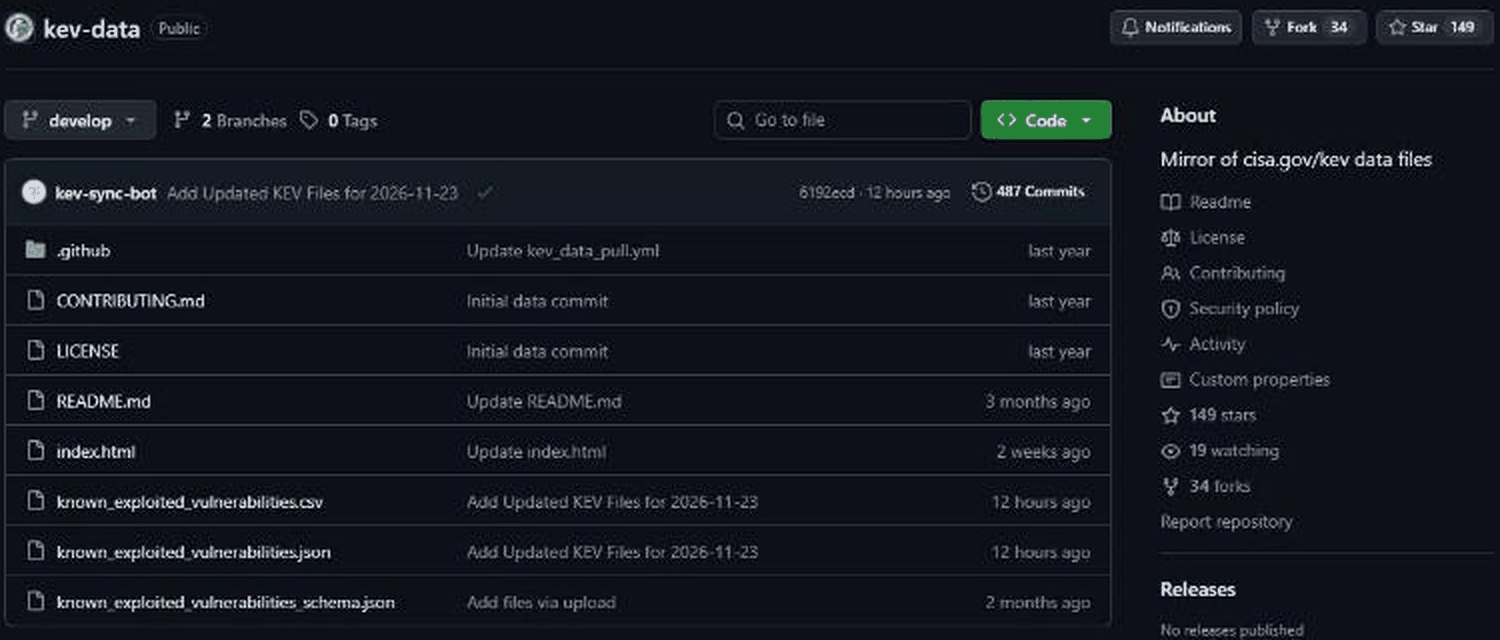
Published November 25, 2026. A news analysis of IBM Aspera Faspex vulnerability CVE-2026-123218, built from IBM’s security bulletin “IBM Aspera Faspex has addressed a vulnerability that could allow authorization bypass” (read on IBM’s support site on November 25, 2026) and CISA’s Known Exploited Vulnerabilities (KEV) data as mirrored on CISA’s GitHub. The screenshot is ours (the CISA data mirror on GitHub). CISA’s own website returned “Access Denied” to our automated browser, so we did not use it. This article contains no affiliate links and we have no commercial relationship with IBM. ToolReviewHub is produced with the help of an AI assistant (Claude, made by Anthropic). We did not run Aspera Faspex or test the flaw. Descriptions are the vendors’ and CISA’s wording, and numbers marked “ours” are our own arithmetic.
IBM Aspera Faspex CVE-2026-123218: the short version
- What it is: an incorrect-authorization flaw (CWE-863) in IBM Aspera Faspex 5. IBM says a user can craft a specific message to bypass authorization and obtain full administrative privileges.
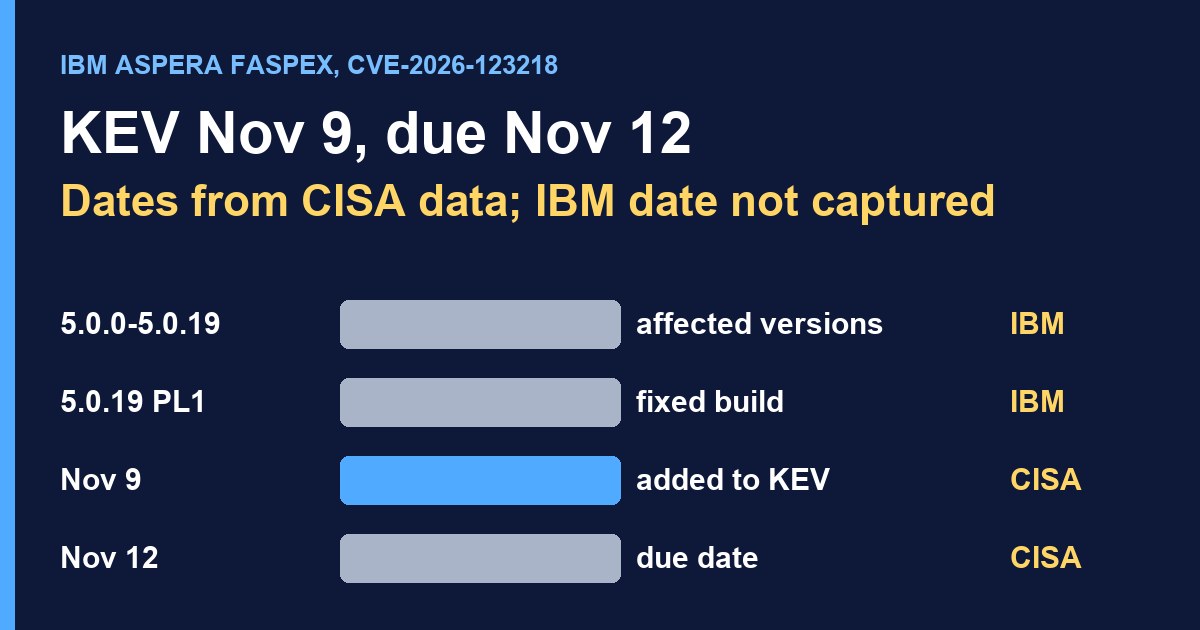
- Affected: Faspex 5.0.0 through 5.0.19. Fixed in: 5.0.19 PL1 (patch level 1).
- Score and a wording puzzle: IBM’s CVSS 3.1 base score is 9.8 with the vector AV:N/AC:L/PR:N/UI:N. “PR:N” means no privileges needed, yet the text says the user is authenticated or authorized. We could not resolve that mismatch (see below).
- KEV status: CISA added it to the Known Exploited Vulnerabilities catalog on November 9, 2026, with a November 12 due date.
- Why it is sensitive: Faspex is software for sending large files, and administrative control of such a server may expose what is stored on it. That is our general reading and not an IBM statement.
What Faspex is
IBM Aspera is a family of high-speed file transfer products. Faspex 5 is the part that lets people and organizations send and receive packages of files through a web interface, with accounts, workgroups and administrators. The details of how Faspex stores and shares files are on IBM’s product pages, which we did not read for this article. What the bulletin tells us is enough: Faspex has users with different levels of authorization, and an administrator role with full control.
Our note on exposure: file-transfer servers are often reachable from the internet so that outside partners can send files. We do not know how many Faspex 5 servers are exposed, and the bulletin does not say.
What the vulnerability is
IBM’s bulletin says that Faspex 5.0.0 through 5.0.19 could allow an authorized user to craft a specific message to bypass user authorization and gain full administrative privileges. The weakness class is CWE-863, incorrect authorization. In plain terms: the software checks who you are, but fails to check properly what you are allowed to do, and a specially formed message makes it hand over administrator rights.
The bulletin does not publish the message format, and we have not tried to reproduce anything. Nothing in this article is an exploitation guide.
Questions to put to IBM and your own team
Because the public text leaves several things open, it is reasonable to ask IBM for written answers. First, which account types can trigger the flaw: only full user accounts, or also guest-style or externally invited users? Second, whether the fix in 5.0.19 PL1 is the only supported remedy or whether a configuration change reduces the risk in the meantime. Third, whether IBM can share indicators that would show abuse in the Faspex logs.
Inside your own organization, ask which teams depend on the server, who owns patching for it, and what data it holds. File-transfer servers often start life as a project tool and end up holding contracts, medical files or source code. Knowing what sits on the server decides how urgent the response should be, and what notice you may owe to others if the worst happened.
Finally, keep a record. If you patch after the KEV date, note the date and time, the build you reached and who did it. Auditors, customers and insurers may later ask when you closed the exposure, and a written record is easier to defend than memory.
One more practical point is the patch-level naming. IBM calls the fix 5.0.19 PL1, which is a patch level on top of 5.0.19 rather than a new major release. After applying it, confirm the displayed version or build information on the server shows the patch level, because an upgrade that silently failed would otherwise look identical to a successful one. If the version display does not mention the patch level, ask IBM how to verify it.
The mismatch in IBM’s own description
One detail deserves a careful look. IBM’s text speaks of an authenticated or authorized user, which suggests the attacker needs an account. The CVSS vector in the record, however, says PR:N, no privileges required, along with a network attack path, low complexity and no user interaction, and scores 9.8. The two do not match: a flaw that needs a logged-in user would normally carry PR:L and a lower score. We cannot tell which is right from the public text. There are several possible explanations: the vector may be a worst-case estimate; “authorized” may include very low-privileged or guest-style accounts; or the score may include a separate path that the text does not describe. That is speculation, and we flag it as an open question.
What it means in practice: do not assume that having no accounts on your server protects you, and do not assume that anyone on the internet can take it over either. Plan as though a low-privileged user, and possibly an outsider, could try. IBM is the right source for clarification.
Versions and fix
| Item | What IBM says |
|---|---|
| Affected | IBM Aspera Faspex 5.0.0 through 5.0.19 |
| Fixed in | 5.0.19 PL1 (patch level 1) |
| Weakness | Incorrect authorization, CWE-863 |
| Score | CVSS 3.1 base 9.8, vector AV:N/AC:L/PR:N/UI:N/S:U/C:H/I:H/A:H |
| Impact | Bypass of user authorization and full administrative privileges |
Timeline
| Date (2026) | Event | Source |
|---|---|---|
| Not captured | IBM publishes the bulletin and the 5.0.19 PL1 fix | IBM |
| November 9 | CISA adds CVE-2026-123218 to the KEV catalog | CISA KEV data |
| November 12 | KEV due date for U.S. federal civilian agencies | CISA KEV data |
We did not capture IBM’s publication date, so we cannot say how long the gap to the KEV listing was. The three-day window (ours: November 9 to November 12) is the shorter of CISA’s two, as we describe in our November KEV analysis, and the date has passed.
What to do: a practical checklist
- Find every Aspera Faspex 5 server and its version. Faspex servers set up for a one-off project are easy to forget.
- Install 5.0.19 PL1 or later following IBM’s instructions in the bulletin. If you are on an older line, ask IBM which build applies.
- Review the administrator list. Look for administrators you did not create, and for ordinary accounts that gained admin rights recently.
- Review recent configuration changes, new workgroups, new shared inboxes, new API keys and changed notification settings.
- Check who can reach the server. If it does not need to be open to the whole internet, restrict it to partner networks or require a VPN.
- Review transfers. Look for packages downloaded or sent in ways that do not fit your normal pattern. If you find suspicious access, treat the files stored on the server as potentially exposed.
- Ask IBM about the PR:N versus authorized-user wording if your risk decision depends on it.
What we could not confirm
- Whether the attacker needs an account: IBM’s text and its CVSS vector disagree.
- How the flaw is exploited in the wild, by whom and against what: CISA’s entry records exploitation without details.
- IBM’s publication date of the bulletin: we did not capture it.
- Whether versions before 5.0.0 or other Aspera products are affected: the bulletin lists only 5.0.0 through 5.0.19.
- How many Faspex 5 servers are exposed to the internet.
- CISA’s own catalog page, which we could not open; the KEV facts come from CISA’s GitHub mirror (catalog version 2026.11.23).
Frequently asked questions
What is CVE-2026-123218?
An incorrect-authorization flaw in IBM Aspera Faspex 5 that lets a crafted message bypass authorization and gain full administrative privileges.
Which versions are affected and fixed?
Faspex 5.0.0 through 5.0.19 are affected. IBM lists 5.0.19 PL1 as the fix.
Do I need an account to exploit it?
IBM’s description says an authorized user, but its CVSS vector says no privileges are required. We could not resolve the difference.
Is it exploited?
CISA added it to the Known Exploited Vulnerabilities catalog on November 9, 2026. We found no public detail about the attacks.
What is the KEV deadline?
November 12, 2026 for U.S. federal civilian agencies. For everyone else it signals urgency and is not a legal deadline.
Method: details come from IBM’s security bulletin for CVE-2026-123218 and CISA KEV data (catalog version 2026.11.23), read on November 25, 2026. For how we research, see How We Review Tools.