SonicWall CVE-2026-19868: SAML SSLVPN Bypass on CISA KEV
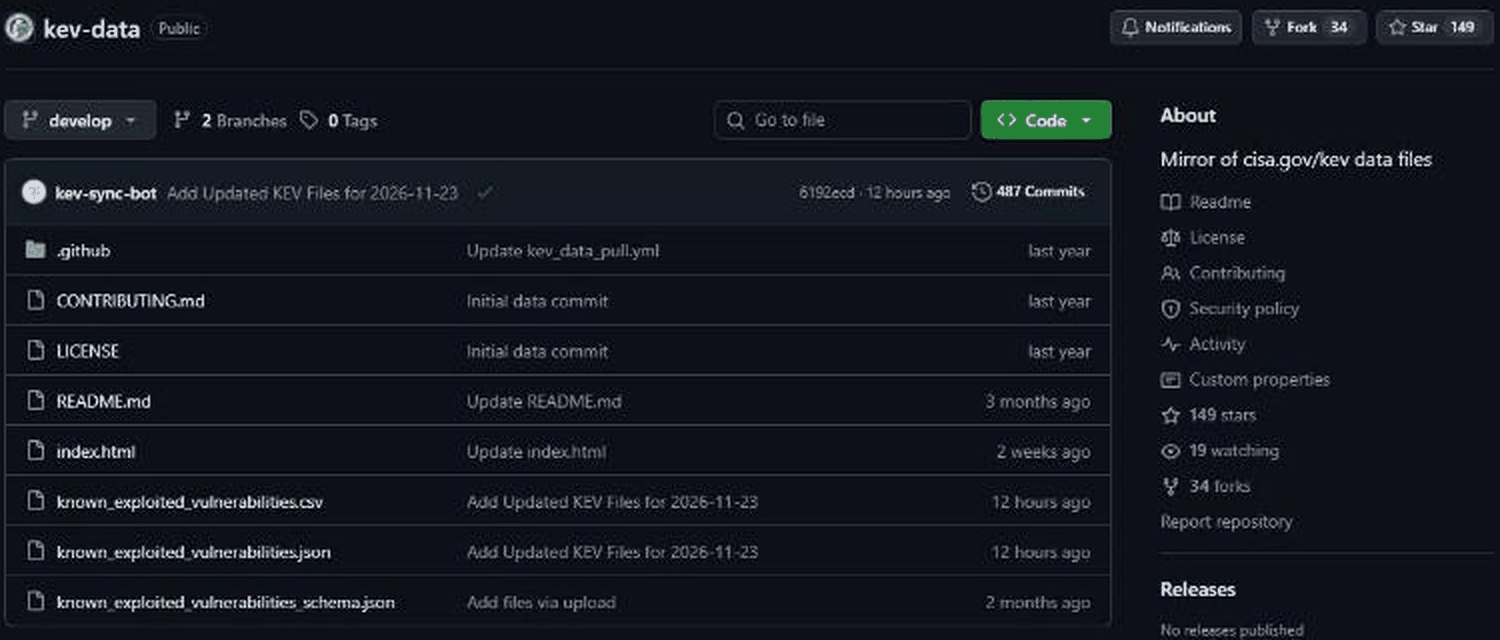
Published November 25, 2026. A news analysis of SonicWall SonicOS vulnerability CVE-2026-19868, built from SonicWall’s PSIRT advisory SNWLID-2026-0014 (read on SonicWall’s website on November 25, 2026) and CISA’s Known Exploited Vulnerabilities (KEV) data as mirrored on CISA’s GitHub. The screenshot is ours (the CISA data mirror on GitHub). CISA’s own website returned “Access Denied” to our automated browser, so we did not use it. This article contains no affiliate links and we have no commercial relationship with SonicWall. ToolReviewHub is produced with the help of an AI assistant (Claude, made by Anthropic). We did not use a SonicWall firewall for this article or test the flaw. Descriptions are the vendors’ and CISA’s wording, and numbers marked “ours” are our own arithmetic.
SonicWall CVE-2026-19868: the short version
- What it is: an authentication-enforcement flaw in the SSLVPN of SonicOS. SonicWall says a user who holds valid credentials for an alternate authentication method may bypass SAML authentication controls, including multi-factor authentication (MFA) that SAML enforces.
- Condition: it affects SSLVPN only if SAML is enabled for SSLVPN logins. SonicWall’s advisory also says its PSIRT has investigated a report indicating potential exploitation.
- Score: CVSS 7.1 (vector CVSS:3.1/AV:N/AC:H/PR:L/UI:N/S:C/C:H/I:L/A:N), weakness CWE-308 (use of single-factor authentication). It is one of seven vulnerabilities in the same advisory, whose headline score is 8.8.
- Fixed in: SonicOS 7.3.4-7013 and higher for Gen7, and 8.2.3-8015 and higher for Gen8. Builds 7.3.3-7015 and 8.2.2-8015 and older are affected.
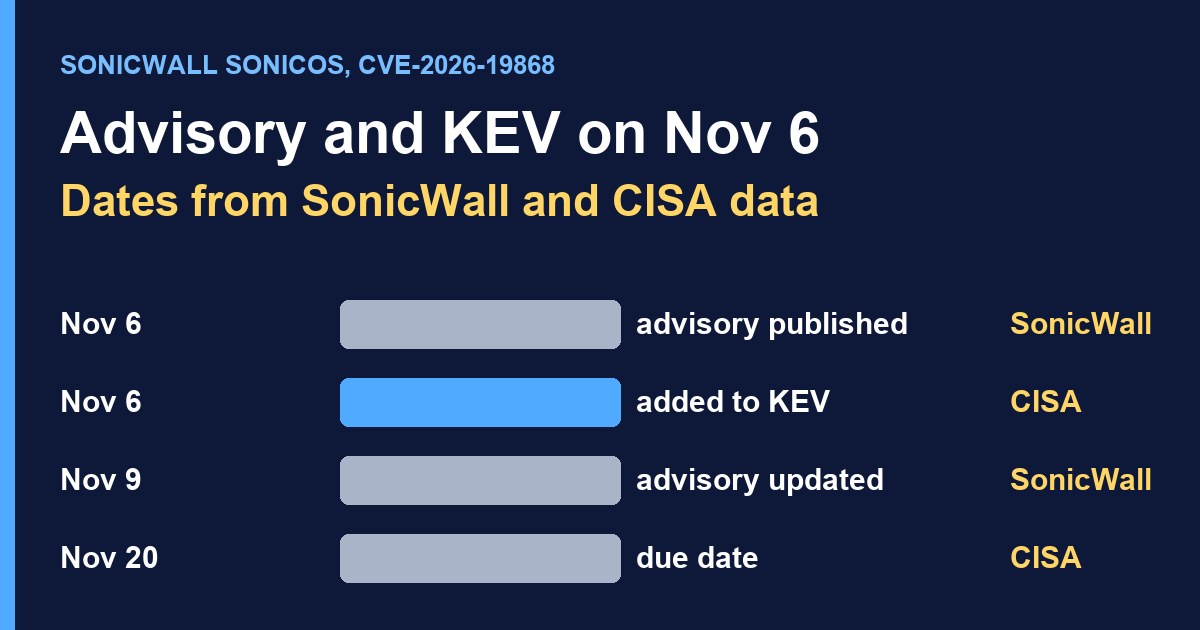
- KEV status: CISA added it to the Known Exploited Vulnerabilities catalog on November 6, 2026, the same day as the advisory, with a November 20 due date.
How SAML and SSLVPN fit together
SSLVPN is SonicWall’s remote-access VPN: employees connect through a web-based client to reach internal resources. Instead of keeping passwords on the firewall, many organizations let the firewall hand the login to an identity provider using SAML, a standard for single sign-on. The big benefit is that the identity provider can demand MFA. When this works as designed, a stolen password alone is not enough to get a VPN session.
The flaw in CVE-2026-19868 sits exactly at that boundary. If the firewall also has other login methods configured, the advisory says that a user with valid credentials for one of those methods can get past the SAML controls, including the MFA enforced through SAML. It is an authentication bypass, but it is not “no login needed”: the attacker needs a valid account in an alternate method. How easy that is depends on the environment.
What the advisory says
SNWLID-2026-0014, “SonicWall SonicOS affected by multiple vulnerabilities,” was first published on November 6, 2026 and last updated on November 9. It lists seven CVEs. The entry for CVE-2026-19868 is titled “SSLVPN Authentication Enforcement Vulnerability via Alternate Authentication Methods.” SonicWall marks it with an “important” note that the PSIRT has investigated a report indicating potential exploitation. It affects SSLVPN only if SAML is enabled for SSLVPN logins. The CVSS 3.1 score is 7.1, and the weakness class is CWE-308.
Read the vector carefully. Attack complexity is high (AC:H) and privileges required are low (PR:L), which fits the need to hold a valid credential for an alternate method. Scope is changed (S:C), which means the impact can reach beyond the vulnerable component. Confidentiality impact is high. These are the vendor’s ratings, and we have not tested the flaw.
Why MFA bypasses deserve extra attention
Most organizations that adopt SAML for a VPN do it to gain MFA. If a bypass exists, the control that the security team believes is protecting remote access is silently not applied for some logins. That changes how you read your logs: a clean-looking login with a valid identity may not have been checked against the identity provider at all. This is why we suggest comparing firewall logs with the identity provider’s logs, because the two should agree on who logged in. If they do not, that difference is the lead to follow.
A second lesson is configuration hygiene. The workaround works because the alternate authentication servers are what the bypass relies on. Old LDAP or RADIUS entries that were left in place after a migration to SAML are the kind of leftover that turns a clean design into a weakness. Review what your firewall is configured to accept, and remove what you no longer use. This is general advice and not a statement from SonicWall.
The other six vulnerabilities in the advisory
Because the advisory covers seven issues, it is worth knowing what else is in it. The excerpt we read includes a permissive cross-domain policy (CVE-2026-107155, CVSS 8.8, CWE-942), a session validation issue that relies on the client IP address for authentication (CVE-2026-107154, CVSS 8.8, CWE-291), a pre-authentication heap buffer overflow in SSL-VPN (CVE-2026-82308) and a pre-authentication stack-based buffer overflow (CVE-2026-77708), as well as CVE-2026-77709 and CVE-2026-19703, which we did not read in detail. Only CVE-2026-19868 is in the KEV catalog. But the same builds fix all seven, so patching deals with the whole group.
Affected and fixed versions
| Platform | Affected (SonicWall) | Fixed in |
|---|---|---|
| Gen7 hardware (TZ 270 to 670, NSa 2700 to 6700, NSsp 10700 to 15700) | 7.3.3-7015 and older | 7.3.4-7013 and higher |
| Gen7 virtual (NSv 270, 470, 870) | 7.3.3-7015 and older | 7.3.4-7013 and higher |
| Gen8 hardware (TZ 80 to 680, NSa 2800 to 5800) | 8.2.2-8015 and older | 8.2.3-8015 and higher |
| Gen8 virtual (NSv) | 8.2.2-8015 and older | 8.2.3-8015 and higher |
Workaround. If you use SAML and cannot upgrade immediately, SonicWall says to disable or delete any active LDAP, RADIUS and TACACS+ authentication server configured on the firewall (found in the authentication settings under Device, Users, Settings). That removes the alternate methods the bypass relies on. It will also stop anyone from logging in with those methods, so plan for the impact on users and other services first.
Timeline: advisory and KEV on the same day
| Date (2026) | Event | Source |
|---|---|---|
| November 6 | SonicWall publishes SNWLID-2026-0014 | SonicWall |
| November 6 | CISA adds CVE-2026-19868 to the KEV catalog | CISA KEV data |
| November 9 | SonicWall updates the advisory | SonicWall |
| November 20 | KEV due date for U.S. federal civilian agencies | CISA KEV data |
KEV on the same day as the advisory means CISA already had evidence of exploitation when the vendor published. SonicWall’s wording is careful (“potential exploitation”), and CISA’s listing implies something firmer, but neither tells us what attackers did. The 14-day window (ours) ended on November 20. Our KEV analysis explains the difference between the three-day and 14-day deadlines.
What to do: a practical checklist
- Check whether SAML is enabled for SSLVPN. If it is not, this particular flaw does not apply, but the other six vulnerabilities in the advisory still do.
- Check your SonicOS version and compare it with the table. Upgrade to 7.3.4-7013 or 8.2.3-8015 or higher on the matching generation.
- If you cannot upgrade immediately, consider SonicWall’s workaround of removing active LDAP, RADIUS and TACACS+ servers, after checking what depends on them.
- Review VPN logins since early November for sessions that did not go through the SAML provider, or that came from unusual addresses. Compare firewall logs with your identity provider’s logs.
- Review accounts in the alternate methods. Disable accounts you do not need. Any valid credential in an alternate method is a potential key.
- Reset credentials and sessions for users whose logins look odd, and review what internal systems the VPN pool can reach.
- Keep the management interface off the internet, as a general rule for any firewall.
What we could not confirm
- How the flaw has been exploited, by whom and against whom: SonicWall says “potential exploitation” and CISA’s entry gives no detail.
- How an attacker would obtain valid credentials for an alternate method.
- Details of CVE-2026-77709 and CVE-2026-19703: we did not read them closely.
- Whether the workaround has side effects on your environment: only you can check what depends on LDAP, RADIUS or TACACS+.
- How many SonicWall devices use SAML for SSLVPN.
- CISA’s own catalog page, which we could not open; the KEV facts come from CISA’s GitHub mirror (catalog version 2026.11.23).
Frequently asked questions
What is CVE-2026-19868?
A flaw in SonicOS SSLVPN that lets a user with valid credentials for an alternate authentication method bypass SAML controls, including SAML-enforced MFA.
Does it affect me if I do not use SAML?
SonicWall says it affects SSLVPN only if SAML is enabled for SSLVPN logins. The advisory’s other vulnerabilities may still apply.
Which versions fix it?
SonicOS 7.3.4-7013 and higher on Gen7, and 8.2.3-8015 and higher on Gen8.
Is there a workaround?
Yes: if you use SAML and cannot upgrade, disable or delete active LDAP, RADIUS and TACACS+ authentication servers on the firewall.
What is the KEV deadline?
November 20, 2026 for U.S. federal civilian agencies. For everyone else it signals urgency and is not a legal deadline.
Method: details come from SonicWall’s advisory SNWLID-2026-0014 (published November 6, 2026, updated November 9) and CISA KEV data (catalog version 2026.11.23), read on November 25, 2026. For how we research, see How We Review Tools.