MONAI Label CVE-2026-133968: Critical Path Traversal on CISA’s Exploited List, Open to Anyone Who Can Reach the Server by Default
Published November 24, 2026. A news analysis of vulnerability CVE-2026-133968 in MONAI Label, built from the project’s GitHub security advisory GHSA-qc22-rmgc-vg94, the PyPI release data for the monailabel package, CISA’s Known Exploited Vulnerabilities (KEV) data as mirrored on CISA’s GitHub, and the project’s pull request #1915 as described in the advisory. The screenshots are ours and were taken on November 24, 2026. CISA’s own website returned “Access Denied” to our automated browser, so we did not use it. This article contains no affiliate links and we have no commercial relationship with Project MONAI or its sponsors. ToolReviewHub is produced with the help of an AI assistant (Claude, made by Anthropic). We did not install MONAI Label or test the flaw. Descriptions are the project’s and CISA’s wording, and numbers marked “ours” are our own arithmetic.
MONAI Label CVE-2026-133968: the short version
- What it is: a path traversal flaw in MONAI Label’s datastore upload endpoints that lets a caller write an uploaded file to any location the MONAI Label process can write to. The project rates it Critical, and the weakness is CWE-22.
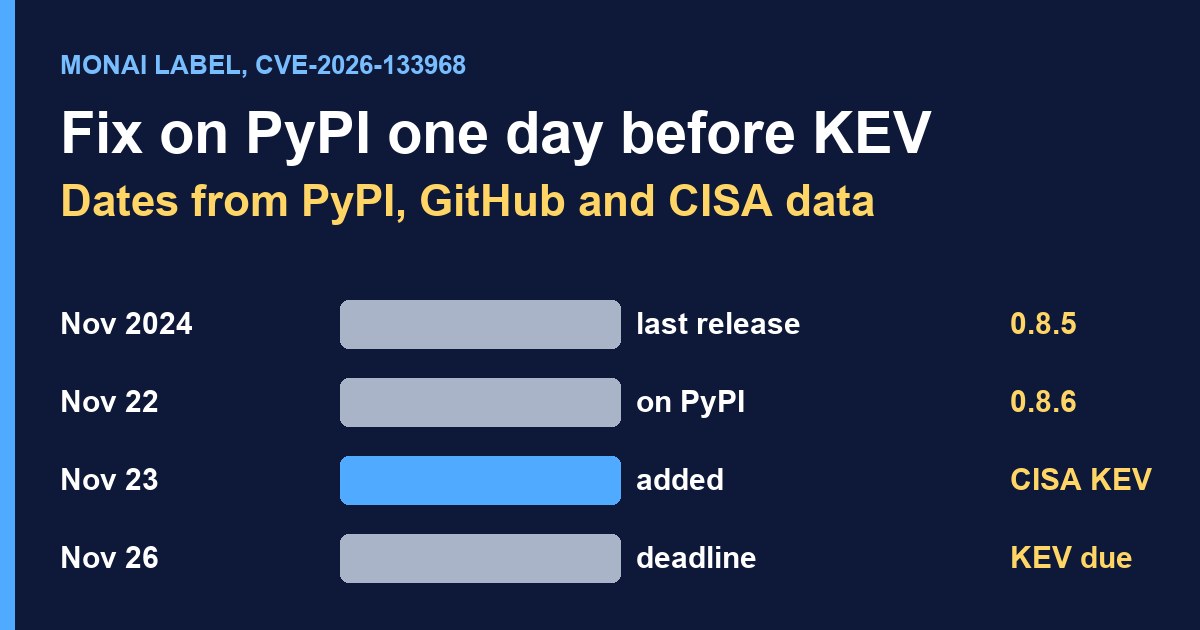
- Affected versions: monailabel 0.8.5 and earlier. Patched version: 0.8.6, which appeared on PyPI on November 22, 2026.
- The default is the problem: the advisory says authentication is disabled by default, so in the default configuration any network client that can reach the server can exploit the flaw. With authentication on, the lowest “annotator” role is enough.
- Impact: arbitrary file write can lead to remote code execution or to denial of service, according to the advisory.
- KEV status: CISA added it to the Known Exploited Vulnerabilities catalog on November 23, 2026 with a due date of November 26, 2026.
- What to do now: upgrade to 0.8.6, turn authentication on, keep the server off untrusted networks, and run it as an unprivileged user with narrow write access.
What MONAI Label is
MONAI Label is an open-source toolkit from Project MONAI (the Medical Open Network for AI). PyPI describes it as an active learning toolkit for healthcare imaging: it is a server that lets clinicians and researchers annotate medical images with the help of AI models, with the models learning from the corrections. In a typical deployment, a MONAI Label server runs alongside an image viewer and stores images and labels in a datastore directory on disk. That fact is exactly what the vulnerability abuses: the server accepts uploads and decides where to write them.
This is not a consumer product. It is research and clinical-research infrastructure, often installed by a lab or hospital IT team on a workstation or server that may also hold images. Whether a given server holds real patient data is up to the deployment, and nothing in the advisory says anything about that. We do not know how many MONAI Label servers are reachable from the internet.
What the advisory says
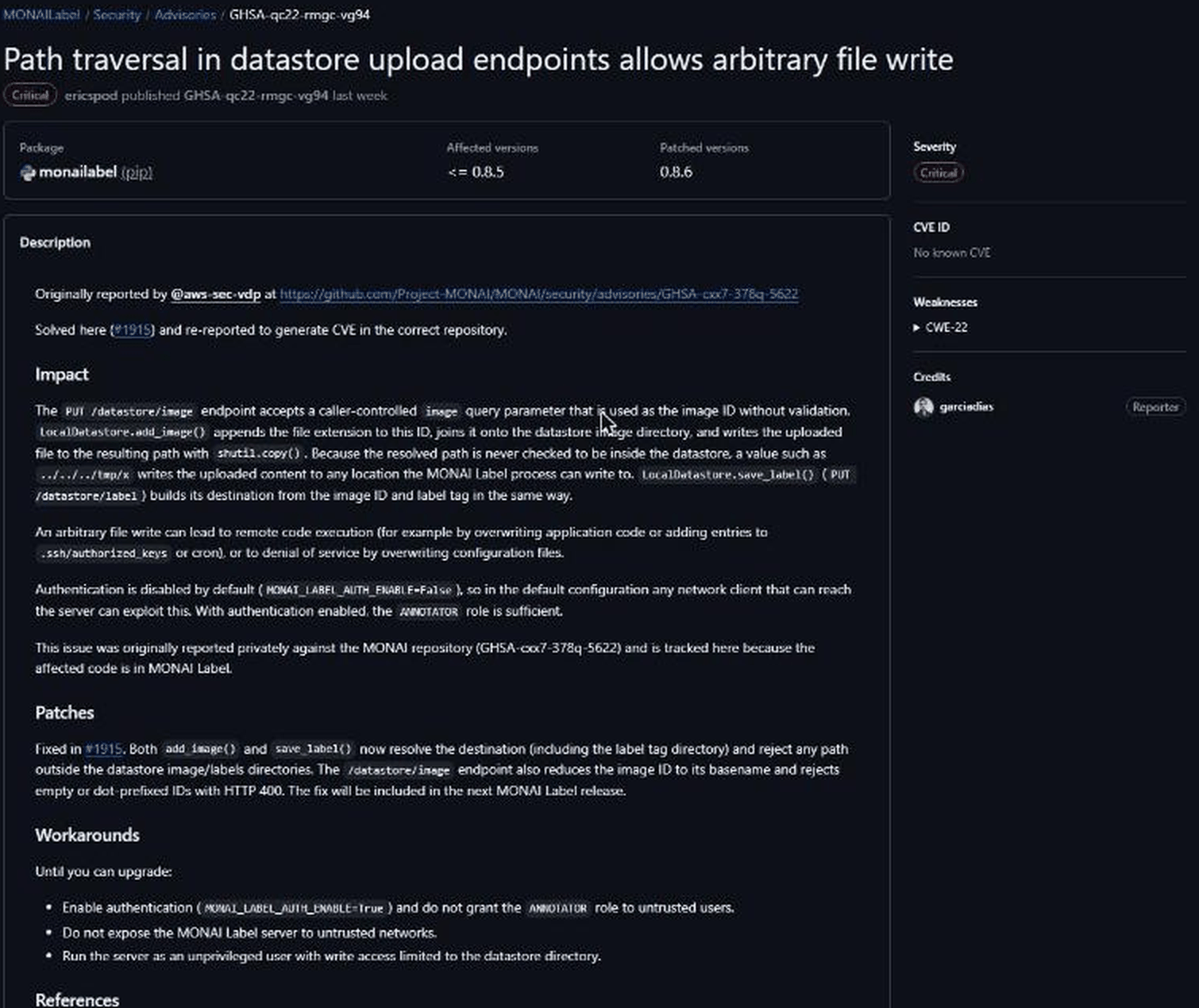
The project’s advisory is titled “Path traversal in datastore upload endpoints allows arbitrary file write.” It describes the weakness in these terms:
- One upload endpoint takes a caller-controlled “image” parameter and uses it as the image ID without validating it.
- The datastore code then appends a file extension, joins the result to the datastore image directory and writes the uploaded file there. Because the final path is never checked to be inside the datastore, the caller can steer the write to any location the server process can write.
- A second endpoint, which saves labels, builds its destination from the image ID and the label tag in the same way.
- The advisory says an arbitrary file write “can lead to remote code execution,” for example by overwriting application code or adding entries to SSH key files or scheduled jobs, or to denial of service by overwriting configuration files.
We are not reproducing the request format or an example of a malicious value. The project’s advisory contains one, but a defender does not need it, and CISA’s description is enough to understand the risk: an unauthenticated remote attacker can write arbitrary files outside the intended datastore directory, potentially leading to remote code execution.
Why the default configuration matters
The advisory is blunt about the setting that decides your exposure: authentication is disabled by default, controlled by a setting named MONAI_LABEL_AUTH_ENABLE, which defaults to false. In the default configuration, “any network client that can reach the server” can exploit the flaw, according to the advisory. With authentication switched on, a user with the annotator role is enough, so merely enabling authentication limits who can attack but does not remove the flaw. Only the upgrade does that.
The advisory lists three workarounds for people who cannot upgrade at once:
- Enable authentication, and do not grant the annotator role to untrusted users.
- Do not expose the MONAI Label server to untrusted networks.
- Run the server as an unprivileged user whose write access is limited to the datastore directory.
The third item is a good general lesson: a path traversal can only write where the process can write, so a server that runs as a locked-down user with write access to one folder limits the damage of any file-write bug.
Versions, patches and the PyPI timeline
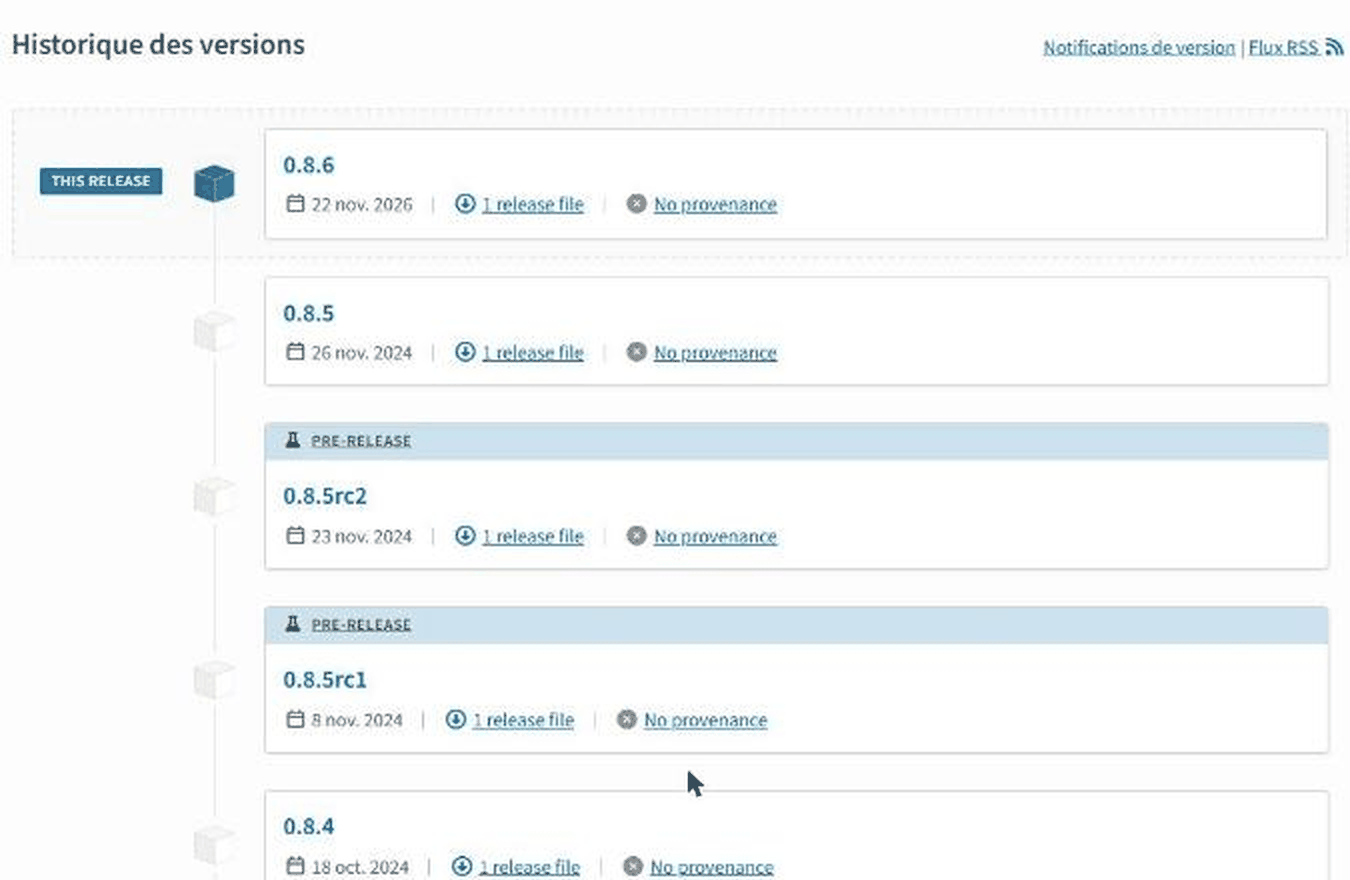
The advisory lists affected versions as 0.8.5 and earlier and the patched version as 0.8.6. We checked PyPI: version 0.8.6 of the monailabel package was uploaded on November 22, 2026, and the previous stable release, 0.8.5, dates from late November 2024, roughly two years earlier (ours; PyPI’s page shows November 26, 2024 in our locale, its JSON data shows November 25 UTC). The advisory says the fix, pull request #1915, makes both save functions resolve the destination path and reject any path outside the datastore image and label directories, reduces the image ID to its base name, and rejects empty or dot-prefixed IDs with an HTTP 400 error. One sentence in the advisory says the fix “will be included in the next MONAI Label release,” which was true when written; PyPI now shows that release.
| Date | Event | Source |
|---|---|---|
| Late November 2024 | monailabel 0.8.5 released | PyPI |
| Before the fix | A researcher reports the issue privately against the main MONAI repository, which is then re-reported against MONAI Label so the CVE is created in the right repository | GitHub advisory |
| November 22, 2026 | monailabel 0.8.6 is uploaded to PyPI | PyPI |
| November 23, 2026 | CISA adds CVE-2026-133968 to KEV | CISA KEV data |
| November 26, 2026 | KEV due date (three days) | CISA KEV data |
The fix appeared on PyPI one day before the KEV addition (ours). That is a short window between release and listing, and it means many deployments will still be on 0.8.5 or earlier as of today.
One oddity: “No known CVE” on the advisory page
When we read the GitHub advisory, its CVE field said “No known CVE,” while CISA’s KEV entry lists the vulnerability as CVE-2026-133968. The advisory was likely written before the CVE was assigned and the page may not yet have been updated, or the link between them may not yet be recorded. We could not resolve the difference. If you search a vulnerability scanner by CVE number and find nothing for MONAI Label, search by the advisory ID GHSA-qc22-rmgc-vg94 or the package name instead.
What to do: a practical checklist
- Find your servers. Search for MONAI Label installs, including lab workstations, research clusters and containers. The package name is monailabel.
- Check the version. In the Python environment that runs the server, list the installed monailabel version. 0.8.5 and earlier are affected.
- Upgrade to 0.8.6 or later, then restart the server and confirm the version.
- Turn authentication on. Set the MONAI_LABEL_AUTH_ENABLE option to true and manage who gets the annotator role.
- Restrict the network. Keep the server off the public internet; allow only the viewer and the users that need it, for instance through a VPN or an internal network segment.
- Run as an unprivileged user whose write permissions are limited to the datastore directory.
- Look for signs of abuse. Check the datastore and the machine for files you do not recognise, recently modified application or configuration files, unexpected entries in SSH authorized keys or scheduled jobs, and unusual requests to the datastore endpoints in your logs. CISA’s required-action text for November entries refers to forensics triage requirements, which is a prompt to review, not only patch.
- If the server held patient or other regulated data, involve your security and privacy teams. We make no claim about whether any data was accessed.
What we could not confirm
- Who is exploiting the flaw, how, and against which deployments: the KEV entry records exploitation but gives no details, and we found no public attack report.
- How many MONAI Label servers are exposed to the internet or use the default no-authentication setting.
- Whether releases other than 0.8.5 and 0.8.6 matter: we relied on the advisory’s version range.
- Why the advisory page shows “No known CVE” next to a CVE listed by CISA.
- Anything about the code beyond the advisory’s description; we did not install or test any version.
- CISA’s own catalog page, which we could not open; the KEV facts come from CISA’s GitHub mirror (catalog version 2026.11.23).
Frequently asked questions
What is CVE-2026-133968?
A path traversal vulnerability in Project MONAI’s MONAI Label that lets a caller write files outside the intended datastore directory, which can lead to remote code execution. The project rates it Critical.
Which MONAI Label versions are affected, and which are fixed?
The advisory lists 0.8.5 and earlier as affected and 0.8.6 as patched. Version 0.8.6 appeared on PyPI on November 22, 2026.
Do I need to log in to exploit it?
Not in the default configuration. Authentication is disabled by default, and CISA describes the attacker as unauthenticated. With authentication enabled, the advisory says the annotator role is sufficient.
Is it being exploited?
CISA added it to the Known Exploited Vulnerabilities catalog on November 23, 2026, which means CISA says it is exploited. We found no further public detail.
Does turning on authentication fix it?
No. It reduces who can reach the vulnerable endpoints but does not remove the flaw. Upgrade to 0.8.6 or later.
What is the KEV deadline?
November 26, 2026 for U.S. federal civilian agencies. For everyone else it signals urgency and is not a legal deadline.
Method: details come from the GitHub advisory GHSA-qc22-rmgc-vg94 for Project-MONAI/MONAILabel, the PyPI release data for monailabel, and CISA KEV data (catalog version 2026.11.23), all read on November 24, 2026. For how we research, see How We Review Tools.