N-able MailAssure CVE-2026-134624: SSRF in the LDAP Sync Check, Fixed in 20261121.1943 and Added to CISA’s Exploited List a Day After the Advisory
Published November 24, 2026. A news analysis of N-able MailAssure vulnerability CVE-2026-134624, built from N-able’s security advisory (read on N-able’s customer portal on November 24, 2026) and CISA’s Known Exploited Vulnerabilities (KEV) data as mirrored on CISA’s GitHub. The screenshot is ours. CISA’s own website returned “Access Denied” to our automated browser, so we did not use it. This article contains no affiliate links and we have no commercial relationship with N-able. ToolReviewHub is produced with the help of an AI assistant (Claude, made by Anthropic). We did not use MailAssure or test the flaw. Descriptions are N-able’s and CISA’s wording, and numbers marked “ours” are our own arithmetic.
N-able MailAssure CVE-2026-134624: the short version
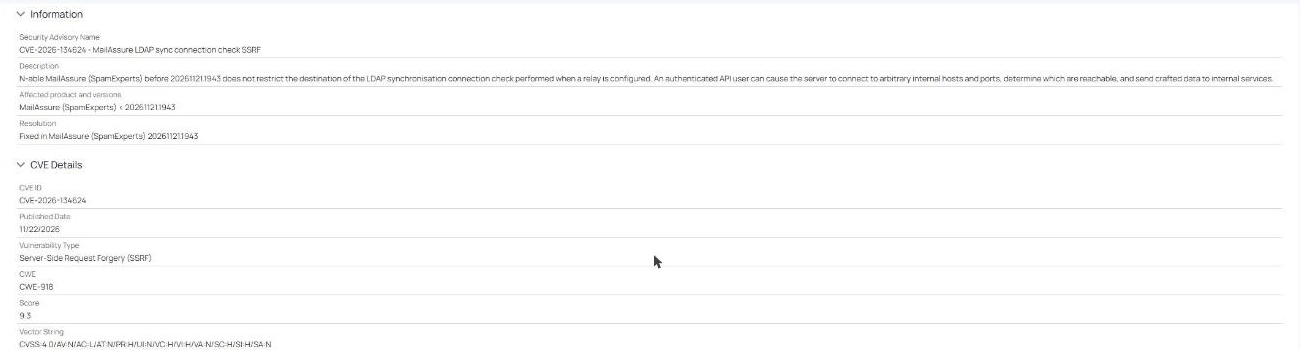
- What it is: a server-side request forgery (SSRF, CWE-918) in N-able MailAssure (SpamExperts), in the LDAP synchronization connection check that runs when a relay is configured. N-able says an authenticated API user can make the server connect to arbitrary internal hosts and ports, learn which are reachable, and send crafted data to internal services.
- Affected: MailAssure (SpamExperts) versions before 20261121.1943. Fixed in: 20261121.1943.
- Severity: N-able publishes a CVSS 4.0 score of 9.3 with the vector CVSS:4.0/AV:N/AC:L/AT:N/PR:H/UI:N/VC:H/VI:H/VA:N/SC:H/SI:H/SA:N. The “PR:H” part means the attacker needs high privileges, which here is an authenticated API user.
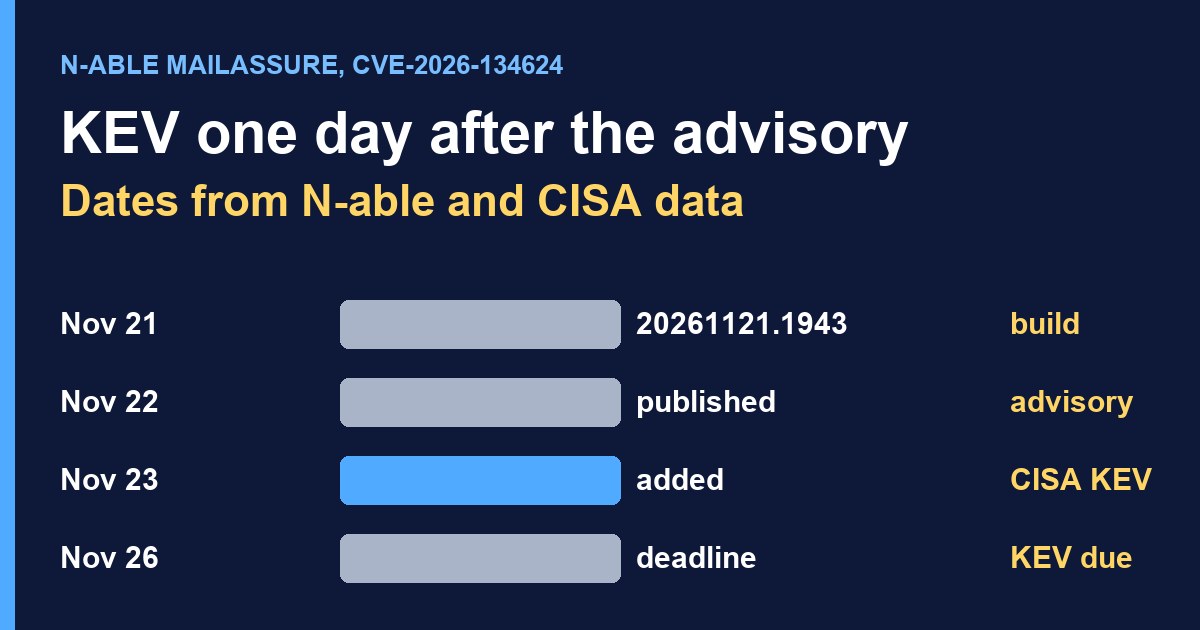
- KEV status: CISA added it to the Known Exploited Vulnerabilities catalog on November 23, 2026, one day after N-able’s advisory was published on November 22, with a November 26 due date.
- The open question: the advisory does not say whether the fix has already been applied to N-able-hosted MailAssure, or whether customers must act. Ask N-able.
What MailAssure is
The advisory names the product “MailAssure (SpamExperts),” an email security product from N-able. We did not read N-able’s product pages for this article, so we do not describe its features beyond what the advisory says. What the advisory does say is enough to understand the exposure: the product can synchronize with a directory over LDAP, it has a “relay” configuration, and when a relay is configured it performs a connection check to that directory. That check is where this flaw lives. Email filtering products of this kind commonly use directory lookups to learn which mailboxes exist, but that is general background, not something N-able states here. We do not know how many customers or partners use the product.
What the vulnerability is
An SSRF flaw lets an attacker make a server send requests on the attacker’s behalf, usually to places the attacker cannot reach directly, such as internal systems. N-able’s advisory (titled “CVE-2026-134624 – MailAssure LDAP sync connection check SSRF”) explains: the product, in versions before 20261121.1943, does not restrict the destination of the LDAP synchronization connection check performed when a relay is configured. An authenticated API user can cause the server to connect to arbitrary internal hosts and ports, determine which are reachable, and send crafted data to internal services.
That has three layers of risk. The first is reconnaissance: learning which internal addresses and ports answer, which maps a network. The second is reaching internal-only services, such as management interfaces or databases that trust requests from the mail platform. The third is sending crafted data to those services, which can turn a mapping flaw into one that changes things, depending on what the internal service accepts. N-able does not say what an attacker could achieve against a particular service, and neither do we.
Reading the score
A 9.3 looks like the top of the scale, but the vector shows what produces it. It uses CVSS version 4.0. “AV:N/AC:L/AT:N” means the attack is over the network, with low complexity and no special preconditions. “PR:H” means the attacker needs high privileges. In this case N-able says the attacker is an authenticated API user. The high impact ratings (VC:H, VI:H, plus SC:H and SI:H for the subsequent system) reflect that the vulnerable server can be used to reach other systems, which is the whole point of SSRF. So the number is high because of the potential reach, not because anyone on the internet can attack it. That distinction matters when you decide how worried to be about exposure: you first need to know who holds API credentials.
The flip side: CISA’s KEV entry says it concerns an authenticated API user, and CISA says the flaw is exploited. That implies exploitation by someone who already had a way to authenticate, such as a stolen or reused credential or a malicious insider, or a customer account. We do not know. The advisory gives no evidence of how it is exploited.
Versions and the fix
| Item | What N-able says |
|---|---|
| Affected | MailAssure (SpamExperts) before 20261121.1943 |
| Resolution | Fixed in MailAssure (SpamExperts) 20261121.1943 |
| Published | 11/22/2026 (November 22, 2026) |
| Weakness | Server-side request forgery, CWE-918 |
| Score | 9.3 (CVSS 4.0) |
| Attacker needs | An authenticated API user |
The version string looks like it encodes a date (2026-11-21) plus a build number, which would put the fixed build on November 21, one day before the advisory and two days before the KEV entry (ours, from the format, not stated by N-able). The advisory does not say how customers receive the update. For a cloud-delivered product, the vendor often updates its own servers, but N-able’s page does not say so, so we will not assume it.
Timeline: KEV one day after the advisory
| Date (2026) | Event | Source |
|---|---|---|
| November 21 (inferred) | Fixed build 20261121.1943 (the version string appears to encode this date) | N-able advisory, our inference |
| November 22 | N-able publishes the advisory and CVE-2026-134624 | N-able |
| November 23 | CISA adds the vulnerability to KEV, with a November 26 due date | CISA KEV data |
This is one of the shortest gaps in November’s KEV additions. As we showed in our analysis of the month’s KEV entries, three-day deadlines have become the norm in 2026. A vulnerability that is added to KEV the day after its advisory suggests that CISA already had information about exploitation, or that a vendor or partner shared it, before the public notice. We cannot tell which.
What to do: a practical checklist
- Find out how you consume MailAssure. If you are an MSP or an organization with MailAssure accounts, identify the instance or tenant and its version if it is shown to you.
- Ask N-able what you need to do. The advisory does not say whether hosted instances were updated automatically. Ask N-able support or your account contact to confirm that your environment runs 20261121.1943 or later, and get it in writing.
- Review API users. The attacker needs an authenticated API user, so list every API user and token, remove the ones you do not need, rotate the rest, and check who created them and when.
- Check LDAP and relay settings. Look for LDAP synchronization or relay entries you did not create, or pointing at unusual internal addresses or ports.
- Look at logs for odd connection checks. Unusual LDAP connection checks from the platform to unexpected internal hosts or ports could indicate abuse. If you only see logs on your side, check firewall logs for connections coming from the mail platform’s addresses to internal systems that never talked to it before.
- Reduce what the mail platform can reach. In your own network, limit which internal systems accept connections from the platform’s address ranges. This is general hygiene and not an N-able instruction.
- Turn on multi-factor authentication for the console accounts that can create API users, if available.
What we could not confirm
- Whether hosted MailAssure is already patched for you: the advisory states only the fixed version.
- How the vulnerability is being exploited, by whom, and whether the attackers used stolen API credentials: the KEV entry records exploitation without details.
- What a particular internal service would do with data sent through the flaw.
- Whether the version string 20261121.1943 is a build date: that is our reading of its format.
- How many MailAssure customers or partners are affected, and how API users are issued.
- CISA’s own catalog page, which we could not open; the KEV facts come from CISA’s GitHub mirror (catalog version 2026.11.23).
Frequently asked questions
What is CVE-2026-134624?
A server-side request forgery in N-able MailAssure (SpamExperts), in the LDAP synchronization connection check, that lets an authenticated API user make the server connect to arbitrary internal hosts and ports.
Which MailAssure version fixes it?
20261121.1943. Versions before it are affected, according to N-able.
Can an anonymous attacker exploit it?
N-able says the attacker is an authenticated API user, and the CVSS vector shows high privileges required.
Is it exploited?
CISA added it to the Known Exploited Vulnerabilities catalog on November 23, 2026. We found no public detail about the exploitation.
Do I need to patch MailAssure myself?
The advisory does not say. Ask N-able to confirm your environment’s version and keep the answer in writing.
What is the KEV deadline?
November 26, 2026 for U.S. federal civilian agencies. For everyone else it signals urgency and is not a legal deadline.
Method: details come from N-able’s security advisory for CVE-2026-134624 (published 11/22/2026) and CISA KEV data (catalog version 2026.11.23), read on November 24, 2026. For how we research, see How We Review Tools.