Openwave Webtop Media Transcoder CVE-2026-111793 on KEV
Published November 25, 2026. A news analysis of Openwave Webtop Media Transcoder vulnerability CVE-2026-111793, built from Openwave’s public security advisory CAN-2026-2032674 (on GitHub), the JPCERT/CC vulnerability note JVNVU#93403064 and CISA’s Known Exploited Vulnerabilities (KEV) data as mirrored on CISA’s GitHub (all read on November 25, 2026). The screenshot is ours (the CISA data mirror on GitHub). CISA’s own website returned “Access Denied” to our automated browser, so we did not use it. This article contains no affiliate links and we have no commercial relationship with Openwave Messaging. ToolReviewHub is produced with the help of an AI assistant (Claude, made by Anthropic). We did not run Openwave software or test the flaw. Descriptions are the vendors’ and CISA’s wording, and numbers marked “ours” are our own arithmetic.
Openwave Webtop Media Transcoder CVE-2026-111793: the short version
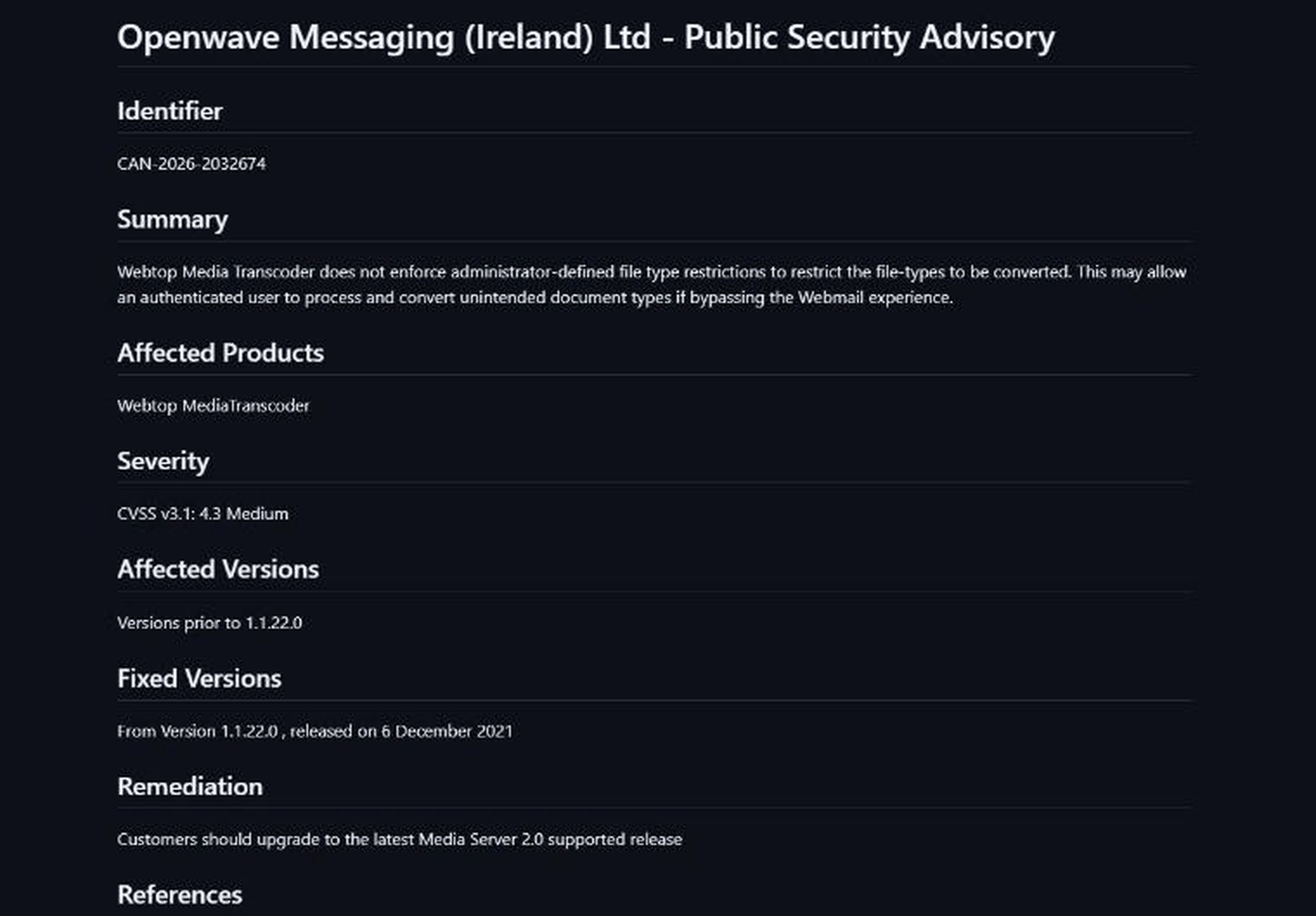
- What it is: Openwave says the Webtop Media Transcoder does not enforce the file-type restrictions that an administrator defines, so an authenticated user who bypasses the webmail interface may be able to convert document types that were meant to be blocked. CISA names the weakness class “incorrect resource transfer between spheres” (CWE-669).
- Score gap: Openwave rates it CVSS 3.1 4.3 (Medium). The JPCERT/CC note, in contrast, carries a “Critical” label on its page. We could not tell what that label is based on.
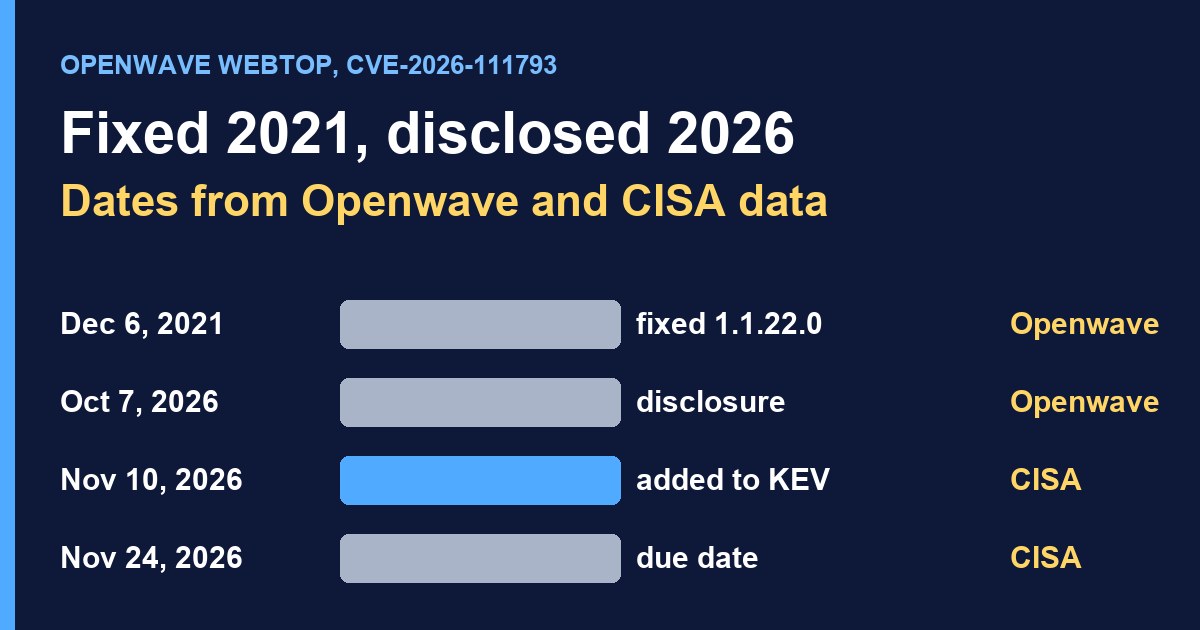
- Affected: Webtop Media Transcoder versions before 1.1.22.0. Openwave says 1.1.22.0 was released on December 6, 2021, and tells customers to move to the latest supported Media Server 2.0 release.
- Exploitation: the JPCERT/CC note says the developer states that attacks exploiting the flaw have been observed. Openwave’s disclosure date is October 7, 2026, and CISA added it to the KEV catalog on November 10, 2026, with a November 24 due date.
- The oddity: a fix that is almost five years old for a flaw first disclosed in 2026 (ours: December 2021 to October 2026).
What the Webtop Media Transcoder is
Openwave Messaging (the advisory names Openwave Messaging (Ireland) Ltd) makes messaging software for service providers. Webtop is its webmail front end, and the Media Transcoder is a component that converts documents and media so that a user can view them in the browser. The advisory says administrators can define which file types the transcoder is allowed to convert. That configuration is the control that this flaw bypasses. We did not read Openwave’s product pages, so we do not describe features beyond what the advisory says.
We do not know how many service providers use the product, and we do not know whether any of their installations are internet-facing. Webmail is by nature reachable by customers, so a flaw that needs only a normal login is within the reach of every customer. Whether a given provider exposes the transcoder directly, rather than only through the webmail interface, is a configuration question that the advisory does not answer.
What the vulnerability is
Openwave’s advisory CAN-2026-2032674 is short. It says that the Media Transcoder “does not enforce administrator-defined file type restrictions to restrict the file-types to be converted.” The consequence is that an authenticated user may be able to process and convert document types that were not intended, if the user goes around the webmail interface and talks to the transcoder in another way.
The JPCERT/CC note on JVN (JVNVU#93403064) adds a few points. It gives the weakness class as incorrect resource transfer between spheres (CWE-669). It says that if an authenticated attacker uploads a specially crafted file by following specific steps, sensitive information may be obtained. And it says that the developer states that attacks exploiting the vulnerability have been observed. The vendor reported the flaw to JPCERT/CC to notify users of its solution through JVN.
In plain language: the transcoder is a service that opens and converts files. If it can be told to convert a file type that should be blocked, an attacker who controls the file may make the transcoder touch data it should not, and the result can leak information. How the leak works is not described, and we did not try to find out.
Medium, Critical, and on the exploited list
Three different signals point in three directions. The vendor says Medium, CVSS 4.3. The JPCERT/CC page shows the word Critical in its heading. CISA lists the flaw in the exploited catalog. The first and the third are easy to reconcile: the KEV catalog ignores the score and looks for evidence of use. The Critical label on the JVN page is the odd one. JVN pages have their own scoring and labeling, and the page we read did not explain it, so we will not guess. The practical lesson is to read the vendor’s own text and the KEV status, and not to rely on a single number.
A 4.3 score generally corresponds to a network attack that needs a login and has a limited impact on confidentiality. That is consistent with the “authenticated user” and “sensitive information” wording in the advisory, but we could not see a vector string, so that is our reading.
What the sources say
| Item | Detail |
|---|---|
| Product | Webtop Media Transcoder (Openwave Messaging (Ireland) Ltd) |
| Affected | Versions prior to 1.1.22.0 |
| Fixed | From 1.1.22.0, released December 6, 2021 (Openwave) |
| Remediation | Upgrade to the latest supported Media Server 2.0 release (Openwave) |
| Weakness | CWE-669, incorrect resource transfer between spheres |
| Score (vendor) | CVSS 3.1 4.3 Medium |
| Attacker | Authenticated user, uploads a crafted file |
| Exploitation | Observed, per the developer (JPCERT/CC); in the KEV catalog |
Timeline: a 2021 fix, a 2026 disclosure
| Date | Event | Source |
|---|---|---|
| December 6, 2021 | Webtop Media Transcoder 1.1.22.0 released | Openwave |
| October 7, 2026 | Openwave disclosure date for CAN-2026-2032674 / CVE-2026-111793 | Openwave |
| November 10, 2026 | CISA adds CVE-2026-111793 to the KEV catalog | CISA KEV data |
| November 24, 2026 | KEV due date for U.S. federal civilian agencies | CISA KEV data |
From disclosure to the KEV listing is 34 days (ours, from October 7 to November 10). The fix itself is far older than both. That means two things for readers. If you keep your software reasonably current, you probably already have the fix. And if you run an old Webtop, you have been exposed for years to a flaw that nobody described until October. As we noted in our November KEV analysis, the catalog is a list of what attackers use, not what vendors announce, and the 14-day window here ended on November 24.
What to do: a practical checklist
- Find out whether you run Openwave Webtop and which Media Transcoder version. Service providers usually have a messaging team that knows.
- Upgrade past 1.1.22.0. Openwave recommends moving to the latest supported Media Server 2.0 release.
- Check the file-type restrictions that administrators configured, and test that they apply when the transcoder is reached directly and not only through the webmail interface. Do this on a test system with your vendor’s help.
- Limit who can reach the transcoder directly. It should be an internal service of the webmail platform, not something that every user’s network path can touch.
- Review logs for unusual uploads and conversion requests of types that your policy blocks.
- Ask Openwave for indicators of the attacks that the developer says were observed.
- If you are a customer of a mail provider, ask whether it runs this product and whether it is up to date.
What we could not confirm
- What attackers did with the flaw, and what sensitive information was obtained: the sources say only that exploitation was observed.
- Why the JVN page carries a Critical label while the vendor rates the flaw 4.3: the page does not explain it.
- Why a flaw fixed in 2021 was only disclosed in October 2026.
- The exact steps or file types involved: Openwave’s advisory does not detail them, and we did not look.
- How many installations run versions before 1.1.22.0.
- CISA’s own catalog page, which we could not open; the KEV facts come from CISA’s GitHub mirror (catalog version 2026.11.23).
Frequently asked questions
What is CVE-2026-111793?
A flaw in Openwave’s Webtop Media Transcoder that does not enforce administrator-defined file-type restrictions, letting an authenticated user convert unintended document types and possibly obtain sensitive information.
Which version fixes it?
1.1.22.0 and later, released December 6, 2021 according to Openwave. The company advises moving to the latest supported Media Server 2.0 release.
Why is a 4.3-rated flaw on the KEV list?
CISA’s catalog is based on evidence of exploitation, not on the score. The JPCERT/CC note says the developer states that attacks were observed.
Do I need an account to exploit it?
Yes. Both Openwave and JPCERT/CC describe an authenticated user.
What is the KEV deadline?
November 24, 2026 for U.S. federal civilian agencies. For everyone else it signals urgency and is not a legal deadline.
Method: details come from Openwave’s advisory CAN-2026-2032674 (disclosure date October 7, 2026), the JPCERT/CC note JVNVU#93403064 and CISA KEV data (catalog version 2026.11.23), read on November 25, 2026. For how we research, see How We Review Tools.