Puppet Enterprise CVE-2026-115731: Report Flaw on CISA KEV
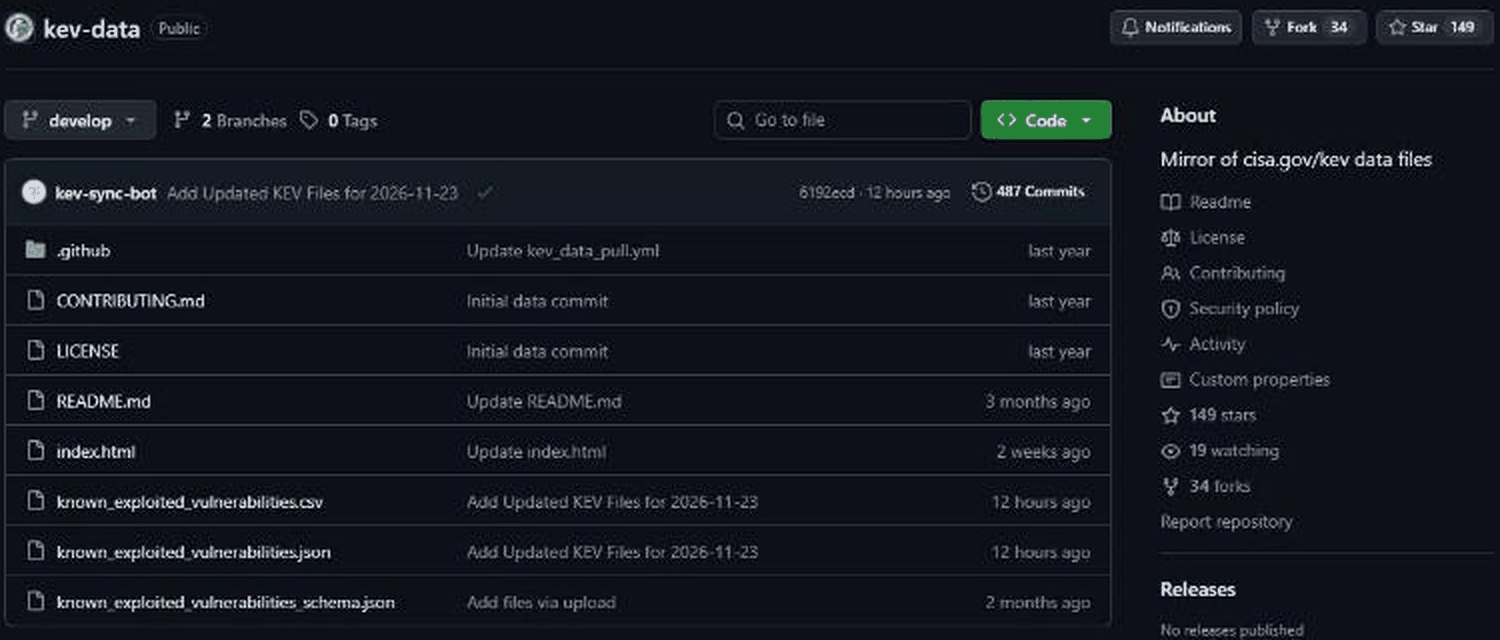
Published November 25, 2026. A news analysis of Puppet Enterprise and Puppet Core vulnerability CVE-2026-115731, built from Perforce’s advisory “Report Deserialization Code Execution” (read on Perforce’s support portal on November 25, 2026) and CISA’s Known Exploited Vulnerabilities (KEV) data as mirrored on CISA’s GitHub. The screenshot is ours (the CISA data mirror on GitHub). CISA’s own website returned “Access Denied” to our automated browser, so we did not use it. This article contains no affiliate links and we have no commercial relationship with Perforce. ToolReviewHub is produced with the help of an AI assistant (Claude, made by Anthropic). We did not run Puppet Server or test the flaw. Descriptions are the vendors’ and CISA’s wording, and numbers marked “ours” are our own arithmetic.
Puppet Enterprise CVE-2026-115731: the short version
- What it is: an unsafe-deserialization flaw (deserialization of untrusted data) in the report-processing code of Puppet Server. Perforce says a client holding any certificate signed by the Puppet certificate authority (CA) can run arbitrary code on the Puppet Server, as the account the server runs under, by sending a report that carries a specially crafted “rich data” type.
- Affected: Puppet Enterprise 2026.0.0 before 2026.0.1, 2025.0.0 before 2025.12.1, 2023.8.0 before 2023.8.13, Puppet Core 9.0.0 before 9.1.3, and Puppet Core 8.x before 8.22.2.
- Severity: Perforce publishes a CVSS 4.0 base score of 9.4 (Critical) with the vector CVSS:4.0/AV:N/AC:L/AT:N/PR:L/UI:N/VC:H/VI:H/VA:H/SC:H/SI:H/SA:H. “PR:L” means low privileges: the attacker needs a valid agent certificate.
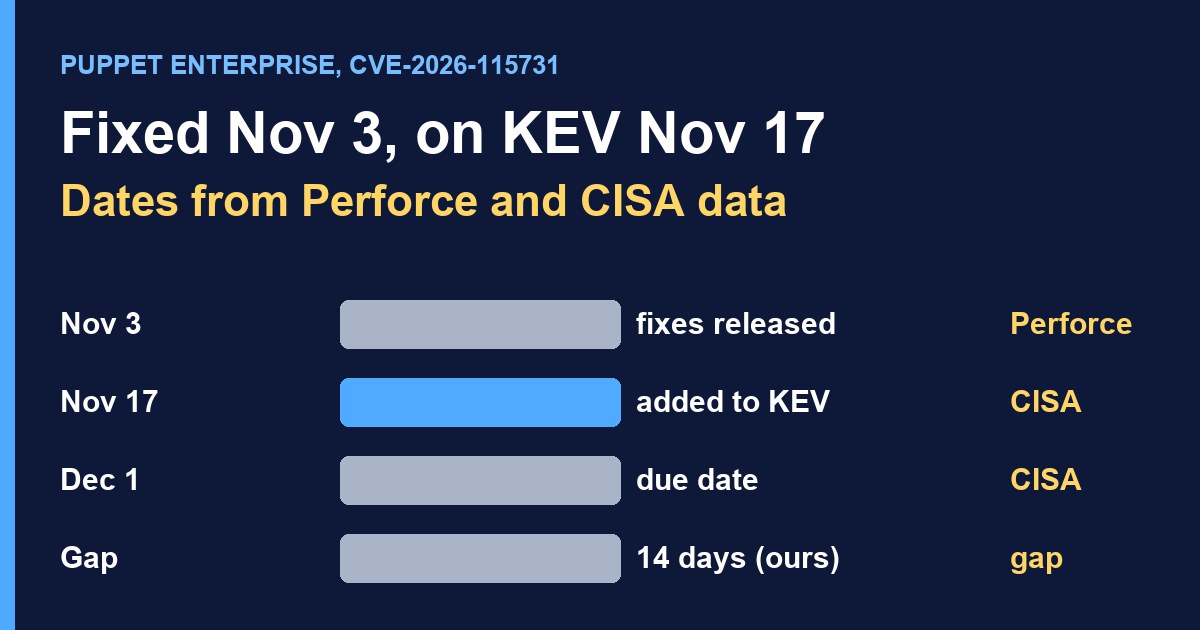
- KEV status: CISA added it to the Known Exploited Vulnerabilities catalog on November 17, 2026, with a December 1 due date. That is 14 days (ours), the longer of the two deadline lengths we see this month.
- The sting: where the CA signs certificate requests automatically without strong verification, Perforce says an unauthenticated attacker on the network can obtain such a certificate first. Whether your CA does that is the first thing to check.
What Puppet is, and why a flaw here matters
Puppet is configuration-management software. In the usual set-up, a central Puppet Server tells many machines (agents) how they should be configured, and the agents report back what they did. That makes the server a high-value target: it holds the rules for a whole fleet, and in many shops it can influence every machine that runs an agent. That is general background about how Puppet is commonly used, not something Perforce says in this advisory.
Two products appear in the affected list. Puppet Enterprise is the commercial distribution; Puppet Core is the other product line named in the advisory, with its own 8.x and 9.x version numbers. The advisory maps each Enterprise release to a Core release, which we show in the table below. We do not know how many installations exist, and we could not check which of them are internet-facing.
What the vulnerability is
Perforce’s advisory describes deserialization of untrusted data in the report-processing code. Deserialization means turning received bytes back into live objects. If a program does that with data an attacker controls, and it allows the attacker to choose which kind of object gets built, the attacker may be able to trigger behavior the developers never intended. The advisory says the Puppet Server accepts a report submitted with a PUT request, and that a crafted “rich data” type inside that report leads to code execution as the Puppet Server’s service user.
Notice the precondition. The attacker is not anonymous in the first step: they need a client certificate that the Puppet CA signed. In a well-run environment that is a real barrier, because certificates are issued only to machines an administrator approved. Perforce points out the weak spot: where the CA is configured to autosign requests without strong verification, anyone who can reach the server’s certificate-request endpoint can get a certificate and then use the flaw. In that case the whole chain is reachable from the network without prior credentials. This is why one configuration choice decides whether the flaw is a nuisance or an emergency.
The advisory does not publish the exact object types or the payload, and we have not tried to reproduce anything. Nothing in this article is an exploitation guide.
Reading the score
A 9.4 on the CVSS 4.0 scale looks like the top of the chart. The vector explains the number: network attack path (AV:N), low complexity (AC:L), no special attack requirements (AT:N), low privileges (PR:L), no user interaction (UI:N), and high impact on confidentiality, integrity and availability for both the vulnerable system and subsequent systems (VC, VI, VA, SC, SI, SA all H). The “subsequent system” ratings reflect that a compromised Puppet Server is a stepping stone to the machines it manages.
The “PR:L” element is the one to remember. A score of 9.4 does not mean that any stranger can do this from the internet by default. It means that a client with an ordinary, low-privileged identity is enough, and that identity may be easy to get depending on how you handle certificate signing. Treat the score as a prompt to review your CA settings, not as a statement about exposure.
Versions and fixes
| Product line | Affected (Perforce) | Resolved in |
|---|---|---|
| Puppet Enterprise 2026.0 | 2026.0.0 before 2026.0.1 | 2026.0.1 (Puppet Core 9.1.3) |
| Puppet Enterprise 2025 | 2025.0.0 before 2025.12.1 | 2025.12.1 (Puppet Core 8.22.2) |
| Puppet Enterprise 2023.8 | 2023.8.0 before 2023.8.13 | 2023.8.13 (Puppet Core 8.22.2) |
| Puppet Core 9 | 9.0.0 before 9.1.3 | 9.1.3 |
| Puppet Core 8 | 8.x before 8.22.2 | 8.22.2 |
The advisory lists November 3, 2026 as the resolution date. It rates the issue Critical, 9.4 on CVSS 4.0. The pairing of Enterprise and Core releases in the table is Perforce’s, and it is useful if you run Core directly: the fixed Core number tells you which library level you need.
Timeline: fixes first, KEV two weeks later
| Date (2026) | Event | Source |
|---|---|---|
| November 3 | Resolution date: Puppet Enterprise 2026.0.1, 2025.12.1, 2023.8.13 and Puppet Core 9.1.3, 8.22.2 released | Perforce advisory |
| November 17 | CISA adds CVE-2026-115731 to the KEV catalog | CISA KEV data |
| December 1 | KEV due date for U.S. federal civilian agencies | CISA KEV data |
The fixes came out 14 days before the KEV listing (ours, from November 3 to November 17), and the KEV due date is another 14 days after the listing. As we explained in our analysis of the month’s KEV entries, CISA uses a short three-day window for some entries and a 14-day window for others. This one got the longer window. The December 1 date has not passed at the time of writing (November 25), but there is no reason to wait for it.
What to do: a practical checklist
- Find every Puppet Server and its version. Check Puppet Enterprise and Puppet Core installations, including test and disaster-recovery servers that nobody has looked at for months.
- Upgrade to a fixed build. The table above lists the fixed version for each line. If you cannot upgrade today, ask Perforce for guidance in writing; the advisory text we read does not describe a workaround.
- Review certificate autosigning. If your CA signs requests automatically, check whether the rule is a broad pattern (for example, anything matching a domain name) or something tied to a verification step. Broad autosign rules are what turns this into an unauthenticated problem.
- List the signed certificates. Look for agent certificates you do not recognize, especially ones issued recently. Revoke the ones you cannot account for.
- Limit who can reach the server. Agents usually need only one port on the Puppet Server. Make sure that port is not exposed to networks that contain no agents.
- Look at the server for signs of abuse. Review recent report submissions and unexpected processes or files owned by the Puppet Server’s service account. We cannot tell you what exploitation looks like; the advisory does not say.
- Think about blast radius. If the server was exposed during the window, treat secrets stored on it (for example, those used in manifests or hiera data) as potentially seen, and plan rotation in proportion to your risk.
What we could not confirm
- How the attacks are being carried out, by whom, and against which kind of environment: CISA’s KEV entry records exploitation without details.
- Whether the exploited installations used autosigning, or whether attackers already held valid certificates.
- Whether there is an official workaround for people who cannot upgrade immediately: the advisory excerpt we read lists fixed versions only.
- The exact object types or payload involved: Perforce does not publish them, and we did not look for them.
- How many Puppet Enterprise or Puppet Core installations are exposed to untrusted networks.
- CISA’s own catalog page, which we could not open; the KEV facts come from CISA’s GitHub mirror (catalog version 2026.11.23).
Frequently asked questions
What is CVE-2026-115731?
A deserialization flaw in the report-processing code of Puppet Server that lets a client with a CA-signed agent certificate run code on the server as its service user.
Which versions fix it?
Puppet Enterprise 2026.0.1, 2025.12.1 and 2023.8.13, and Puppet Core 9.1.3 and 8.22.2, according to Perforce.
Can an anonymous attacker exploit it?
Not directly. The attacker needs a certificate signed by the Puppet CA. Perforce says that where the CA autosigns without strong checks, an unauthenticated network attacker can get one.
Is it exploited?
CISA added it to the Known Exploited Vulnerabilities catalog on November 17, 2026. We found no public detail about the attacks.
What is the KEV deadline?
December 1, 2026 for U.S. federal civilian agencies. For everyone else it is a signal of urgency and not a legal deadline.
Method: details come from Perforce’s advisory for CVE-2026-115731 (resolution date November 3, 2026) and CISA KEV data (catalog version 2026.11.23), read on November 25, 2026. For how we research, see How We Review Tools.