UnrealIRCd CVE-2026-114713: Critical IRC Server Bug on KEV
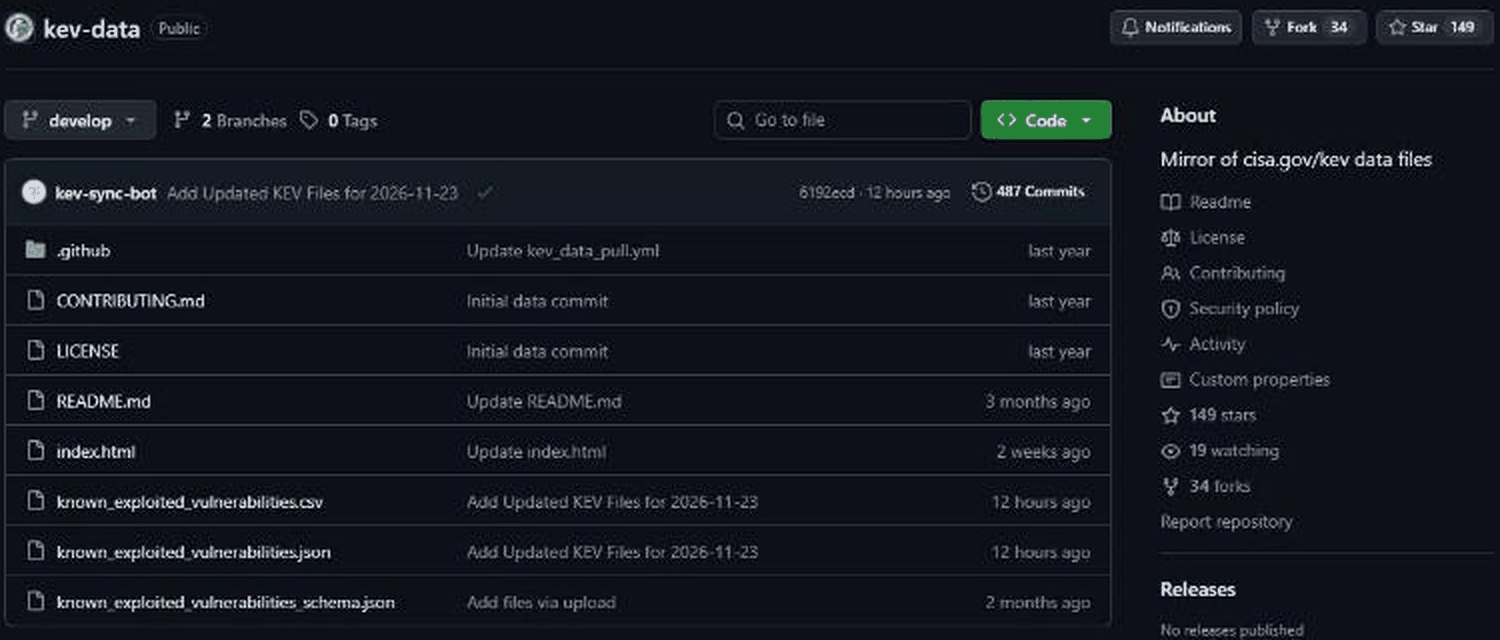
Published November 25, 2026. A news analysis of UnrealIRCd vulnerability CVE-2026-114713, built from the UnrealIRCd project’s release announcement for version 6.2.7.1 and its hot-patch (a forum post by the maintainer dated November 7, 2026, read on November 25, 2026) and CISA’s Known Exploited Vulnerabilities (KEV) data as mirrored on CISA’s GitHub. The screenshot is ours (the CISA data mirror on GitHub). CISA’s own website returned “Access Denied” to our automated browser, so we did not use it. This article contains no affiliate links and we have no commercial relationship with the UnrealIRCd project. ToolReviewHub is produced with the help of an AI assistant (Claude, made by Anthropic). We did not run an IRC network or test the flaw. Descriptions are the vendors’ and CISA’s wording, and numbers marked “ours” are our own arithmetic.
UnrealIRCd CVE-2026-114713: the short version
- What it is: a critical flaw in UnrealIRCd, a widely used open-source IRC server. According to the maintainer, it lets an ordinary user execute commands with the authority of a server or IRC operator, for example to kill users or ban hosts. The maintainer calls it the most critical issue found in UnrealIRCd in the past 15 years.
- Fix: release 6.2.7.1, or a hot-patch bundle (bundle-20261107) that works on versions 6.0.0 through 6.2.7 and, on almost all networks, needs no restart.
- Same release, more fixes: the update closes nine security issues in total, including crashes, hangs and denial-of-service problems, plus one that lets any user reveal another user’s IP address (a “decloak”).
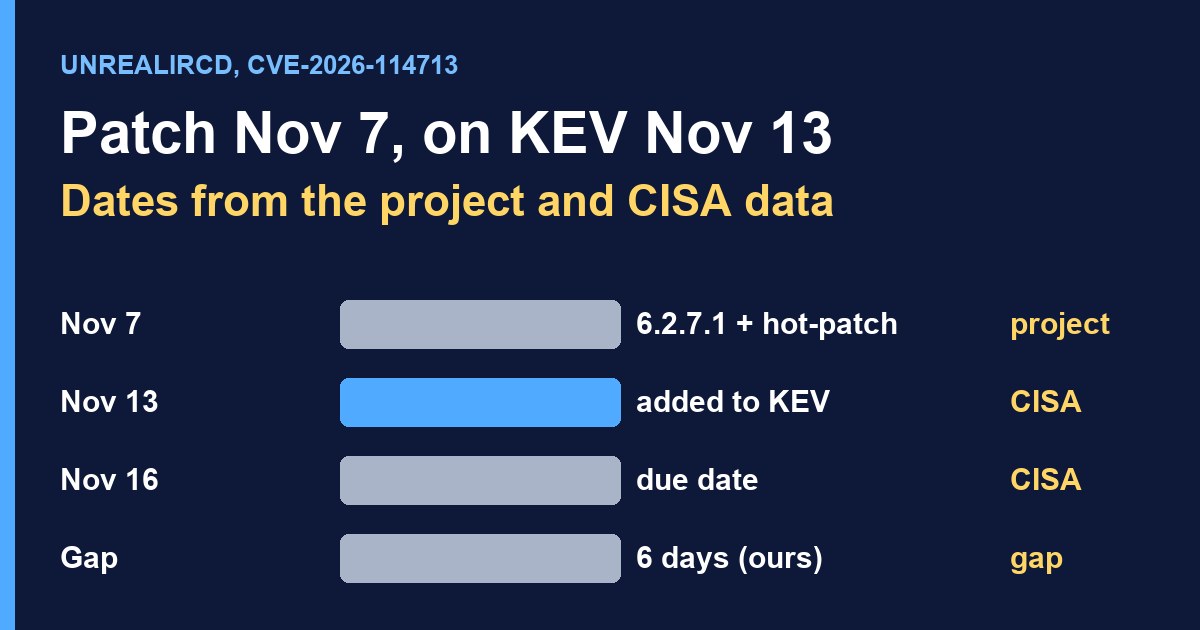
- KEV status: CISA added it to the Known Exploited Vulnerabilities catalog on November 13, 2026, six days after the release (ours), with a November 16 due date. CISA classifies the weakness as improper neutralization of delimiters.
- Oddity: the maintainer says the issues were found during an internal audit done with the help of AI. Take that as the project’s description of its own process; we did not verify it.
What UnrealIRCd is
IRC (Internet Relay Chat) is a decades-old chat protocol that is still used by open-source communities, hobby networks and some private teams. UnrealIRCd is one of the best-known server programs for it. A network can be a single server or several linked servers, and users on it have different levels of power: ordinary users, channel operators, and IRC operators (IRCOps), who can administer the network. The maintainer’s post says a normal user could run actions that should belong to servers or IRCOps. That is the heart of the issue.
We do not know how many UnrealIRCd networks exist or how many run version 6. The project says its guidance applies to almost all UnrealIRCd 6 networks, which suggests that version 6 is the version in common use, but that is our reading, not a figure from the project.
What the vulnerability is
The maintainer’s announcement (a forum post by the developer known as Syzop) describes a critical issue that lets normal users run commands with server or IRCOp authority. Examples given are killing users and placing network-wide bans (GLINE). On a chat network that means an attacker could disconnect people, ban them, and generally take control of moderation. CISA’s catalog labels the weakness class as improper neutralization of delimiters, which points to a parsing problem: input that should be treated as plain data is interpreted as structure. The post does not give a more detailed technical description, and we have not tried to reproduce it.
The same release fixes eight other issues. The post describes them as crashes, hangs and denial-of-service problems, plus one that allows any user to “decloak” another user, meaning to reveal an IP address the network normally hides. That last item is a privacy matter: networks that rely on host cloaking to protect their users should read the details on the project’s page.
The three ways to get protected
The project describes a layered response. This is a summary of its guidance, so read the original post before acting.
- Step 1, interim workaround: an IRC operator adds a spamfilter that blocks a specific invalid label pattern. The post says this protects linked servers only if all servers on the network run 6.0.4 or later.
- Step 2a, hot-patch: run the project’s hot-patch command with the bundle named bundle-20261107 on every server. It works for versions 6.0.0 through 6.2.7 and, on almost all networks, applies without a restart.
- Step 2b, upgrade: install 6.2.7.1. The project recommends this on Windows, or when the hot-patch fails.
The project also has a section for end-of-life lines (3.2.x, 4 and 5). If you still run one of them, the practical reading is that you should move to a supported release, because fixes are made for supported versions. We did not read that section in detail.
Versions and fixes
| Item | What the project says |
|---|---|
| Critical issue | CVE-2026-114713: normal users can execute commands with server or IRCOp authority |
| Hot-patch | bundle-20261107, for 6.0.0 through 6.2.7 |
| Full fix | UnrealIRCd 6.2.7.1 |
| Other fixes in the release | Eight further issues: crashes, hangs, denial of service, and an IP-address decloak |
| Interim workaround | Spamfilter blocking an invalid label pattern (full protection of linked servers needs all servers on 6.0.4 or later) |
Timeline: KEV within a week
| Date (2026) | Event | Source |
|---|---|---|
| November 7 | UnrealIRCd 6.2.7.1 and the hot-patch are announced | Project forum post |
| November 13 | CISA adds CVE-2026-114713 to the KEV catalog | CISA KEV data |
| November 16 | KEV due date for U.S. federal civilian agencies | CISA KEV data |
Six days from announcement to the KEV listing (ours) is quick for an open-source project with no big corporate sponsor. We do not know what CISA saw. It could be attacks reported by operators, or evidence gathered by CISA’s partners. As our KEV analysis for November shows, three-day due dates are now the norm, and this entry followed that pattern: due three days after being added. The dates have passed, so any network that has not patched is already behind CISA’s schedule.
What to do: a practical checklist
- Find every UnrealIRCd server you run, including linked leaf servers and any test server. Note each one’s version.
- Apply the hot-patch or upgrade to 6.2.7.1 on every server, following the project’s instructions. Do all linked servers; a partial rollout leaves the weak link in place.
- Do not trust the interim spamfilter forever. Treat it as a stopgap and confirm the project’s wording about which servers it protects.
- Look at your logs for unexpected KILL, GLINE or similar actions since early November, especially by users who are not IRC operators. A command that arrived without an operator account behind it is the signal to investigate.
- Review operator accounts and passwords if you see suspicious activity. We do not know whether the flaw exposes credentials, so treat that as a precaution and not a finding.
- Tell your users if you find signs of misuse, and if you rely on host cloaking, tell them about the decloak fix.
- Retire end-of-life versions. If you are on 3.2.x, 4 or 5, plan the migration; do not count on a back-ported fix.
What we could not confirm
- How the flaw is being exploited in the wild, by whom, and against which networks: the KEV entry records exploitation without details.
- The technical root cause beyond the maintainer’s high-level description and CISA’s weakness label.
- Whether the hot-patch and the 6.2.7.1 release cover every build type: the project mentions that Windows or a failed hot-patch needs a full upgrade.
- The claim that the issues were found with AI help: it is the maintainer’s statement and we did not verify it.
- How many UnrealIRCd networks exist and what share are still unpatched.
- CISA’s own catalog page, which we could not open; the KEV facts come from CISA’s GitHub mirror (catalog version 2026.11.23).
Frequently asked questions
What is CVE-2026-114713?
A critical flaw in UnrealIRCd that, according to the project, lets normal users run commands with server or IRC-operator authority.
Which version fixes it?
UnrealIRCd 6.2.7.1. A hot-patch bundle (bundle-20261107) covers versions 6.0.0 through 6.2.7 without a restart on almost all networks.
Do I need to restart the server after the hot-patch?
The project says the hot-patch works without a restart on almost all UnrealIRCd 6 networks. If it fails, or you run Windows, install 6.2.7.1.
Is it exploited?
CISA added it to the Known Exploited Vulnerabilities catalog on November 13, 2026. We found no public detail about the attacks.
What is the KEV deadline?
November 16, 2026 for U.S. federal civilian agencies. For everyone else it signals urgency and is not a legal deadline.
Method: details come from the UnrealIRCd project’s announcement for 6.2.7.1 (November 7, 2026) and CISA KEV data (catalog version 2026.11.23), read on November 25, 2026. For how we research, see How We Review Tools.