Drupal Core CVE-2026-132165: Installer Flaw Exploited a Day After the Fix, Patch 11.4.13, 11.3.22 or 10.6.22
Published November 25, 2026. A news analysis of Drupal core vulnerability CVE-2026-132165 (SA-CORE-2026-017), built from the Drupal Security Team’s advisory SA-CORE-2026-017 (read on drupal.org on November 25, 2026) and CISA’s Known Exploited Vulnerabilities (KEV) data as mirrored on CISA’s GitHub. Both screenshots are ours (the Drupal advisory page). CISA’s own website returned “Access Denied” to our automated browser, so the KEV facts come from CISA’s GitHub mirror. This article contains no affiliate links and we have no commercial relationship with the Drupal Association and the Drupal Security Team. ToolReviewHub is produced with the help of an AI assistant (Claude, made by Anthropic). We did not run a Drupal site for this article or test the flaw. Descriptions are the vendors’ and CISA’s wording, and numbers marked “ours” are our own arithmetic.
Drupal core CVE-2026-132165: the short version
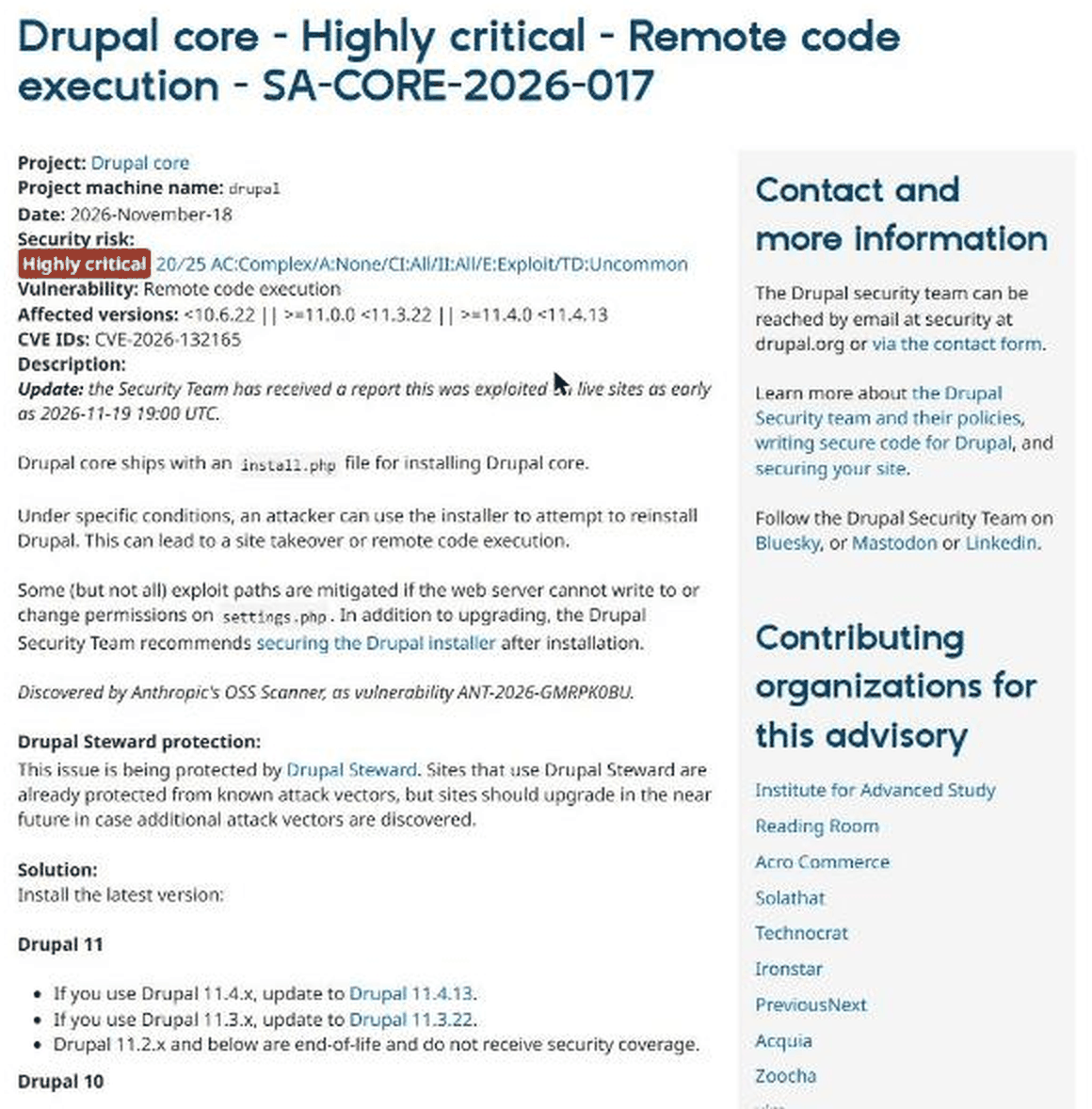
- What it is: a remote code execution flaw in Drupal core. The advisory says that Drupal ships an install.php file, and that under specific conditions an attacker can use the installer to attempt to reinstall Drupal, which can lead to a site takeover or remote code execution.
- Rating: the Drupal Security Team scores it “Highly critical,” 20 out of 25, with the risk string AC:Complex/A:None/CI:All/II:All/E:Exploit/TD:Uncommon. The “AC:Complex” part says the attack is not trivial.
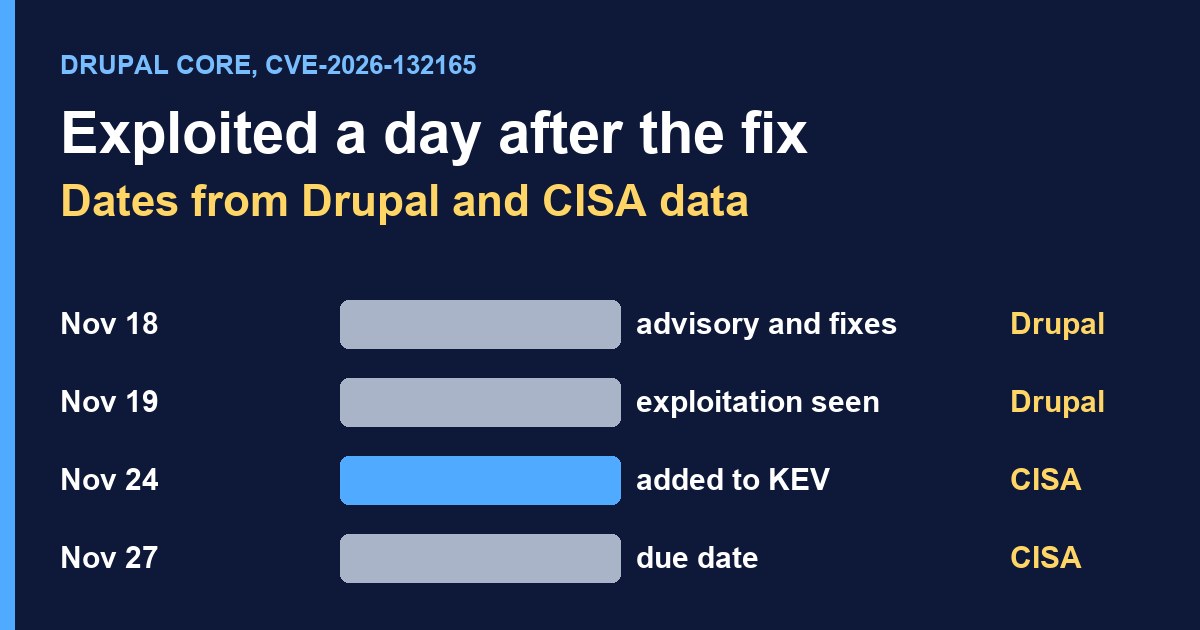
- Exploited: the advisory carries an update saying that the Security Team received a report that the flaw was exploited on live sites as early as 2026-11-19 19:00 UTC, one day after the advisory’s date of November 18.
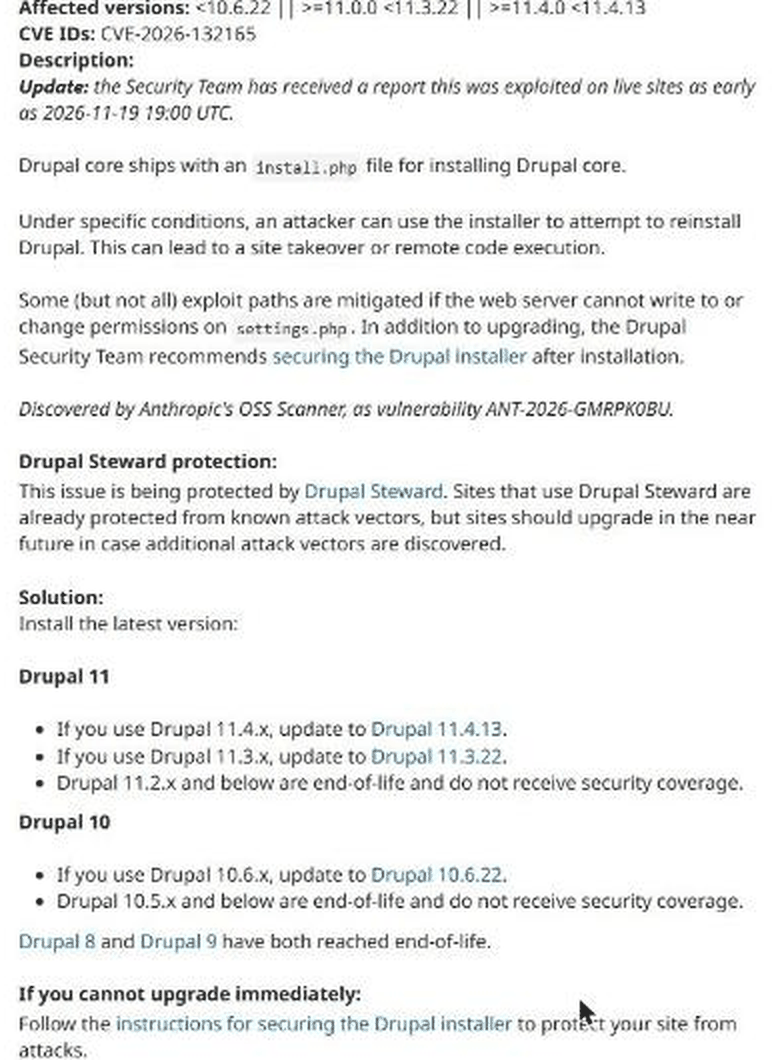
- Fixed in: Drupal 11.4.13, 11.3.22 and 10.6.22. Drupal 11.2.x and below, 10.5.x and below, and Drupal 8 and 9 are end of life and get no security coverage.
- KEV status: CISA added it to the Known Exploited Vulnerabilities catalog on November 24, 2026, with a November 27 due date. If you cannot upgrade at once, Drupal says to follow its instructions for securing the installer.
What Drupal core is, and why this matters
Drupal is an open-source content management system. Governments, universities, publishers and large companies run it, and the advisory’s own list of contributing organizations shows how broad that world is. “Core” is the main software that every Drupal site uses, as distinct from the add-on modules. A flaw in core therefore affects every site on an affected version, whatever modules it has installed. We do not know how many Drupal sites are exposed; the advisory gives no count.
Drupal’s security advisories are unusually well structured, so there is more to read here than in many vendor notices. They give a risk score, a list of affected versions, a plain-language solution, a workaround, and a list of the people who reported, fixed and coordinated the fix.
What the vulnerability is
The description is short. Drupal core ships with an install.php file, which is the script that sets up a new site. The advisory says that under specific conditions an attacker can use the installer to attempt to reinstall Drupal, and that this can lead to a site takeover or remote code execution. In other words, the first-run setup screen, which should be useless once a site exists, can in some situations be turned against the running site.
The advisory says that some, but not all, exploit paths are mitigated if the web server cannot write to or change the permissions of settings.php, the file that holds a site’s database connection and other core settings. It recommends, in addition to upgrading, securing the Drupal installer after installation. The advisory does not say what the “specific conditions” are, and we are not going to guess; publishing them would help attackers more than defenders.
The risk score gives a few more clues. “AC:Complex” means the attack complexity is high, which fits the “specific conditions” wording. “CI:All” and “II:All” mean that confidentiality and integrity impacts are total, and “A:None” means availability is not affected. “E:Exploit” says an exploit exists, and “TD:Uncommon” says the targets are an uncommon share of sites. The total of 20 out of 25 puts it in the top band.
“Exploited as early as November 19”
The most urgent line on the page is the update at the top: the Security Team received a report that the flaw was exploited on live sites as early as 2026-11-19 19:00 UTC. The advisory is dated November 18. If those two dates are right, attackers had a working technique within about a day of the fix being published (ours, from the dates shown). That is the typical pattern for open-source projects: once a fix is public, anyone can compare the old and new code and work out what changed.
We do not know how many sites were hit, how the attackers got in, or what they did afterwards. The advisory says only that it received a report. That is the honest limit of what we can state.
A note on who found it
The advisory says the issue was “discovered by Anthropic’s OSS Scanner,” tracked internally as ANT-2026-GMRPK0BU, and lists Tyler Nighswander (tylerni7-ant) among the reporters, together with four others including members of the Drupal Security Team. This site is itself produced with the help of Claude, made by Anthropic, as we say at the top of every article. We have no involvement in that scanner or that report, and we mention it so that you can weigh our commentary with the full context.
Affected and fixed versions
| Your Drupal version | What the advisory says |
|---|---|
| Drupal 11.4.x | Affected before 11.4.13; update to 11.4.13 |
| Drupal 11.3.x | Affected before 11.3.22; update to 11.3.22 |
| Drupal 11.2.x and below | End of life, no security coverage |
| Drupal 10.6.x | Affected before 10.6.22; update to 10.6.22 |
| Drupal 10.5.x and below | End of life, no security coverage |
| Drupal 8 and 9 | End of life |
The advisory’s affected-version string is “<10.6.22 || >=11.0.0 <11.3.22 || >=11.4.0 <11.4.13.” Read literally, that includes older lines, which is why the end-of-life notes matter: a site on 11.2 or 10.5 is in the affected range but will not get a patch from the Drupal Security Team. Those sites need a jump to a supported release. Drupal also says the issue is being protected by Drupal Steward, a protection program the advisory names, and that sites using it are already protected from known attack vectors; the advisory still tells those sites to upgrade soon in case other vectors turn up. We did not look at how Steward works.
Timeline
| Date (2026) | Event | Source |
|---|---|---|
| November 18 | Advisory SA-CORE-2026-017 published; fixes 11.4.13, 11.3.22 and 10.6.22 | Drupal |
| November 19, 19:00 UTC | Earliest exploitation reported to the Security Team | Drupal (update on the advisory) |
| November 24 | CISA adds CVE-2026-132165 to the KEV catalog | CISA KEV data |
| November 27 | KEV due date for U.S. federal civilian agencies | CISA KEV data |
The KEV listing came six days after the advisory (ours), with a three-day deadline, the short window we described in our analysis of the November KEV additions. The due date has not passed as of November 25, so there is still time to meet it, but not much.
What to do: a practical checklist
- Find every Drupal site you run, including staging, forgotten microsites and sites run by agencies on your behalf. Note each version.
- Upgrade to a fixed release: 11.4.13, 11.3.22 or 10.6.22. If you are on an end-of-life line, plan the jump to a supported release now.
- Secure the installer. Follow Drupal’s instructions for securing the installer. In general terms, that means that a finished site should not serve install.php to visitors; check Drupal’s guide for the exact steps for your server.
- Make settings.php hard to change. The advisory says some exploit paths are mitigated if the web server cannot write to or change the permissions on settings.php. Review the file’s ownership and permissions.
- Check for signs of a reinstall or takeover. Unexpected admin accounts, changed site settings, new PHP files in the web directory and unusual database changes are warning signs. Look at web logs for requests to install.php since November 18.
- If you find signs of compromise, restore from a clean backup taken before the incident, rotate database and admin credentials, and rebuild from known-good code.
- Ask your hosting provider or agency whether they have patched, and get a written answer.
What we could not confirm
- The “specific conditions” under which the installer can be abused: the advisory does not say, and we did not try to find out.
- How many sites were attacked, by whom and with what outcome: the advisory says only that exploitation was reported from November 19.
- Whether sites behind a firewall or on a managed host were protected: we did not test any configuration.
- How Drupal Steward protection works in detail, beyond the advisory’s statement.
- Whether the risk score’s “AC:Complex” reflects the real difficulty, given that exploitation followed within a day.
- CISA’s own catalog page, which we could not open; the KEV facts come from CISA’s GitHub mirror (catalog version 2026.11.24).
Frequently asked questions
What is CVE-2026-132165?
A remote code execution vulnerability in Drupal core, in which the installer can be used under specific conditions to attempt a reinstall, leading to site takeover or code execution. The advisory is SA-CORE-2026-017.
Which versions fix it?
Drupal 11.4.13, 11.3.22 and 10.6.22. Lines below those are end of life.
Is it exploited?
Yes. Drupal says it received a report of exploitation as early as 2026-11-19 19:00 UTC, and CISA added it to the KEV catalog on November 24, 2026.
What if I cannot upgrade right away?
Drupal says to follow its instructions for securing the installer, and notes that some exploit paths are mitigated when the web server cannot write to settings.php.
What is the KEV deadline?
November 27, 2026 for U.S. federal civilian agencies. For everyone else it signals urgency and is not a legal deadline.
Method: details come from Drupal’s advisory SA-CORE-2026-017 (dated November 18, 2026, with the exploitation update) and CISA KEV data (catalog version 2026.11.24), read on November 25, 2026. For how we research, see How We Review Tools.