Drupal CVE-2026-136716: The Installer Patch Missed Some Sites, and Attackers Are Already Using the Gap
Published November 28, 2026. A news analysis of CVE-2026-136716, a Drupal core access bypass (advisory SA-CORE-2026-019) that Drupal says is being exploited and that follows an earlier installer fix released a week before, built from the Drupal Security Team’s advisory SA-CORE-2026-019 (published November 25, 2026, read on drupal.org on November 28, 2026), SecurityWeek’s report of November 26, 2026 and CISA’s Known Exploited Vulnerabilities (KEV) data as mirrored on CISA’s GitHub (catalog version 2026.11.25). Both screenshots are ours (Drupal’s advisory page, cropped). This article contains no affiliate links and we have no commercial relationship with the Drupal project. ToolReviewHub is produced with the help of an AI assistant (Claude, made by Anthropic). We did not run Drupal or test the flaw, and we do not describe how to trigger it. Descriptions are the vendors’ and CISA’s wording, and numbers marked “ours” are our own arithmetic.
Drupal CVE-2026-136716 (SA-CORE-2026-019): the short version
- What happened: on November 25, 2026, the Drupal Security Team published SA-CORE-2026-019, rated Highly critical (21 out of 25), for CVE-2026-136716. It says that the installer fixes released on November 18 in SA-CORE-2026-017 did not protect every site, and that the new gap is being exploited in the wild.
- Who is at risk: sites that left their installer remotely accessible, in what Drupal calls an unusual or incomplete install state, including production sites. Drupal says it is not apparent in the user interface whether a site is in that state. If you had already secured the installer, you are not vulnerable.
- The impact: Drupal describes it as an access bypass that can lead to site takeover. It adds that sites that are already compromised may no longer be in the vulnerable state, so a site that looks fine may have been taken over already.
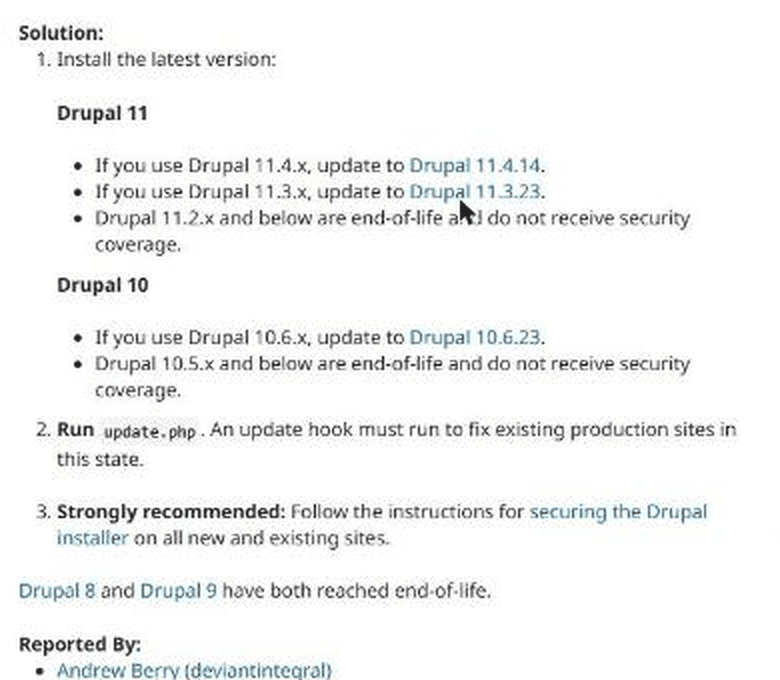
- The fix: Drupal 11.4.14, 11.3.23 or 10.6.23, and then run update.php, because an update hook must run to fix existing production sites in this state. Drupal strongly recommends securing the installer on all sites as well.
- Not on the CISA list yet: CISA’s catalog (version 2026.11.25) lists the earlier flaw, CVE-2026-132165, but not this one.
The background: a fix that arrived a week earlier
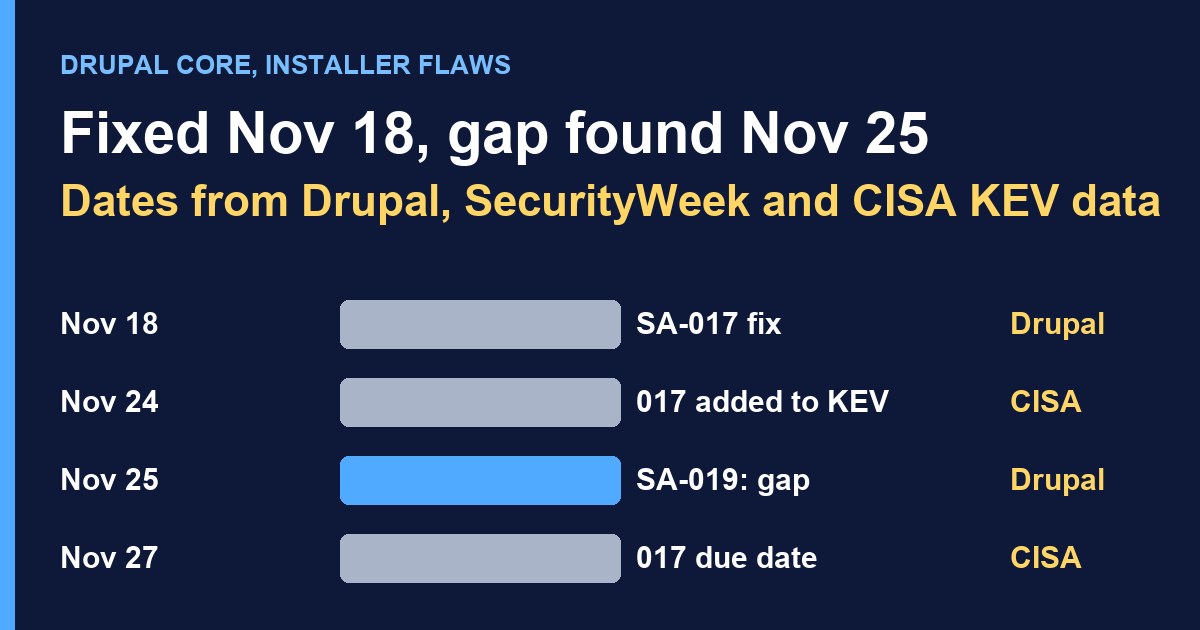
To understand this advisory you need the one before it. On November 18, 2026, the Drupal Security Team published SA-CORE-2026-017, which fixed several vulnerabilities in the installer that ships with Drupal core. The installer is the install.php file that sets up a new Drupal site. One of those flaws, CVE-2026-132165, was a remote code execution issue in the installer. SecurityWeek credits its discovery to Anthropic’s OSS Scanner. We covered that advisory in an earlier article.
Drupal was told soon afterwards that the installer flaw was being exploited, and CISA added CVE-2026-132165 to its Known Exploited Vulnerabilities catalog on November 24, with a federal due date of November 27, 2026, which has now passed. The following day, Drupal published SA-CORE-2026-019, exactly a week after the first advisory, to say that the first fix had not covered every case.
What SA-CORE-2026-019 says
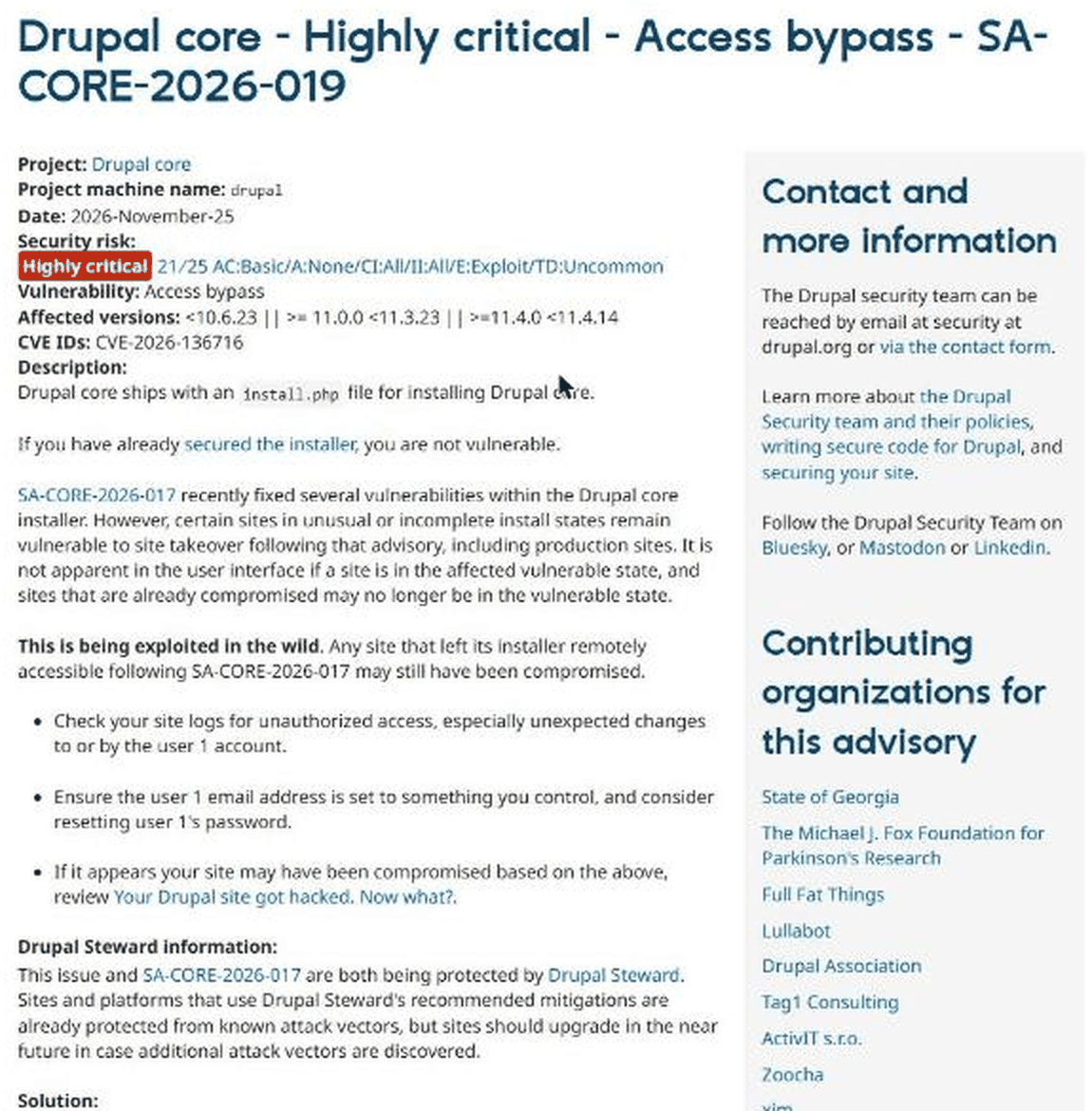
The advisory is short and direct. It explains that Drupal core ships with an install.php file, and that if you have already secured the installer you are not vulnerable. It then states that SA-CORE-2026-017 fixed several vulnerabilities in the installer, but that certain sites in unusual or incomplete install states remain vulnerable to site takeover afterwards, including production sites.
Two sentences in the description are the heart of the matter. The first says it is not apparent in the user interface whether a site is in the affected state. The second says that sites that are already compromised may no longer be in the vulnerable state. Put together, they mean that a site owner cannot look at the site, see nothing wrong and conclude that all is well. The vulnerable state is invisible, and an attack can end it.
Then comes the sentence that turns this from a patch note into an incident: the advisory says the issue is being exploited in the wild, and that any site that left its installer remotely accessible following SA-CORE-2026-017 may still have been compromised. Drupal rates the risk Highly critical, with a score of 21 out of 25 on its own scale. The advisory’s risk string lists a basic attack complexity, no prior access needed and an exploit marked as present.
Why “unusual or incomplete install states” is the part to take seriously
The advisory does not define what an unusual or incomplete install state is, and we will not guess at the mechanics. What it does tell us is who is in danger: not only brand-new sites, but production sites. That is the surprising part. Most people think of the installer as something that matters on day one and not afterwards. The advisory says that on some sites it still matters long after launch.
In practice, that means that the usual question, “are we running the vulnerable version?”, is no longer enough. A site on a patched release from November 18 may still be exposed if it is in the affected state and the installer is reachable. Drupal’s own answer is a two-part one: upgrade to a release that contains the new fix, and run an update hook that repairs existing production sites in that state. The hook is not optional, since an upgrade without it may leave a vulnerable site vulnerable.
The advisory also gives a protective measure that works regardless of state. Drupal strongly recommends following its instructions for securing the installer on all new and existing sites, and says that sites which have secured the installer are not vulnerable.
The two Drupal installer advisories (Drupal, SecurityWeek and CISA KEV data)
| SA-CORE-2026-017 | SA-CORE-2026-019 | |
|---|---|---|
| Published | November 18, 2026 | November 25, 2026 |
| CVE | CVE-2026-132165 (installer, remote code execution) | CVE-2026-136716 (access bypass) |
| Fixed releases | 10.6.22, 11.3.22, 11.4.13 (per the companion advisory of the same date) | 10.6.23, 11.3.23, 11.4.14 |
| Exploitation | Reported; added to CISA KEV on November 24 | Drupal says exploited in the wild; not in the CISA catalog version we checked |
| Extra step after upgrading | None stated in the sources we read | Run update.php (update hook) |
The fixed releases for SA-CORE-2026-017 are not named in the advisory we read for this article. We took them from the companion advisory published the same day, SA-CORE-2026-018, which lists 10.6.22, 11.3.22 and 11.4.13 as its fixed versions. We could not confirm that SA-CORE-2026-017 used exactly the same release numbers, which is why the table says so.
What Drupal tells site owners to do
The advisory gives a short list. Check your site logs for unauthorized access, especially unexpected changes to or by the user 1 account, which is the original administrator account on a Drupal site. Make sure the user 1 email address is set to something you control, and consider resetting that account’s password. If it looks as if the site may have been compromised, follow Drupal’s guide for sites that have been hacked.
The focus on user 1 is informative. It tells us that the account Drupal expects an attacker to touch is the first administrator, and that an email change on that account is a recognizable sign. An attacker who can change the user 1 email can use the password reset flow later, even after the site is patched. That is why resetting the password and checking the email address matter even if you upgrade straight away. This reading is ours; the advisory does not spell out the reason.
Drupal also mentions Drupal Steward. It says both this issue and SA-CORE-2026-017 are protected by Steward, and that sites and platforms using Steward’s recommended mitigations are already protected from known attack vectors. Drupal still says to upgrade in the near future in case additional attack vectors are discovered. If your host is part of Steward, ask whether the mitigation is active; do not treat it as a reason to skip the upgrade.
Who is exploiting this, and how widely
Drupal has not shared details about the attacks, and SecurityWeek reports that it is unclear who is responsible. We could not find a count of affected sites. That is a real limit on what can be said: the only firm facts are that Drupal says exploitation is happening and that the vulnerable state can disappear once a site is compromised, which means that any count of vulnerable sites would understate the sites that were already attacked.
Drupal published the follow-up a week after the first fix, and its advisory is frank that the first fix was not complete for some sites. In our view, that frankness is useful to site owners: it tells them exactly what to do next, which is the part that matters.
Timeline
| Date (2026) | Event | Source |
|---|---|---|
| November 18 | SA-CORE-2026-017 fixes the installer flaws, including CVE-2026-132165 | Drupal |
| November 24 | CISA adds CVE-2026-132165 to KEV, due November 27 | CISA KEV data |
| November 25 | SA-CORE-2026-019 published for CVE-2026-136716; Drupal says it is exploited | Drupal |
| November 26 | SecurityWeek reports the new advisory | SecurityWeek |
| November 27 | Federal due date for CVE-2026-132165 passes | CISA KEV data |
The wider picture
CISA’s catalog now holds six Drupal core entries (our count): the remote code execution flaws of 2018 and 2019, an upload flaw, the SQL injection added in May 2026 and the installer flaw added this week. A widely deployed content management system stays a target for years, and the site owners who suffer are usually those with the oldest installs. For the month as a whole, see our November 2026 KEV roundup.
What to do: a practical checklist
- Upgrade Drupal core to 11.4.14, 11.3.23 or 10.6.23. Drupal 11.2 and below, 10.5 and below, 9 and 8 are end-of-life and receive no security coverage, so those sites must move to a supported release.
- Run update.php after the upgrade. The advisory says an update hook must run to fix existing production sites in the affected state.
- Secure the installer on every site, new or existing, by following Drupal’s instructions for securing install.php. Sites that did so are not vulnerable.
- Check the user 1 account: look at logs for unexpected changes to or by user 1, confirm its email address is one you control, and consider resetting the password.
- Review logs for unauthorized access since November 18, when the first installer advisory appeared, and treat any site whose installer was reachable as a possible victim.
- If anything looks wrong, follow Drupal’s guide for hacked sites. Do not assume that upgrading removes an attacker who is already in.
- Ask your host about Drupal Steward if you rely on a hosting platform, but upgrade anyway.
What we could not confirm
- Who is exploiting CVE-2026-136716, how many sites were affected and since when: Drupal has not shared details, according to SecurityWeek.
- What exactly an unusual or incomplete install state is: the advisory does not define it and we did not test any site.
- Whether CISA will add CVE-2026-136716 to its catalog: it was not in version 2026.11.25.
- The fixed release numbers for SA-CORE-2026-017, which we took from the companion advisory SA-CORE-2026-018.
- Whether Drupal Steward’s mitigations are active on any particular host.
- CISA’s own catalog page, which we did not open; the KEV facts come from CISA’s GitHub mirror (catalog version 2026.11.25).
Frequently asked questions
Which Drupal versions fix CVE-2026-136716?
Drupal 11.4.14, 11.3.23 and 10.6.23, according to SA-CORE-2026-019. After upgrading, run update.php so that the update hook repairs existing production sites.
Is it being exploited?
Yes. Drupal’s advisory says the issue is being exploited in the wild and that any site that left its installer remotely accessible after SA-CORE-2026-017 may still have been compromised.
I patched on November 18. Am I safe?
Not necessarily. The advisory says certain sites remain vulnerable after the first fix, including production sites. Upgrade again, run update.php, secure the installer and check the user 1 account.
What if I had already secured the installer?
Drupal says that if you have already secured the installer, you are not vulnerable.
Is it on CISA’s KEV list?
Not in the catalog version we checked (2026.11.25). The earlier installer flaw, CVE-2026-132165, was added on November 24.
What should I check for signs of compromise?
Drupal tells you to check site logs for unauthorized access, especially unexpected changes to or by the user 1 account, and to make sure the user 1 email address is one you control.
Method: details come from the Drupal Security Team’s advisories SA-CORE-2026-019 (November 25, 2026) and SA-CORE-2026-018 (November 18, 2026), SecurityWeek’s report of November 26, 2026 and CISA KEV data (catalog version 2026.11.25), read on November 28, 2026. The count of Drupal entries in the catalog is ours. For how we research, see How We Review Tools.