Xen Orchestra CVE-2026-133469: An Empty Login Token Lets Attackers In as Admin, and the Flaw Is Being Exploited
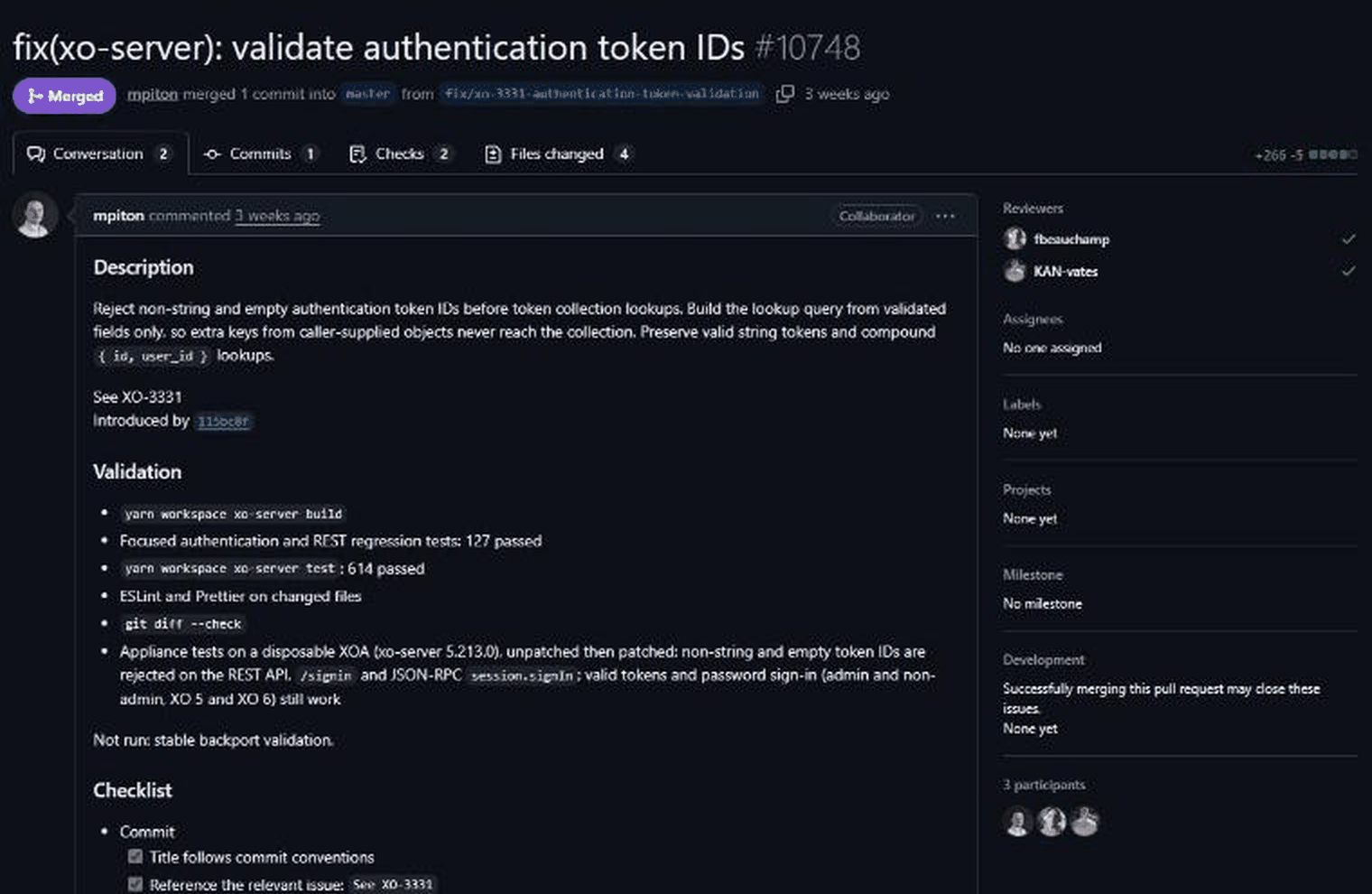
Published November 28, 2026. A news analysis of CVE-2026-133469, an authentication bypass in Vates Xen Orchestra (advisory VSA-2026-062) that Vates says is being exploited and that CISA added to its Known Exploited Vulnerabilities catalog on November 25, 2026, built from Vates’ security advisory VSA-2026-062 (last updated November 25, 2026, read on November 28, 2026), the public GitHub pull request that fixed the flaw and CISA’s Known Exploited Vulnerabilities (KEV) data as mirrored on CISA’s GitHub (catalog version 2026.11.25). The screenshot of the fix is ours (the GitHub pull request page, cropped). Vates’ documentation site would not let us capture a screenshot, so we read the advisory as text. This article contains no affiliate links and we have no commercial relationship with Vates. ToolReviewHub is produced with the help of an AI assistant (Claude, made by Anthropic). We did not run Xen Orchestra or test the flaw, and we do not describe how to trigger it beyond what Vates’ advisory states in its title and summary. Descriptions are the vendors’ and CISA’s wording, and numbers marked “ours” are our own arithmetic.
Xen Orchestra CVE-2026-133469: the short version
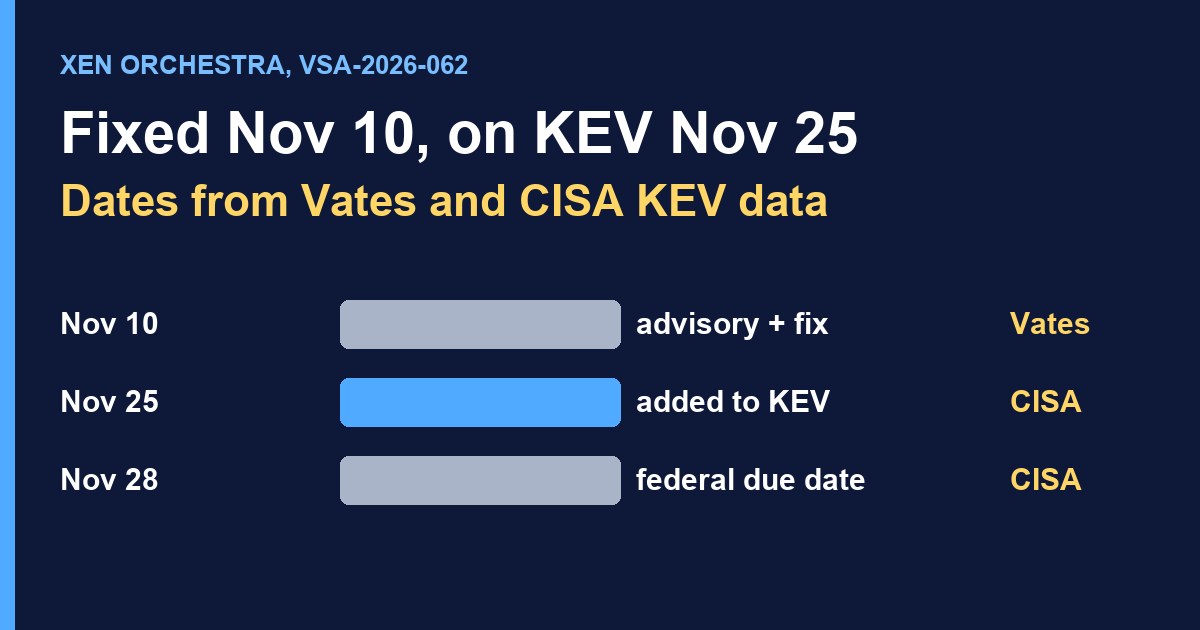
- What happened: Vates published advisory VSA-2026-062 on November 10, 2026 and updated it on November 25, the day CISA added CVE-2026-133469 to its Known Exploited Vulnerabilities (KEV) catalog. Vates says the flaw is actively exploited by a threat actor.
- The flaw: an unauthenticated attacker can bypass login in Xen Orchestra by presenting a specially formed, empty login token, and then act with Administrator privileges. Vates classifies the impact as Critical; its CVSS 4.0 score was “not available yet” when we read the advisory.
- Why it matters: Xen Orchestra manages XCP-ng and Xen virtualization hosts. Vates warns that a compromise can lead to arbitrary code execution on managed pools and a full takeover of XCP-ng nodes as root.
- The fix: Xen Orchestra 6.9.2 (stable channel) and 6.10.1 (latest channel), delivered as xo-server 5.211.2 and 5.213.1. Anything older is affected, including the Xen Orchestra Appliance.
- Deadline: CISA’s due date for US federal civilian agencies is November 28, 2026, which is today.
What Xen Orchestra is
Xen Orchestra, usually shortened to XO, is the management console for XCP-ng and Xen virtualization pools. Administrators use it to start and stop virtual machines, manage storage and networks, schedule backups and delegate access to other users. It is sold and supported by Vates as part of its VMS product line, and it is distributed either as a ready-made virtual appliance, the Xen Orchestra Appliance (XOA), or as source code that people build themselves.
A console like this is a concentrated target. It holds credentials for the hosts it manages, for backup storage such as NFS, S3, Azure and SMB, and for mail servers, so an attacker who becomes an XO administrator gets much more than one machine. Vates’ own advisory spells out the stakes: compromise of Xen Orchestra can lead to arbitrary code execution on managed pools and a full takeover of the XCP-ng nodes as root.
What Vates says the flaw is
The advisory is titled “Empty-object login token”, and its summary explains the mechanism at the level of code. Xen Orchestra’s REST interface reads a login token from a cookie. In the vulnerable versions, the interface passes whatever the cookie decodes to into the token lookup without first requiring it to be a string. An empty object then behaves like a lookup with no filter, so the token store returns the first token it holds, and Xen Orchestra authenticates the request as that token’s owner if the token has not expired. An authenticated route then returns reusable login token IDs, which the attacker can keep using.
In plain terms, the login check was asked “which token matches this?”, was handed something that matches everything, and picked the first one. That is why Vates describes the result as a bypass that allows actions with Admin privilege, and why no password is involved. The advisory also notes that, in a successful attack, there is no log entry that would reveal the unauthenticated access, so you cannot simply search your logs to find out whether it happened.
The public fix confirms the diagnosis. The GitHub pull request that closed the hole, number 10748, rejects non-string and empty authentication token IDs before the token lookup, and builds the lookup only from validated fields so that extra keys supplied by a caller never reach the collection. The pull request says it was tested on a disposable Xen Orchestra Appliance, unpatched and then patched, and that valid tokens and password sign-in still worked. It also says validation of the stable-channel backport was not run, which is worth knowing if you are on stable: Vates did publish a stable release, 6.9.2, but the pull request itself does not cover it.
Exploited, not just exposed
Most advisories describe what could happen. This one says what has happened: a warning at the top of VSA-2026-062 states that the vulnerability is actively exploited by a threat actor, and names the infrastructure the attacker used, an IP address and a Tor onion address. Vates lists eight IP addresses to block in total, and also recommends blocking Tor traffic.
Vates also describes what the attacker did afterwards, which is useful if you need to check a system. The advisory says to look for a virtual machine named pivot2 among the running VMs, for VMs on XCP-ng hosts that use a serial-device parameter pointing to a file, and for specific files on the hosts: /etc/ld.so.preload, a few files at the root of the filesystem beginning with .ustar, and cron entries named zz-ustar. It also publishes two request patterns that can be watched for on the network. We do not reproduce the commands here; they are in the advisory.
Vates adds two cautions we think are important. First, its detection methods are based on the indicators from this one campaign, so exploitation by other actors with different tools cannot be ruled out. Second, the absence of these indicators is not sufficient to conclude that no compromise happened. That is the honest limit of any indicator list, and it is the reason the patch should come first and the checks second, not the other way round.
What Vates says to do (VSA-2026-062)
| Step | What the advisory says |
|---|---|
| Update | Xen Orchestra 6.9.2 (stable) or 6.10.1 (latest); xo-server 5.211.2 or 5.213.1. If installed from source, update to the latest master. Xen Orchestra Appliance is affected too. |
| Limit exposure | Do not expose Xen Orchestra to the internet; put it on a dedicated management network. |
| Block the attacker | Block the eight listed IP addresses for inbound and outbound traffic, and block Tor traffic. |
| Filter at a proxy | Add a WAF or reverse-proxy rule for the empty-token cookie patterns, with the warning that a pattern rule can be bypassed with other formats. |
| If compromised | Rotate all passwords and secrets used by Vates VMS (proxy, backup remotes, root account, pool secret, user accounts, one-time-password secrets, mail server). Vates recommends a full reinstall after a confirmed compromise, because cleanup alone cannot guarantee removal of backdoors. |
The last row deserves attention. Vates does not suggest a quick clean-up for a confirmed compromise; it recommends reinstalling. That is a strong statement from a vendor about an incident it is actively tracking, and it follows from the privilege involved: an attacker who has been an XO administrator and who reached the hosts as root may have left changes that are hard to find.
What CISA says
CISA’s KEV entry calls the flaw an improper validation of specified type of input vulnerability that lets an unauthenticated attacker bypass authentication and act with administrative privileges through an authentication token containing an empty JSON object. It files it under weaknesses CWE-287 (improper authentication) and CWE-1287 (improper validation of specified type of input). Use of the flaw in ransomware campaigns is listed as “Unknown”. The entry carries CISA’s note for flaws in open-source components that could affect other products, pointing readers to Vates’ advisory, and the required action is to apply mitigations in line with the vendor’s instructions and CISA’s risk-based patching directive, BOD 26-04.
The due date is November 28, 2026. Vates published the fix 15 days before CISA’s listing (ours), so organizations that applied the November 10 update promptly were protected before the KEV entry appeared. Anyone who treated the vendor advisory as routine and left the update for later was exposed to an attack that Vates says was already happening.
Timeline
| Date (2026) | Event | Source |
|---|---|---|
| Early November | Fix merged in the public repository (pull request 10748) | GitHub |
| November 10 | Vates publishes VSA-2026-062 with fixed releases 6.9.2 and 6.10.1 | Vates |
| November 25 | Vates updates the advisory; CISA adds CVE-2026-133469 to KEV | Vates, CISA KEV data |
| November 28 | Federal due date | CISA KEV data |
The rest of the November 25 KEV update
This was one of ten entries CISA added on November 25. The others were five Mitel MiCollab flaws, which we covered in a separate article, the Juniper Session Smart Conductor flaw we covered here, and three older Danfoss refrigeration-controller flaws. For the month as a whole, see our November 2026 KEV roundup.
What to do: a practical checklist
- Find every Xen Orchestra instance, including appliances that a colleague or an MSP set up and forgot, and note the version and channel.
- Update to 6.9.2 (stable) or 6.10.1 (latest), or to the latest master if you build from source.
- Take Xen Orchestra off the internet. Put it on a management network or behind a VPN. This is Vates’ first mitigation and it also protects against the next flaw.
- Block the attacker’s addresses and Tor from the list in the advisory, in both directions.
- Check for the signs Vates lists: a VM named pivot2, VMs using a serial-device parameter that points to a file, the named files on the hosts, and the request patterns at your proxy. A clean result does not prove you were not attacked.
- If anything is found, rotate every secret that Xen Orchestra stores and plan a reinstall, as Vates recommends.
- Review who can reach the XCP-ng hosts directly, since the advisory describes root access to nodes as the end of the chain.
What we could not confirm
- Who the threat actor is, how many organizations were affected, and when the first attack happened: the advisory says only that exploitation is active.
- The CVSS 4.0 score, which Vates listed as not available yet.
- Whether the flaw is being combined with other vulnerabilities in the same attacks: the advisory describes one campaign and says others cannot be ruled out.
- Whether the stable-channel release 6.9.2 behaves exactly like the fix tested in the public pull request, which says stable backport validation was not run.
- How many Xen Orchestra instances are reachable from the internet: we did not find a count we could verify.
- CISA’s own catalog page, which we did not open; the KEV facts come from CISA’s GitHub mirror (catalog version 2026.11.25).
Frequently asked questions
Which Xen Orchestra versions fix CVE-2026-133469?
Xen Orchestra 6.9.2 on the stable channel and 6.10.1 on the latest channel, delivered as xo-server 5.211.2 and 5.213.1, according to Vates’ advisory VSA-2026-062.
Is it being exploited?
Yes. Vates says the flaw is actively exploited by a threat actor, and CISA added it to the KEV catalog on November 25, 2026.
Does the attacker need a password?
No. The advisory describes an unauthenticated bypass of login using a specially formed token, which lets the attacker act with Admin privileges.
How can I tell whether I was attacked?
Vates says successful exploitation leaves no log entry for the unauthenticated access. It lists indicators to check, such as a VM named pivot2 and specific files on XCP-ng hosts, but says that absence of these indicators does not prove you are clean.
What if I cannot update today?
Take Xen Orchestra off the internet, block the listed addresses and Tor, and add a proxy rule for the empty-token cookie, keeping in mind that Vates warns such a rule can be bypassed.
What is the CISA deadline?
November 28, 2026 for US federal civilian agencies.
Method: details come from Vates’ advisory VSA-2026-062 (published November 10 and last updated November 25, 2026), the public GitHub pull request 10748 in the Xen Orchestra repository and CISA KEV data (catalog version 2026.11.25), read on November 28, 2026. The 15-day gap is our own arithmetic. For how we research, see How We Review Tools.