Idunno.AntiCsrf CVE-2026-131914: A 2008 Anti-CSRF Library With No Patch Is Being Exploited
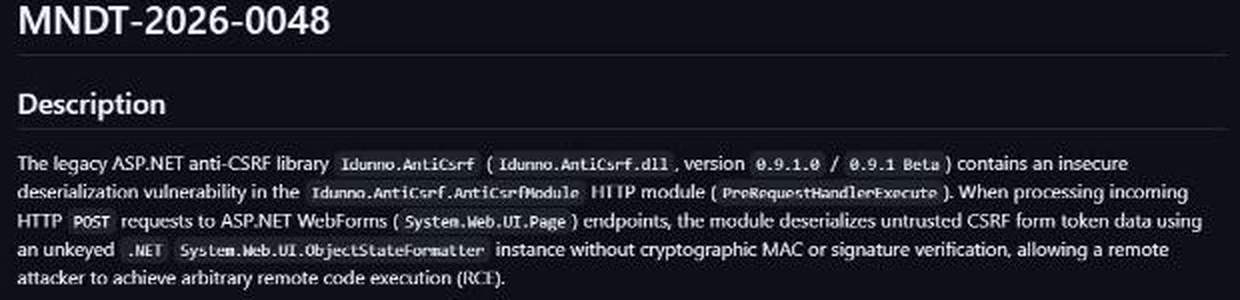
Published November 25, 2026. A news analysis of Idunno.AntiCsrf vulnerability CVE-2026-131914, built from Mandiant’s public advisory MNDT-2026-0048 (read on GitHub on November 25, 2026) and CISA’s Known Exploited Vulnerabilities (KEV) data as mirrored on CISA’s GitHub. The screenshot is ours (the description section of Mandiant’s advisory). We cropped out the technical detail below it. CISA’s own website returned “Access Denied” to our automated browser, so the KEV facts come from CISA’s GitHub mirror. This article contains no affiliate links and we have no commercial relationship with the Idunno.AntiCsrf project (defunct) and Mandiant. ToolReviewHub is produced with the help of an AI assistant (Claude, made by Anthropic). We did not run any affected application or test the flaw. Descriptions are the vendors’ and CISA’s wording, and numbers marked “ours” are our own arithmetic.
Idunno.AntiCsrf CVE-2026-131914: the short version
- What it is: a critical insecure-deserialization flaw (CWE-502) in Idunno.AntiCsrf, an old third-party anti-CSRF module for ASP.NET WebForms. Mandiant says a remote attacker can achieve arbitrary code execution in the IIS worker process with a single request and no prior authentication.
- No patch will come: the project is defunct. Its last release was 0.9.1 Beta, an official build dated December 2008, on the retired CodePlex platform. Mandiant’s advice is to remove it and replace it with a supported mechanism.
- Exploited: Mandiant says active exploitation in the wild has been observed, and its engineers found the flaw during an incident response investigation.
- Severity: CVSS 4.0 score 9.3 (Critical) using the CVSS-BT form, with the vector CVSS:4.0/AV:N/AC:L/AT:N/PR:N/UI:N/VC:H/VI:H/VA:H/SC:N/SI:N/SA:N/E:A.
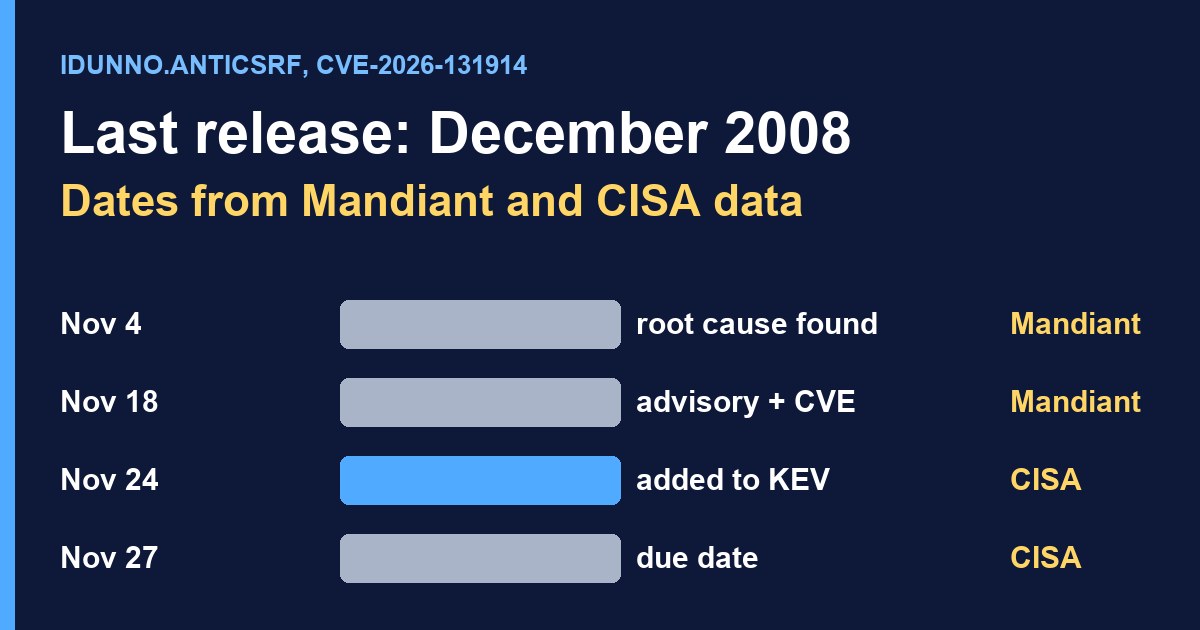
- KEV status: CISA added it on November 24, 2026, with a November 27 due date, six days after Mandiant’s advisory of November 18 (ours). CISA’s note says the component may be used by different products.
What Idunno.AntiCsrf is
CSRF (cross-site request forgery) is an attack in which a malicious page makes a visitor’s browser send a request to another site where the visitor is logged in. Anti-CSRF protection makes each form carry a secret token that an attacker cannot guess. Idunno.AntiCsrf was a third-party add-on for ASP.NET WebForms, the older Microsoft web framework, that added a cookie-and-form-token check to every page. Mandiant’s advisory says it was originally published on CodePlex, a code-hosting service that has since been retired.
A module like this is typically set up once and forgotten. It lives in a configuration file and a DLL in the application’s bin folder, and nobody on the current team may remember it. That is the central practical difficulty of this advisory: you may be running it without knowing.
What the vulnerability is
Mandiant says the module’s HTTP handler, which runs for incoming POST requests before the page’s own code, reads a token from the request and turns it back into an object using a .NET formatter that has no cryptographic key. In plain terms, it deserializes untrusted data without a way to check that the data is genuine. Deserialization flaws of this kind are well known: if an attacker controls the data and the formatter will build whatever objects it is told to, the attacker can make the server run code.
The advisory rates exploitability High for a reason that matters for defenders. The vulnerable step runs before most of the application’s own page logic. Pages that sit behind a login are protected only if the login is enforced earlier in the request pipeline; pages that are reachable anonymously, or that check the session inside their own code, expose the weakness. Mandiant says exploitation needs only a single POST request with no prior authentication or valid CSRF token, and that the page does not even need to contain a server-side form.
The impact is code execution in the context of the IIS worker process, which Mandiant calls complete compromise of the web application server. We are not describing the request details beyond this; the advisory gives them and attackers already have them, but there is no reason to repeat them here.
A security library as the weak point
There is an irony here. This module existed to protect forms against forged requests, and its protection mechanism was the way in. The lesson is not that anti-CSRF checks are bad. It is that a security component that is abandoned, unreviewed and built on an unsafe primitive adds risk instead of removing it. The flaw was found by Mandiant’s responders (and by researchers at Google Cloud’s FLARE team) during an incident response, which means that attackers were using it on a real victim before it had a name.
The advisory credits Genwei Jiang and Dhanesh Kizhakkinan of Google Cloud FLARE, Brian Bahtiarian and Lucas Kossack of Mandiant Incident Response, and one other researcher.
What the advisory says
| Item | Detail |
|---|---|
| Component | Idunno.AntiCsrf.dll, version 0.9.1.0 (0.9.1 Beta), ASP.NET WebForms module |
| Weakness | CWE-502, deserialization of untrusted data |
| Attacker | Remote, unauthenticated, a single POST request |
| Impact | Arbitrary code execution in the IIS worker process |
| Score | CVSS 4.0 9.3 Critical (CVSS-BT), exploit maturity: attacked |
| Fix | None: defunct project, no maintainer. Remove and replace |
| Known official build | 69,632 bytes, SHA-256 da1efcfed182597ee946a9ef2895dfdfeab2bdff16855aeef01656d8158ead06 (0.9.1.0 official 2008 release) |
The advisory lists the hashes of three known builds of the DLL (the 2008 official build and two rebuilds of the CodePlex source). It also warns that organizations that recompiled or customized the library will have different hashes but the same flaw, so you should search for the name and not only the hash.
Timeline
| Date (2026) | Event | Source |
|---|---|---|
| November 4 | Root-cause analysis completed during an incident response investigation | Mandiant |
| November 11 | Mandiant, as a CVE numbering authority, starts the CVE assignment | Mandiant |
| November 18 | Mandiant advisory and CVE-2026-131914 published | Mandiant |
| November 24 | CISA adds CVE-2026-131914 to the KEV catalog | CISA KEV data |
| November 27 | KEV due date for U.S. federal civilian agencies | CISA KEV data |
The library’s last official build dates from December 2008, which makes the code almost 18 years old at disclosure (ours). The three-day deadline matches the pattern in our November KEV analysis, and the due date has not passed as of November 25.
What to do: a practical checklist
- Search for it. Look through every ASP.NET application’s Web.config files and bin folders for Idunno.AntiCsrf and the AntiCsrfModule name, including old internal apps, vendor-supplied apps and backups. Search by name as well as by hash.
- Remove it. Following Mandiant’s guidance: delete the module entries from the httpModules and modules sections, remove the csrfSettings section and element from Web.config, remove references to the suppression attribute and interface, and delete the DLL from bin.
- Replace it with a supported mechanism. Mandiant suggests the framework’s own anti-forgery support (System.Web.Helpers.AntiForgery), WebForms ViewStateUserKey with MAC-verified or encrypted view state, or ASP.NET Core’s anti-forgery services. Test forms after the change.
- Look for signs of abuse. Review IIS logs for unusual POST requests to .aspx pages that returned an HTTP 302 or 500, especially with larger-than-normal response sizes where that is logged.
- If you find signs of exploitation, rotate all secrets in Web.config and applicationHost.config, including the machineKey, other encryption keys and database credentials, and inspect the web root for files you did not put there.
- Ask your vendors. If a product you buy bundles the DLL, ask the vendor in writing whether it is affected, and what its remediation date is.
- Put abandoned components on a list. Add old, unmaintained libraries to your inventory so that the next such advisory does not start with a hunt.
What we could not confirm
- Which commercial products or internal applications embed Idunno.AntiCsrf: CISA’s note says the component may be used by different products, but names none.
- How many servers are exposed, who is exploiting the flaw and what they are doing afterwards: the advisory says only that active exploitation was observed.
- The exact attack request: Mandiant’s advisory describes it, and we have chosen not to repeat it.
- Whether the three listed hashes cover every build in circulation: the advisory itself says custom builds differ.
- Whether other anti-CSRF components built on the same unsafe pattern exist.
- CISA’s own catalog page, which we could not open; the KEV facts come from CISA’s GitHub mirror (catalog version 2026.11.24).
Frequently asked questions
What is CVE-2026-131914?
A deserialization vulnerability in the abandoned Idunno.AntiCsrf ASP.NET WebForms module that lets a remote, unauthenticated attacker run code in the IIS worker process.
Is there a patch?
No. The project is defunct and has no maintainer. Mandiant advises removing the library and using a supported anti-CSRF mechanism.
How do I know if I use it?
Search Web.config files and bin folders for Idunno.AntiCsrf and AntiCsrfModule by name, and check file hashes for the known builds.
Is it exploited?
Yes. Mandiant says active exploitation was observed, and CISA added it to the KEV catalog on November 24, 2026.
What is the KEV deadline?
November 27, 2026 for U.S. federal civilian agencies. For everyone else it signals urgency and is not a legal deadline.
Method: details come from Mandiant’s advisory MNDT-2026-0048 (published November 18, 2026) and CISA KEV data (catalog version 2026.11.24), read on November 25, 2026. For how we research, see How We Review Tools.