Tobira, Dageno, AXL and Databox CLI: Four More New AI Tools Priced, and Two Roundup Prices Were Already Out of Date
Published November 23, 2026. A news analysis built from the official pricing pages of Tobira, Dageno, AXL and Databox, the Databox CLI repository on GitHub, and the Product Hunt weekly ranking for November 5 to 12, 2026 as summarized by the Shareuhack roundup. The screenshots are ours and were taken on November 23, 2026. This article contains no affiliate links and we have no commercial relationship with any company named here. ToolReviewHub is produced with the help of an AI assistant (Claude, made by Anthropic), and several of these products work with Claude through MCP connections, so we say so up front. We did not sign up for, install or test any of these tools: everything below is what the vendors’ own pages say, and numbers marked “ours” are our own arithmetic.
The short version
- What we looked at: four products from the top ten of Product Hunt’s week of November 5 to 12, 2026 that share one idea: products built so that AI agents can read, call or buy from them. They are Tobira Site Agent (turns a website into an agent that answers and sells, fourth with 400 upvotes), Dageno AI 2.0 (tracks which brands AI assistants recommend, fifth with 378), Databox CLI (analytics from the terminal, seventh with 305) and AXL (a sales and marketing platform exposed through MCP, ninth with 295). Upvote counts come from the Shareuhack roundup, not our own count.
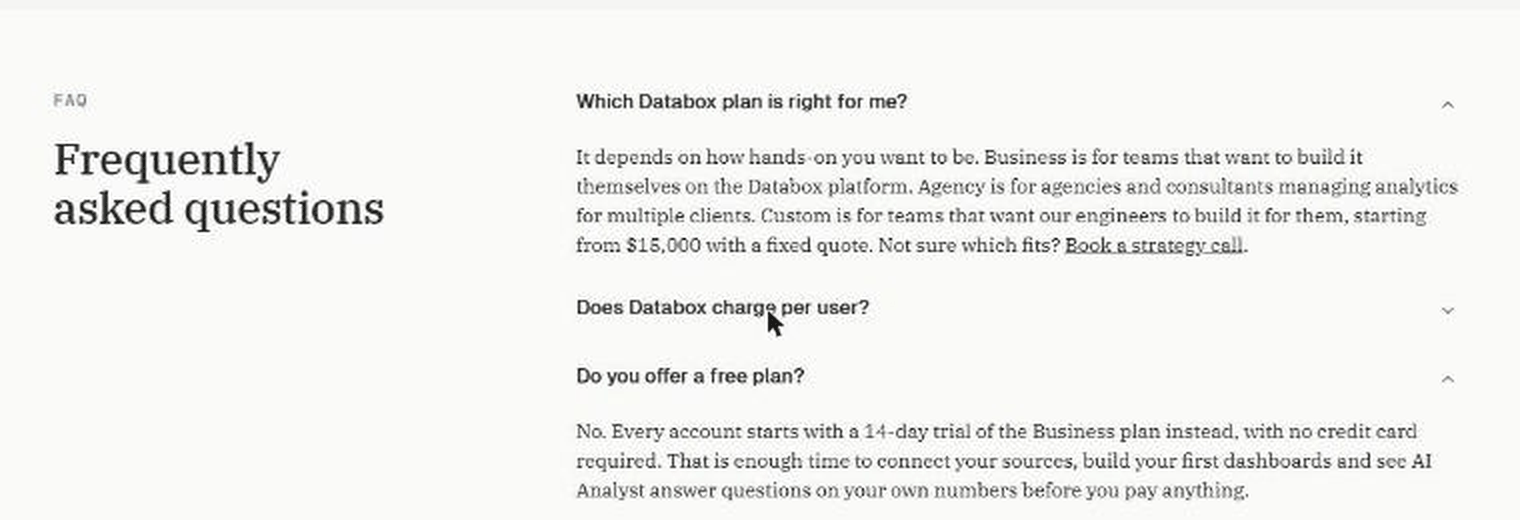
- Two of the four roundup prices were already out of date. The roundup lists Dageno’s Starter at $79 a month and Scale at $499; Dageno’s own page now shows $49 and $410. It describes a Databox free plan with one user, three data sources and 50 AI credits; Databox’s own FAQ now answers “Do you offer a free plan?” with “No” and shows a Business plan at $399 a month. Tobira and AXL matched, with one caveat for Tobira below.
- Cheapest way in: AXL has a free plan with hard limits and no card. Tobira starts at $49 a month, Dageno at $49 a month with a 7-day trial, and Databox at $399 a month on yearly billing after a 14-day trial. The Databox CLI itself is free, MIT-licensed software.
- The number worth a second look: Tobira’s four plans work out to almost the same price per conversation, between $0.16 and $0.19 on every tier (ours), so moving up a plan buys capacity and features, not a discount.
- What we could not do: verify any performance claim, count AXL’s “1,200+ actions,” or confirm whether the Databox CLI can be used without a paid plan.
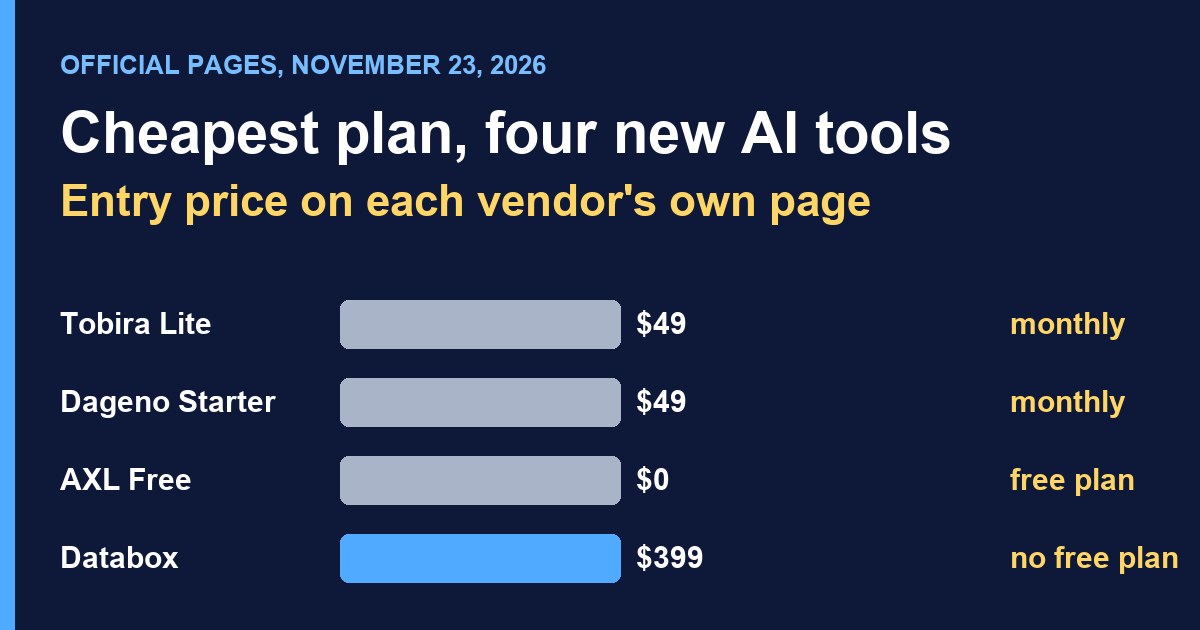
How these four were picked
Product Hunt’s weekly ranking measures attention, not quality, payment or reliability, and the roundup says so itself. This is the third article in our series on the recent top tens, after RankSpot, Rakazo, Plurai and HiringNow and Creatify Max, YouArt, S.Space and Filament, which covered the week of November 12 to 19. From the earlier week we took the four that publish prices we could read without an account. We left out Alsona and Maxma, whose pricing we could not read as fixed amounts, Glasshand, where the roundup itself found no cross-verified pricing, ChatGPT Images 2.6 (an OpenAI feature, not a startup product) and LiveReview, which we did not study.
| Product | What it says it does | Product Hunt week rank, upvotes | Entry price on its own page |
|---|---|---|---|
| Tobira Site Agent | An agent on your website that answers visitors and visiting AI agents, books meetings and takes orders | 4th, 400 | $49/month (Lite) |
| Dageno AI 2.0 | Shows whether ChatGPT, Gemini, Perplexity and other AI answers recommend your brand or competitors | 5th, 378 | $49/month (Starter), 7-day trial |
| Databox CLI | A command-line tool for the Databox API, aimed at scripts and AI agents | 7th, 305 | CLI is free (MIT); Databox plans start at $399/month |
| AXL | An all-in-one sales and marketing platform reachable by AI assistants through MCP | 9th, 295 | Free plan; paid from $49/month |
Tobira Site Agent: a website that talks back, to people and to AI
Tobira’s pitch is that “your clients already ask” an AI assistant “what to buy,” and a website with no answer for that assistant loses the sale. Its Site Agent answers visitors and also answers AI agents that visit on a customer’s behalf, with examples of booking a demo, quoting a price and taking a deposit. The company says the agent goes live in about two minutes, and the site links to machine-readable files (llms.txt, agent.json and AGENTS.md) as its own agent-facing interface. The demo scenarios on the page, such as a demo booked for a head of sales, are sample content, not customer results.
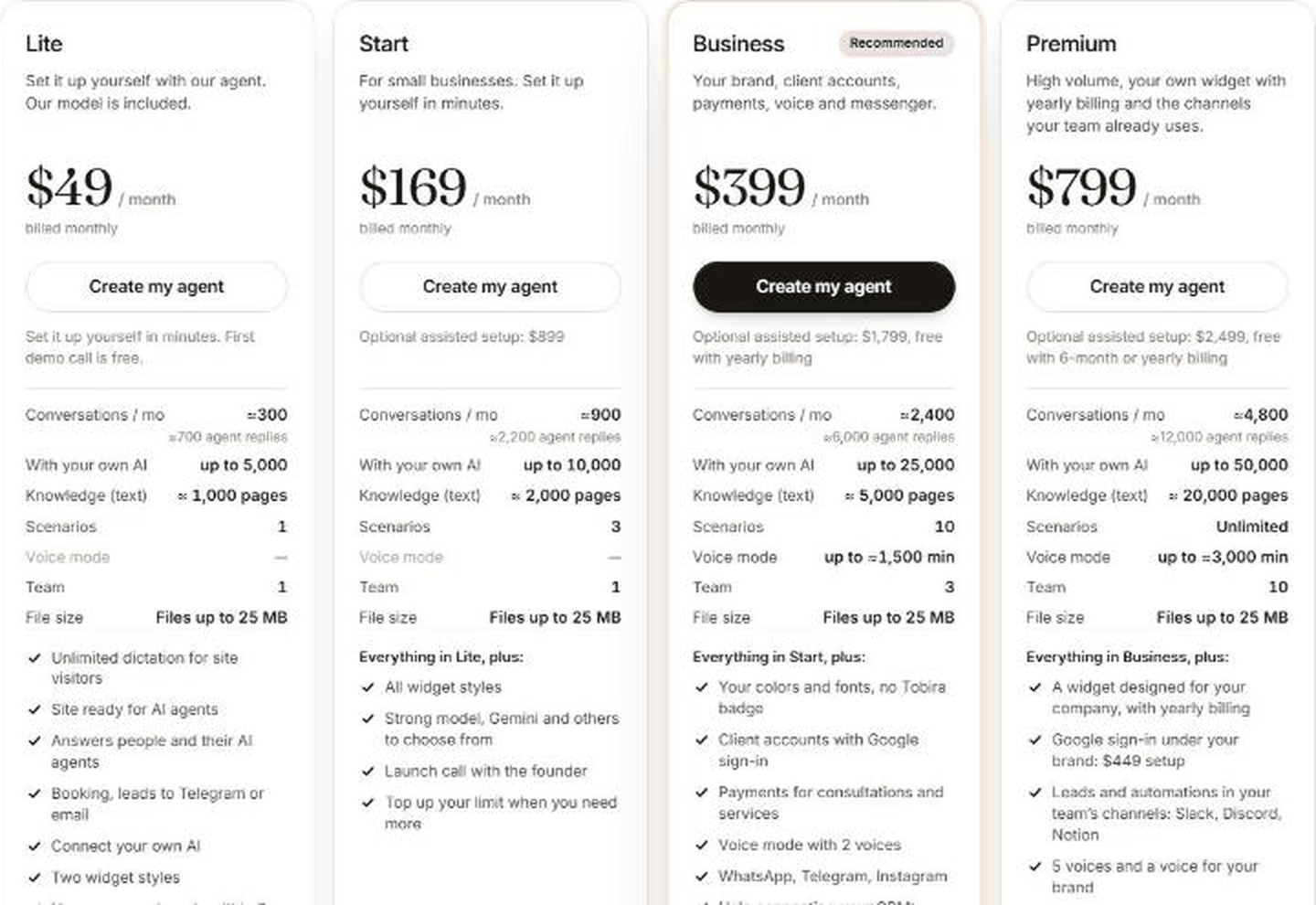
| Plan | Price (monthly billing) | Conversations a month | Conversations with your own AI | Knowledge, scenarios, team | Our price per conversation |
|---|---|---|---|---|---|
| Lite | $49 | about 300 (about 700 agent replies) | up to 5,000 | about 1,000 pages, 1 scenario, 1 seat | about $0.16 |
| Start | $169 | about 900 (about 2,200 replies) | up to 10,000 | about 2,000 pages, 3 scenarios, 1 seat | about $0.19 |
| Business | $399 | about 2,400 (about 6,000 replies) | up to 25,000 | about 5,000 pages, 10 scenarios, 3 seats, voice up to about 1,500 minutes | about $0.17 |
| Premium | $799 | about 4,800 (about 12,000 replies) | up to 50,000 | about 20,000 pages, unlimited scenarios, 10 seats, voice up to about 3,000 minutes | about $0.17 |
Optional assisted setup costs $899 on Start, $1,799 on Business (free with yearly billing) and $2,499 on Premium (free with 6-month or yearly billing). The page also shows 6-month billing “up to −12%” and yearly “up to −20%”, a 14-day money-back guarantee, and an optional model where visitors pay for an AI under your brand and Tobira keeps 15% of that subscription revenue.
What the numbers show (our arithmetic)
- Almost flat price per conversation. Dividing each plan price by its monthly conversations gives about $0.16, $0.19, $0.17 and $0.17. Start is the least efficient tier. What you buy by moving up is features and seats: your own colours without the Tobira badge, client accounts, payments, voice and messenger channels on Business, then Slack, Discord and Notion routing and up to three sites on Premium.
- Bringing your own AI changes the maths. With your own AI key the page lists 5,000, 10,000, 25,000 and 50,000 conversations, about 10 to 17 times the included counts. On Lite that works out to roughly a cent per conversation of platform fee ($49 divided by 5,000, ours), before your own AI bill, which the page does not estimate.
- The approximations matter. Every volume figure on the page starts with “about,” and one “conversation” maps to roughly 2.3 agent replies. Ask what exactly counts as a conversation before you size a plan.
What to check. The roundup lists a Free plan, and the homepage says “Free plan, 14-day money-back,” but the pricing grid we saw has four paid cards and no Free card; the headline over the grid reads “Start free with your own AI key.” We could not tell whether that free tier is a separate plan or a way to use the paid plans, so confirm it before you plan around it. The page also served us a French version first; the English prices above come from the English page. Because the agent talks to your customers and takes bookings and deposits in your name, test it with a staging page, read what it says about your prices and refund terms, and check how a conversation is handed to a person. Tobira’s page describes agents built from your own materials; we did not test how well one keeps to them.
Dageno AI 2.0: watching what AI says about your brand
Dageno sells visibility tracking for the new answer surfaces: whether AI assistants name your brand, your competitors and particular sources when someone asks a buying question. The pricing page lists nine standard AI platforms on every plan (ChatGPT, Perplexity, Gemini, Google AI Overview, Google AI Mode, Grok, Copilot, Dola and Brave), with Amazon Alexa on custom plans, and says every standard platform and region (86 or more) is included with no add-on fees. It also sells a managed service from US$6,000 a quarter that includes one AI platform, one business scenario and one region.
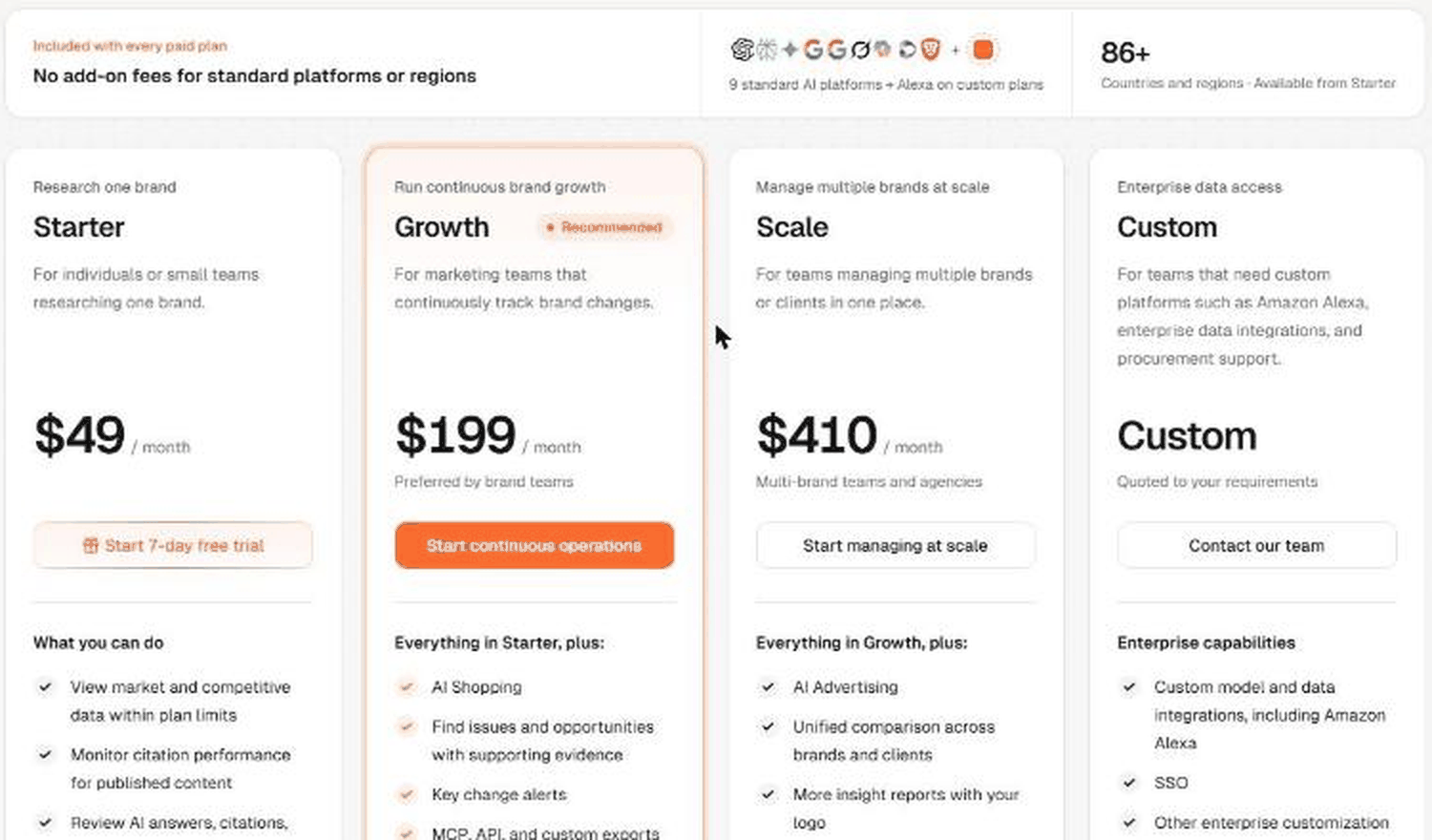
| Plan | Price (monthly billing) | Projects | Insight reports | API and MCP calls | Market segments | Competitors in rankings |
|---|---|---|---|---|---|---|
| Starter | $49, 7-day free trial | 1 | none | none | 2 | top 100 |
| Growth | $199 | 2 | 2 a month | 3,000 a month | 5 | top 300 |
| Scale | $410 | 5 | 5 a month | 6,000 a month | 12 | top 1,000 |
| Custom | Quoted | Custom | Custom | Custom | Custom | Custom |
The upgrade path is defined by capability, not only by volume. AI Shopping, key change alerts, custom exports and MCP and API access start on Growth, and AI Advertising and a unified comparison across brands or clients start on Scale. Growth’s page shows a prompt quota of 300 and 9,000 monthly prompt runs. Annual billing is advertised as saving about 15%.
What the numbers show (our arithmetic)
- Price per tracked prompt. Growth’s 300-prompt quota at $199 is about $0.66 per tracked prompt a month. The 9,000 monthly runs equal 300 prompts run daily for 30 days, which is about $0.022 per run (ours).
- Per project the price falls as you go up. Starter is $49 per project, Growth about $99.50 and Scale $82 (ours). Growth is the most expensive per project, which suggests you pay extra for the continuous-tracking features, not the extra project.
- Scale roughly doubles Growth for twice the API calls. $410 is about 2.06 times $199, for 2 times the API and MCP calls and 2.5 times the projects and reports.
What to check. The roundup and several third-party listings give Starter as $79 and Scale as $499; the page we captured says $49 and $410. We cannot tell whether the price was cut, whether there is a promotional or regional difference, or whether the listings were stale, so treat any price you read in a roundup as a lead and the vendor’s page as the answer. More importantly, what the dashboard measures is what a sample of AI answers said on a given day, and AI answers differ from run to run, by region and by how a question is worded. A visibility score is an observation, not a ranking and not demand. Before paying, ask how many times each prompt is run, how answers are sampled and whether you can export the raw answers. The “Free forever” button in Dageno’s menu leads to a separate site (insight.dageno.ai) that we did not study, so it does not change the plan prices above.
Databox CLI: a free tool in front of a $399 platform
Databox repositioned itself this year as an agentic analytics platform, and the CLI is its terminal front door. The public repository (databox/databox-cli) describes a command-line interface for the Databox API that manages data sources, datasets, custom metrics, dashboards, users, accounts, connections and billing from the terminal, from scripts or through an AI agent. It installs with npm install -g databox-cli, needs Node.js 18 or later, is TypeScript under the MIT licence, and since version 1.0 targets Databox’s V2 API. A skills folder in the repository holds instructions for coding agents.
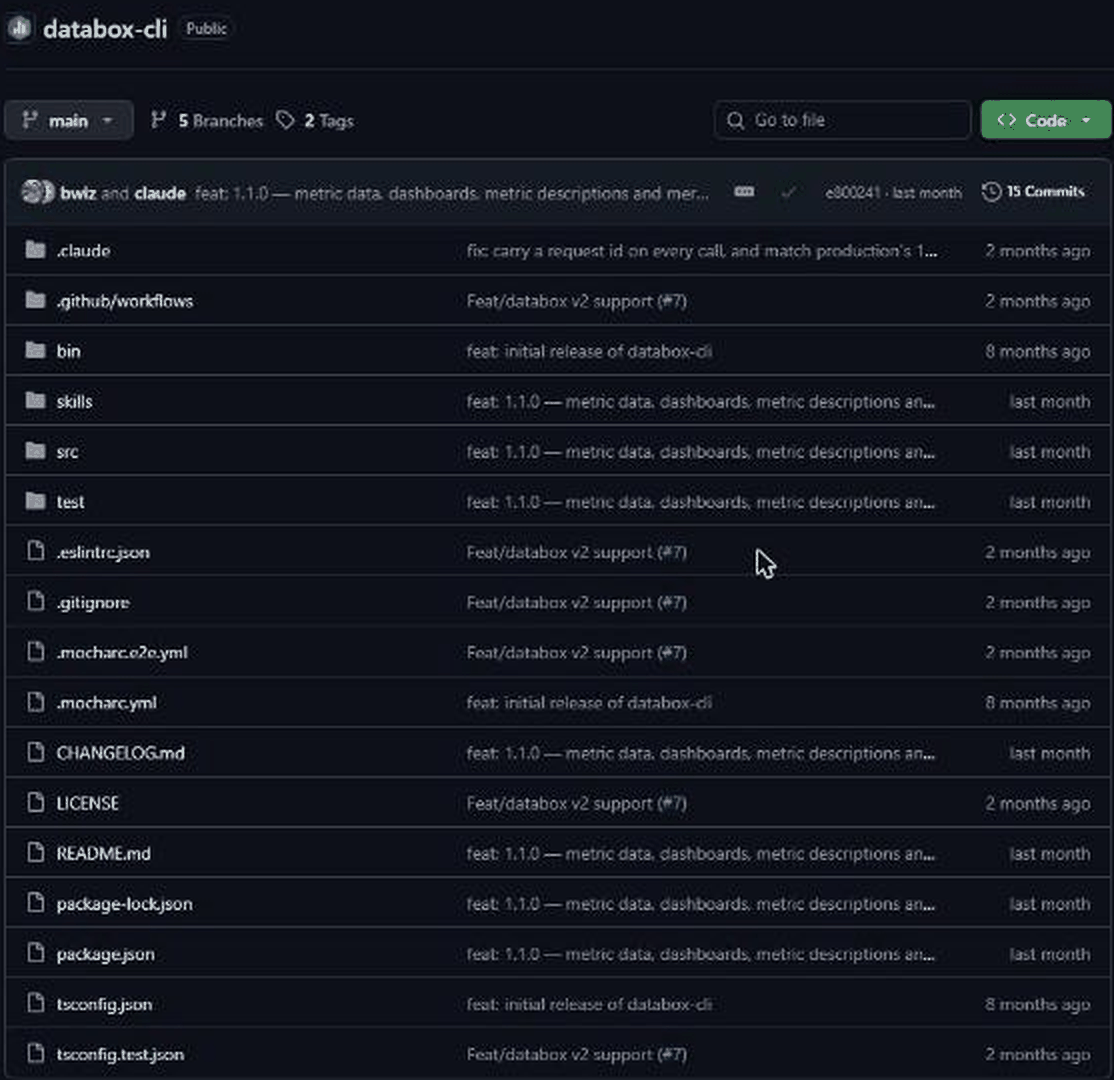
| Fact (GitHub, November 23, 2026) | What we saw |
|---|---|
| Licence and language | MIT, TypeScript |
| Size of the project | 3 stars, 1 fork, 4 open pull requests, 15 commits, 2 tags |
| Created, last updated | March 6, 2026; last push October 26, 2026 |
| Install | npm install -g databox-cli, Node.js 18 or later |
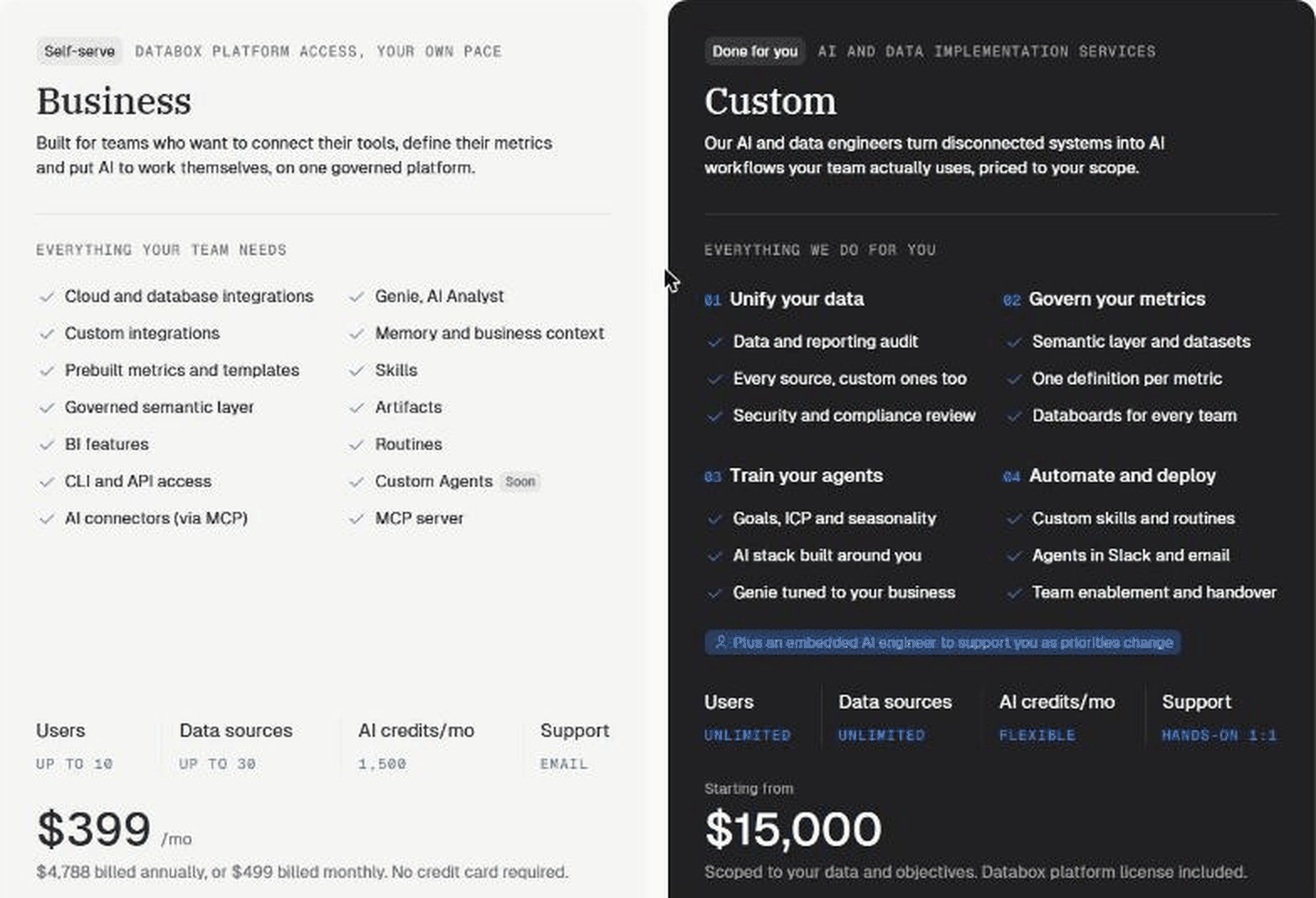
The tool is free; the platform behind it is not. Databox’s pricing page lists three tiers, and its FAQ is blunt about the free plan.
| Plan | Price | What the page lists |
|---|---|---|
| Business (self-serve) | $399/month, billed as $4,788 a year; $499 billed monthly | Up to 10 users, up to 30 data sources, 1,500 AI credits a month, email support, CLI and API access, MCP connectors, an MCP server; “Custom Agents” marked Soon; 14-day trial, no credit card |
| Agency | $79/month, billed annually, plus account packs | Unlimited users, one login for many client accounts; each extra account pack is $20 a month for 1 account, 5 data sources and 50 AI credits |
| Custom (done for you) | From $15,000 | Databox engineers build the setup; unlimited users and sources; platform licence included |
What the numbers show (our arithmetic)
- Yearly billing saves $1,200. Twelve months of $499 is $5,988 against $4,788 on yearly billing, a 20% saving, which matches the page.
- Business is about $40 a user and about $13 a data source if you fill all 10 users and 30 sources; per AI credit it is about $0.27 ($399 divided by 1,500), against $0.40 for credits inside an Agency account pack ($20 divided by 50).
- The cheapest paid road is the Agency plan. At $79 a month plus packs it is the lowest entry price on the page, but it is sold for agencies managing client accounts, and we did not read its terms for ordinary businesses.
What to check, and a correction. Our own Databox review, last updated November 12, described a Free plan (1 user, 3 data sources, 50 AI credits) and an Analyst plan at $71 a month. The page now shows none of those, so we are correcting that review and noting the date. We cannot say when the change happened. The Product Hunt launch comments say the CLI works on any plan and that anyone can create an API key, but those are the maker’s comments, and the pricing page lists “CLI and API access” under Business. If you want the free software without the platform, find out whether a key is available outside the trial before you build anything on it. The repository is small and young (3 stars, last push in October), so check that its commands match the current API.
AXL: a sales platform that publishes its limits
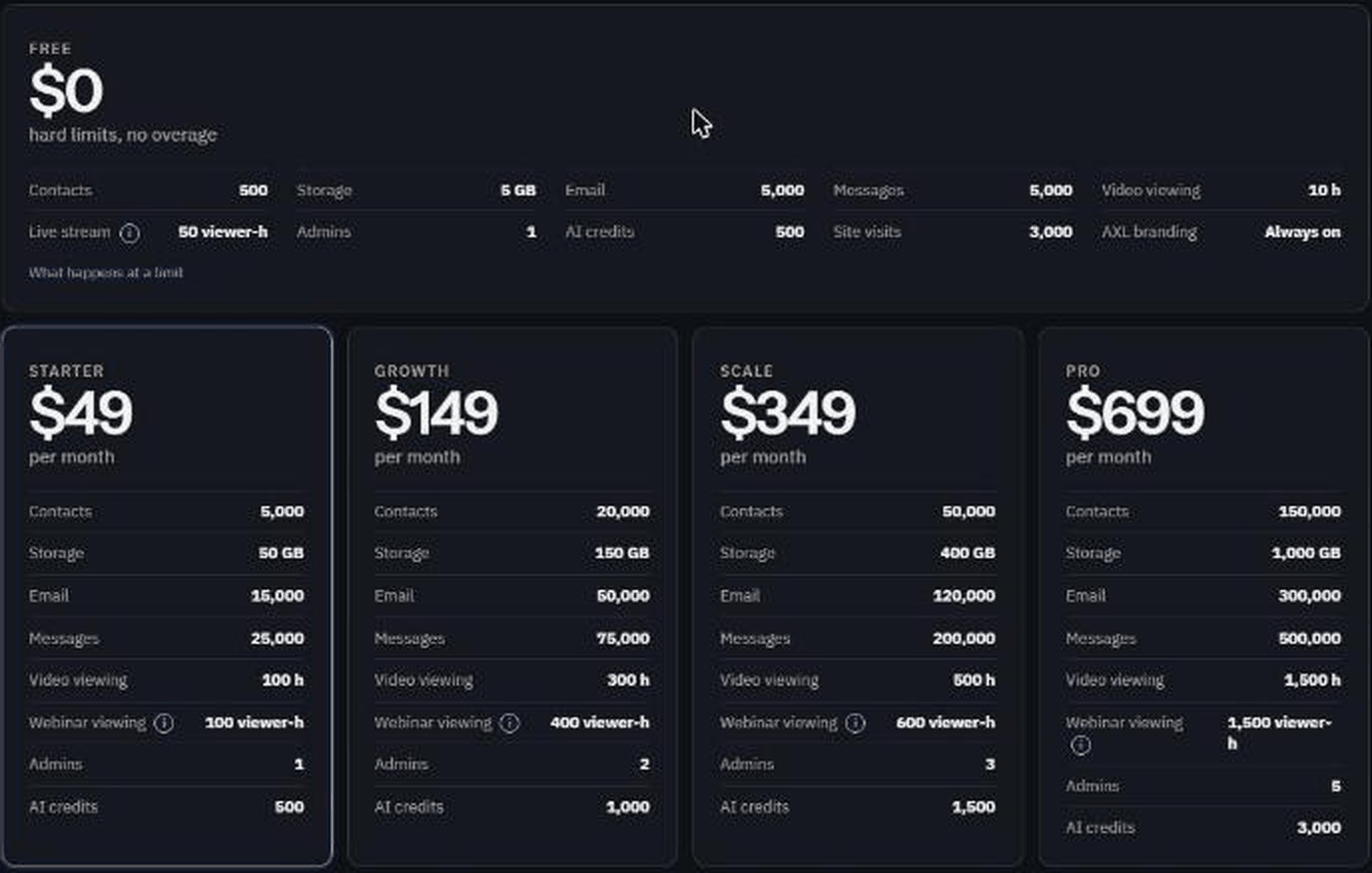
AXL calls itself an AI-native sales and marketing platform, and its Product Hunt tagline is “GTM copilot for AI product founders: 1,200+ actions via MCP,” meaning an assistant such as Claude or ChatGPT can run tasks inside your account over the MCP standard. We did not read AXL’s MCP documentation and did not count the actions, so the figure is the vendor’s tagline. The pricing page, by contrast, is unusually specific.
| Plan | Price a month | Contacts | Emails | Messages | Video viewing | Admins | AI credits |
|---|---|---|---|---|---|---|---|
| Free (hard limits, no overage) | $0 | 500 | 5,000 | 5,000 | 10 hours | 1 | 500 |
| Starter | $49 | 5,000 | 15,000 | 25,000 | 100 hours | 1 | 500 |
| Growth | $149 | 20,000 | 50,000 | 75,000 | 300 hours | 2 | 1,000 |
| Scale | $349 | 50,000 | 120,000 | 200,000 | 500 hours | 3 | 1,500 |
| Pro | $699 | 150,000 | 300,000 | 500,000 | 1,500 hours | 5 | 3,000 |
The page says the full platform is included on every plan, that plans change included usage and admin seats rather than access to features, that overage rates are public, and that AXL takes 0% of sales. The Free plan also adds storage of 5 GB, 3,000 site visits and AXL branding that is always on. A bill estimator on the page lets you choose a business profile and see the monthly total.
What the numbers show (our arithmetic)
- Price per 1,000 contacts falls with each plan: about $9.80 on Starter, $7.45 on Growth, $6.98 on Scale and $4.66 on Pro.
- AI credits do not scale with price. Pro is about 14 times Starter’s price and has 6 times its AI credits (3,000 against 500), so heavy AI use may cost more than the plan fee alone suggests; the page lists overage rates, which we did not work through.
- Free is a real test bed: 500 contacts and 5,000 emails a month at $0 with hard limits means a limit stops you rather than billing you.
What to check. One directory listing we found describes AXL as a 14-day trial only; the official page shows a free plan with no card, so the free plan appears to be the current offer. Contacts, emails, payments and calls are sensitive; an MCP connection that lets an assistant act inside that account needs the same care as handing a person admin access. Ask what the assistant can and cannot do by default, whether destructive or billing actions are excluded (one third-party listing says 21 sensitive operations are kept off the AI surface, which we could not verify), and how actions are logged.
What the four have in common
1. Prices move faster than roundups. Two of the four roundup entries no longer match the vendors’ own pages. Either the prices changed since the roundup was written or the roundup had them wrong, and we cannot tell which. The roundup itself says launch pricing can change. The lesson is not that the roundup was careless but that prices in any summary, including ours, have a date on them, and that is why we print ours.
2. “Free” means four different things. AXL’s free plan has hard limits and no card. Dageno offers a 7-day trial. Databox offers a 14-day trial and says no free plan. Tobira shows a free plan on its homepage and none in its pricing grid. When a page says free, ask whether it means free forever, free trial, free software or free with your own key.
3. Products are being built for machine readers. Tobira publishes llms.txt, agent.json and AGENTS.md; Dageno measures how AI models describe brands; AXL and Databox expose actions and data over MCP. For a site owner this is a reminder that being understood by assistants is becoming part of how customers find you, and that the metrics for it, such as visibility scores, are young and noisy.
4. The free part is often the door, not the room. The Databox CLI is free software that sits in front of a $399 platform, AXL’s free plan is a hard-capped sample, and Dageno’s trial leads to a $49 plan whose useful alerts and exports start at $199. That is a normal business model. It only becomes a problem when you build workflows before you know what the next step costs.
Checklist before you connect anything
- Open the vendor’s pricing page, not a summary, and note the date and whether you are looking at monthly or yearly prices.
- Ask what exactly is counted: a conversation, a prompt run, an AI credit, a contact, an account pack.
- Find out whether a free option is a plan, a trial, free software or a way to bring your own key.
- For anything that talks to customers or acts in an account (Tobira, AXL, an MCP connection), test on a staging page or a test account first.
- Check what leaves your systems: customer chats, contact lists, analytics data or API keys.
- Treat visibility and ranking scores as samples, and keep your own notes of what AI assistants actually say about you.
- Know how you stop and reverse an agent’s action before you enable a routine.
What we could not confirm
- That any of the four works as described: we did not create an account, install or run them.
- Whether Tobira has a separate free plan, how it counts a “conversation,” and how well its agent sticks to your materials.
- Whether Dageno’s price differences with the roundup are a price change, a regional difference or stale listings, and how Dageno samples AI answers.
- When Databox removed its free plan, whether the CLI works without a paid plan, and the maker’s claim of ten agent skills in the repository.
- AXL’s “1,200+ actions via MCP,” which we did not count, and the third-party claim that 21 sensitive operations are excluded from the AI surface.
- Product Hunt rankings, which come from the Shareuhack roundup, and any funding or company detail that is not on the vendors’ own pages. We read the pages from Vietnam, so prices shown to you may differ by region.
Frequently asked questions
Is Databox free?
No, according to its own FAQ. Every account starts with a 14-day trial of the Business plan, and the Business plan is $399 a month billed yearly or $499 billed monthly. The Databox CLI software is free and MIT-licensed, but it works against a Databox account.
Is AXL free?
Its pricing page shows a free plan with hard limits and no overage, then paid plans from $49 a month. The free plan has AXL branding that is always on.
How much is Dageno?
On its pricing page, Starter is $49 a month with a 7-day free trial, Growth $199 and Scale $410 on monthly billing, with about 15% off on annual billing. Some third-party pages list Starter at $79 and Scale at $499.
Does Tobira charge per conversation?
Not directly. Its plans include a monthly number of conversations, about 300 on Lite up to about 4,800 on Premium, and the page lists higher limits if you connect your own AI. Our arithmetic puts every tier at about $0.16 to $0.19 per included conversation.
Which of the four is the lowest-risk to try?
AXL’s free plan or Databox’s trial on test data are the most contained, since a limit or a trial end stops you. Tobira and any MCP connection that acts in a live account deserve a staging test first.
Method: figures come from the vendors’ public pages and the databox-cli GitHub repository on November 23, 2026; our screenshots show the pages that day. Product Hunt data is from the Shareuhack weekly roundup for November 5 to 12, 2026. Calculations marked “ours” divide the prices shown by the quantities shown and exclude taxes, add-ons and overage. For how we research, see How We Review Tools.