Scalekit, UnleashX, Wanaka and Screen Studio: Four More New AI Tools Priced, and Three Roundup Entries Missed Something
Published November 23, 2026. A news analysis built from the official pricing pages of Scalekit, UnleashX, Wanaka and Screen Studio, Screen Studio’s public changelog, and the Product Hunt weekly ranking for October 29 to November 5, 2026 as summarized by the Shareuhack roundup. The screenshots are ours and were taken on November 23, 2026. This article contains no affiliate links and we have no commercial relationship with any company named here. ToolReviewHub is produced with the help of an AI assistant (Claude, made by Anthropic), and Scalekit’s product is built to connect agents such as Claude to other apps, so we say so up front. We did not sign up for, install or test any of these tools: everything below is what the vendors’ own pages say, and numbers marked “ours” are our own arithmetic.
The short version
- What we looked at: four products from the top ten of Product Hunt’s week of October 29 to November 5, 2026: Scalekit (a gateway that lets AI agents call other apps with the right permissions, fifth with 420 upvotes), UnleashX (an “AI workforce” for sales, support and operations, eighth with 359), Wanaka Studio (build and publish 3D games with AI, fourth with 431) and Screen Studio (a Mac screen recorder, second with 455). Upvote counts come from the Shareuhack roundup, not our own count.
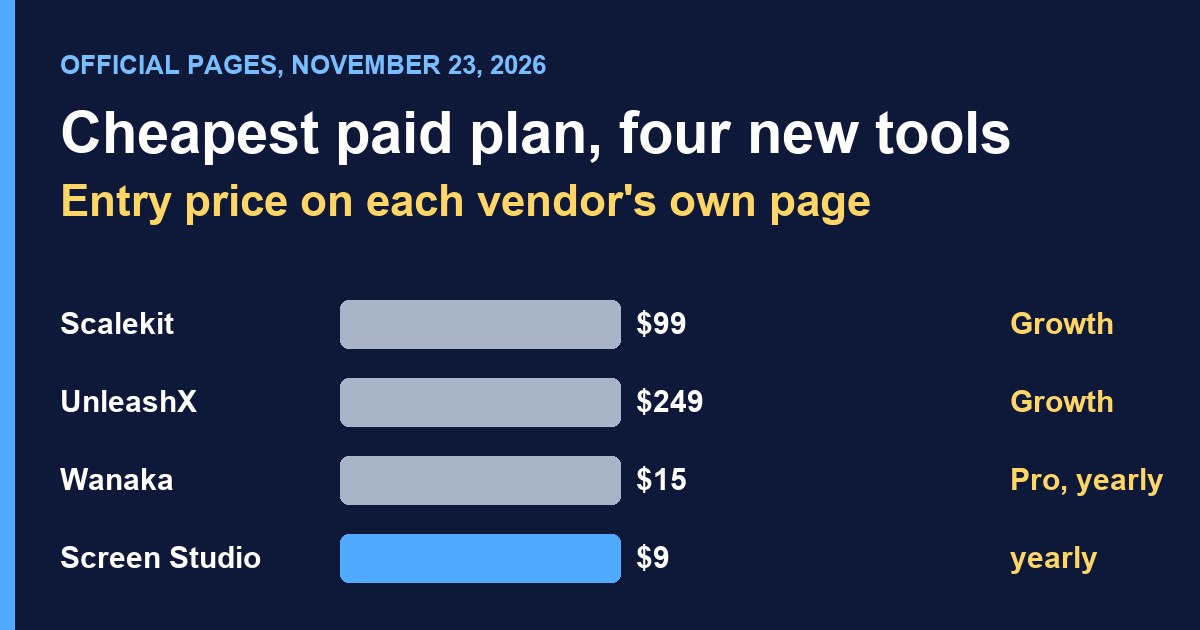
- Three of the four roundup entries differ from the vendors’ pages today. Scalekit has a fourth plan, Scale at $699 a month, marked “NEW,” that the roundup does not list. The roundup gives UnleashX a Basic plan at $49 and Growth at $299; the page we read shows a pay-as-you-go tier with 1,000 free credits and Growth at $249, and no Basic. The roundup’s Wanaka prices of $15 and $40 are the yearly-billing prices; monthly is $19 and $49, and there is an Ultra plan at $160 a month yearly. Only Screen Studio matched ($9 yearly, $29 monthly).
- Cheapest way in: Scalekit, UnleashX and Wanaka each have a free tier you can start without a card. Screen Studio has no free tier and costs $9 a month on yearly billing.
- The number worth a second look: on Scalekit, extra tool calls beyond the Growth allowance cost $0.50 per thousand, half of what the included calls work out to ($0.99 per thousand, ours). Heavy users may find Growth plus overage cheaper than the $699 Scale plan, which is priced for compliance features, not volume.
- What we could not do: sign in to any of the four (Wanaka’s studio sits behind a login), verify any performance claim, or work out what a credit costs on UnleashX’s pay-as-you-go tier.
How these four were picked
Product Hunt’s weekly ranking measures attention, not quality, payment or reliability, and the roundup says so itself. This is the fourth article in our series on recent top tens, after RankSpot, Rakazo, Plurai and HiringNow, Creatify Max, YouArt, S.Space and Filament and Tobira, Dageno, AXL and Databox CLI. From this week we took four whose pricing pages we could read without an account. We left out Empacer and Teamily AI (the roundup says Empacer’s pricing is not published and Teamily’s is unconfirmed), Vaani (priced in Indian rupees per minute, a different market), beacon.sh and Knocket AI. Scape, another top-ten product, already has a review on this site.
| Product | What it says it does | Product Hunt week rank, upvotes | Entry price on its own page |
|---|---|---|---|
| Scalekit | One endpoint between an AI agent and the apps and MCP servers it needs, with identity, permissions and logs | 5th, 420 | Free; $99/month (Growth) |
| UnleashX | AI employees, agents and automations for sales, support and operations | 8th, 359 | 1,000 free credits; $249/month (Growth) |
| Wanaka Studio | An AI agent, editor and 3D generator for building and publishing games | 4th, 431 | Free; $15/month yearly or $19 monthly (Pro) |
| Screen Studio | Screen recordings that zoom, frame and edit themselves | 2nd, 455 | $9/month yearly or $29 monthly |
Scalekit: the permission layer for agents that act
Scalekit’s AgentKit is aimed at developers who ship agents that must act inside other people’s accounts. Its pricing page describes “one endpoint between your agent and every app and MCP it needs,” with 1,100 or more connectors and more than 55,000 tools, bring-your-own credentials and unlimited connected accounts on every plan. The page links to a separate price list for its authentication product for SaaS apps and MCP servers, which we did not read. The roundup’s one-line summary is “who can call what when an agent goes live,” which is exactly the problem a gateway with identity and logs is meant to answer.
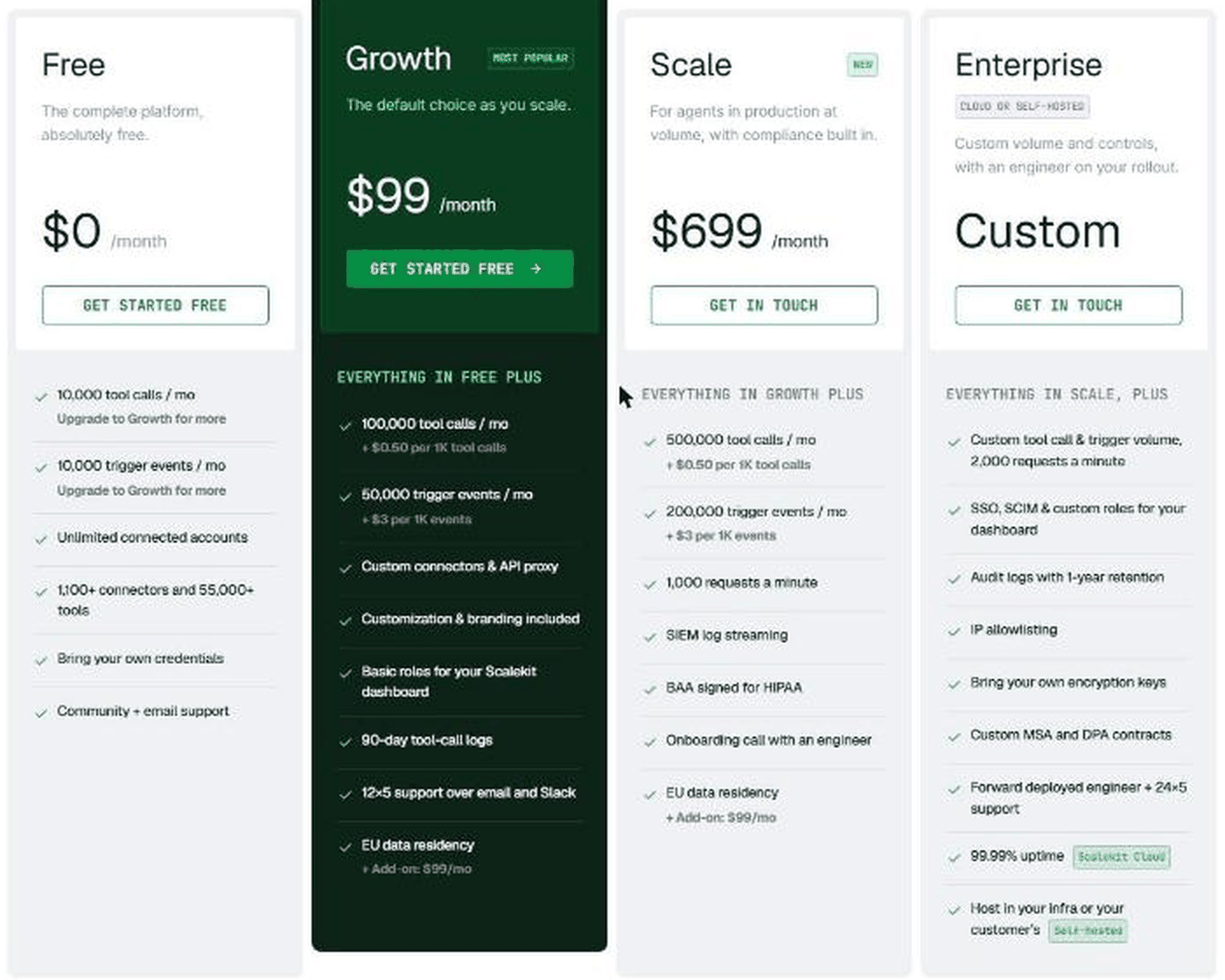
| Plan | Price a month | Tool calls a month | Trigger events a month | Notable limits and features |
|---|---|---|---|---|
| Free | $0 | 10,000 | 10,000 | Community and email support |
| Growth | $99 | 100,000, then $0.50 per 1,000 | 50,000, then $3 per 1,000 | Custom connectors and API proxy, branding, basic dashboard roles, 90-day tool-call logs, 12×5 support on email and Slack |
| Scale (marked NEW) | $699 | 500,000, then $0.50 per 1,000 | 200,000, then $3 per 1,000 | 1,000 requests a minute, SIEM log streaming, signed BAA for HIPAA, onboarding call with an engineer |
| Enterprise | Custom | Custom | Custom | 2,000 requests a minute, SSO and SCIM, 1-year audit logs, IP allowlisting, bring-your-own encryption keys, custom contracts, forward-deployed engineer, 99.99% uptime on the cloud version, or self-hosting |
EU data residency is listed as a $99 a month add-on on Growth and Scale.
What the numbers show (our arithmetic)
- Overage is cheaper than the included rate. Growth’s 100,000 included calls cost $0.99 per thousand ($99 divided by 100), while calls beyond that are $0.50 per thousand. A team that uses 500,000 calls would pay $99 plus 400 times $0.50, or $299 on Growth, against $699 on Scale (ours).
- Scale is priced for requirements, not volume. The extra $400 buys SIEM streaming, a signed HIPAA agreement, a higher rate limit and an onboarding call. If you do not need those, Growth with overage costs less for the same calls.
- Triggers change the answer. If you also use 200,000 trigger events, Growth would cost $99 plus $200 for calls plus 150 times $3, or $749, which is more than Scale’s $699 (ours). The break-even depends on your mix of calls and events.
- The free tier is a real test bed. 10,000 calls and 10,000 trigger events a month is enough to prove a workflow, and the upgrade to Growth is a 10-times jump in calls.
What to check. The roundup describes Free, Growth at $99 and a custom Enterprise tier; it does not list Scale, which the page marks as new. Ask what counts as a tool call (a failed call? a retry?), whether logs beyond 90 days are needed for your audits, and where credentials are stored when you bring your own. A gateway sits in the path of every agent action, so its uptime, its rate limits and what it logs are part of your own reliability and privacy story. We did not test any of it.
UnleashX: pricing an AI workforce in credits
UnleashX describes AI employees, agents and automations that automate “end-to-end business workflows across sales, support and operations.” The platform covers voice agents, video agents, chatbots, call evaluation, click-to-call, automations and general AI agents, with an assistant called Leasha. The pricing page offers a pay-as-you-go entry with 1,000 free credits and no card, a Growth subscription, and a custom Enterprise plan, and has a US dollar and Indian rupee toggle.
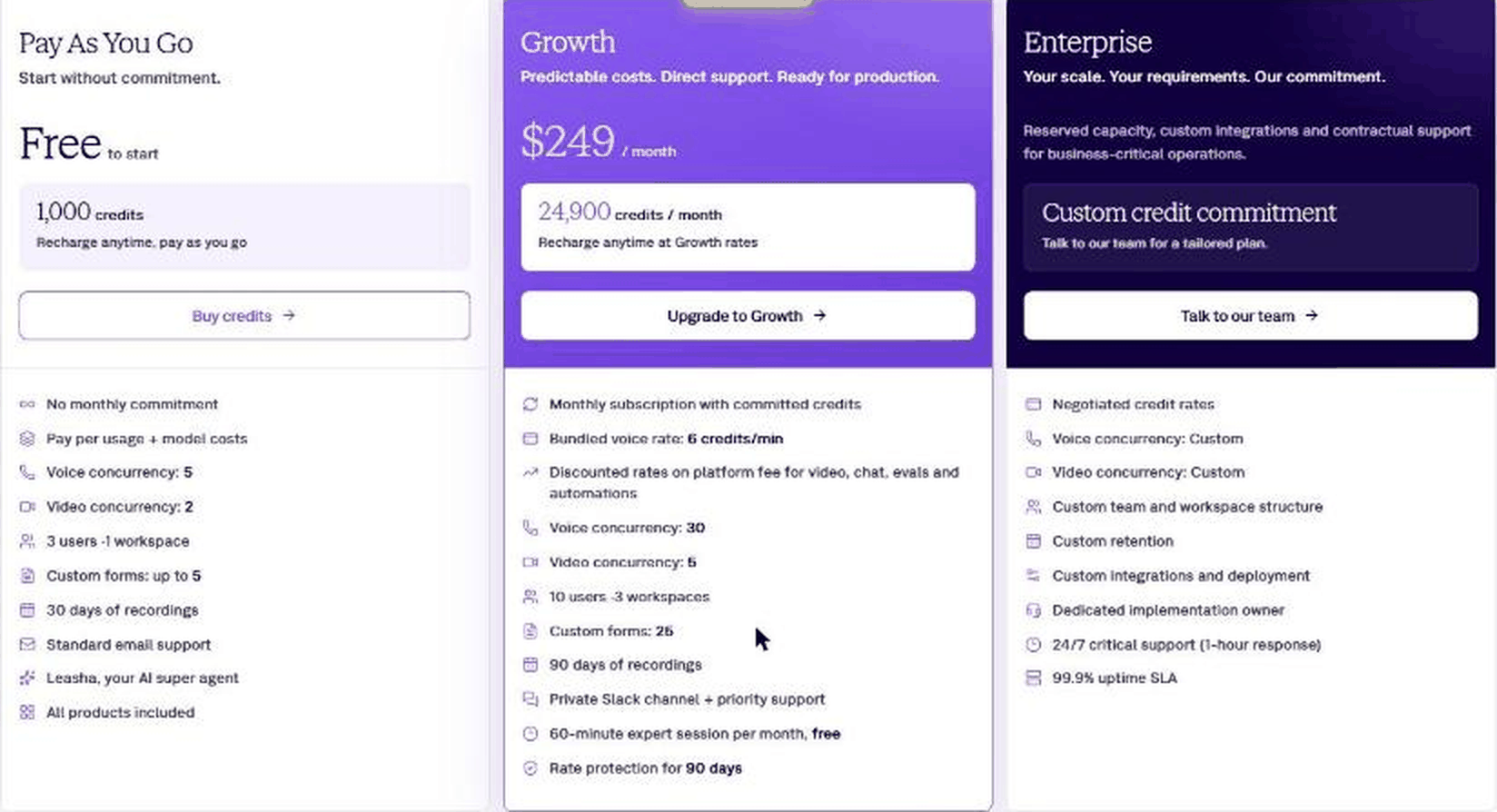
| Plan | Price | Credits | Capacity and extras |
|---|---|---|---|
| Pay As You Go | Free to start; recharge any time | 1,000 to start | Voice concurrency 5, video 2, 3 users and 1 workspace, 5 custom forms, 30 days of recordings, standard email support |
| Growth | $249 a month | 24,900 a month; recharge at Growth rates | Voice concurrency 30, video 5, 10 users and 3 workspaces, 25 custom forms, 90 days of recordings, private Slack channel and priority support, a free 60-minute expert session each month, 90-day rate protection |
| Enterprise | Custom credit commitment | Negotiated | Custom concurrency and retention, dedicated implementation owner, 24/7 critical support with a one-hour response, 99.9% uptime SLA |
The cost of any one job is set by the rate table, and the numbers differ between the two paid ways to buy:
| Product | Pay As You Go | Growth |
|---|---|---|
| Voice AI | 3 credits a minute plus model costs | 6 credits a minute, standard models included |
| Video agents | 5 credits a minute plus model costs | 4 credits a minute (20% off) plus model costs |
| Chatbots | 2 credits a conversation plus model costs | 1.8 credits (10% off) plus model costs |
| Call evaluation | 2 credits an audio minute plus model costs | 1.8 credits (10% off) plus model costs |
| Automations | 2 credits an execution, plus model costs when used | 1.8 credits (10% off), plus model costs when used |
| AI agents | 1 credit a run plus model costs | 1 credit a run plus model costs |
| Click to call | 1 credit a minute, no model costs | 1 credit a minute, no model costs |
What the numbers show (our arithmetic)
- A Growth credit is exactly one cent. $249 divided by 24,900 credits is $0.01. At that rate a bundled voice minute on Growth is $0.06, and the full allowance is about 4,150 voice minutes, or roughly 69 hours a month, if nothing else is used.
- Pay as you go looks cheaper for voice but is not the same product. Three credits a minute is half of Growth’s six, but pay as you go adds model costs, and Growth says standard models are included. The page does not say what the model costs are or what a pay-as-you-go credit costs, so we cannot compare the two in dollars.
- The free credits go a short way. 1,000 credits is about 333 voice minutes at the pay-as-you-go rate or 200 video minutes at 5 credits, before model costs (ours).
- Growth’s discount is on the cheaper modules. Video falls by 20% and chat, evaluation and automation by 10%, so a team that mostly runs voice gains capacity and support, not a lower rate.
What to check. The roundup lists a Basic plan at $49 and Growth at $299. We saw neither: the page shows Growth at $249 and a pay-as-you-go tier, and G2’s listing we came across names Free, Growth and Pay As You Go. We do not know whether a Basic plan was withdrawn, but plan on the vendor’s page. The larger risk is not the sticker price but “plus model costs” on almost every line: ask for a worked example of a 10-minute support call and a 100-message chat, including the model charge. An AI that talks to customers on the phone or sends messages also needs a clear rule for when it hands over to a person, and clear call-recording and consent rules for the places you operate in.
Wanaka Studio: free credits by the day, paid credits by the month
Wanaka combines an AI agent, a visual editor, 3D generation and one-click publishing, with “start making games for free” as its pricing headline. The studio itself sits behind a sign-in, so what we can describe is the public pricing page, not how the product works.
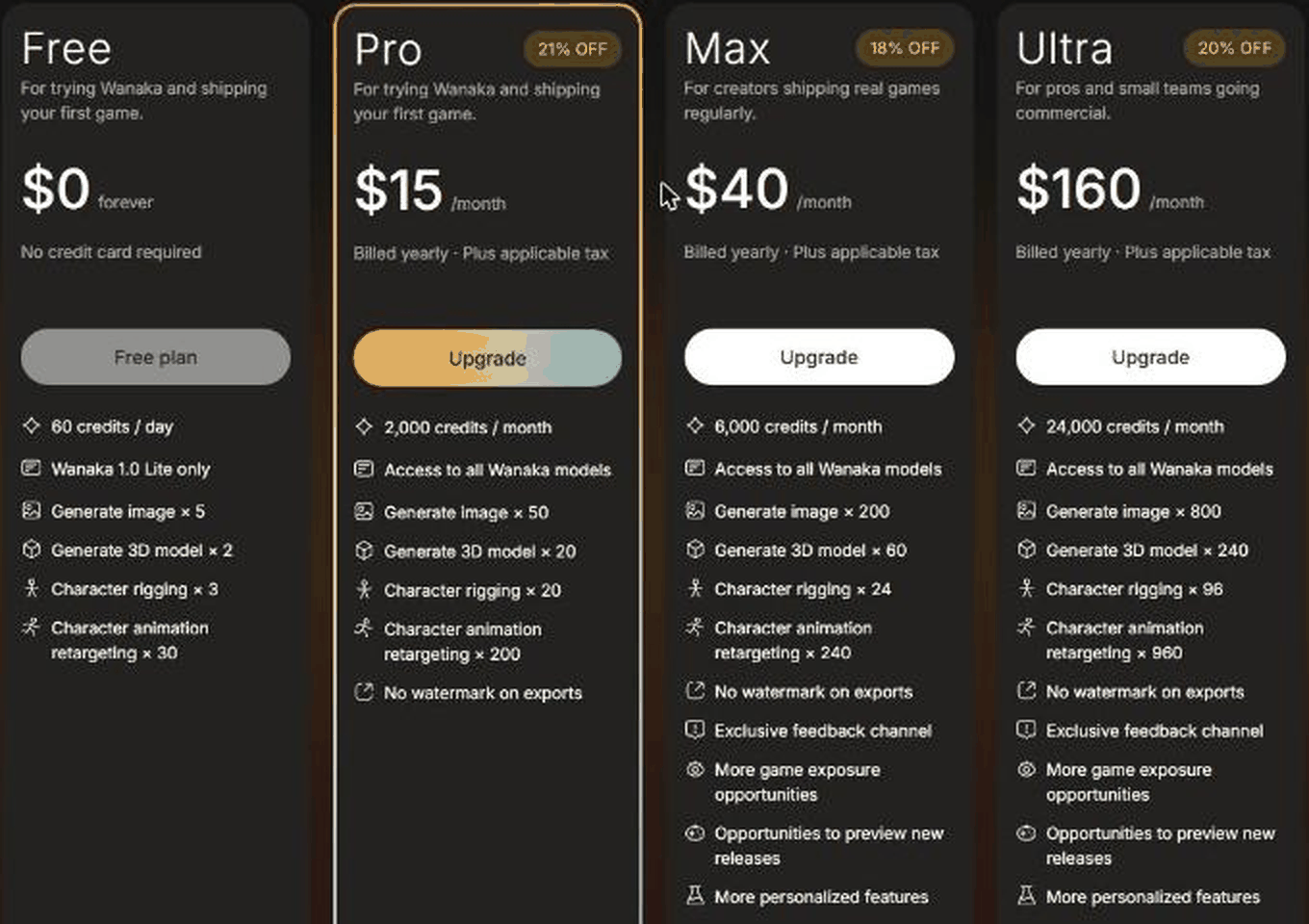
| Plan | Yearly billing (per month) | Monthly billing | Credits | Example outputs listed |
|---|---|---|---|---|
| Free | $0 forever, no card | $0 | 60 a day, Wanaka 1.0 Lite model only | 5 images, 2 3D models, 3 character rigs, 30 animation retargets |
| Pro | $15 (21% off) | $19 | 2,000 a month, all Wanaka models | 50 images, 20 3D models, 20 rigs, 200 retargets; no watermark on exports |
| Max | $40 (18% off) | $49 | 6,000 a month | 200 images, 60 3D models, 24 rigs, 240 retargets; feedback channel, more game exposure |
| Ultra | $160 (20% off) | $200 | 24,000 a month | 800 images, 240 3D models, 96 rigs, 960 retargets; same extras as Max |
What the numbers show (our arithmetic)
- The roundup quoted the yearly prices. Pro at $15 and Max at $40 are the yearly-billing figures; paying monthly is $19 and $49, and the roundup does not mention Ultra. Yearly billing saves $48, $108 and $480 a year on Pro, Max and Ultra (ours).
- Free daily credits are close to Pro’s monthly credits. 60 credits a day is about 1,800 a month if you use them every day, against 2,000 on Pro. The difference is the model (Lite only on Free), the output limits and the watermark: the page lists “no watermark on exports” starting on Pro, which suggests Free exports carry one, though we did not confirm it.
- Per-credit price falls, then flattens. On yearly billing a credit costs about $0.0075 on Pro and about $0.0067 on Max and Ultra. If a plan’s credits were spent entirely on 3D models, a model would cost about $0.75 on Pro and $0.67 on Max and Ultra (ours; this assumes the listed outputs are alternatives for the same credits, which the page does not say).
- Max and Ultra are about exposure and support, not only credits. Both add a feedback channel, more game exposure, previews of new releases and more personalized features.
What to check. Games built with generated assets raise questions that a pricing page does not answer: who owns the generated 3D models and characters, whether you can sell a game built from them, and how Wanaka’s “game exposure” works. Read the terms before you publish a commercial game, and check whether credits roll over, since the page lists credits per day on Free and per month on paid plans.
Screen Studio: a recorder that sells on polish, not credits
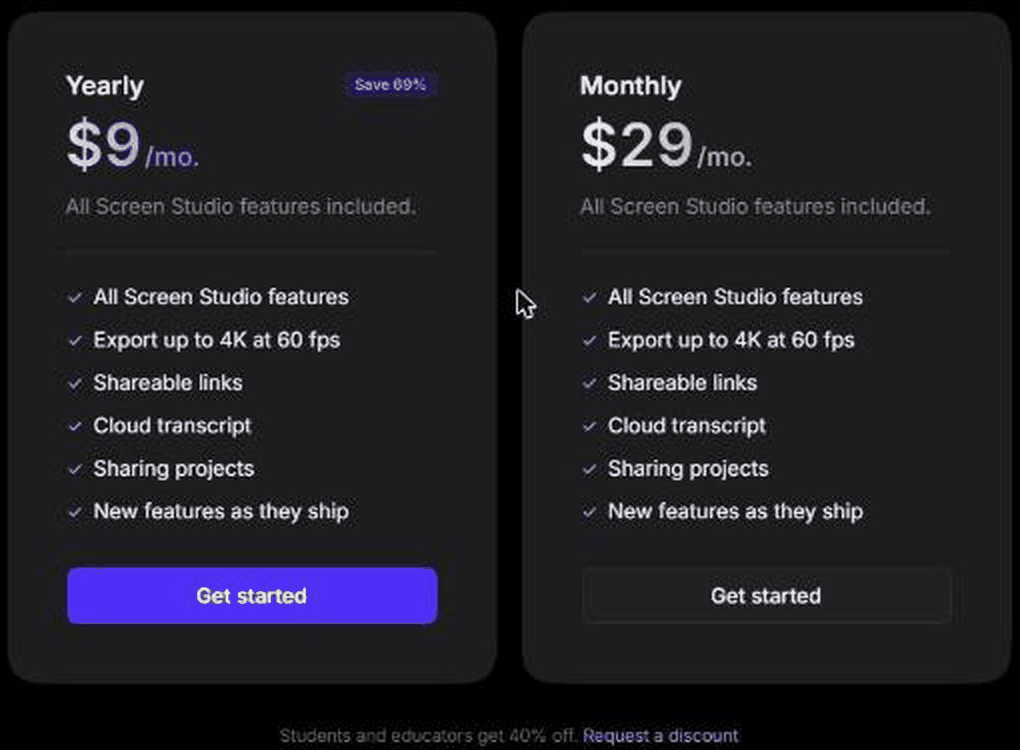
Screen Studio is the oldest of the four and the simplest to price. The pricing page says personal plans start at $9 a month billed yearly, or $29 a month billed monthly, with every feature in every plan: export up to 4K at 60 frames a second, shareable links, cloud transcripts and shared projects. Students and educators get 40% off. The download button is for Mac.
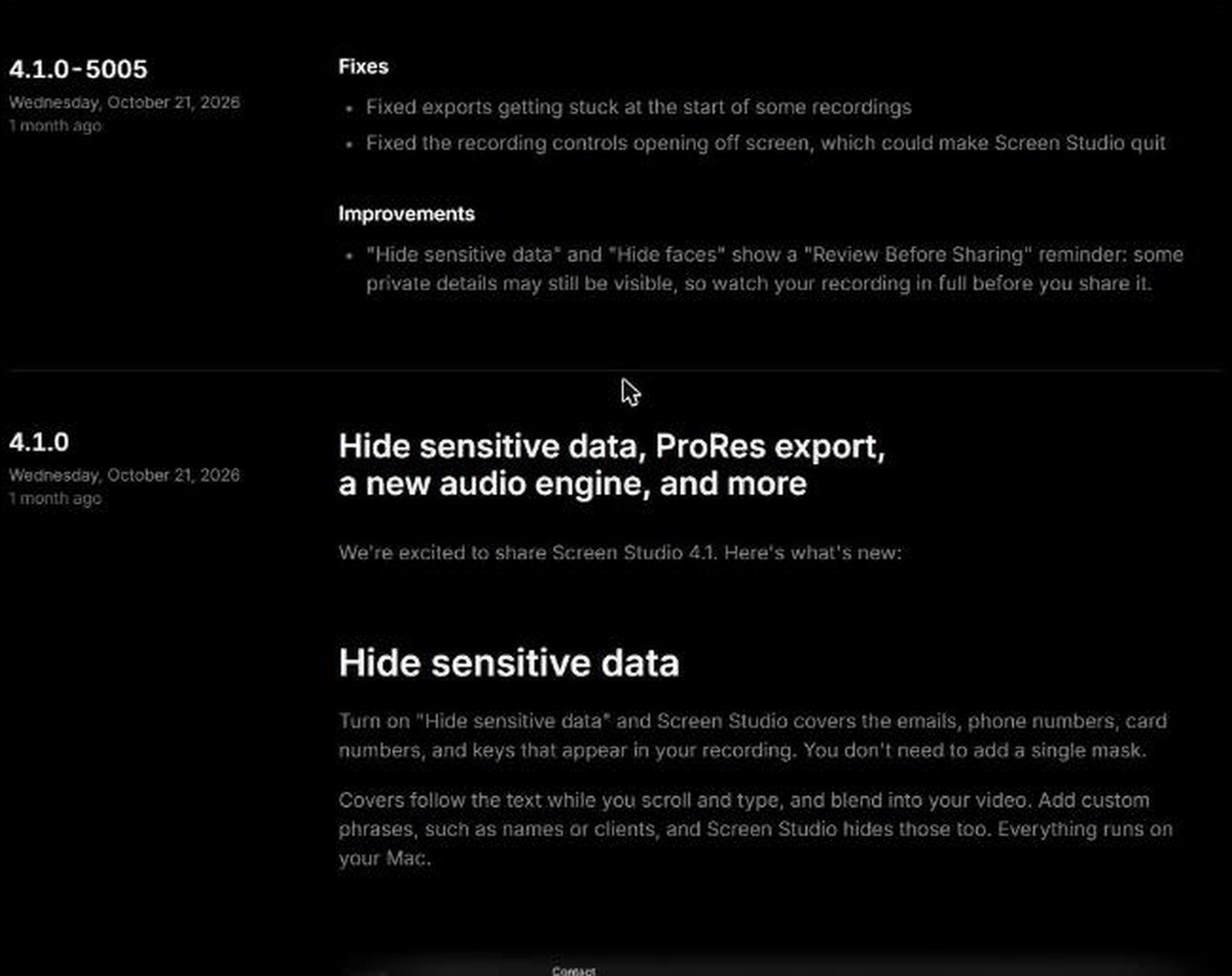
The changelog is the more interesting source. It shows Screen Studio 4.0 shipping on October 1, 2026 (Glass Loupe, camera cutout, edit by transcript and split screen) and 4.1 on October 21, 2026, which adds “Hide sensitive data,” “Hide faces,” ProRes export in four flavours, a new audio engine and MP4 exports the page says are up to three times faster. Note the dates: the roundup’s headline is “Screen Studio 4.0,” but the privacy features it highlights (hiding emails, phone numbers, card numbers and keys, and blurring faces) belong to the 4.1 release in the changelog.
What the numbers show (our arithmetic)
- Yearly billing is $108 a year against $348 on monthly billing, a saving of $240. The page’s “Save 69%” matches ($20 saved of $29).
- The yearly plan pays for itself in under four months of monthly billing (about 3.7 months at $29, ours), so it only makes sense if you will record for more than that.
What to check. The most useful line in the changelog is the one most buyers will not read: after 4.1.0, “Hide sensitive data” and “Hide faces” show a “Review Before Sharing” reminder, saying some private details may still be visible and that you should watch the whole recording before sharing it. That is honest and it matters, because automatic masking is a convenience, not a guarantee. The changelog also shows a local fallback for transcripts if cloud processing fails, which means transcripts are normally made in the cloud, so ask what is sent and how long it is kept before recording anything confidential. Our own Screen Studio review lists the same $9 and $29 prices.
What the four have in common
1. Prices in roundups lose details. Scalekit’s new tier, UnleashX’s plan names and prices, and Wanaka’s yearly-versus-monthly distinction were all missing or different. The roundup tells readers to check official pages; the lesson is to read the billing toggle and the tier list yourself.
2. Credits and “plus model costs” are the new fine print. UnleashX prices almost everything in credits plus model costs, and Wanaka prices outputs in credits. A monthly price does not tell you a unit cost until you know what one task consumes.
3. Free tiers differ in purpose. Scalekit’s free tier is a developer sandbox, UnleashX’s is a starter balance of credits, Wanaka’s is a daily allowance for hobbyists, and Screen Studio has none. Decide whether you want to evaluate a workflow or just look around.
4. Control is the product for the agent tools. Scalekit sells identity, scopes and logs; UnleashX sells concurrency limits, recording retention and a support channel. For anything that touches customers or accounts, those details matter more than the headline price.
Checklist before you connect anything
- Read the vendor’s own pricing page, switch between monthly and yearly, and note the date.
- Find what one real task costs: a tool call, a voice minute, a 3D model, a recording hour.
- Ask what is charged on top of the plan: overage, model costs, add-ons such as data residency.
- Start on the free tier or a trial with data you could afford to lose.
- Check what leaves your systems and for how long: logs, call recordings, transcripts, credentials.
- Decide who can approve or stop an agent action, and how you reverse one.
- Read the terms for ownership of generated content before you ship it.
What we could not confirm
- That any of the four works as described: we did not create an account, install or run them, and Wanaka’s studio needs a sign-in.
- What a tool call, a trigger event or a credit is defined as on Scalekit and UnleashX, and what a pay-as-you-go credit costs on UnleashX.
- Whether UnleashX ever had a Basic plan, and why the roundup lists one.
- Whether Wanaka exports on the Free plan carry a watermark, and what the generated-asset licence terms are.
- Scalekit’s separate authentication pricing, which we did not read.
- Product Hunt rankings, which come from the Shareuhack roundup, and any funding or company detail not on the vendors’ own pages. We read the pages from Vietnam, so prices shown to you may differ by region.
Frequently asked questions
How much is Scalekit?
Its AgentKit pricing shows Free at $0 for 10,000 tool calls a month, Growth at $99 a month for 100,000, a new Scale plan at $699 for 500,000, and a custom Enterprise plan. Calls beyond the included amount are $0.50 per thousand on Growth and Scale.
Does UnleashX have a free plan?
It offers 1,000 free credits to start, with no card, on a pay-as-you-go basis. The subscription plan is Growth at $249 a month for 24,900 credits.
Is Wanaka free?
There is a free plan with 60 credits a day and the Wanaka 1.0 Lite model only. Paid plans are Pro, Max and Ultra, from $15 a month on yearly billing or $19 monthly.
How much is Screen Studio?
$9 a month billed yearly or $29 billed monthly, with every feature on both, and 40% off for students and educators. It is a Mac app.
Which of the four is the lowest-risk to try?
Wanaka’s free plan and Scalekit’s free tier on test data cost nothing to try. Screen Studio needs a paid plan but runs on your own Mac, though transcripts use the cloud. Anything that talks to customers by voice or chat, such as UnleashX, deserves a small pilot with a human handover rule.
Method: figures come from the vendors’ public pages and Screen Studio’s public changelog on November 23, 2026; our screenshots show the pages that day. Product Hunt data is from the Shareuhack weekly roundup for October 29 to November 5, 2026. Calculations marked “ours” divide the prices shown by the quantities shown and exclude taxes, add-ons, overage and model costs unless stated. For how we research, see How We Review Tools.