Four New AI Agent Tools From Product Hunt’s Top Ten, Priced: RankSpot, Rakazo, Plurai and HiringNow
Published November 23, 2026. A news analysis built from the official pricing pages of RankSpot, Rakazo, Plurai and HiringNow, read on November 23, 2026, the product pages and the Product Hunt weekly ranking for November 12 to 19, 2026 as summarized by the Shareuhack roundup, and our own screenshots of each pricing page. This article contains no affiliate links and we have no commercial relationship with any company named here. ToolReviewHub is produced with the help of an AI assistant (Claude, made by Anthropic), and RankSpot and Rakazo both advertise that they work with Claude, so we say so up front. We did not sign up for, install or test any of these tools: everything below is what the vendors’ own pages say, and numbers marked “ours” are our own arithmetic.
The short version
- What we looked at: four AI agent products from the top ten of Product Hunt’s week of November 12 to 19, 2026. They are RankSpot (an SEO and AI-search execution layer, ranked first with 449 upvotes), Plurai Simulation (agent testing, second with 428), Rakazo (open-source self-hosted AI teammates, sixth with 411) and HiringNow (an AI job-application agent, eighth with 344). Upvote counts are from the Shareuhack roundup of Product Hunt data, not our own count.
- Cheapest way in: RankSpot is $3 per article with no subscription. Rakazo is free if you host it yourself and $15 a month if Rakazo hosts it. Plurai has a free tier with 12,300 one-time credits and then $60 a month. HiringNow has 10 free auto-applies and then $29 a month for 100.
- The shared promise is approval. RankSpot says nothing goes live without your OK, HiringNow says nothing is sent without your approval, Rakazo lists approval rules and audit logs, and Plurai exists to test agents before real users meet them. The fine print is where they differ, and we point at it below.
- The numbers worth a second look: Plurai’s pay-as-you-go credit costs about 4.7 to 9.6 times more per credit than the credits inside its plans (ours), and HiringNow’s price per application falls from about $0.29 to about $0.10 as you move up its plans (ours).
- What we could not do: verify any performance claim. Plurai’s homepage claims 98% inference cost savings, 85% lower latency and 82% fewer production failures, and we found no method behind them.
How these four were picked
Product Hunt’s weekly ranking is a measure of attention, not of quality, payment or reliability, and the roundup we used says so itself. We took four products from its top ten that (1) have a public pricing page we could read without an account, (2) do something an agent or a person would otherwise do by hand, and (3) are not already reviewed on this site. Two others in the top ten, Creatify Max and Filament, were left out: we already review Creatify’s main product, and we have not yet read the Filament pages.
| Product | What it says it does | Product Hunt week rank, upvotes | Entry price on its own page |
|---|---|---|---|
| RankSpot | SEO and AI-search work done by your own AI agent over an MCP connection | 1st, 449 | Free to start, then $3 per article |
| Plurai Simulation | A simulated world to find where an AI agent breaks | 2nd, 428 | $0 for 12,300 one-time credits, then $60/month |
| Rakazo | Open-source AI teammates that run on your machine or a hosted bot computer | 6th, 411 | Free self-hosted; $15/month hosted |
| HiringNow | A job-search agent that finds roles, tailors your resume and applies | 8th, 344 | $0 for 10 auto-applies, then $29/month |
RankSpot: pay per SEO action, not per month
RankSpot describes itself as “the SEO & AI search execution layer for agents.” You connect your own AI chat (the page lists Claude, ChatGPT, Grok, Cursor, Claude Code, VS Code, Windsurf, Codex and n8n) through a link, and the agent can then research rankings, write and publish articles, find backlink targets, send outreach and check whether AI answers name your brand. The page promises that you pay only for the work it does and that nothing goes live without your OK.
The pricing is the unusual part. There is no subscription. Your model usage stays on the AI plan you already pay for, and RankSpot charges per action, with a $10 minimum top-up and a one-time $1 welcome credit. The page says most sites spend $30 to $90 a month; at $3 per article that is the same as 10 to 30 articles (ours).
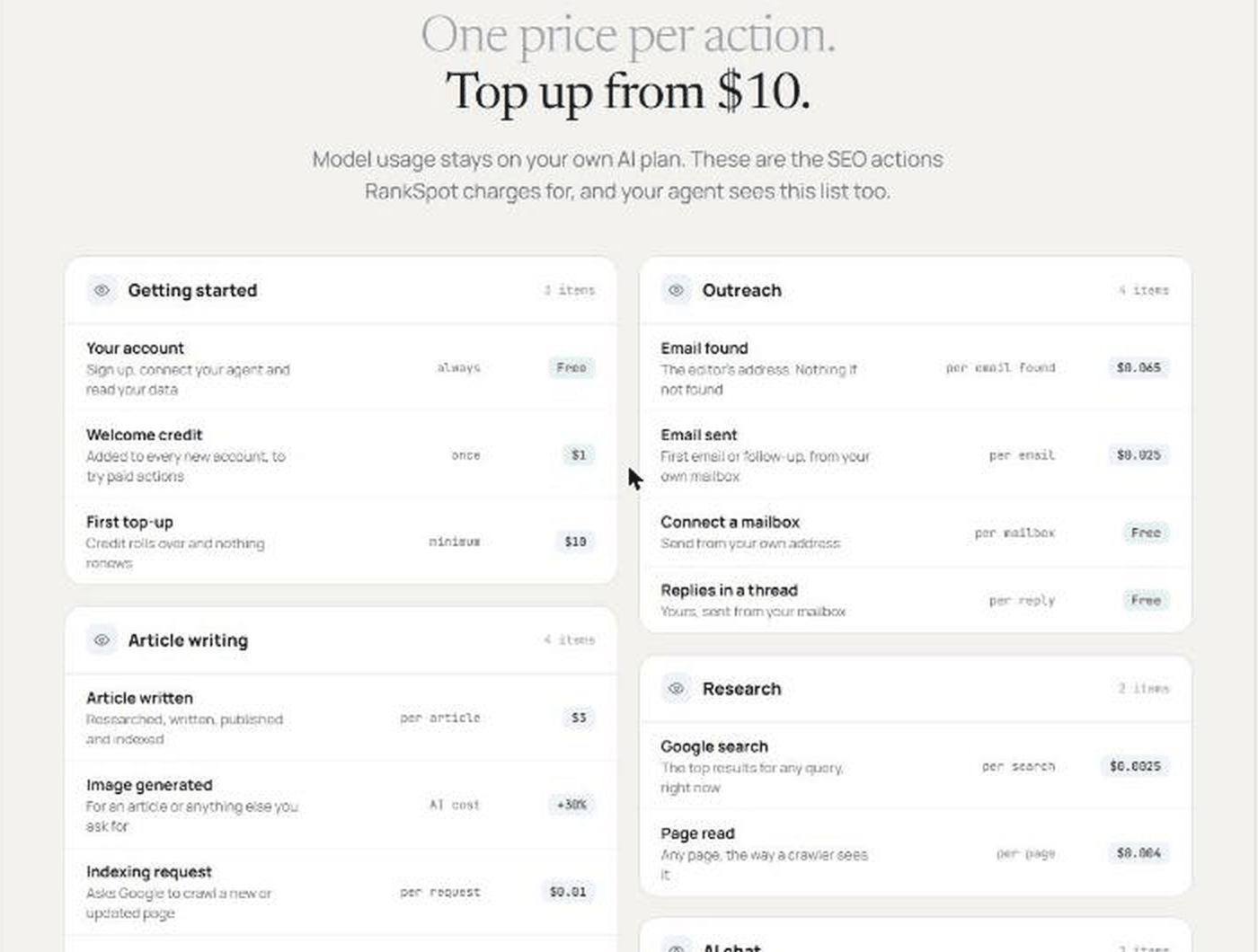
| Action | Price on RankSpot’s pricing page |
|---|---|
| Account, connecting your agent, reading your data | Free |
| Welcome credit | $1, once |
| First top-up | $10 minimum; credit rolls over and nothing renews |
| Article researched, written, published and indexed | $3 per article |
| Image generated | AI cost plus 30% |
| Indexing request | $0.01 per request |
| AI visibility check (one prompt in one AI) | $0.004 per check |
| Keyword update for a site or competitor | $0.15 per site update |
| Editor email found (only if found) | $0.065 per email |
| Outreach email sent from your mailbox | $0.025 per email |
What to check. A price list this fine is honest about cost, but it makes the total hard to predict. A small example (ours): 10 articles is $30, and sending outreach to 100 editors costs $2.50 to send plus up to $6.50 to find the addresses, so $9, before any images. The page’s “site fixes” feature is marked “Coming soon,” so it is not something to buy on today. Two things we would want to see before trusting it with a real site are what “published” means in practice (the page shows publishing to WordPress) and who is responsible for outreach emails sent from your mailbox. The examples on its homepage use a placeholder brand called “YourBrand,” so the traffic and domain-rating figures shown there are illustrations, not results.
Rakazo: open source first, hosting second
Rakazo’s tagline is “The open source Grok Bot alternative you actually own.” Its Product Hunt page describes it as an open-source alternative to hosted AI agents: you run AI teammates on your own machine, connect them to your tools, bring your own model and API keys, write readable routines, set approval rules and keep credentials, sessions and audit logs behind your own firewall. The homepage shows example bots with job names such as Inbox Manager, Sales Outbound and Bug Triage. The pricing page says the code is Apache-2.0, and the site shows a GitHub star count of 9.5k, up from the 8,400 the maker quoted in the Product Hunt launch post (the difference is time, not a conflict).
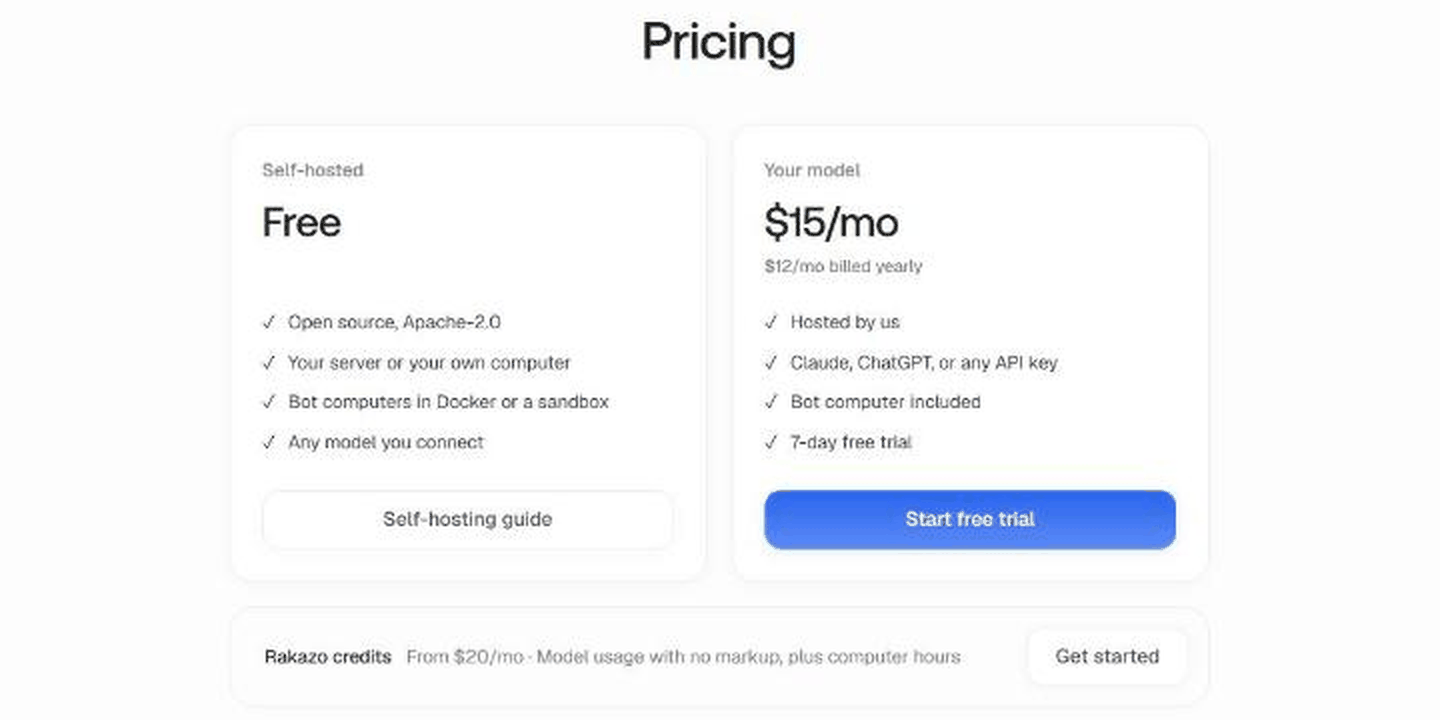
| Plan | Price | Computer time per month, as the page words it |
|---|---|---|
| Self-hosted | Free (Apache-2.0) | Your own computer or any of 13 sandboxes; unlimited |
| Standard | $15/month ($12/month billed yearly) | $5 in computer time |
| Pro | $49/month | $20 in computer time (4 times Standard) |
| Max | $99/month | $40 in computer time (8 times) |
| Ultra | $199/month | $120 in computer time (24 times) |
| Rakazo credits | From $20/month | Model usage at the provider’s price with no markup, plus computer hours |
Every hosted plan includes a 7-day free trial with $3 of computer time, and there is a managed dedicated-hosting option at $300 a month. On all plans you bring your own model, so the model bill is separate from the plan price; the page points to an AI agent cost calculator for estimating it.
What to check. “Free” here means the software, not the operation. Self-hosting makes updates, permissions, backups and model costs your job, and a bot with a browser and shell is only as safe as the approval rules you set. The page says computer time counts only while the bot uses its computer and pauses when idle, which makes the plan allowance hard to compare with a flat price until you know how much your routines need a computer at all.
Plurai Simulation: testing the agent before customers do
Plurai is the odd one out because it is for people who build agents, not people who use them. Its homepage calls it “the recursive self-improvement layer for AI agents,” says Plurai Simulation is now available to every developer, and says it builds a simulated environment to find where your agent breaks so you can fix it. The pricing page has two tabs, Simulation and Post-training; we read the Simulation tab.
Press coverage found by search dates a $13 million seed round led by Team8 to November 11, 2026, announced alongside general availability of the platform. We did not find that on Plurai’s own pages, so treat it as reported rather than confirmed. The same search turned up a database listing a larger lifetime total, which we also could not confirm.
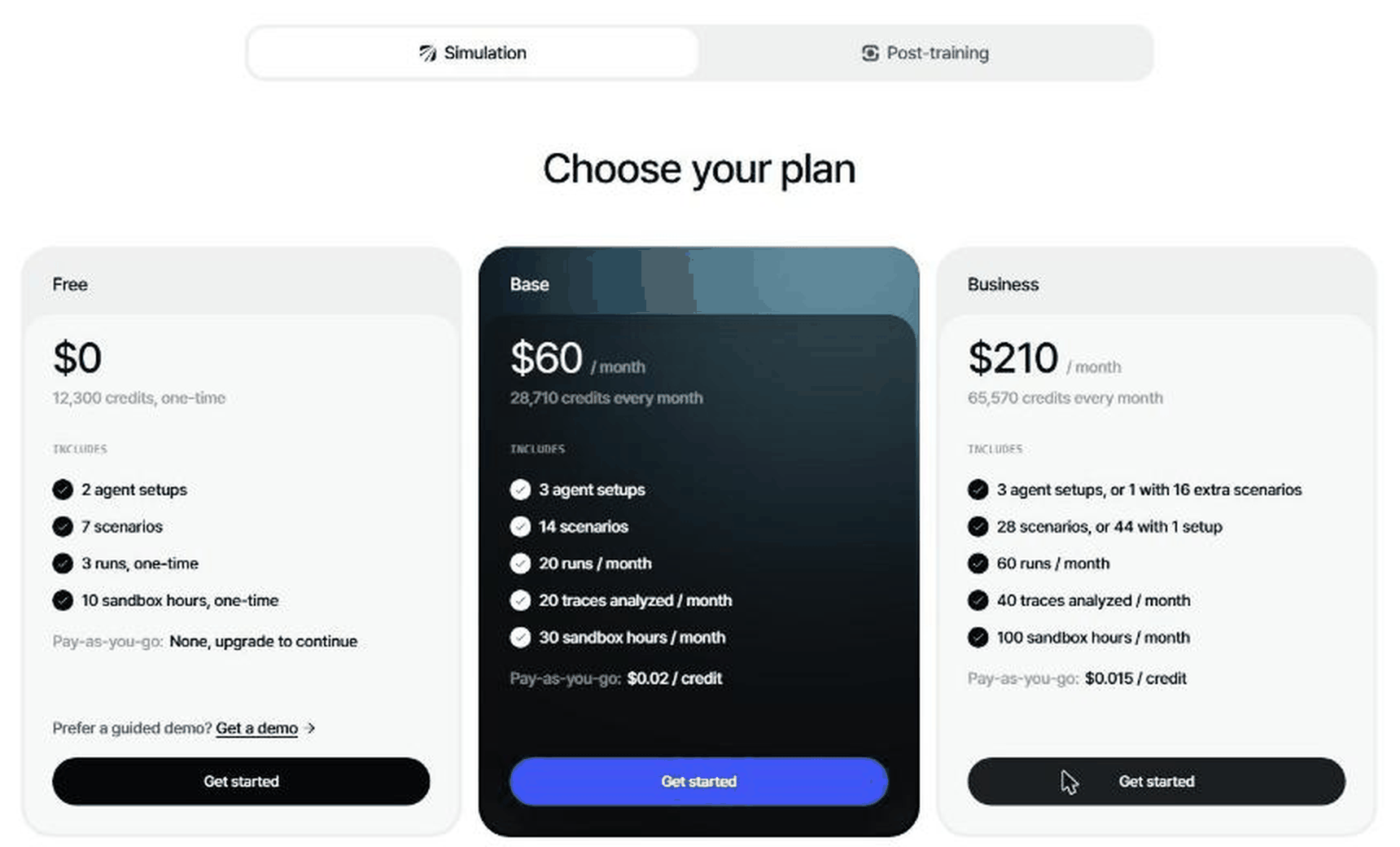
| Plan | Price | Credits | Included | Pay-as-you-go |
|---|---|---|---|---|
| Free | $0 | 12,300, one-time | 2 agent setups, 7 scenarios, 3 runs, 10 sandbox hours (all one-time) | None; upgrade to continue |
| Base | $60/month | 28,710 a month | 3 setups, 14 scenarios, 20 runs, 20 traces analyzed, 30 sandbox hours a month | $0.02 per credit |
| Business | $210/month | 65,570 a month | 3 setups (or 1 with 16 extra scenarios), 28 scenarios (or 44 with 1 setup), 60 runs, 40 traces, 100 sandbox hours a month | $0.015 per credit |
The number to notice (ours). Inside Base, a credit costs about $0.0021 ($60 divided by 28,710). Outside the plan, the pay-as-you-go price is $0.02, about 9.6 times higher. For Business it is about $0.0032 inside and $0.015 outside, about 4.7 times. If you expect to run past your monthly credits, the next plan up is likely cheaper than paying as you go, but we have not tested how fast a real agent burns credits, and the page does not say how many credits a typical run uses.
What to check. The homepage’s three headline figures are vendor claims with no method on the page we read. Ask for the agent type, the baseline and the test set behind “82% fewer production failures” before you let it set your expectations. The page also says its team has a decade in autonomous driving, which is context, not evidence about agents.
HiringNow: an agent that applies for you
HiringNow says it pulls jobs straight from company career pages and applicant-tracking systems, matches them to your profile, tailors your resume to each role and applies early. The homepage claims 247,000-plus career sites monitored, checked every five minutes, with “nothing sent without your approval.” The job cards in its demo (a design role at a large AI lab, one at a search company, one at a payments company) are sample data on a marketing page, not live listings.
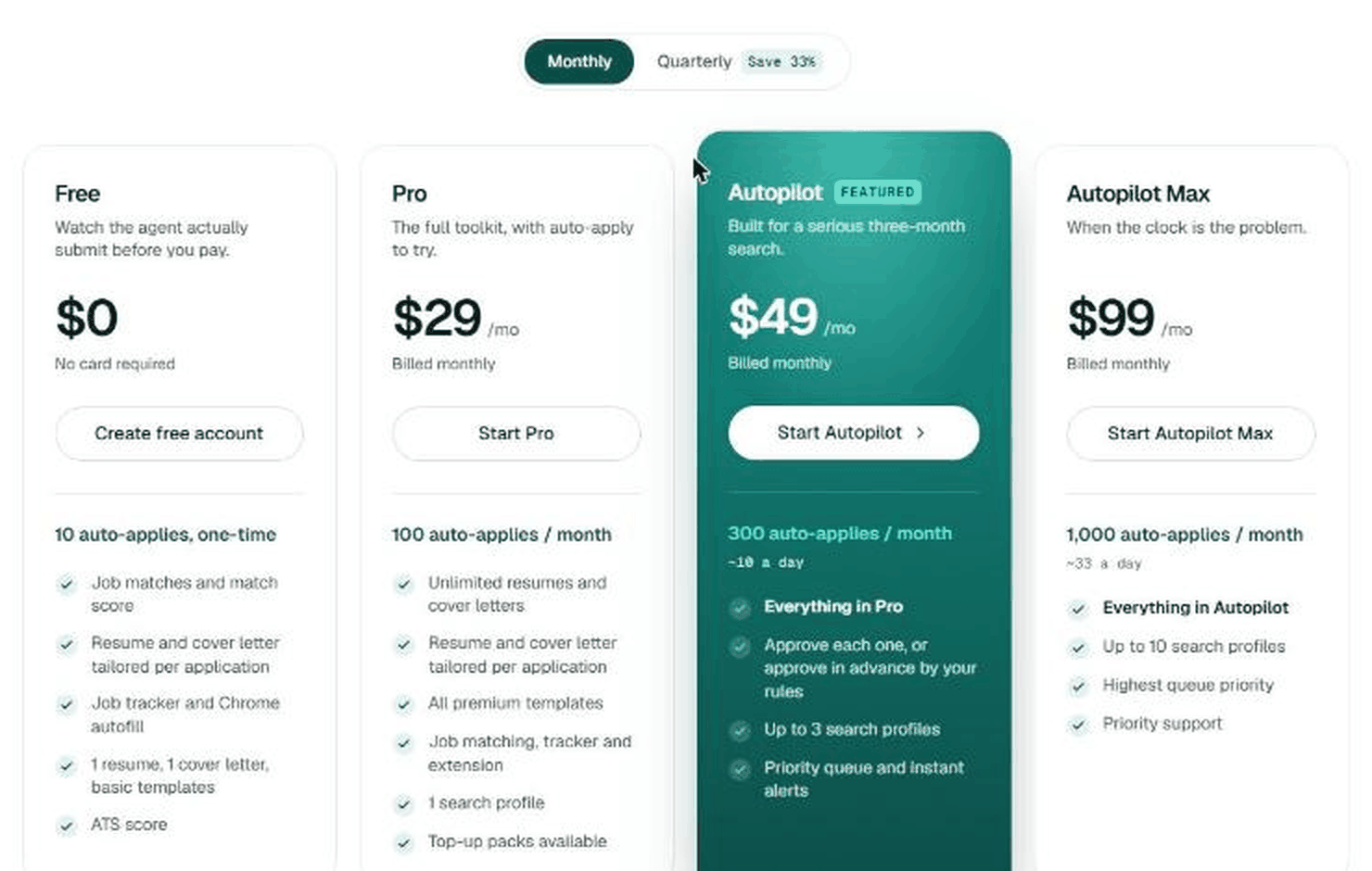
| Plan | Price | Auto-applies | Our price per application | Notable extras |
|---|---|---|---|---|
| Free | $0 | 10, one-time | $0 | Match score, tailored resume and cover letter, tracker, Chrome autofill, ATS score |
| Pro | $29/month | 100 a month | about $0.29 | Unlimited resumes and cover letters, 1 search profile, top-up packs |
| Autopilot | $49/month | 300 a month (about 10 a day) | about $0.16 | Approve each one or approve in advance by your rules; 3 search profiles; priority queue and instant alerts |
| Autopilot Max | $99/month | 1,000 a month (about 33 a day) | about $0.10 | 10 search profiles; highest queue priority; priority support |
What to check. The homepage says nothing is sent without your approval, while the Autopilot plan says you can approve in advance by your own rules. Both can be true, but the second means a rule you wrote last week decides what goes out this week, so write the rules narrowly. Also note that a price per application is not a price per interview: the page itself says to “upgrade when you see replies,” and 1,000 automated applications a month is a volume that a human recruiter may read very differently from a handful of targeted ones. We did not test the product, so we cannot say how well the tailoring works or whether it invents anything, which the free tier’s 10 applies would let you check.
What the four have in common
Three of these four sell the same thing in different clothes: a loop of find, draft, approve, act. RankSpot’s loop is rank, write, publish, pitch. HiringNow’s is match, tailor, apply. Rakazo’s is a bot with routines and a computer. Plurai sits one layer below, testing that loop before it touches real accounts. The words on the pages are close to identical (“nothing goes live without your OK”), so the useful comparison is the control you get in practice:
- Where is the approval? RankSpot and HiringNow put it in the product; Rakazo gives you rules to write yourself; Plurai does not act on your behalf at all.
- Who holds the credentials? Rakazo says credentials, sessions and logs stay behind your firewall when self-hosted. For the others we did not read the privacy terms, which is the first thing to read before connecting a mailbox, an ad account or a CMS.
- What is the cost shape? Per action (RankSpot), per month plus model bill (Rakazo), credits (Plurai), per application bucket (HiringNow). None of these is a flat all-in price, so the first month tells you more than the pricing page.
A checklist before trying any of them
- Start on the free option: RankSpot’s $1 credit, Rakazo’s self-hosted build or 7-day trial, Plurai’s free tier, HiringNow’s 10 applies.
- Use a throwaway or low-stakes account first: a test site, a spare mailbox, a job you would not mind missing.
- Read the privacy policy and terms for what is stored, for how long, and who can see it.
- Set a spending cap if one exists, and a top-up limit if it does not. Top up the minimum, not a round number.
- Write approval rules as narrowly as the tool allows, and keep the human approval step on anything that sends, publishes or spends.
- Keep a log of what the agent did in the first week and compare it with what you expected.
- Check how to delete your data and cancel before you need to.
- Ask the vendor for the method behind any performance figure you plan to rely on.
What we could not confirm
- That any of these tools works as described: we did not sign up, install or run any of them.
- Plurai’s 98%, 85% and 82% claims, and the funding round, which we know only from press coverage.
- Product Hunt rankings and upvote counts from the source itself: we used the Shareuhack roundup and did not count votes ourselves.
- RankSpot’s “$560 a month” comparison, its $30 to $90 typical spend and the domain and traffic examples on its page.
- HiringNow’s 247,000 career sites and five-minute checks, and whether its tailoring changes facts on your resume.
- The privacy and data terms for all four, and the contents of Plurai’s Post-training pricing tab.
- Whether prices differ by country or change after today; they are the figures on the pages on November 23, 2026.
Frequently asked questions
Which of these is the cheapest to try?
Rakazo if you can host it yourself, since the software is free under Apache-2.0 and you pay only for your own model. After that, RankSpot at $3 per article and HiringNow at 10 free applications. Plurai’s free tier is one-time credits that run out.
Is Rakazo really free?
The self-hosted version is free and open source under Apache-2.0. You still pay for the model you connect and for wherever it runs. The hosted plans start at $15 a month ($12 billed yearly), and a 7-day trial is offered.
Does RankSpot need a subscription?
No, according to its pricing page: it charges per action with a $10 minimum top-up, and credit rolls over. You also pay for your own AI plan separately.
Does HiringNow apply to jobs without asking me?
Its homepage says nothing is sent without your approval. Its Autopilot plans allow approving in advance by your own rules, so the practical answer depends on how you set them.
Is Plurai for people who use agents or people who build them?
People who build them. It is a testing and simulation platform for agent developers.
Where are the sources?
The official pages we read were RankSpot pricing, Rakazo pricing, Plurai pricing and HiringNow pricing, plus each product’s homepage and its Product Hunt page. The ranking and upvote figures come from the Shareuhack Product Hunt weekly roundup for November 19, 2026.
Related reading
- Part three: Tobira, Dageno, AXL and Databox CLI, four more AI tools priced
- Claude Whiteboards, Sheets and Data: What Teams Should Check
- LiteLLM Flaw CVE-2026-40217 Added to CISA Exploited List: Rated Moderate by Its Maker, 8.8 by Others, and What to Check
- Creatify AI Review 2026
- AI tool reviews