OpenSSH 10.6p2 Fixes CVE-2026-123158, a Password Bypass on musl Linux Now on CISA’s Exploited List: What Alpine Users Should Check
Published November 22, 2026. A news analysis built from primary sources: the OpenSSH 10.6p2 release notes and the 10.6 release notes on openssh.org, the OpenSSH commit that carries the fix, the Alpine Linux security advisory of November 5, 2026 and its security tracker, the NVD entry for CVE-2026-123158, and CISA’s Known Exploited Vulnerabilities (KEV) data as published in CISA’s own GitHub mirror, plus our own screenshots. The OpenSSH release notes credit one 10.6 fix to a researcher working “in collaboration with Claude and Anthropic Research,” and Claude is among the tools we use to help draft articles, so we disclose that connection; it did not change what we reported. This article contains no affiliate links. We did not install or run any affected software and we publish no exploit steps; where a source gives a number that would help an attacker more than a defender, we leave it out and say so. Calculations marked “ours” are our own arithmetic.
The short version
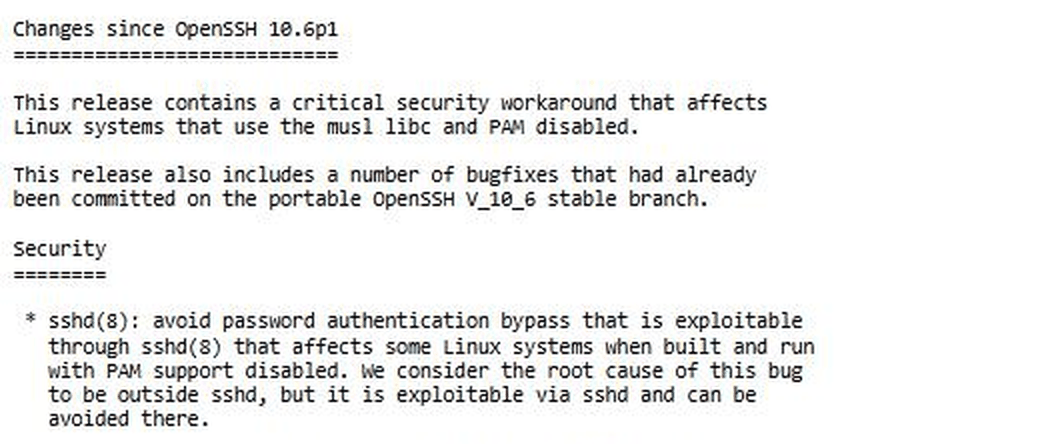
- What happened: on November 5, 2026 the OpenSSH team released Portable OpenSSH 10.6p2 with what its notes call “a critical security workaround” for Linux systems that use the musl C library with PAM disabled. The bug lets a remote client log in over SSH without knowing a password, on affected setups.
- The identifier: CVE-2026-123158. The MITRE CVE record scores it 8.1 High (CVSS 3.1). NVD had not yet provided its own assessment when we looked.
- It is on CISA’s exploited list: CISA’s KEV data shows CVE-2026-123158 added on November 9, 2026 with a remediation due date of November 12, 2026, which is the agency’s signal that it has evidence of exploitation. That date has already passed as we write.
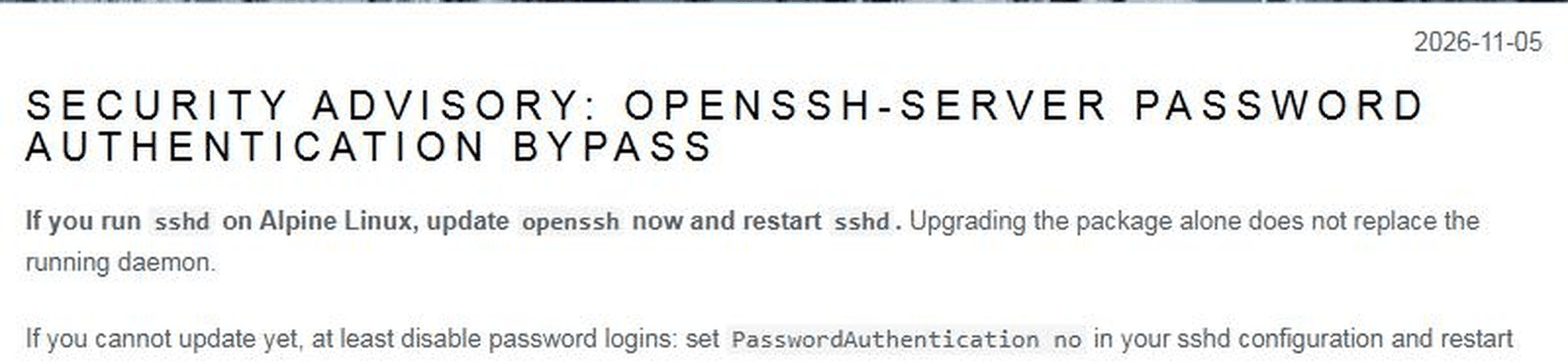
- Who is exposed: Alpine Linux is the named example. Alpine’s advisory says its default
openssh-serverpackage is built without PAM, and that every release it checked, from 3.16 to edge, is affected unless the right conditions are absent. - What to do: update OpenSSH, then restart sshd (upgrading the package does not replace the running daemon), or, if you cannot update yet, turn off SSH password authentication and use keys.
The timeline
| Date (2026) | Event |
|---|---|
| Oct 6 | OpenSSH 10.6 released, with 11 items under “Security” in its notes (our count) |
| Nov 5 | OpenSSH 10.6p2 released; Alpine publishes its advisory and fixed packages; the CVE record is published at NVD |
| Nov 9 | CISA adds CVE-2026-123158 to the KEV catalog (4 days after the release, ours) |
| Nov 12 | KEV due date for US federal agencies |
| Nov 22 | Today: 17 days since the release (ours) |
One detail from the Alpine advisory: when it was written on November 5, “no CVE identifier had been assigned.” The identifier arrived afterwards, which is a reminder to search for the fix by version number, not only by CVE.
What OpenSSH says
The 10.6p2 notes are short. Under “Security” there is a single entry: sshd avoids a password authentication bypass that is exploitable through sshd and affects some Linux systems when built and run with PAM support disabled. The OpenSSH team adds that it considers the root cause of the bug to be outside sshd, but that the bug is exploitable via sshd and can be avoided there. The report is credited to Özgün Kültekin of Wakefield.
The code change is public: a commit titled “avoid password authn bypass,” which touches three files with 34 lines added and 17 removed (the numbers GitHub shows). Reading the diff, the change adds a minimum length, defined as 4, for the stored password field before sshd will accept a match. That is our reading of the diff, and we did not test it.
What Alpine says about the mechanism
Alpine’s advisory gives the clearest explanation we found. In plain words, when sshd is built without PAM it checks a password by running the attempt through the C library’s crypt() function and comparing the result with the stored password field. For an account whose stored field is too short to contain a salt, sshd uses the salt of another account. musl’s crypt() returns a single asterisk as an error indicator when the supplied password is over-long. An asterisk is also exactly what the stored field contains for every account with no password set, which is normal for key-only accounts. So the two values “match” and the login succeeds.
Alpine states the attacker needs three things: the name of an account whose password field is an asterisk, at least one other account on the machine with a SHA-crypt password hash, and a password of unusual length. The advisory also says one connection is enough and that it works every time. The NVD text gives the length range; we leave the exact numbers out of this article because they are of more use to an attacker than to an administrator. They are in the sources linked below.
The conditions matter, and they are worth reading carefully, because they decide whether a system is exposed. Alpine says you are affected if all of the following are true: you run its openssh-server package (built without PAM), or openssh-server-pam with UsePAM no; PasswordAuthentication is on (the OpenSSH default); the machine has an account with an asterisk password field; and at least one local account has a $5$ or $6$ password hash.
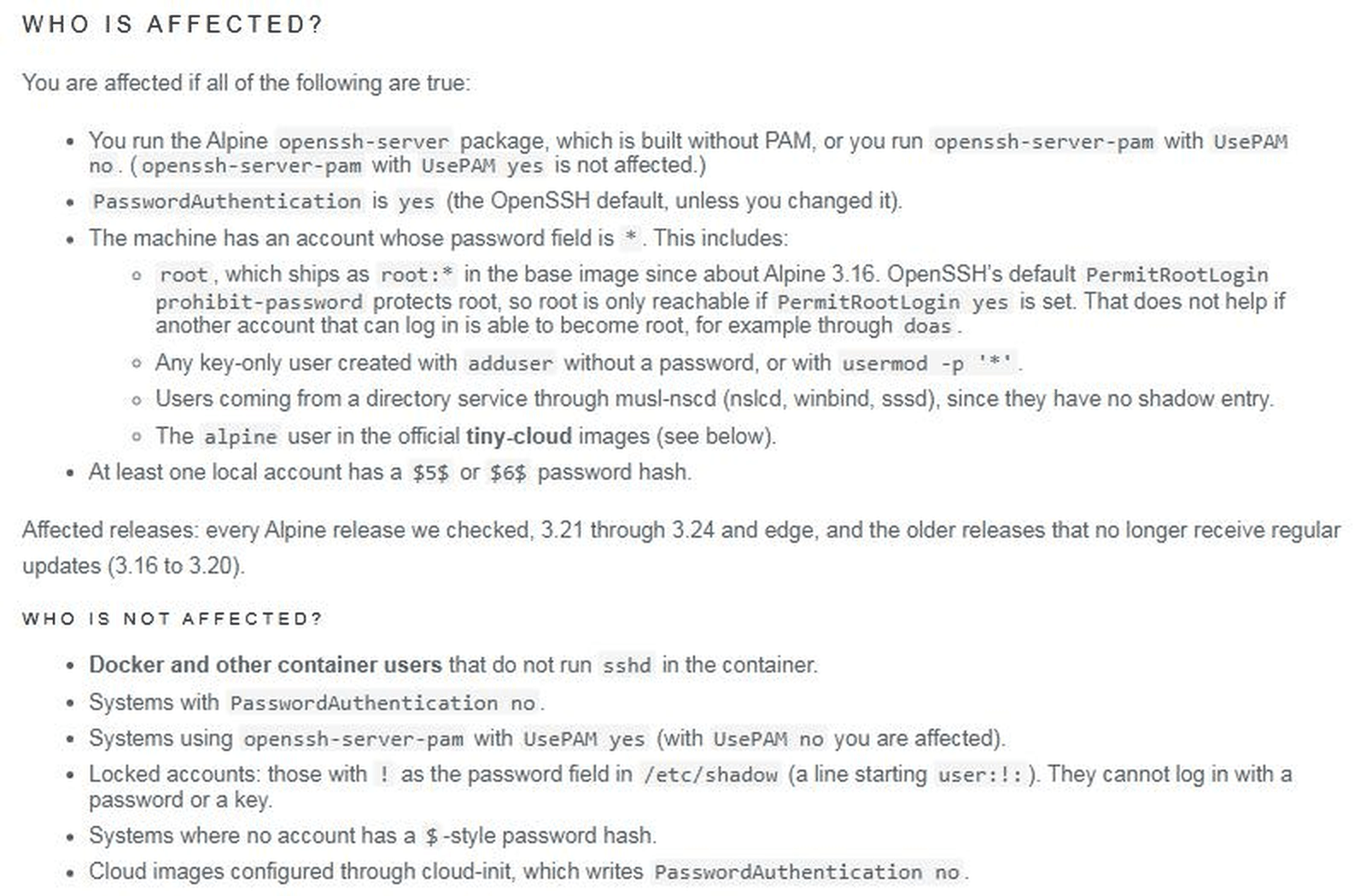
Alpine lists the accounts that typically carry an asterisk: root, which ships that way in the base image since about Alpine 3.16 (OpenSSH’s default PermitRootLogin prohibit-password protects root unless it is set to yes, though the advisory warns this does not help if another account that can log in can become root); any key-only user created without a password; users that come from a directory service through musl-nscd; and the alpine user in the official tiny-cloud images.
Is it being exploited? What the sources show
We checked this because it changes how fast you should move. CISA’s own website refused our automated request (HTTP 403, “Access Denied”), and we did not try to get around that. CISA publishes the same catalog in a public GitHub repository, so we read the catalog data there. The version we read was 2026.11.20, released November 20, 2026, with 1,790 entries. It contains CVE-2026-123158, named “OpenBSD OpenSSH Unexpected Status Code or Return Value Vulnerability,” with the short description that OpenSSH on Linux contains an unexpected status code or return value vulnerability that could allow authentication bypass. The entry carries these dates: added November 9, 2026, due November 12, 2026. The “known ransomware campaign use” field says “Unknown,” and the entry asks for forensic triage in addition to patching.
Two cautions. The catalog tells you that CISA has evidence of exploitation; it does not tell you how widely, against whom or with what result, and we found nothing else on that in the primary sources. Alpine’s security tracker also lists links to public exploit entries (Exploit-DB and Metasploit are named there); we did not open them and we are not linking them. Take the combination as a reason to treat this as exposed, not as a measure of how many systems were compromised.
The fix, version by version
Alpine’s fixed packages differ by branch, because the older branches carry a backported patch for the same problem and not the 10.6p2 code. Alpine lists these fixed OpenSSH package versions:
| Alpine branch | Fixed openssh package | Notes |
|---|---|---|
| edge | 10.6_p2-r0 | Upstream release |
| 3.24 | 10.3_p1-r2 | Point release 3.24.4 contains it |
| 3.23 | 10.2_p1-r1 | Point release 3.23.8 |
| 3.22 | 10.0_p1-r11 | Point release 3.22.8 |
| 3.21 | 9.9_p2-r1 | Point release 3.21.10; support ended 2026-11-01 |
| 3.20 to 3.16 | 9.7_p1-r6, 9.6_p1-r3, 9.3_p2-r4, 9.1_p1-r7, 9.0_p1-r6 | Releases no longer regularly updated, but Alpine published fixed packages |
The practical consequence is that a patched Alpine system may not report version 10.6p2. Check the package revision for your branch, not only the upstream number. After updating, restart the daemon (Alpine gives rc-service sshd restart); Alpine says plainly that upgrading the package does not restart a running sshd.
Alpine also warns about its official tiny-cloud images, built from 3.18.11 through 3.24.3: they ship an alpine user with an asterisk password field and passwordless doas. They are safe on first boot, the advisory says, and become exploitable as soon as any SHA-crypt hash exists on the machine, for example when an administrator sets a console password or user data adds a user with a hashed password. Images built from the new point releases include the fix. Cloud images configured through cloud-init, which writes PasswordAuthentication no, are listed as not affected.
Is my system affected? A short checklist
These steps follow the Alpine advisory and the OpenSSH notes. We have not run them against any system.
- Does it run musl without PAM? On Alpine, the default
openssh-serverpackage qualifies. Mainstream glibc-based distributions are not in the descriptions we read, but we tested none. Some secondary write-ups mention other musl-based systems such as OpenWrt; we did not verify that. - Is sshd running in the system or in a container? Alpine lists containers that do not run sshd as not affected.
- Is password login on? Run
sshd -Tand look at thepasswordauthenticationline. If it says no, Alpine lists the system as not affected. - Which package version? Compare your Alpine package revision with the table above.
- Update, then restart sshd. Alpine’s command is
apk upgrade -U -a, followed by the restart. - If you cannot update: turn off password logins with
PasswordAuthentication noand restart sshd. Before you do, make sure key-based login works and keep your current session open until you have tested a new one. Alpine publishes a drop-in file and a sed command for this; we point you to its advisory instead of repeating a script that edits your configuration. - Look for signs of use. Alpine suggests searching the system log for sshd lines reading “Accepted password” for an account that has no password (alpine, root or any key-only user), and reviewing
doasuse, recently created users, files and authorized keys on exposed machines. Its advice is blunt: if you cannot rule out a login, treat the machine as compromised.
What else is in the 10.6 line
If you move to upstream 10.6p2 from an older OpenSSH, you also take the changes in 10.6 (released October 6, 2026), which its notes describe as containing “a number of security fixes, several new features and some small bugfixes.” Some are potentially incompatible, and the notes list them:
- Compression is less effective. sshd and ssh disable the LZ77 dictionary coder to mitigate a published side-channel attack on shared compression across multiplexed channels. The notes recommend application-level compression instead.
- Stricter command-line usernames. ssh refuses destination usernames entered on the command line that include a backslash or a dollar sign, to avoid injection in shell contexts such as ProxyCommand. Usernames set through configuration files are not subject to the check.
- Two options forcibly disabled on a few platforms. On platforms that cannot pass file descriptors and need root for PTY allocation (the notes name QNX 6 and SCO OpenServer 5, and builds made with
--disable-fd-passing), GatewayPorts and StreamLocalForwarding are disabled.
By our count the 10.6 notes carry 11 bullets under “Security,” including fixes to GSSAPI credential handling, sftp path validation, the restrict keyword for tunnel forwarding, and the handling of the word “none” in some options. One of them, about options that accept “none,” is credited “with Chris Rohlf in collaboration with Claude and Anthropic Research.”
An unusual note from the maintainers
Both the 10.6 and 10.6p2 notes carry the same paragraph, which is worth reading in full on openssh.org. The team says it has received a large number of security reports, many of them from AI models or made with AI assistance. Many are judged to have no security impact in a realistic threat model, but the team welcomes them, especially with human triage, test cases and proposed fixes. It also says it has seen cases where a bug found by AI tools was later found independently by another researcher, which suggests that adversaries who do not report bugs can find them too. For that reason, the team says, it will for now make more frequent releases instead of batching fixes.
The release dates fit that statement. Counting from the release notes, the gaps between releases were 95 days (10.3 on April 2 to 10.4 on July 6), 36 days (to 10.5 on August 11), 56 days (to 10.6 on October 6) and 30 days (to 10.6p2 on November 5), our arithmetic. The sample is small and the notes do not promise a schedule, but administrators who patch OpenSSH once or twice a year should plan for more frequent updates.
What we could not confirm
- That the fixed packages work as described. We did not install them or test the bug.
- How many systems were attacked or compromised. CISA’s catalog entry says nothing about scale.
- Which systems other than Alpine are affected. The OpenSSH notes say “some Linux systems” with musl and PAM disabled; Alpine is the named example, and we checked no other distribution or device.
- Whether software other than sshd that calls
crypt()on musl behaves the same way. OpenSSH says the root cause lies outside sshd. - NVD’s own severity rating. NVD showed “assessment not yet provided”; the 8.1 score comes from MITRE as the CVE record’s CNA.
- The contents of the exploit entries that Alpine’s tracker links. We did not open them.
Frequently asked questions
What is CVE-2026-123158?
A password authentication bypass in OpenSSH’s sshd on Linux systems that use the musl C library without PAM, fixed in OpenSSH 10.6p2 and in Alpine’s backported packages. MITRE scores it 8.1 High.
Is CVE-2026-123158 being exploited?
CISA added it to its Known Exploited Vulnerabilities catalog on November 9, 2026, with a due date of November 12, 2026.
Which OpenSSH version fixes it?
Upstream 10.6p2. Alpine’s stable branches carry a patched package under their own version numbers, such as 10.3_p1-r2 on Alpine 3.24.
Am I affected if I use Ubuntu, Debian or Red Hat?
The descriptions we read concern musl libc without PAM, which is how Alpine builds sshd. We did not test other distributions. Check your vendor’s advisory if you are unsure.
I disabled password authentication. Am I safe?
Alpine lists systems with PasswordAuthentication no as not affected, and recommends it as a stop-gap. It is still sensible to update and to restart sshd.
Where are the sources?
The OpenSSH release notes, the upstream fix commit, Alpine’s advisory, the Alpine Security Tracker entry, the NVD entry, and the CISA KEV data repository. All screenshots are ours, taken November 22, 2026.
Disclosure
The OpenSSH 10.6 notes credit one fix to a researcher working with Claude and Anthropic Research. Anthropic makes the Claude models that we use among our drafting tools. We have no commercial relationship with Anthropic, the OpenSSH project, Alpine Linux, CISA or any vendor named here, and this article contains no affiliate links.
Related reading
- Node.js Security Releases: 16 Flaws Fixed in v22.23.5, v24.22.3 and v26.13.1
- Xen XSA-526, 527 and 528: Linux Kernel Use-After-Free Fixes and 5.10, 5.15 End of Life
- Quad9 Leaves France on November 24: What Changes for DNS Users
- LiteLLM Flaw CVE-2026-40217 Added to CISA Exploited List: Rated Moderate by Its Maker, 8.8 by Others, and What to Check
- VMware vCenter CVE-2026-123890: Critical Authentication Bypass Exploited as a Zero-Day Before Broadcom’s November 19 Patch, and What to Check
- Hosting reviews