Firefox 160 Security Update: 99 CVEs, 13 Sandbox Escapes, and Why 160.0.1 Matters
Published November 22, 2026. A news analysis built from primary sources: Mozilla’s own security advisories MFSA 2026-124 to 2026-130 on mozilla.org, the Firefox 160.0 release notes on firefox.com, and the CISA Known Exploited Vulnerabilities (KEV) catalog as mirrored on GitHub, plus our own screenshots of the pages. This article contains no affiliate links and we have no commercial relationship with Mozilla, OpenAI or any vendor named here. We did not install the new versions, run any exploit or test any of the fixes, and we publish no technical detail about how any flaw works beyond the one-line titles Mozilla itself published. Counts marked “ours” are our own tallies of Mozilla’s pages and may differ from other sites’ counts.
The short version
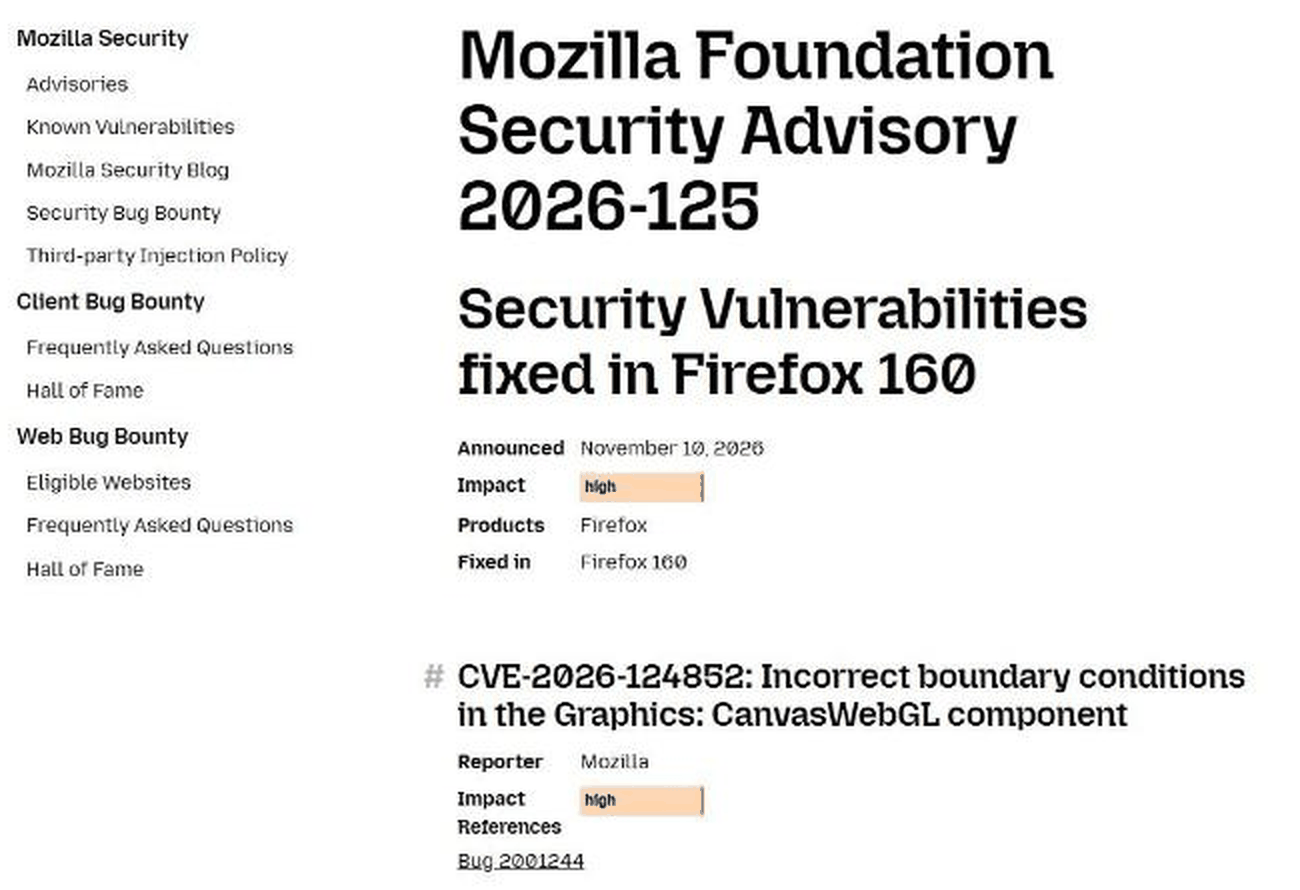
- What happened: Firefox 160 shipped on November 10, 2026 with Mozilla Foundation Security Advisory 2026-125, which lists 99 separate CVEs. Mozilla rates the advisory as a whole “high.” Our count of its entries: 57 high, 24 moderate and 18 low.
- The scary-sounding part: 13 of the 99 entries have “sandbox escape” in their title, and 43 mention a use-after-free (both ours). These are bug classes, not proof of attacks. The advisory does not say any of them is being exploited.
- The newer fix to be on: Firefox 160.0.1 arrived on November 17 with advisory 2026-130, two more high-impact fixes. If you stopped at 160.0, you are one update behind.
- Not only Firefox: the same day Mozilla published advisories for Firefox ESR 153.7, Firefox ESR 115.45, Thunderbird 160 and Thunderbird 153.7. Many CVEs appear in several of them.
- Exploitation status: none of the 99 CVE numbers in advisory 2026-125, and none of the three IDs we spot-checked from the other advisories, appears in the CISA KEV catalog (version 2026.11.20 on GitHub). Absence from that list is not proof that nothing is being exploited.
- What to do: update Firefox to 160.0.1 or later, ESR users to 153.7 or later, and Thunderbird users to the fixed version for their line. Details and a checklist below.
The advisories, in one table
Mozilla publishes a separate advisory for each product and release line. Here is everything we read for the November 2026 releases. The counts are ours, taken by reading each page entry by entry; the dates and version numbers are Mozilla’s.
| Advisory | Product fixed in | Date | CVEs listed | Rated high | Credited to “OpenAI Codex Security” |
|---|---|---|---|---|---|
| MFSA 2026-125 | Firefox 160 | Nov 10 | 99 | 57 | 25 |
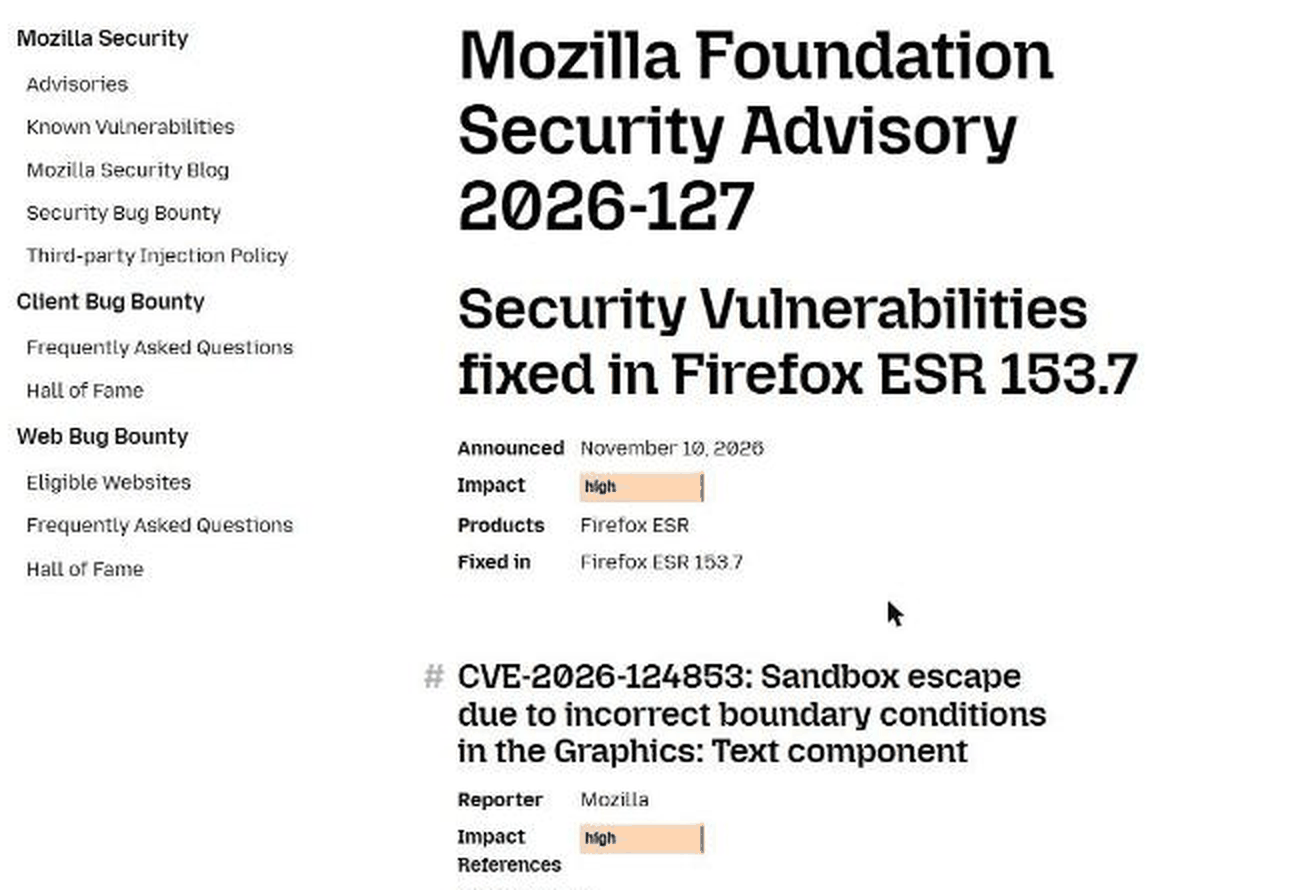
| MFSA 2026-127 | Firefox ESR 153.7 | Nov 10 | 81 | 51 | 23 |
| MFSA 2026-126 | Firefox ESR 115.45 | Nov 10 | 28 | 28 | 10 |
| MFSA 2026-128 | Thunderbird 160 | Nov 10 | 103 | 59 | 25 |
| MFSA 2026-129 | Thunderbird 153.7 | Nov 10 | 86 | 52 | 23 |
| MFSA 2026-124 | Firefox for iOS 160.0 | Nov 9 | 3 | not counted | 0 |
| MFSA 2026-130 | Firefox 160.0.1 | Nov 17 | 2 | 2 | 0 |
Do not add these rows together. The same CVE can appear in more than one advisory because the same code ships in Firefox, its extended-support release and Thunderbird. For example, CVE-2026-124853 appears in both the Firefox 160 and ESR 153.7 advisories. The honest total of distinct flaws is lower than the sum, and we did not work out the exact figure.
What is in the 99
Mozilla’s entries are short: a CVE number, a one-line title naming the bug class and the browser component, the reporter, an impact rating and a Bugzilla bug number. Reading the titles gives a rough picture of where the work was, without saying anything about how a bug can be reached.
| Component area (title text) | Entries in advisory 2026-125 (ours) |
|---|---|
| DOM (including Core and HTML, HTML Parser, Navigation, Editor, Service Workers) | 24 |
| Graphics (including Canvas, WebGL, WebGPU, WebRender, Text) | 15 |
| Layout (including Text and Fonts, Positioned, Form Controls) | 12 |
| Networking (HTTP, Cache, Cookies, JAR) | 6 |
| CSS Parsing and Computation | 6 |
| Audio/Video | 4 |
| JavaScript (garbage collector, JIT engine) | 4 |
| SVG | 3 |
Those eight groups cover 74 of the 99 entries; the other 25 are spread across smaller areas such as WebRTC, Storage, Security, Address Bar, WebExtensions and Autofill. We grouped by the component name in each title, so a few judgement calls on how to bucket an entry are ours.
Other tallies from the titles, also ours:
- Use-after-free: 43 of 99 titles mention it. It is a memory-safety bug class, and it is the most common label on the page.
- Sandbox escape: 13 titles say so, of which 9 are rated high. A sandbox is the restricted environment that keeps web-page code away from the rest of your computer. The titles do not say how any escape could be reached, and we do not speculate.
- Privilege escalation: 5 titles. Same-origin policy bypass: 4 titles. The same-origin policy is the browser rule that stops one website from reading another’s data.
- Android-only: 2 titles say “in Firefox for Android”: an autofill clickjacking issue rated moderate and a media issue rated low.
- Missing number: the CVE numbers on the page run from CVE-2026-124852 to CVE-2026-124951, a span of 100, but CVE-2026-124916 is not on the page we read. We do not know why and make nothing of it.
Who reported them: Mozilla itself, and a long list from one credit line
The “Reporter” field is where the advisory gets interesting. Our tally for advisory 2026-125:
- 47 of 99 are credited to “Mozilla,” meaning found by the company’s own people or tools.
- 25 of 99 are credited to “OpenAI Codex Security (kylebot),” and all 25 are rated high. That is 44 percent of the 57 high-rated entries (ours).
- One more is credited to “Amy Burnett of OpenAI,” a use-after-free in the HTML Parser, also rated high. Together, 26 entries carry an OpenAI-related credit.
- The rest are outside researchers, with Takashi Suzuki credited on 7 entries, and others on one or two each.
The credits repeat in the other advisories: 23 of the 81 ESR 153.7 entries, 10 of the 28 ESR 115.45 entries, and 25 and 23 entries in the two Thunderbird advisories, all with the same credit line. What we can say is limited to what Mozilla wrote: a credit string naming OpenAI Codex Security appears on many of the high-rated entries. We did not read any OpenAI statement about how these were found, so we cannot say whether a person, a tool, or a mix of the two did the work, or how much of it was automated. The advisory only says who gets the credit.
A disclosure, in the interest of fairness: this site uses Claude, an AI assistant from Anthropic, as one of its drafting tools. OpenAI is a competitor of Anthropic. We searched four of the advisory pages (2026-125, 2026-126, 2026-127 and 2026-128) for the words “Anthropic” and “Claude” and found neither. The credit lines are reported here as Mozilla published them, neither promoted nor played down.
Why 99 is not simply “more than last time”
Here is how the Firefox release advisories have looked over the last four major releases. Dates and versions are Mozilla’s; the counts are ours.
| Release | Advisory date | CVEs listed | Rated high | Credited to Codex Security | Credited to Mozilla |
|---|---|---|---|---|---|
| Firefox 157 | Sep 29 | 76 | 38 | 0 | 46 |
| Firefox 158 | Oct 13 | 77 | 30 | 0 | 40 |
| Firefox 159 | Oct 27 | 167 | 108 | 34 | 102 |
| Firefox 160 | Nov 10 | 99 | 57 | 25 | 47 |
Two things stand out. First, the number of entries jumped from 77 to 167 between Firefox 158 and 159 and then fell to 99. Second, among these four advisories the Codex Security credit does not appear in the 157 or 158 ones at all and shows up for the first time in 159.
A note in Mozilla’s Thunderbird 160 advisory (2026-128) helps explain how to read those counts. It says Mozilla has changed how it publishes advisories: it no longer rolls all internally found memory-safety bugs into one CVE and now issues an advisory for every individual bug. We read that note on the Thunderbird page, not on the Firefox pages, and Mozilla does not say in it when the change started for Firefox. It is our reading, and only a reading, that this change is part of why the counts are larger and lumpier than they were in September, so a raw count of 99 is not directly comparable with a count from the old format. The safe conclusion: more entries does not automatically mean a more dangerous release, and fewer does not mean a safer one.
Firefox 160.0.1: the second update
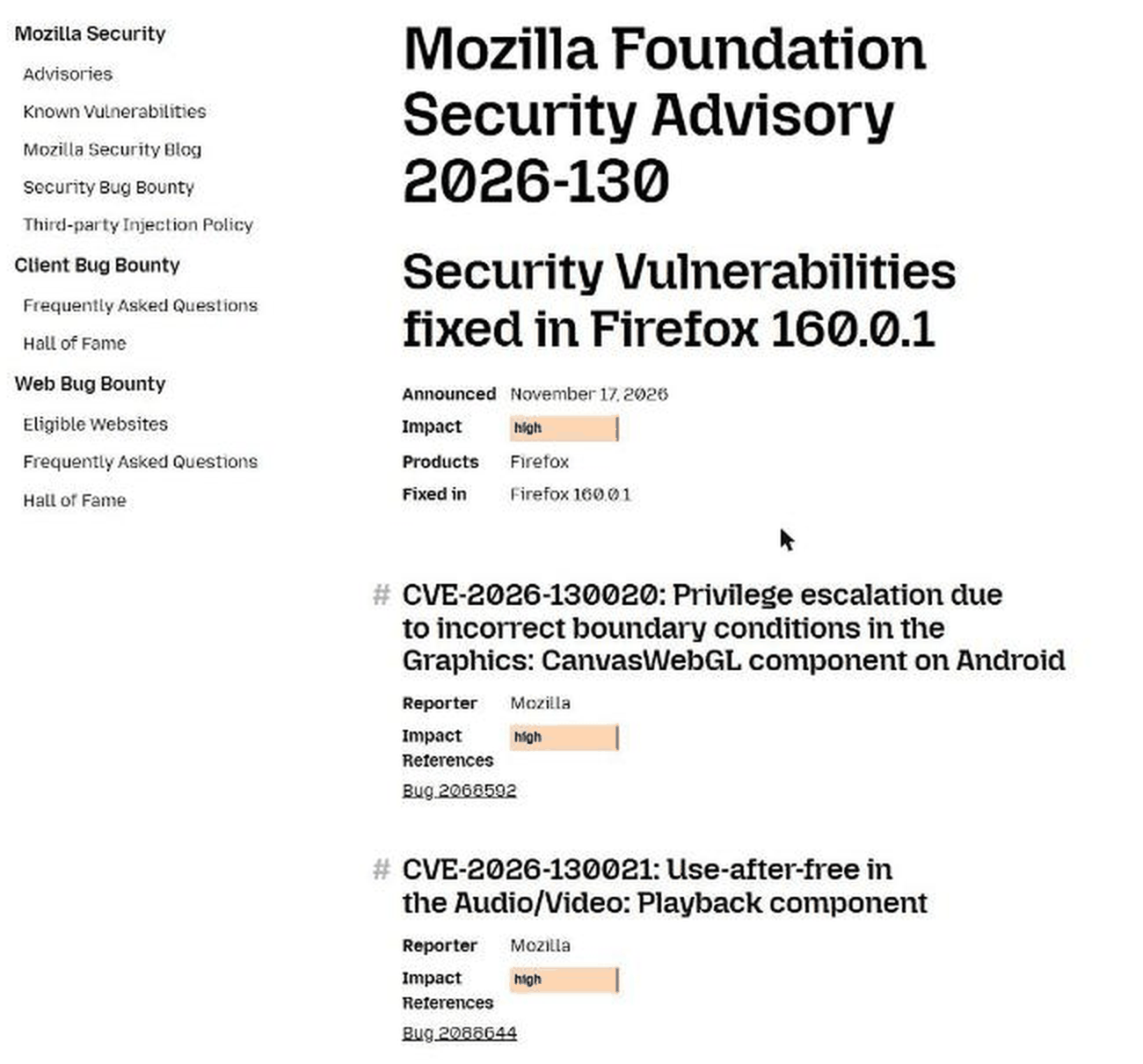
On November 17, Mozilla published advisory 2026-130 for Firefox 160.0.1. It lists two entries, both rated high and both credited to Mozilla:
- CVE-2026-130020: privilege escalation due to incorrect boundary conditions in the Graphics: CanvasWebGL component on Android.
- CVE-2026-130021: a use-after-free in the Audio/Video: Playback component.
The first is labelled Android in its title, so Android users in particular should check that the app has updated. The second has no platform in its title. We did not read the Firefox 160.0.1 release notes page or the Google Play listing, so we cannot say what else changed in that release or how fast it reached each platform.
What the release notes say
The Firefox 160.0 release notes on firefox.com, dated November 10, list new features: a playback-speed setting for the Picture-in-Picture player from 0.25x to 2.0x, an early “Mini Window” feature, drag-and-drop of history entries to the tab strip, a “Never allow” button for sites that repeatedly ask to handle email links, MKV playback with FLAC, MP3 or PCM audio, and Metal-based WebGL rendering on macOS. Under “Fixed,” the security line reads, in full, “Various security fixes.”
That is a normal pattern: the release notes point readers to the advisory for detail. But it matters for how people hear about updates. Someone who reads only the release notes learns about Picture-in-Picture speeds and nothing about 99 CVEs. The advisory, not the release note, is the document that tells an administrator how much is in the update.
Is any of this being exploited?
We checked this the same way as in our earlier security articles. The CISA Known Exploited Vulnerabilities catalog lists flaws that CISA has evidence are being used in real attacks. CISA’s own website refuses automated reads, so we read the official mirror on GitHub, which showed catalog version 2026.11.20 with 1,790 entries. Result:
- None of the CVE numbers from CVE-2026-124852 to CVE-2026-124951 is in the catalog.
- We also checked CVE-2026-130020 and CVE-2026-130021 from the 160.0.1 advisory, and CVE-2026-109736, the first entry in the ESR 115.45 advisory. None is listed.
- Mozilla’s advisories, in the pages we read, do not say any of these flaws is exploited in the wild.
What this does not prove: a catalog is a record of what has been confirmed and reported, with delay. It cannot tell you about attacks no one has seen. Browser bugs of this class are valuable to attackers, which is the best argument for updating promptly even when no one is known to be using them.
What to do: a checklist
This is general guidance drawn from the advisories’ version numbers, not a tested procedure.
- Firefox on a desktop: open the menu, go to Help, then About Firefox. It checks for updates and shows the version. You want 160.0.1 or later. If a restart is pending, restart.
- Firefox ESR: the fixed versions named by Mozilla are 153.7 for the current ESR and 115.45 for the older 115 line. If you are on a pinned or managed ESR, check whether your software distribution has actually pushed it.
- Thunderbird: 160 or 153.7, depending on your line. The Thunderbird advisory notes that many of the flaws cannot be reached through email because scripting is disabled when reading mail, though they may matter in browser-like contexts. Mozilla still lists them, so update.
- Android and iOS: the 160.0.1 Android item names the platform in its title; iOS has its own advisory, 2026-124, for Firefox for iOS 160.0 with three entries. Check your app store for updates. We did not read either store listing.
- Linux distributions: Firefox is often installed from your distribution, not from Mozilla, and the version can lag. Check the version you actually have, and whether the package is a Snap, a Flatpak or a distribution package, because each updates on its own schedule. We did not check any distribution’s status.
- Managed fleets: if your organization sets policies that disable automatic updates, the browser will not pick up the fix on its own. Ask whoever runs the deployment which version is rolled out.
- Forks and embedded copies: other browsers and applications are built on Firefox’s code and release on their own schedules. We checked none of them. Look at the maker’s own notice.
What we could not confirm
- That the fixes work. We installed nothing and tested nothing.
- How any of the 99 flaws can be reached. Mozilla’s entries give a title, a component and a rating; we read nothing deeper and say nothing about exploitation techniques.
- Whether the flaws have been used in real attacks. The KEV catalog and Mozilla’s pages show nothing, which is not the same as proof.
- How the Codex Security credit was earned, or how much of the work was automated. We read no OpenAI statement.
- When Mozilla changed to one-advisory-per-bug for Firefox, and how much of the jump in counts that explains. The note we found is on the Thunderbird 160 page.
- The exact number of distinct CVEs across all the November 10 advisories, since entries overlap. We did not de-duplicate them.
- The Firefox 160.0.1 release notes, the Google Play and App Store listings, and any Linux distribution’s status. We did not open them.
- The story of Chrome 158. Press reports said Google fixed 204 flaws on November 17, but when we looked, Google’s Chrome Releases blog showed no desktop stable post we could read, so we are not writing about it until we can read the primary source.
Frequently asked questions
Which Firefox version should I be on?
Firefox 160.0.1 or later. Firefox 160.0 carried advisory 2026-125, and 160.0.1 added two more high-impact fixes in advisory 2026-130.
How many vulnerabilities did Firefox 160 fix?
Mozilla’s advisory 2026-125 lists 99 CVEs: 57 high, 24 moderate and 18 low by our count. Mozilla rates the advisory as a whole as high.
Is Firefox 160 being actively exploited?
The advisories we read do not say so, and none of the 99 CVE numbers is in the CISA KEV catalog on GitHub (version 2026.11.20). That is not a guarantee that no attacks exist.
Does this affect Firefox ESR and Thunderbird?
Yes. Mozilla published separate advisories for Firefox ESR 153.7 (81 entries), ESR 115.45 (28), Thunderbird 160 (103) and Thunderbird 153.7 (86). Many CVEs are shared between them.
What does “sandbox escape” mean?
A sandbox keeps the code of a web page in a restricted process away from the rest of your system. A sandbox-escape bug is one that could let code get out of that restriction. Thirteen entries in the Firefox 160 advisory have it in the title. The titles do not explain how any of them could be reached.
Where are the sources?
Mozilla advisories 2026-125, 2026-127, 2026-126, 2026-128, 2026-129 and 2026-130; the Firefox 160.0 release notes; and the CISA KEV data repository on GitHub. All screenshots are ours, taken November 22, 2026.
Related reading
- Git 2.56.1 Security Release: Six CVEs, Clone-Time Code Execution, What to Check
- WordPress 7.1.5 Security Release: 20 Fixes, What Site Owners Should Check
- Node.js Security Releases, November 2026: What to Check
- LiteLLM Flaw CVE-2026-40217 Added to CISA Exploited List: Rated Moderate by Its Maker, 8.8 by Others, and What to Check
- Hosting reviews