Mitel MiCollab: Five Conferencing Flaws, Including a 10.0 Command Injection, Are Now on CISA’s Exploited List
Published November 27, 2026. A news analysis of five Mitel MiCollab vulnerabilities that CISA added to its Known Exploited Vulnerabilities catalog on November 25, 2026, built from Mitel’s security advisory MISA-2026-0012 (revision 2.0, read on November 27, 2026) and CISA’s Known Exploited Vulnerabilities (KEV) data as mirrored on CISA’s GitHub (catalog version 2026.11.25). Both screenshots are ours (Mitel’s advisory page, cropped). This article contains no affiliate links and we have no commercial relationship with Mitel. ToolReviewHub is produced with the help of an AI assistant (Claude, made by Anthropic). We did not run MiCollab or test any of the flaws, and we do not describe how to trigger them. Descriptions are the vendors’ and CISA’s wording, and numbers marked “ours” are our own arithmetic.
Mitel MiCollab CVE-2026-133323 and four related flaws: the short version
- What happened: on November 25, 2026, CISA added five Mitel MiCollab vulnerabilities to its Known Exploited Vulnerabilities (KEV) catalog, which means CISA has evidence that they are being exploited. All five sit in the same part of the product, the Audio, Web and Video Conferencing (AWV) component.
- The worst two: CVE-2026-133323 is an unauthenticated blind command injection that Mitel rates Critical 10.0. CVE-2026-133303 is an XML injection that can lead to command execution, rated Critical 9.0. The other three (file upload, weak authentication and authentication bypass) are rated Medium, 5.3 to 5.9.
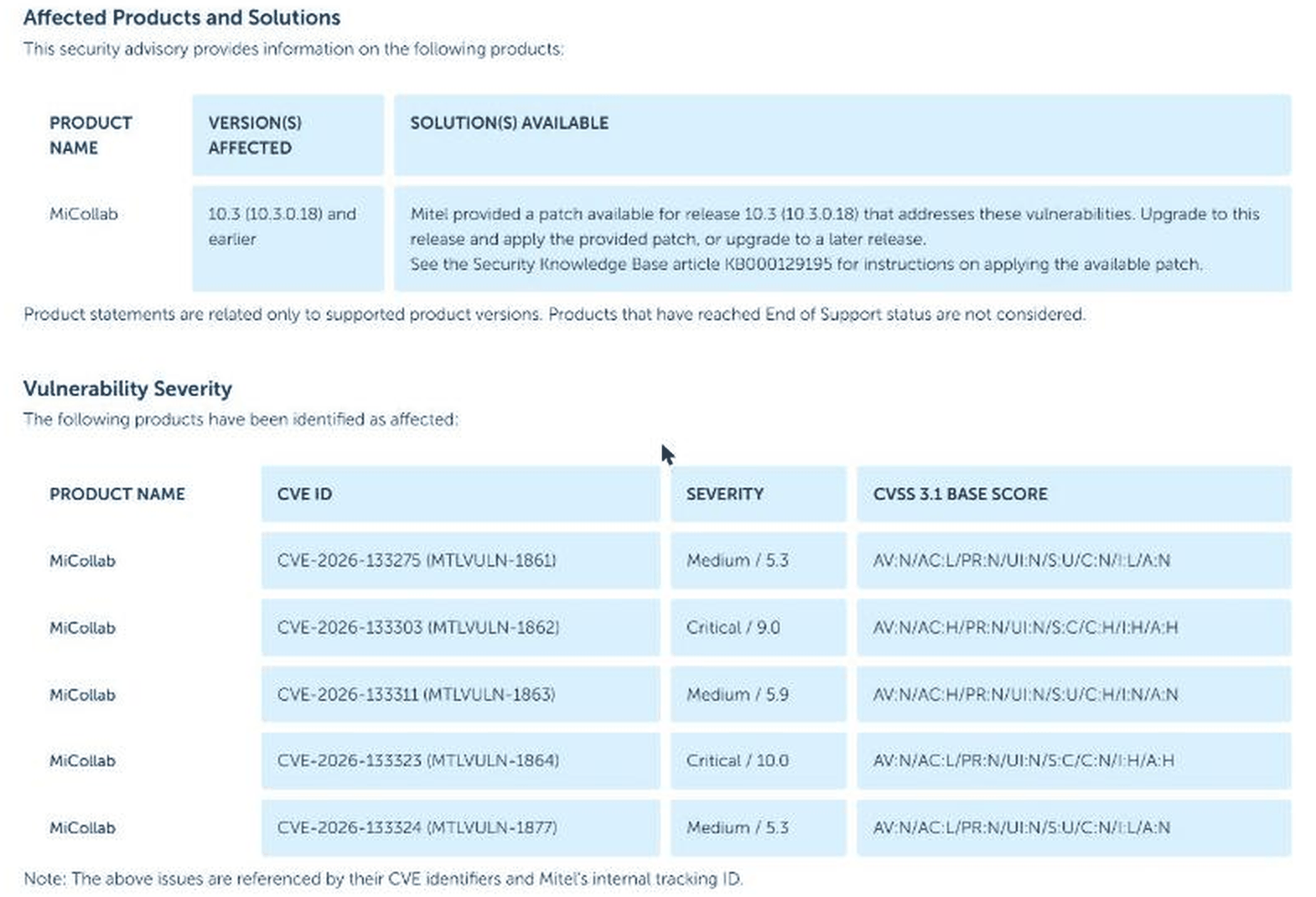
- Who is affected: MiCollab 10.3 (10.3.0.18) and earlier, according to Mitel’s advisory MISA-2026-0012.
- The fix: upgrade to 10.3 (10.3.0.18) and apply Mitel’s patch, or move to a later release. Mitel’s Knowledge Base article KB000129195 has the patch instructions. If you cannot patch at once, Mitel says to restrict external access to the AWV component.
- Deadline: US federal civilian agencies must act by November 28, 2026 for four of the flaws and by December 9 for the fifth, three and fourteen days after the listing (ours).
What MiCollab is, and why it matters
MiCollab is Mitel’s unified communications and collaboration software. It bundles features such as softphones, presence, messaging and conferencing for organizations that run Mitel phone systems, and it is usually deployed on the organization’s own servers or virtual machines. The part affected here, the Audio, Web and Video Conferencing component (AWV), is the piece that lets people join calls and web meetings, often from outside the corporate network. That design goal is the reason this matters: a conferencing service is frequently reachable from the internet on purpose, so that guests and remote staff can join.
Communications servers are attractive to attackers for the same reasons they are attractive to businesses. They sit at the edge, they talk to internal systems such as directory services and voicemail, and they are not always patched on the same schedule as laptops and web servers. Phone and collaboration platforms are often run by a separate telecom team or a reseller, which can slow down updates.
MiCollab has been here before. CISA’s catalog lists two earlier MiCollab flaws, CVE-2024-41713 and CVE-2024-55550, both added on January 7, 2025, and marks both as known to have been used in ransomware campaigns. It also lists CVE-2022-26143, a MiCollab and MiVoice Business Express flaw added in March 2022. Counting the five new entries, CISA’s data now has twelve Mitel vulnerabilities, eight of which involve MiCollab (our count from the catalog).
The five flaws in plain terms
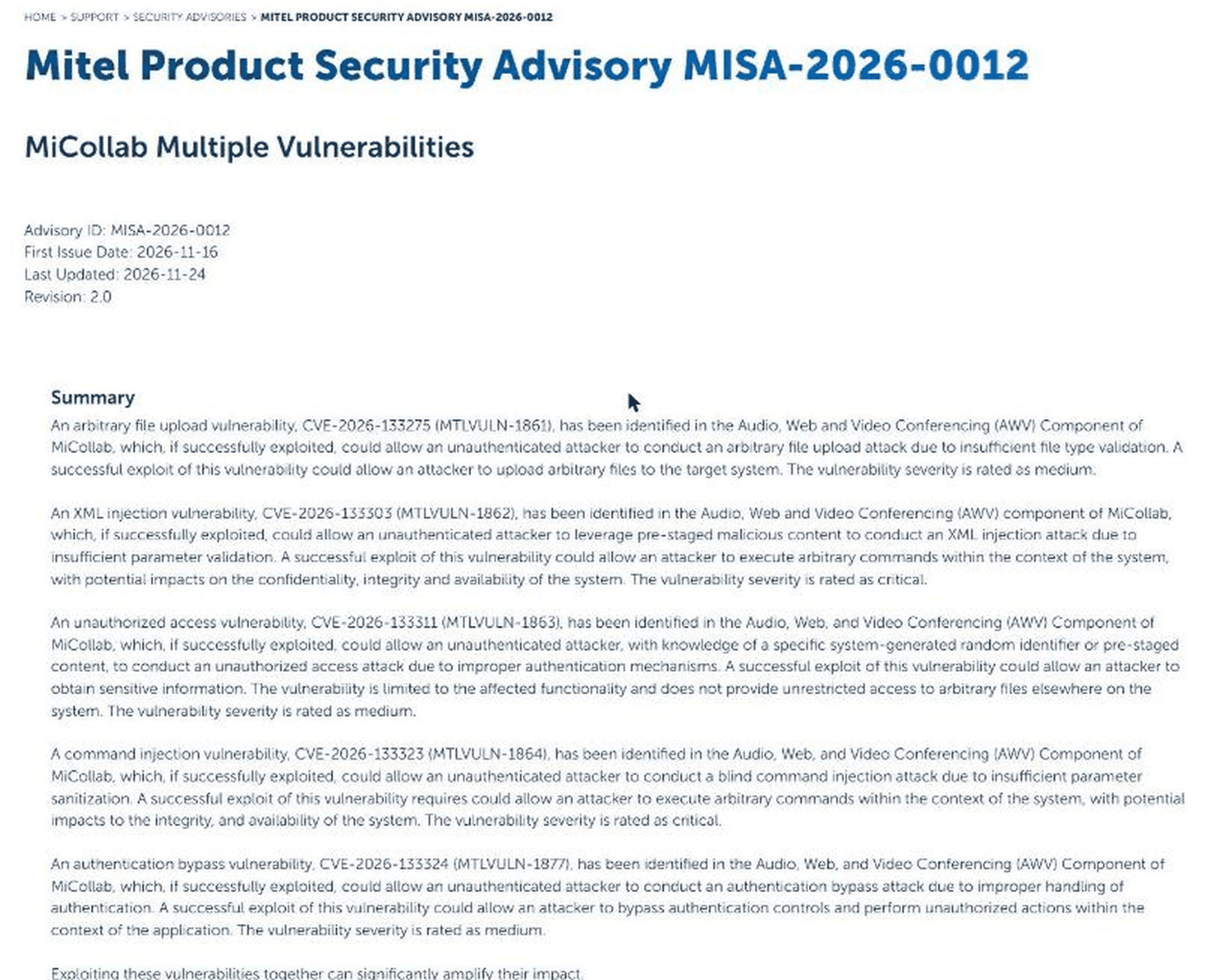
Mitel’s advisory, first issued on November 16 and updated on November 24 to add the CVE numbers, describes each issue in a sentence or two. All five can be attempted by an attacker who is not logged in. We summarize them from the advisory, in descending order of Mitel’s severity rating, and leave out the mechanics.
- CVE-2026-133323, blind command injection (Critical, 10.0): insufficient parameter sanitization lets an unauthenticated attacker run arbitrary commands on the system. “Blind” means the attacker does not see the command output directly in the response, which slows an attacker down but does not stop them. CISA classifies it as OS command injection (CWE-78).
- CVE-2026-133303, XML injection (Critical, 9.0): insufficient parameter validation lets an unauthenticated attacker use “pre-staged malicious content” to inject XML and execute arbitrary commands. CISA’s entry also describes it as leading to command execution. The CVSS vector rates the attack complexity as high.
- CVE-2026-133311, unauthorized access (Medium, 5.9): an attacker who knows a specific system-generated random identifier, or has pre-staged content, can obtain sensitive information because of improper authentication. Mitel says the flaw is limited to the affected functionality and does not give access to arbitrary files elsewhere on the system.
- CVE-2026-133275, arbitrary file upload (Medium, 5.3): insufficient file type validation lets an unauthenticated attacker upload arbitrary files to the system.
- CVE-2026-133324, authentication bypass (Medium, 5.3): improper handling of authentication lets an attacker bypass authentication controls and perform unauthorized actions within the application. CISA’s catalog files it under “not failing securely” (CWE-636).
Two phrases recur in the advisory: “pre-staged content” in CVE-2026-133303 and CVE-2026-133311, and an unauthenticated file upload in CVE-2026-133275. Mitel does not say which flaw stages content for the others, but it adds a sentence that is worth taking literally: “Exploiting these vulnerabilities together can significantly amplify their impact.” Read that next to the descriptions and a pattern is plausible, in which an attacker places content on the server through one weakness and then uses it through another. That is our reading, not something Mitel or CISA has confirmed.
Why the Medium ratings should not slow you down
Three of the five flaws are rated Medium, and in a busy patch queue Medium issues tend to wait. Here, they should not, for two reasons.
First, the KEV listing is about evidence of exploitation, not about severity scores. CISA added all five on the same day, including the three Medium ones. A CVSS score describes how bad a single flaw could be in isolation; the KEV catalog says that attackers are actually using it. Those are different questions, and the second one is the more urgent.
Second, Mitel says the flaws are more dangerous together. A Medium file upload and a Medium authentication bypass become much more serious when they are steps toward running commands on a server that sits at the network edge. That is the same lesson as other recent chains we have covered, where modest flaws added up to full control of the system.
The practical upshot is simple: there is one patch for all five, so there is no reason to split them. Apply the patch once and all five are addressed.
The five CVEs (Mitel MISA-2026-0012 and CISA KEV data)
| CVE (Mitel ID) | Issue | Mitel severity (CVSS 3.1) | CISA due date |
|---|---|---|---|
| CVE-2026-133323 (MTLVULN-1864) | Blind OS command injection | Critical 10.0 | November 28, 2026 |
| CVE-2026-133303 (MTLVULN-1862) | XML injection leading to command execution | Critical 9.0 | November 28, 2026 |
| CVE-2026-133311 (MTLVULN-1863) | Unauthorized access through weak authentication | Medium 5.9 | December 9, 2026 |
| CVE-2026-133275 (MTLVULN-1861) | Unrestricted upload of a file with a dangerous type | Medium 5.3 | November 28, 2026 |
| CVE-2026-133324 (MTLVULN-1877) | Authentication bypass (CISA: not failing securely) | Medium 5.3 | November 28, 2026 |
CISA lists the ransomware use of all five as “Unknown”, which means it has no public information either way, not that ransomware is ruled out. The required action in each entry is to apply mitigations in line with the vendor’s instructions under Binding Operational Directive 26-04, CISA’s risk-based patching directive, and the entries point agencies to CISA’s forensics triage requirements, not just to the patch.
Patching: what Mitel says to do
The advisory lists one affected range: MiCollab 10.3 (10.3.0.18) and earlier. The fix is a patch for release 10.3 (10.3.0.18). Mitel’s wording is to upgrade to that release and apply the provided patch, or upgrade to a later release, and it says the security update will be included in later MiCollab releases. The patch steps are in Mitel Knowledge Base article KB000129195, titled “MiCollab Security Update, MTLVULN-1861, MTLVULN-1862, MTLVULN-1863, MTLVULN-1864, MTLVULN-1877”. Mitel notes that customers without access to the Knowledge Base should contact their Mitel Authorized Partner.
One detail is easy to miss: the patched release and the last vulnerable release share a version number. A server that reports 10.3.0.18 may or may not have the patch, so a version check alone does not tell you whether you are protected. Confirm that the KB000129195 patch is installed, or move to a later release.
Mitel’s advisory also says that product statements cover only supported versions, and that products past End of Support are not considered. If you are running an older, unsupported MiCollab build, assume it is affected and plan an upgrade, since there may be no patch for it.
If you cannot patch today
Mitel gives one workaround: restrict external access to the AWV component, with details in the same Knowledge Base article. In practice that means making sure the conferencing service is not reachable from the internet, for example by limiting it to the internal network or a VPN, or by allowing only known addresses at the firewall. That will inconvenience external guests who join meetings, which is the trade-off. It buys time; the patch is the fix.
Because CISA has evidence of exploitation, treat an internet-facing, unpatched server as possibly compromised, not just vulnerable. CISA’s KEV entries point federal agencies to forensic triage for that reason. Restricting access today does not undo anything that happened before the change.
Timeline
| Date (2026) | Event | Source |
|---|---|---|
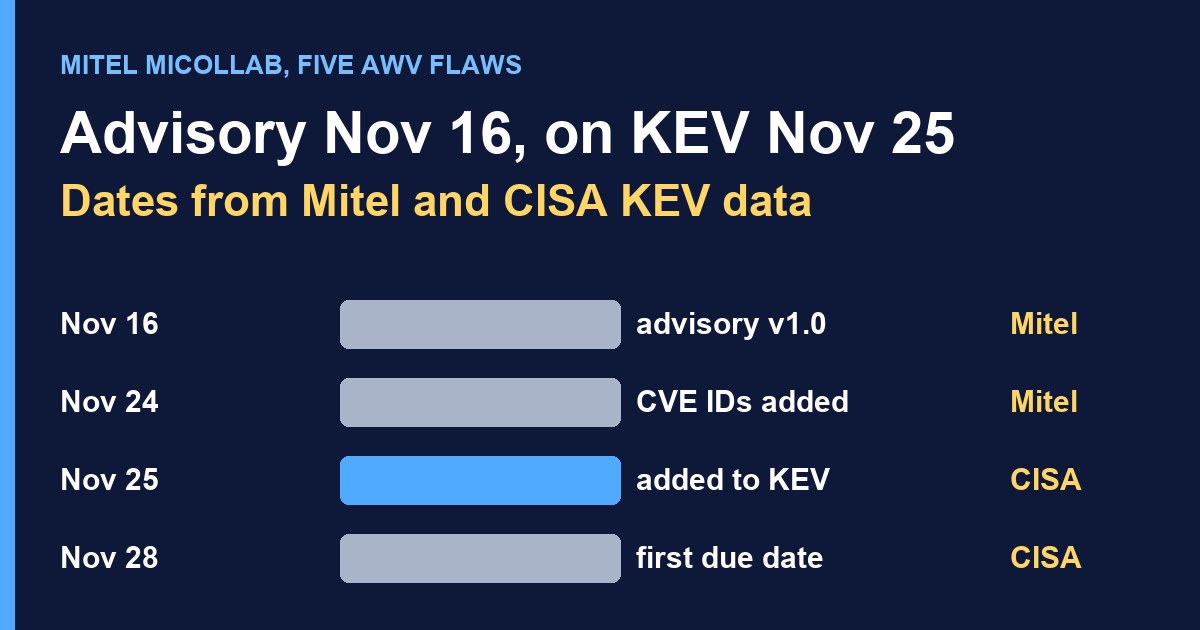
| November 16 | Mitel publishes MISA-2026-0012, revision 1.0 | Mitel |
| November 24 | Revision 2.0 adds the CVE numbers | Mitel |
| November 25 | CISA adds all five flaws to the KEV catalog | CISA KEV data |
| November 28 | Federal due date for four of the five | CISA KEV data |
| December 9 | Federal due date for CVE-2026-133311 | CISA KEV data |
Nine days passed between Mitel’s first advisory and the KEV listing (ours). The CVE numbers were only attached one day before the listing, so anyone who tracks vulnerabilities by CVE alone, without reading vendor advisories, may have had very little warning. If you run Mitel products, subscribing to Mitel’s advisory page is a cheap fix for that gap.
The rest of the November 25 KEV update
The Mitel flaws were half of a ten-entry update. The same day, CISA added CVE-2026-103406, an OS command injection in HPE Juniper Session Smart Conductor and Session Smart Router that can let a remote attacker run commands as root through a crafted salt minion ID; CVE-2026-133469 in Vates Xen Orchestra, filed under improper authentication and improper validation of the specified type of input; and three flaws in Danfoss AK-SM 800A Series refrigeration and building system managers, CVE-2025-41450, CVE-2023-25914 and CVE-2023-25915. With those, CISA’s catalog (version 2026.11.25) lists 1,805 vulnerabilities.
For the wider November picture, our November 2026 KEV roundup lists the month’s additions and what to patch first.
What to do: a practical checklist
- Find every MiCollab server, including ones managed by a reseller or a telecom team, and note the exact build.
- Apply the patch from KB000129195 on 10.3 (10.3.0.18), or upgrade to a later release. Do not rely on the version number alone; confirm the patch is installed.
- If you cannot patch today, restrict external access to the AWV component at the firewall or move it behind a VPN, as Mitel recommends.
- Treat exposed, unpatched servers as possibly compromised. Look for files you did not expect on the server, unknown processes and outbound connections, and unusual conferencing requests from unknown addresses since mid-November.
- Rotate credentials stored on or used by the MiCollab server if you find signs of tampering, and involve your incident response team or Mitel partner.
- Check for unsupported builds. Products past End of Support are not covered by the advisory; plan an upgrade.
- Subscribe to Mitel’s security advisories so that the next advisory reaches you before the CVE numbers do.
What we could not confirm
- Who is exploiting the flaws, and against which organizations: CISA’s entries do not say.
- Whether attackers are chaining the five flaws, and in what order. Mitel says that combining them amplifies the impact, but it does not describe a chain.
- How many MiCollab servers are exposed to the internet: we did not find a count in the sources we read.
- The contents of KB000129195, which needs a Mitel support login; we did not read it.
- Whether the flaws were exploited before Mitel’s November 16 advisory.
- CISA’s own catalog page, which we did not open; the KEV facts come from CISA’s GitHub mirror (catalog version 2026.11.25).
Frequently asked questions
Which MiCollab versions are affected?
MiCollab 10.3 (10.3.0.18) and earlier, according to Mitel’s advisory MISA-2026-0012.
How do I fix it?
Upgrade to 10.3 (10.3.0.18) and apply Mitel’s patch from Knowledge Base article KB000129195, or upgrade to a later release.
Are the flaws being exploited?
CISA added all five to its Known Exploited Vulnerabilities catalog on November 25, 2026, which means it has evidence of exploitation. It has not said who is behind it.
Do attackers need a login?
No. Mitel describes all five as exploitable by an unauthenticated attacker, although CVE-2026-133311 also needs a specific identifier or pre-staged content.
What can I do before patching?
Restrict external access to the AWV conferencing component, as Mitel recommends, and check exposed servers for signs of compromise.
What is the CISA deadline?
November 28, 2026 for four of the flaws and December 9, 2026 for CVE-2026-133311, for US federal civilian agencies.
Method: details come from Mitel’s security advisory MISA-2026-0012 (revision 2.0, last updated November 24, 2026) and CISA KEV data (catalog version 2026.11.25), read on November 27, 2026. The count of Mitel and MiCollab entries is ours, from the same catalog. For how we research, see How We Review Tools.
Related reading
- CISA KEV in November 2026: 26 additions and what to patch first
- GeoServer’s five-step attack chain: two flaws already probed
- Palo Alto PAN-OS Fragnesia: chained flaws that rooted firewalls
- Juniper Session Smart Conductor CVE-2026-103406: a 9.8 flaw exploited and on KEV
- Xen Orchestra CVE-2026-133469 auth bypass (added November 25)
- Danfoss AK-SM 800A: three flaws fixed in 2023 and 2025, added November 25