Juniper Session Smart Conductor CVE-2026-103406: A 9.8 Unauthenticated Command Execution Flaw Is Being Exploited, and Federal Agencies Were Due to Patch Today
Published November 28, 2026. A news analysis of CVE-2026-103406, an unauthenticated command execution flaw in Juniper Session Smart Conductor that Juniper says has been exploited and that CISA added to its Known Exploited Vulnerabilities catalog on November 25, 2026, built from Juniper’s 2026-10 On-Demand Security Bulletin for Session Smart Router and Session Smart Conductor (read on November 28, 2026) and CISA’s Known Exploited Vulnerabilities (KEV) data as mirrored on CISA’s GitHub (catalog version 2026.11.25). Both screenshots are ours (Juniper’s bulletin page, cropped). This article contains no affiliate links and we have no commercial relationship with Juniper Networks and Hewlett Packard Enterprise. ToolReviewHub is produced with the help of an AI assistant (Claude, made by Anthropic). We did not run Session Smart software or test any of the flaws, and we do not describe how to trigger them. Descriptions are the vendors’ and CISA’s wording, and numbers marked “ours” are our own arithmetic.
Juniper Session Smart Conductor CVE-2026-103406: the short version
- What happened: on November 24, 2026, Juniper updated its October security bulletin to say that at least one instance of malicious exploitation of CVE-2026-103406 has been reported to the Juniper security team. The next day, CISA added the flaw to its Known Exploited Vulnerabilities (KEV) catalog.
- The flaw: an unauthenticated attacker can cause arbitrary command execution on Session Smart Conductor during key management. Juniper rates it Critical, CVSS 3.1 score 9.8, with a network attack vector, low complexity, no privileges and no user interaction needed. CISA files it under OS command injection (CWE-78).
- Who is affected: all versions of Session Smart Conductor before 7.0.5, 7.1.7 and 7.2.3. The same bulletin covers 17 other vulnerabilities, 18 in total.
- The fix: upgrade to 7.0.5, 7.1.7 or 7.2.3, or any later release. Juniper says there are no known workarounds for all of the issues in the bulletin.
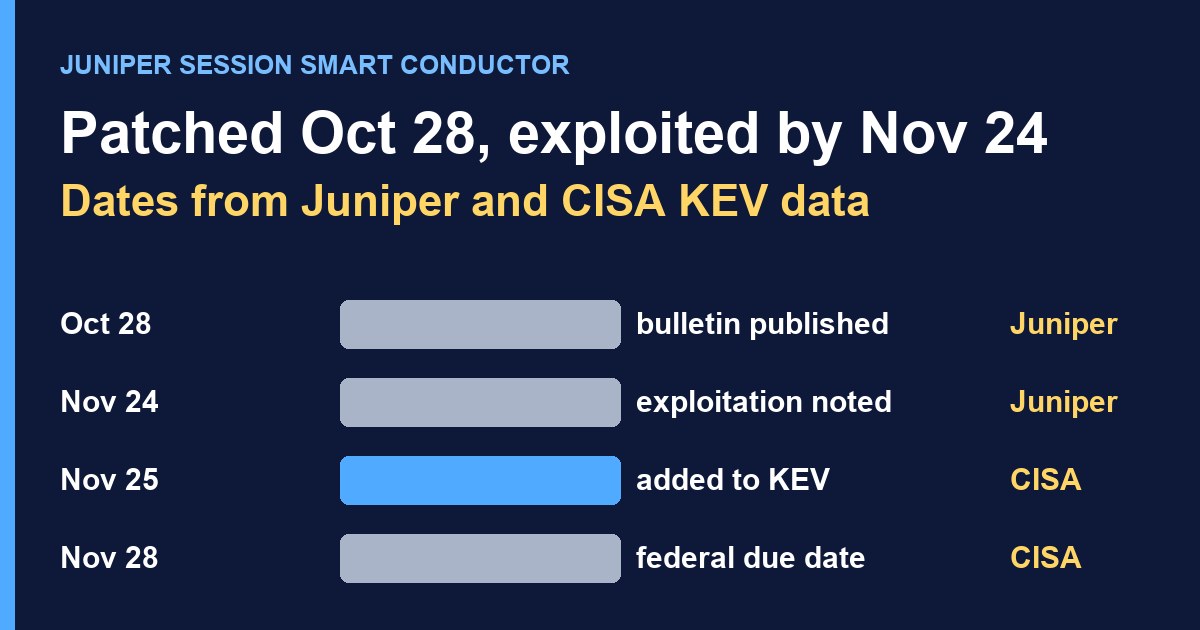
- Deadline: CISA’s due date for US federal civilian agencies is November 28, 2026, which is today, three days after the listing (ours).
What Session Smart Conductor is
Session Smart Router is Juniper’s software router for wide-area networks, and Session Smart Conductor is the management server that sits above it. The Conductor holds the central configuration and pushes it out to the routers in a deployment, and it handles tasks such as the keys that the routers use to talk to each other. After Juniper’s acquisition by Hewlett Packard Enterprise, CISA now lists the product under the vendor name “Hewlett Packard Enterprise (HPE) Juniper”, which is why searches for the older vendor name alone can miss the entry.
That architecture is the reason a Conductor bug matters more than its category suggests. A management server is a high-value target because whoever controls it can influence every device it manages. The affected function here, according to Juniper’s table, is key management, and the effect is arbitrary command execution by an attacker who has not logged in.
Juniper is an old name in CISA’s catalog. Counting the new entry, the catalog lists nine Juniper entries (our count from the KEV data): one Session Smart entry, seven for Junos OS, and one for the older ScreenOS. The earlier ones go back to 2022. This new entry is the first one for the Session Smart product line.
What the bulletin says about CVE-2026-103406
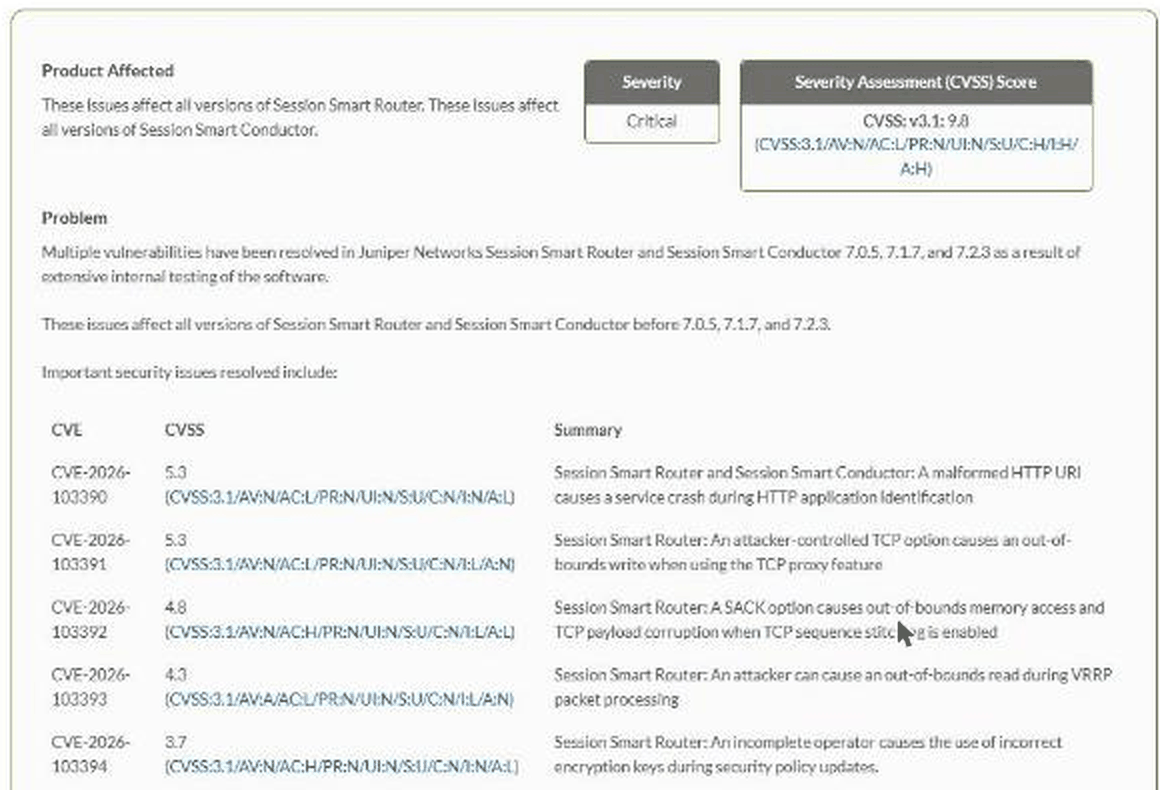
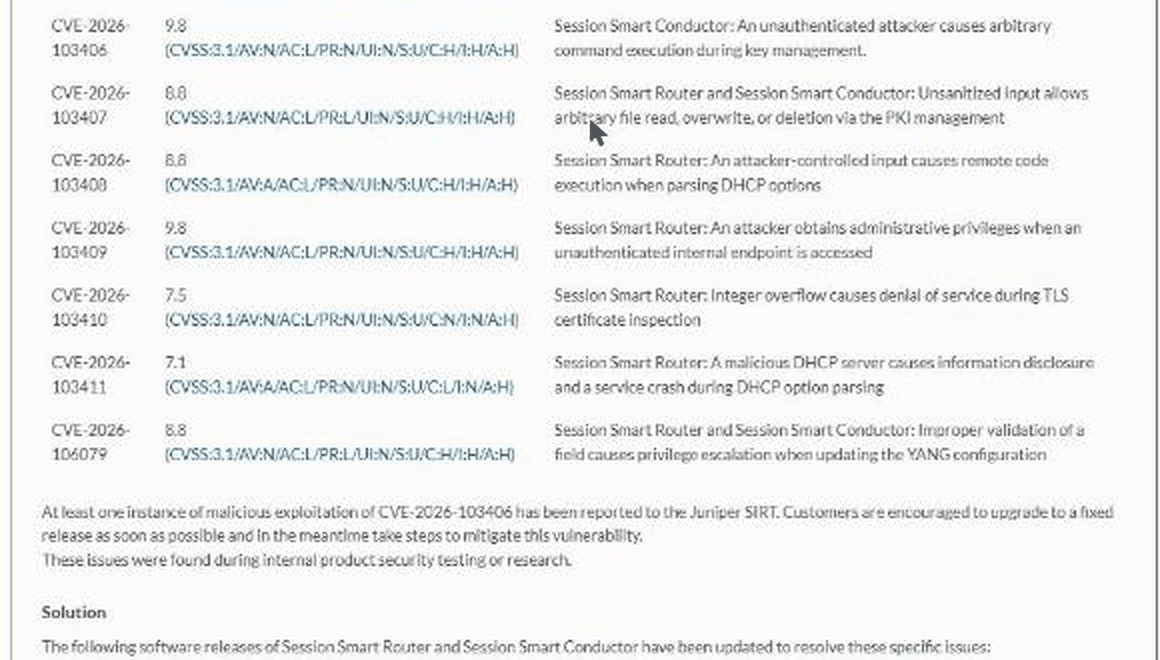
Juniper’s bulletin was first published on October 28, 2026, and describes itself as the result of extensive internal testing of the software. The bulletin lists 18 vulnerabilities, all fixed in Session Smart releases 7.0.5, 7.1.7 and 7.2.3. The row for CVE-2026-103406 reads, in summary, that an unauthenticated attacker can cause arbitrary command execution during key management, and it is one of two entries in the bulletin that Juniper scores 9.8 (the other is CVE-2026-103409, which affects the Router and lets an attacker obtain administrative privileges through an unauthenticated internal endpoint).
The modification history is the important part. On November 24, 2026 Juniper changed the bulletin to “reflect exploitation” of CVE-2026-103406, and added a sentence saying that at least one instance of malicious exploitation has been reported to Juniper’s security team. It urges customers to upgrade to a fixed release as soon as possible and, in the meantime, to take steps to mitigate the vulnerability. It adds that the issues were found during internal product security testing or research. So the bug was not found because of an attack; the attack came afterwards.
CISA’s own description of the flaw in the KEV entry goes a step further than Juniper’s table: it says a remote attacker could execute arbitrary commands as root through a specially crafted salt minion ID. Salt is a configuration and remote-execution framework, and a minion is one of its managed nodes. We did not find that detail in the Juniper bulletin itself, so we attribute it to CISA. If it is accurate, it explains why the flaw is so severe: root-level command execution on the management server.
Why a patched flaw still became an exploited one
The timeline is the lesson. Juniper published fixes on October 28, and its bulletin was updated to note exploitation on November 24, 27 days later (ours). We do not know when the first attack happened: it may have come after the fix, or before it. What the bulletin does show is that by November 24 at least one attacker had worked out how to use the flaw, nearly four weeks after patches were available.
This pattern is familiar. When a vendor publishes a bulletin that lists the vulnerable function, the version range and the fixed releases, it gives people who read it a map. Researchers and attackers compare the old and new software to find what changed, a technique usually called patch diffing, and then build their own exploit. We do not know that this is what happened here, and neither Juniper nor CISA says how the attacker learned how to use the flaw. But a gap of under four weeks between the fix and the exploitation report is short enough that anyone who treats a vendor bulletin as something to schedule for the next maintenance window should reconsider.
The 18 vulnerabilities in the bulletin, by severity (Juniper bulletin, our count)
| Severity (CVSS 3.1) | Count | Examples from the bulletin |
|---|---|---|
| Critical, 9.8 | 2 | CVE-2026-103406 (Conductor, unauthenticated command execution); CVE-2026-103409 (Router, unauthenticated internal endpoint gives administrative privileges) |
| High, 7.1 to 8.8 | 8 | CVE-2026-103401 (arbitrary file overwrite as root); CVE-2026-103402 (cache files lack integrity checks); CVE-2026-103408 (code execution when parsing DHCP options) |
| Medium, 4.3 to 6.8 | 7 | CVE-2026-103404 (Conductor, insecure file permissions expose routing credentials); CVE-2026-103405 (HTTP response splitting) |
| Low, 3.7 | 1 | CVE-2026-103394 (incorrect encryption keys used during security policy updates) |
By product, the bulletin lists 16 of the 18 as affecting the Router and 10 as affecting the Conductor (ours, from the “Session Smart Router” and “Session Smart Conductor” labels in each row). Eight affect both, eight only the Router and two only the Conductor: CVE-2026-103406, the exploited one, and CVE-2026-103404, the credential exposure. The practical meaning is that anyone running either product is covered by the same release train, and the Conductor is not a separate problem to be handled separately.
Which versions and what to install
The bulletin says the issues affect all versions of Session Smart Router and Session Smart Conductor before 7.0.5, 7.1.7 and 7.2.3. The fixed releases are those three and all subsequent releases. In other words, whichever branch you are on, the target is the matching release or newer: 7.0.5 or later on the 7.0 branch, 7.1.7 or later on 7.1, and 7.2.3 or later on 7.2.
One caveat in the bulletin is easy to skip. Juniper says its security team’s policy is not to evaluate releases that are beyond End of Engineering or End of Life. That means the bulletin cannot tell you whether an older, unsupported branch is affected; the safe assumption is that it is, and that the fix is to move to a supported release.
On workarounds, the bulletin says there are no known workarounds for all of the issues, and refers readers to the individual CVE records for any workaround that applies to a specific flaw. At the same time it asks customers to take steps to mitigate CVE-2026-103406 until they upgrade. We did not find a specific mitigation for that flaw in the bulletin page, so we cannot tell you what Juniper has in mind beyond the general advice. Restricting who can reach the Conductor’s management and key-management interfaces is the obvious interim step for any management server, but that is our general advice, not Juniper’s specific guidance.
What CISA asks federal agencies to do
CISA’s required action for the entry is to apply mitigations in line with the vendor’s instructions, in compliance with its Binding Operational Directive 26-04, the risk-based patching directive, and to follow CISA’s forensics triage requirements. The ransomware campaign use is listed as “Unknown”. The due date is November 28, 2026, three days after the listing.
The forensics instruction matters for everyone, not only for agencies. If your Conductor was reachable from an untrusted network at any time since October 28 and was not patched, installing the fix closes the hole but does not tell you whether someone used it before you did. Because the described effect is command execution, possibly as root, the places to look are the usual ones: unfamiliar accounts, new scheduled jobs or services, unexpected outbound connections from the Conductor, and changes to router configuration or keys. A management server that may have been compromised is a reason to review what it has pushed to the routers it manages.
Timeline
| Date (2026) | Event | Source |
|---|---|---|
| October 28 | Juniper publishes the 2026-10 bulletin with fixes in 7.0.5, 7.1.7 and 7.2.3 | Juniper |
| November 24 | Juniper updates the bulletin to reflect exploitation of CVE-2026-103406 | Juniper |
| November 25 | CISA adds CVE-2026-103406 to the KEV catalog | CISA KEV data |
| November 28 | Federal due date | CISA KEV data |
The rest of the November 25 KEV update
This flaw was one of ten that CISA added on November 25. Five were the Mitel MiCollab conferencing flaws, which we covered in a separate article. The others were CVE-2026-133469 in Vates Xen Orchestra, and three flaws in Danfoss AK-SM 800A Series refrigeration and building system managers, CVE-2025-41450, CVE-2023-25914 and CVE-2023-25915. For the wider November picture, our November 2026 KEV roundup lists the month’s additions and what to patch first.
What to do: a practical checklist
- Find every Session Smart Conductor and Router, including ones run by a managed-service provider, and note the version and branch.
- Upgrade to 7.0.5, 7.1.7 or 7.2.3, or any later release on your branch. Plan the Conductor first, since it is the management point and the exploited flaw is specific to it.
- If you cannot upgrade today, limit who can reach the Conductor, put it behind a VPN or an allow-list, and remove any exposure to the public internet.
- Check for signs of compromise, not just vulnerability: new accounts or jobs, unexpected outbound connections, and changed configuration or keys since October 28.
- If anything looks wrong, treat the keys and credentials on the Conductor as exposed and rotate them, and review what the Conductor pushed to its routers.
- Do not stop at the Conductor. The bulletin also fixes 8 high-severity issues and the Router’s own critical flaw, CVE-2026-103409.
- If you run an unsupported branch, plan a move to a supported release, since Juniper does not evaluate end-of-life versions.
What we could not confirm
- Who is exploiting CVE-2026-103406, how many organizations are affected, and where: Juniper says only that at least one instance has been reported.
- How the attacker learned to exploit the flaw, and whether it was before or after the October 28 bulletin.
- The role of the salt minion ID in the flaw: that detail comes from CISA’s description, and we did not find it in the Juniper bulletin.
- The specific mitigation Juniper has in mind for CVE-2026-103406, since the bulletin page we read refers only to general steps and to the individual CVE records.
- Whether the Router-side critical flaw, CVE-2026-103409, is exploited: the bulletin does not say so.
- CISA’s own catalog page, which we did not open; the KEV facts come from CISA’s GitHub mirror (catalog version 2026.11.25).
Frequently asked questions
Which versions fix CVE-2026-103406?
Session Smart Conductor 7.0.5, 7.1.7 and 7.2.3, and all subsequent releases, according to Juniper’s bulletin.
Is it being exploited?
Yes. Juniper updated its bulletin on November 24, 2026 to say that at least one instance of malicious exploitation has been reported, and CISA added the flaw to its KEV catalog on November 25.
Does an attacker need a login?
No. Juniper describes it as an unauthenticated attacker causing arbitrary command execution during key management, with a network attack vector and no user interaction.
Is there a workaround?
Juniper’s bulletin says there are no known workarounds for all of the issues and refers to the individual CVE records. Upgrading is the fix.
Does this affect Session Smart Router too?
CVE-2026-103406 is listed for the Conductor only. The same bulletin fixes 16 vulnerabilities that affect the Router, including a separate critical flaw, CVE-2026-103409.
What is the CISA deadline?
November 28, 2026 for US federal civilian agencies.
Method: details come from Juniper’s 2026-10 On-Demand Security Bulletin (initial publication October 28, 2026, updated November 24, 2026) and CISA KEV data (catalog version 2026.11.25), read on November 28, 2026. The severity counts, product counts, the Juniper entry count and the 27-day gap are our own arithmetic from those sources. For how we research, see How We Review Tools.
Related reading
- CISA KEV in November 2026: 26 additions and what to patch first
- Mitel MiCollab: five conferencing flaws on CISA’s exploited list
- GeoServer’s five-step attack chain: two flaws already probed
- Xen Orchestra CVE-2026-133469 auth bypass (added November 25)
- Danfoss AK-SM 800A: three flaws fixed in 2023 and 2025, added November 25