Danfoss AK-SM 800A: Three Old Flaws, Including a 9.8 Remote Command Execution Bug, Are Added to CISA’s Exploited List
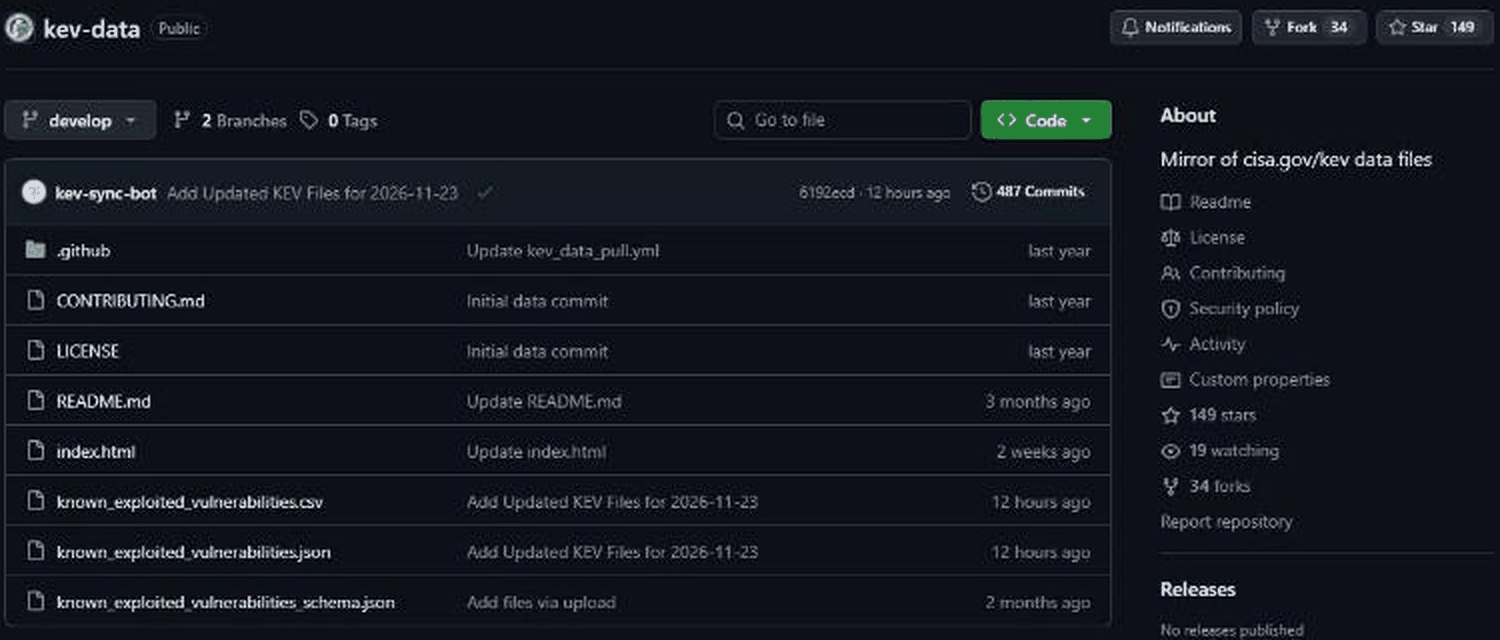
Published November 28, 2026. A news analysis of three vulnerabilities in the Danfoss AK-SM 800A Series that CISA added to its Known Exploited Vulnerabilities catalog on November 25, 2026, although the vendor fixed them in 2023 and 2025, built from Danfoss’ security advisories DSA-2023-08-01 and DSA-2025-03-01, the Dutch Institute for Vulnerability Disclosure (DIVD) case page DIVD-2023-00025 and CISA’s Known Exploited Vulnerabilities (KEV) data as mirrored on CISA’s GitHub (catalog version 2026.11.25), all read on November 28, 2026. Danfoss’ website would not let us capture a screenshot, so the images in this article are our own cards and a screenshot of CISA’s KEV data mirror. This article contains no affiliate links and we have no commercial relationship with Danfoss. ToolReviewHub is produced with the help of an AI assistant (Claude, made by Anthropic). We did not run AK-SM 800A software or test any of the flaws, and we do not describe how to trigger them. Descriptions are the vendors’ and CISA’s wording, and numbers marked “ours” are our own arithmetic.
Danfoss AK-SM 800A CVE-2023-25914, CVE-2023-25915 and CVE-2025-41450: the short version
- What happened: on November 25, 2026, CISA added three Danfoss AK-SM 800A Series vulnerabilities to its Known Exploited Vulnerabilities (KEV) catalog, which means it has evidence of exploitation. The flaws are CVE-2023-25915 (command execution, 9.8), CVE-2023-25914 (path traversal, 7.5) and CVE-2025-41450 (authentication bypass, 8.2).
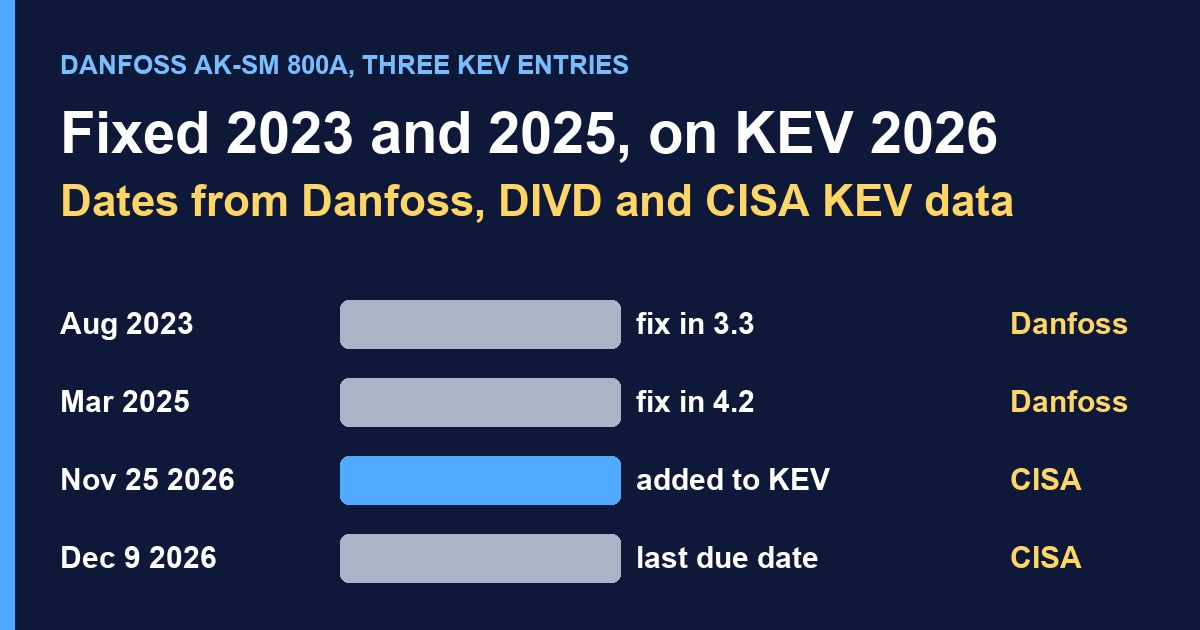
- These are old bugs: Danfoss fixed the first two in software version 3.3, advisory published August 21, 2023, and the third in version 4.2, advisory published March 24, 2025. The KEV listing came 1,192 and 611 days after those advisories (ours).
- The fix: install the latest AK-SM 800A software. Version 3.3 fixes the 2023 flaws and 4.2 fixes the 2025 flaw, so anything below 4.2 is affected by at least one of the three. Danfoss lists no mitigations other than updating.
- Deadlines: US federal civilian agencies have until November 28, 2026 for the two 2023 flaws and December 9, 2026 for CVE-2025-41450.
- What is missing: neither CISA’s entries nor Danfoss say who is exploiting the flaws or how many devices are affected.
What the AK-SM 800A is
The AK-SM 800A Series is a Danfoss system manager that Danfoss distributes through its Adap-Kool software downloads. In the advisories, the sensitive information that an attacker could obtain includes internal IP addresses, usernames and store names, which suggests that these devices sit inside shops and similar sites and are managed over a web interface. We have not tested one, and Danfoss’ advisories are short, so we stick to what they state.
That context matters because devices like this are built to last a long time and are often updated rarely. A controller that runs a building’s equipment is not a laptop that updates itself every month, and it can stay on the software it shipped with for years. The vulnerabilities in this article were fixed in 2023 and 2025, yet CISA now says they are being exploited in 2026. That gap is exactly what you would expect if some devices are still running old software and are reachable from the network.
The three flaws
All three are described in Danfoss’ own advisories. We summarize them from those pages.
- CVE-2023-25915, remote command execution (Critical, 9.8): because of improper input validation, a remote attacker could execute arbitrary commands on the target system. CISA files it under CWE-20, improper input validation. The advisory says the group of 2023 flaws could lead to the full compromise of the system.
- CVE-2023-25914, path traversal (High, 7.5): because of improper restriction, an attacker could retrieve and read system files of the underlying server through the XML interface. CISA files it under CWE-22, path traversal.
- CVE-2025-41450, authentication bypass (High, 8.2): because of an authentication flaw, an attacker could generate a web report that discloses sensitive information such as internal IP addresses, usernames and store names. CISA files it under CWE-305, authentication bypass by primary weakness.
A pattern is visible in the first and third items. One flaw lets an attacker read information and a second lets an attacker run commands. Read together, they describe a device where information gathering and control may be only a step apart, though neither Danfoss nor CISA says that attackers combine them.
Danfoss AK-SM 800A entries in CISA KEV
| CVE | Issue | Danfoss score | Fixed in | Federal due date |
|---|---|---|---|---|
| CVE-2023-25915 | Remote command execution (improper input validation) | Critical 9.8 | 3.3 (advisory August 21, 2023) | November 28, 2026 |
| CVE-2023-25914 | Path traversal through the XML interface | High 7.5 | 3.3 (advisory August 21, 2023) | November 28, 2026 |
| CVE-2025-41450 | Authentication bypass that exposes a web report | High 8.2 | 4.2 (advisory March 24, 2025) | December 9, 2026 |
One detail is worth noting. Danfoss’ 2023 advisory lists a third flaw, CVE-2023-25913, an authentication bypass that discloses information in the same way as CVE-2025-41450 does, rated 7.5. It is not in CISA’s catalog. We do not know why CISA added the other two from the 2023 advisory and not that one. The practical answer is the same, since version 3.3 fixes all three of the 2023 flaws.
Why a fix from 2023 matters in 2026
The history is on the record. The Dutch Institute for Vulnerability Disclosure (DIVD) says researchers from HackDefense contacted it on January 18, 2023, and that the vulnerabilities were reported that day. Danfoss acknowledged them on February 17, 2023. On August 17, 2023, the AK-SM 800A vulnerabilities were disclosed in a limited way, and DIVD began scanning the internet for vulnerable instances. Danfoss published its advisory on August 21, 2023, the fix, version 3.3, was available, and DIVD began notifying owners of vulnerable instances on September 27, 2023. DIVD closed the case on December 20, 2023. The advisory credits HackDefense, the security firm Synacktiv and a DIVD researcher.
In other words, the weaknesses were found by responsible researchers, a fix existed within about seven months of the first report (ours, about 215 days from January 18 to August 21, 2023), and the owners of vulnerable devices were notified in 2023. The 2025 flaw followed the same pattern: the advisory credits a Claroty Team82 researcher and was published in March 2025, with a fix in version 4.2, and updated in September 2025 to improve the classification of the problem type.
The KEV listing of November 2026 therefore says something different from the usual story. These are not new bugs that caught vendors off guard. They are bugs with fixes that are still being used against devices, which implies that some devices were never updated. That is an operations problem, not a software one, and it is the same reason the oldest entries in CISA’s catalog keep appearing in attacks.
Timeline
| Date | Event | Source |
|---|---|---|
| January 18, 2023 | Researchers from HackDefense contact DIVD; vulnerabilities reported | DIVD |
| August 21, 2023 | Danfoss publishes DSA-2023-08-01; fix in version 3.3 | Danfoss |
| September 27, 2023 | DIVD starts notifying owners of vulnerable instances | DIVD |
| March 24, 2025 | Danfoss publishes DSA-2025-03-01; fix in version 4.2 | Danfoss |
| November 25, 2026 | CISA adds the three flaws to KEV | CISA KEV data |
| November 28, 2026 | Federal due date for CVE-2023-25914 and CVE-2023-25915 | CISA KEV data |
| December 9, 2026 | Federal due date for CVE-2025-41450 | CISA KEV data |
What to do if you run these devices
Danfoss’ advisories give one remediation: install the latest software version through the AK-SM 800A download page. Both advisories list the mitigations as not applicable, which means there is no workaround that replaces the update. Version 3.3 fixes the 2023 flaws and 4.2 fixes the 2025 flaw, so the target is 4.2 or newer.
CISA’s required action in each entry is to apply mitigations in line with the vendor’s instructions, in compliance with its risk-based patching directive, BOD 26-04, and to follow its forensics triage requirements. For a device that has been reachable from the internet while running old software, patching closes the hole but does not show whether someone used it. The first thing to check is whether the device’s web interface is reachable from outside your network at all. If it is, take it off the internet or put it behind a VPN, then check it for unexpected accounts, files and outbound connections.
The rest of the November 25 KEV update
These three were part of ten entries CISA added on November 25. The others were five Mitel MiCollab flaws, covered here, the Juniper Session Smart Conductor flaw, covered here, and the Xen Orchestra authentication bypass, covered here. For the wider November picture, see our November 2026 KEV roundup.
What to do: a practical checklist
- Find every AK-SM 800A in your estate, including ones at remote sites that facilities or refrigeration contractors manage, and note the software version.
- Update to version 4.2 or newer through Danfoss’ AK-SM 800A software page. Version 3.3 alone fixes only the 2023 flaws.
- Check whether the web interface is reachable from the internet. If it is, remove that exposure or place it behind a VPN; Danfoss lists no other mitigation.
- Look for signs of misuse on devices that were exposed while on old software: unknown accounts, unexpected files, odd outbound connections, and web reports generated by unfamiliar addresses.
- Rotate the credentials that the devices store or that were used to manage them if you find anything unexpected.
- Ask your service contractor who is responsible for updating these controllers and when they were last updated, since equipment of this kind often falls between IT and facilities.
What we could not confirm
- Who is exploiting these flaws, against which devices, and since when: CISA’s entries do not say.
- Whether the flaws are used together: neither Danfoss nor CISA describes a chain.
- How many AK-SM 800A devices are reachable from the internet: we did not find a count we could verify.
- Why CISA listed CVE-2023-25914 and CVE-2023-25915 but not CVE-2023-25913 from the same 2023 advisory.
- What the device does in a typical installation: Danfoss’ advisories are brief and we did not read product documentation or run the software.
- CISA’s own catalog page, which we did not open; the KEV facts come from CISA’s GitHub mirror (catalog version 2026.11.25).
Frequently asked questions
Which AK-SM 800A versions are affected?
Danfoss says the 2023 flaws affect AK-SM 800A software below version 3.3, and the 2025 flaw affects AK-SM 8xxA software prior to version 4.2. Version 4.2 or newer fixes all three.
Are the flaws being exploited?
CISA added all three to its Known Exploited Vulnerabilities catalog on November 25, 2026, which means it has evidence of exploitation. It has not said who is behind it.
Is there a workaround?
Danfoss lists mitigations as not applicable and says to install the latest software version. Taking the device off the internet is sensible but it is our advice, not a Danfoss mitigation.
Do these flaws need a login?
The advisories describe an authentication bypass that exposes a web report and a remote attacker who could execute commands, without stating that a login is needed.
What are the CISA deadlines?
November 28, 2026 for CVE-2023-25914 and CVE-2023-25915, and December 9, 2026 for CVE-2025-41450, for US federal civilian agencies.
Method: details come from Danfoss security advisories DSA-2023-08-01 and DSA-2025-03-01, DIVD case page DIVD-2023-00025 and CISA KEV data (catalog version 2026.11.25), read on November 28, 2026. The day counts (1,192, 611 and about 215) are our own arithmetic from the advisory dates. For how we research, see How We Review Tools.