Git 2.56.1 Fixes Six Vulnerabilities, Including Code Execution When Cloning a Malicious Repository: Fixed Versions in Every Supported Series and What to Check
Published November 22, 2026. A news analysis built from primary sources: the GitHub Blog post “Git security vulnerabilities announced” (November 10, updated November 17, 2026), the Git project’s own security advisory GHSA-vp2w-7xxj-jvxr on GitHub, the Git maintainers’ announcement on the oss-security mailing list (November 11, 2026), the Git for Windows 2.56.1 release page, GitLab’s Critical Patch Release notice for November 10, 2026, and CISA’s Known Exploited Vulnerabilities (KEV) data as published in CISA’s own GitHub mirror, plus our own screenshots. None of the credits in these sources involves Anthropic; Claude is among the tools we use to help draft articles, and we state that for completeness. This article contains no affiliate links. We did not install the releases or run any proof of concept, and we leave out the technical construction details that the maintainers’ mailing-list post gives; a defender does not need them. Calculations and tallies marked “ours” are our own.
The short version
- What happened: on November 10, 2026 the Git project released Git 2.56.1, with backports to 2.55.1, 2.54.1, 2.53.1, 2.52.1, 2.51.3 and 2.50.2, to fix six security vulnerabilities. They affect cloning, reference handling, merges, binary patches and fast-import.
- The serious one: CVE-2026-111760 lets an attacker-controlled Git server make a clone overwrite the repository’s own
.gitdata, redirecting Git to attacker-controlled configuration or hooks. It can lead to code execution. The project’s advisory rates it High, CVSS 8.3. - Who is affected: everyone who runs Git, in one way or another. The maintainers say all Git versions back to 2.27.0 are affected, and that versions older than 2.50 are affected too but get no maintenance releases.
- Servers too: a merge flaw (CVE-2026-105437) matters to services that merge untrusted content. GitLab rated it Critical and shipped a patch release the same day, saying it can be used to run commands inside its Gitaly service.
- Exploitation: none of the six appears in CISA’s KEV catalog (version 2026.11.20). We found no statement that any is being exploited.
Which version fixes it?
Git maintains several series at once. The fix is the next patch release in your series, or 2.56.1:
| Your series | Fixed version |
|---|---|
| 2.56 | 2.56.1 |
| 2.55 | 2.55.1 |
| 2.54 | 2.54.1 |
| 2.53 | 2.53.1 |
| 2.52 | 2.52.1 |
| 2.51 | 2.51.3 |
| 2.50 | 2.50.2 |
| Older than 2.50 (back to 2.27.0) | No fix in that series; upgrade to 2.50.2 or newer |
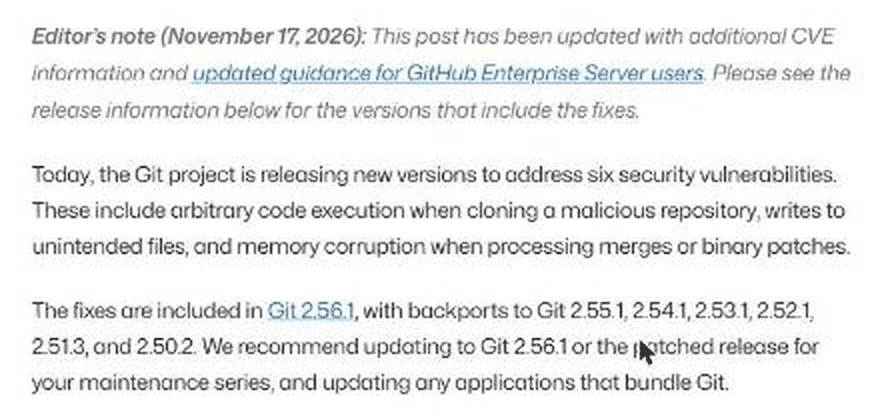
Two other details help. The Git for Windows project released 2.56.1 (as v2.56.1.windows.1) on November 10 and lists all six CVEs as addressed. And git-scm.com showed 2.56.1 as the latest source release when we looked. The page for the 2.56.1 release notes returned a not-found error when we tried it, so we relied on the maintainers’ announcement and GitHub’s post for the contents.
The six vulnerabilities
| CVE | What it is | When it matters | Reported by |
|---|---|---|---|
| CVE-2026-111760 | Code execution when cloning a malicious repository | Cloning from an attacker-controlled server | Robert Chen |
| CVE-2026-113408 | Path traversal through a server’s advertised HEAD | Cloning an empty repository over protocol v2 from a malicious server, with the files reference backend | Luke Martin |
| CVE-2026-114467 | Stack corruption when removing signatures | Merging a tag with more than two signatures; hosting services that merge on users’ behalf | pwn2addr |
| CVE-2026-114469 | Out-of-bounds read when applying binary patches | Applying an untrusted patch; crashes Git | pwn2addr |
| CVE-2026-105437 | Heap corruption during large merges | Merging untrusted content, locally or on a hosting service | Credited by GitLab to a HackerOne reporter |
| CVE-2026-114466 | File access through fast-import streams | Feeding an untrusted fast-import stream to Git | pwn2addr |
The credits come from the GitHub post and, for CVE-2026-105437, from GitLab’s notice. By our tally, one reporter (pwn2addr) is credited with three of the six. Three of the six (CVE-2026-111760, CVE-2026-114469 and CVE-2026-105437) are described as arithmetic or size-check mistakes in how Git handles very large paths, patches or merge results; this is our classification from the descriptions.
CVE-2026-111760: the one to patch first
The Git project’s advisory describes it this way: an attacker-controlled Git server can supply a repository with crafted trees whose combined path lengths overflow an internal name-length field, which allows checkout to overwrite .git despite the path validation. That redirects Git to configuration or hooks the attacker controls, and so can run the attacker’s code. The CVSS 3.1 vector is AV:N/AC:H/PR:N/UI:R/S:C/C:H/I:H/A:H, which in words means network reachable, high complexity, no privileges, user interaction required (you must clone), changed scope and high impact.
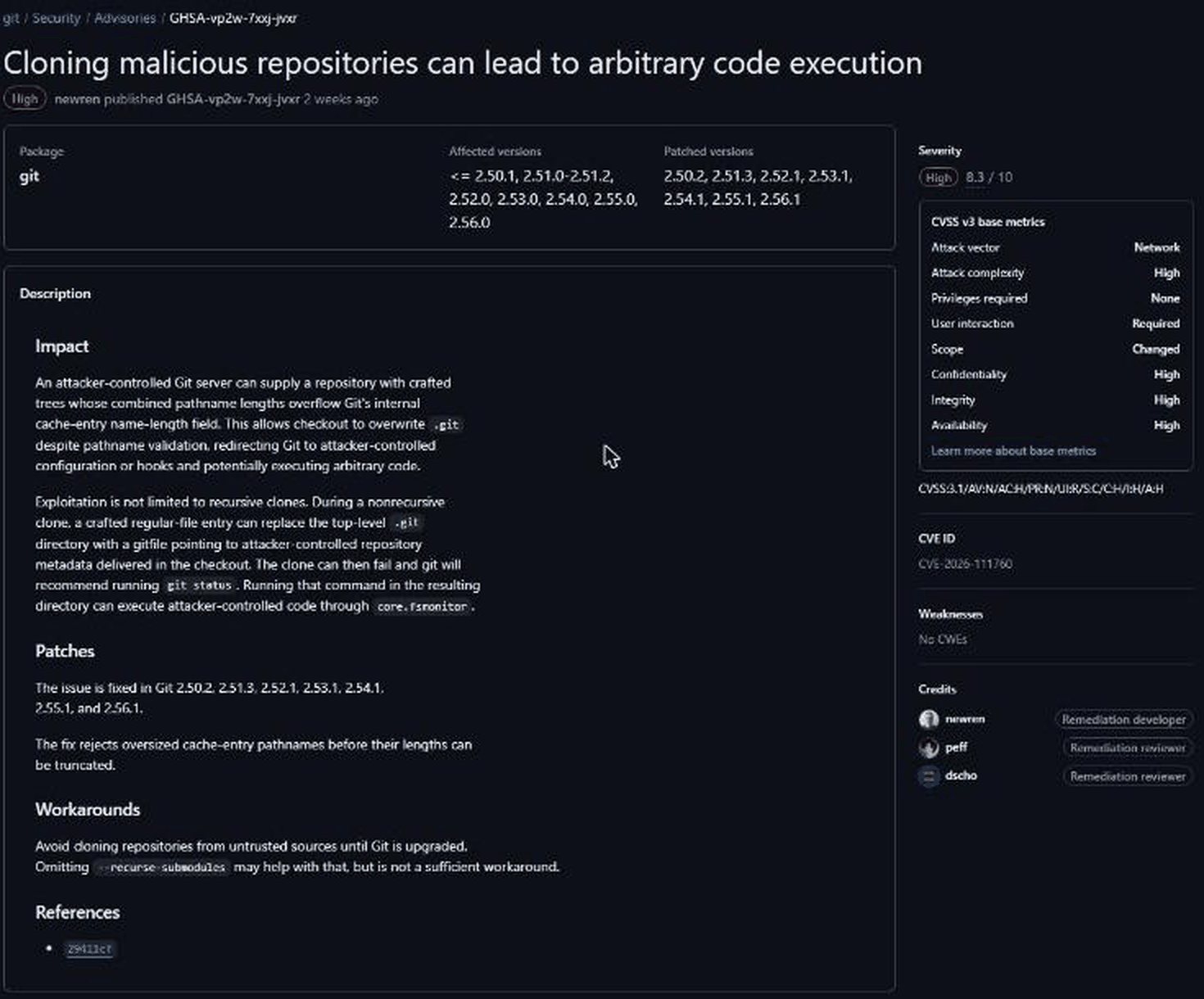
Two points about who is at risk. First, this is not only about recursive clones. The advisory says that in a non-recursive clone a crafted entry can replace the top-level .git directory with a pointer file; the clone can then fail and Git can suggest running git status, which in the resulting directory can execute attacker-controlled code. The advisory therefore says that omitting --recurse-submodules “may help” but is not a sufficient workaround. Second, the maintainers’ mailing-list announcement says that, as far as they know, the issue is currently triggerable only with recursive clones. The two statements differ. We follow the advisory and the GitHub post, which are the more cautious, and we recommend treating any clone of an untrusted repository as risky until Git is updated.
The mailing-list post adds a point that matters for downstream users: a repository built to exploit this fails Git’s own consistency checks, so it cannot easily be pushed to the major hosting services, but an innocent-looking submodule reference pointing to the malicious repository is enough to reach a victim. The practical meaning is that the danger is not limited to people who clone a link they were sent. A project you trust can reference a repository you do not.
The other five
- CVE-2026-113408: during a clone over protocol v2, a malicious server can advertise a HEAD that points somewhere unexpected, and a later operation can then write outside the intended reference directory. Git now validates the advertised target and other reference names received over protocol v2.
- CVE-2026-114467: Git assumed at most two signatures when stripping them from a message. A crafted message with more can corrupt memory, causing at least a crash. The advisory text notes that hosting services that merge on behalf of users can be affected.
- CVE-2026-114469: a size check that looked at the patch as supplied, not at its size after decompression, could be bypassed by a crafted binary patch, which crashes Git with an out-of-bounds read. Git now also checks the declared uncompressed size.
- CVE-2026-105437: the memory calculation for a merge result can overflow when the result is very large, for example with many conflicts and a very large conflict-marker-size attribute. The buffer ends up too small and Git writes outside it. This affects applications and hosting services that merge untrusted content, as well as local merges.
- CVE-2026-114466: three fast-import features (the two rewrite-submodules options and export-pack-edges) could read or create files outside the repository when fed through an untrusted stream. They are now rejected from the input stream unless the caller passes
--allow-unsafe-features. The maintainers call this a backwards-incompatible change with minimal expected impact, because the features are mostly used by import and export helpers.
Hosting services and platforms
Git is not only a developer tool; it runs inside platforms. The three notices we read say:
- GitHub: fixes are deployed on github.com, GitHub Enterprise Cloud and GitHub Enterprise Cloud with data residency. GitHub Enterprise Server updates are available in versions 3.19.16, 3.20.12, 3.21.10 and 3.22.5, which carry the fixes backported into GitHub’s own Git builds, so the bundled Git version number differs from the upstream one. GitHub says it is coordinating releases of GitHub Desktop and the GitHub Copilot app with patched Git, and that Codespaces and Actions will also receive patched versions.
- GitLab: on November 10 it released a Critical Patch Release (19.5.4, 19.4.6, 19.3.8) for one issue, CVE-2026-105437, rated Critical. GitLab says that under certain conditions the vulnerability can result in out-of-bounds heap writes that could be used to execute arbitrary commands within Gitaly, its Git service. It lists the impacted versions as all from 16.2 before 19.3.8, 19.4 before 19.4.6 and 19.5 before 19.5.4. GitLab.com and GitLab Dedicated were already patched. GitLab also published a detection for self-managed instances (“Git merge-tree child process crash”) and credits a reporter through its HackerOne programme.
- Self-compiled GitLab: because the fix is a patch to Git, GitLab says official Linux packages and container images already include it, but self-compiled installations must rebuild the Git binaries embedded in Gitaly and also rebuild the Git referenced by
git.bin_path; if that Git comes from a distribution package, upgrade it to 2.56.1 or later, or to a version the distribution has patched for this CVE.
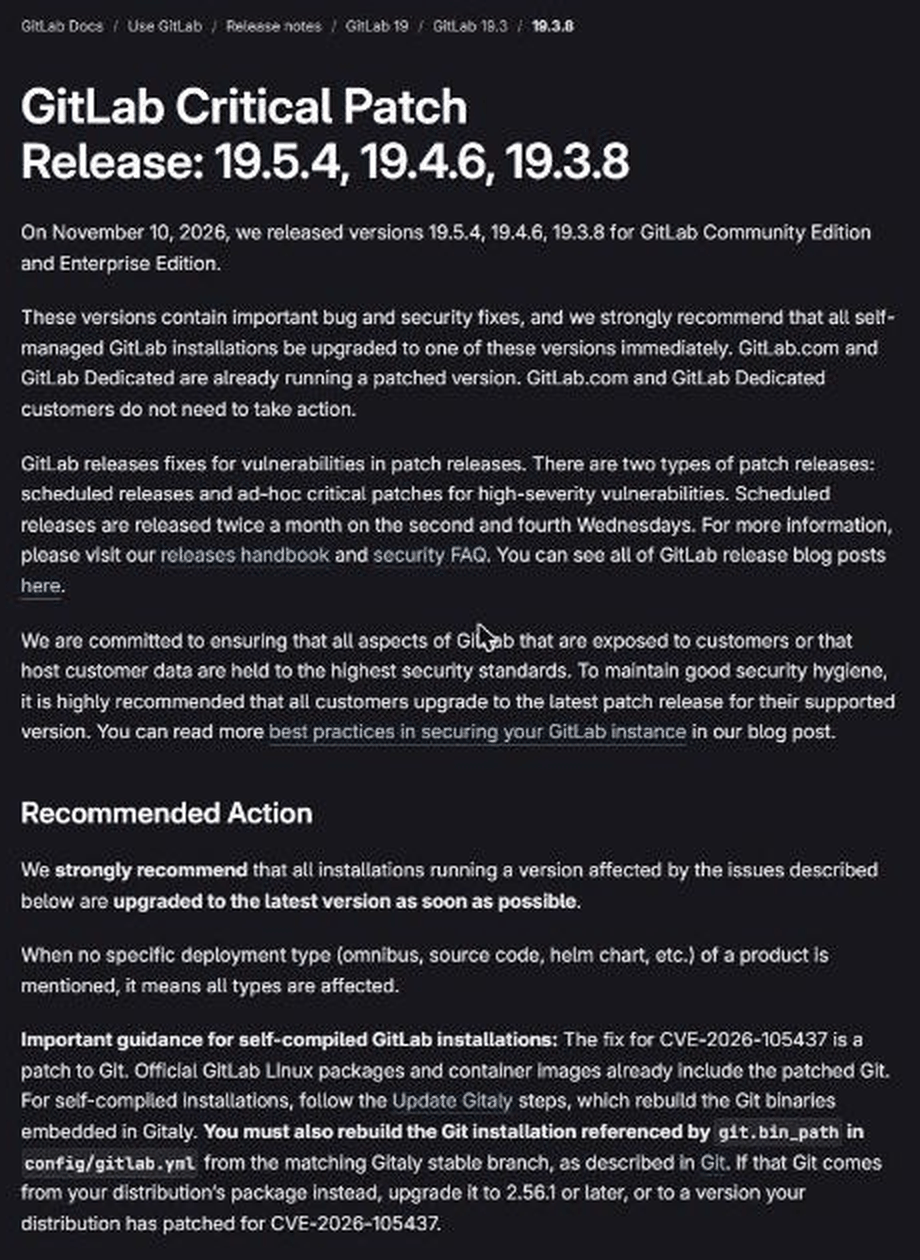
For self-hosters of other Git services, CI systems and merge bots, the lesson is the same: find the copy of Git that the service actually runs. GitLab’s guidance shows that this can be more than one copy.
Is it being exploited?
We checked CISA’s catalog because it changes how urgent the work is. CISA’s website refused our automated request, and we did not work around it. We read the catalog in CISA’s public GitHub repository instead (version 2026.11.20, released November 20, 2026). None of the six CVEs is in it. The catalog does contain an earlier Git entry, CVE-2025-48384, added on August 25, 2025, and several GitLab entries, the latest added on October 29, 2026. That history shows that Git and the platforms around it have been used in real attacks before, which is a reason to patch even without a KEV entry. It is not evidence about these six. We found no statement in any of the notices we read that these six are being exploited.
Timeline
| Date (2026) | Event |
|---|---|
| Nov 10 | Git 2.56.1 and the backports released; GitHub blog post; GitLab Critical Patch Release; Git for Windows 2.56.1 |
| Nov 11 | Maintainers’ announcement on oss-security |
| Nov 17 | GitHub updates its post with additional CVE information and Enterprise Server guidance |
| Nov 22 | Today: 12 days since the release (ours) |
What to check
These steps follow the notices we read. We have not run them against every environment.
- Find every copy of Git. The system one is only the start. Git for Windows, desktop clients, IDEs, CI runner images, container base images, build agents and merge bots can each carry their own. GitHub’s advice is to update any application that bundles Git.
- Check the version. Run
git --versionin each place, and compare with the table above. A distribution package may carry the fix under a different version number, so look at your vendor’s notice if the number looks old. - Update. Install 2.56.1 or the patched version for your series. If your series is older than 2.50, plan the jump, because no fix is coming for it.
- Be careful in the meantime. The advisories say to clone only from trusted servers, avoid cloning untrusted repositories, avoid merging untrusted content or tags, and avoid processing binary patches or fast-import streams from untrusted sources. They also say these precautions do not replace the fixes, and remember that a trusted project can reference an untrusted submodule.
- Review automation. CI jobs that clone external repositories with submodules, and services that merge pull requests or check mergeability on a server, are the places where the flaws are easiest to reach without a person noticing.
- If you use fast-import, check any script that uses the rewrite-submodules options or export-pack-edges. They are now blocked unless you pass
--allow-unsafe-features, and the maintainers say to enable that only when you trust the program that generates the stream. - Self-hosted GitLab: follow GitLab’s notice, including the rebuild steps for self-compiled installations.
What we could not confirm
- That the patched versions fix every flaw. We did not install them or reproduce any issue.
- Whether any of the six is being exploited. None is in CISA’s catalog and none of the notices says so, but absence of evidence is not proof.
- Whether non-recursive clones are exploitable in practice. The advisory says yes; the maintainers’ mailing-list post says that, as far as they know, only recursive clones are currently triggerable.
- When each Linux distribution and each bundled copy of Git ships the fix. We checked none.
- The contents of the Git 2.56.1 release notes page, which was not available when we looked.
- Whether other hosting services and CI products beyond GitHub and GitLab are affected. We read no other vendor’s notice.
Frequently asked questions
What was fixed in Git 2.56.1?
Six vulnerabilities: code execution when cloning a malicious repository, path traversal through an advertised HEAD, stack corruption when removing signatures, an out-of-bounds read in binary patches, heap corruption in large merges, and file access through fast-import streams.
Which Git versions are affected?
The maintainers say all versions back to 2.27.0. Fixed releases exist for the 2.50 through 2.56 series; older ones receive no fix.
Is cloning from GitHub safe now?
GitHub says it has deployed fixes on its hosted services. The risk in these advisories is mostly on the client or server that runs Git, so your own copy of Git still needs the update.
Is CVE-2026-111760 being exploited?
We found no evidence of it. It is not in CISA’s catalog as of version 2026.11.20.
Do I need to update GitLab?
Self-managed GitLab should move to 19.5.4, 19.4.6 or 19.3.8 or later, according to GitLab. GitLab.com and Dedicated were already patched.
Where are the sources?
The GitHub Blog post, the Git advisory GHSA-vp2w-7xxj-jvxr, the oss-security announcement, the Git for Windows releases, GitLab’s Critical Patch Release notice and CISA’s KEV data repository. All screenshots are ours, taken November 22, 2026.
Disclosure
None of the sources credits Anthropic or Claude for these vulnerabilities. Claude is among the tools we use to help draft articles. We have no commercial relationship with the Git project, GitHub, GitLab, CISA or any vendor named here, and this article contains no affiliate links.
Related reading
- WordPress 7.1.5 Security Release: 20 Fixes, 4 Reachable Without a Login
- OpenSSH 10.6p2 Fixes CVE-2026-123158, a Password Bypass on musl Linux
- GitHub Actions Lockfiles: What gh actions-lock Does and What to Check
- LiteLLM Flaw CVE-2026-40217 Added to CISA Exploited List: Rated Moderate by Its Maker, 8.8 by Others, and What to Check
- Hosting reviews